The Undead
Documented on every continent. Still not technically alive.
All
Active
UndeadRevenantGlobalHigh ThreatCorporealHistorical Record
Overview
The Undead represent the broadest and most consistently documented classification in the WTC cryptid database — a category encompassing any human individual who has died and subsequently resumed activity without the involvement of conventional medical intervention. Unlike many cryptid classifications, where evidence is sparse and contested, the Undead benefit from a documentary record spanning approximately 5,000 years, cross-referenced across cultures that had no contact with one another and arrived at functionally identical conclusions. WTC classifies this convergence as ‘strongly suggestive,’ which is as far as our legal team permits us to go.

The category is broad by necessity. Within it, WTC distinguishes between revenants — corporeal entities that have returned in their original physical form, in varying states of preservation — and non-corporeal manifestations, where the deceased returns without the inconvenience of a body but retains sufficient presence to be documented, measured, and in some cases recorded. Both subtypes share the defining characteristic: death occurred, was confirmed by the standards of the relevant era, and did not take. What differentiates a revenant from a ghost, for WTC classification purposes, is a question our editorial board has been attempting to resolve since the third quarter of 2019.
The Undead do not belong to a single geographic region, a single cultural tradition, or a single threat profile. They have been reported from the permafrost of northern Scandinavia, the river deltas of the Yangtze basin, the sugar plantations of colonial Haiti, and the municipal cemeteries of contemporary Ohio. WTC has assigned them region ‘All,’ which is the only entry in the database where that designation was applied without any discussion.
History & Mythology
The earliest documented revenant accounts appear in Mesopotamian funerary texts dated to approximately 3000 BCE, in which the recently deceased are described as returning to settle unfinished business with the living — a motivation that appears with remarkable consistency across subsequent millennia and suggests either a universal human projection onto death or a genuine pattern of behaviour that early scribes correctly identified. The Sumerian ‘gidim,’ the restless dead who had not received proper burial rites, is structurally identical to the European revenant accounts that would appear 4,000 years later and independently in Chinese records of the Han dynasty. WTC notes this parallel without drawing conclusions, though several have been drawn internally.
European revenant folklore reaches its most detailed expression in the medieval Scandinavian ‘draugr’ — a corporeal returned dead described in the Icelandic sagas with a specificity that reads, to a WTC researcher, less like mythology and more like field notes. The Eyrbyggja Saga, written in the 13th century but describing events purportedly from the 10th, documents a revenant named Thorolf Halt-foot who returned after death, killed livestock, and drove tenants from his farm, requiring exhumation, decapitation, and the burning of remains before the activity ceased. The account includes named witnesses, a specific property address, and a documented sequence of escalating interventions. A comparable entry would meet WTC’s current evidentiary threshold for ‘Probable.’
The Haitian ‘zonbi’ tradition, first systematically recorded by European observers in the 18th century, introduced a variant that differed meaningfully from the European model: reanimation performed by a living practitioner rather than arising spontaneously from the deceased. Ethnobotanist Wade Davis’s 1985 fieldwork, which identified tetrodotoxin and other pharmacological agents as potential mechanisms, represents the only peer-reviewed scientific engagement with an Undead subtype to date. The scientific community’s response to Davis’s work was, by most measures, unkind. WTC has no position on Davis’s methodology but notes that the response would have been different if the findings had been easier to explain away.
Physical Description
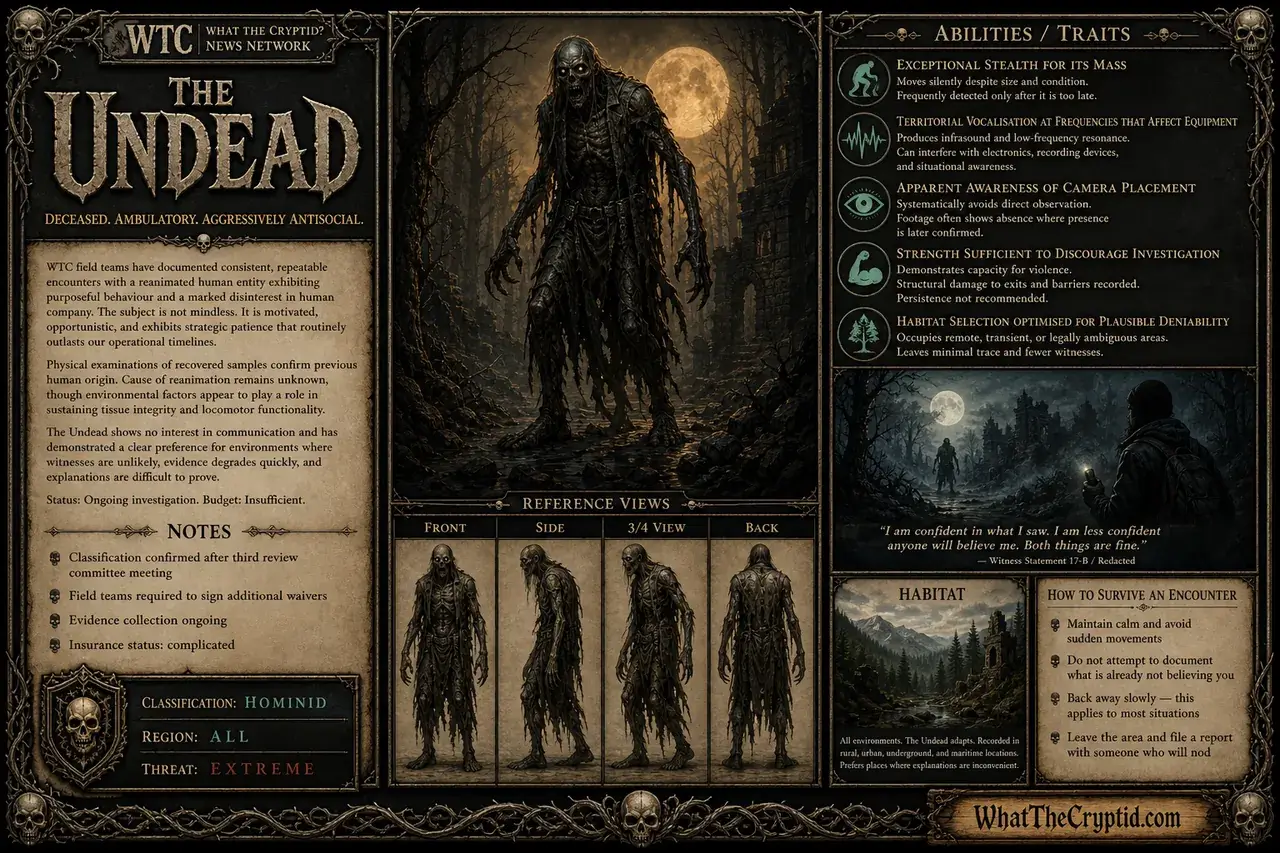
Physical description of the Undead varies substantially by subtype, elapsed time since death, and what WTC researchers have begun calling ‘maintenance conditions’ — a term that emerged from a field report and has since entered the internal lexicon without formal adoption. Freshly returned revenants, documented in the first 72 hours following confirmed death, are frequently indistinguishable from living individuals by casual observation, with reported anomalies limited to abnormal skin temperature, atypical pallor, and an absence of the small involuntary movements — breathing, blinking, postural adjustment — that characterise the living. Witnesses who have encountered these early-stage entities at close range report the experience as uncanny in ways they find difficult to articulate precisely, which WTC considers a consistent and therefore meaningful data point.
As time elapsed since death increases, corporeal revenants exhibit progressive degradation consistent with standard decomposition, modified by reported anomalies including continued purposeful movement, vocalisation, and in multiple documented cases, apparent awareness of and interest in specific living individuals. Field descriptions from historical and contemporary sources converge on a height range broadly matching the living human norm, with body mass reduced in proportion to the degree of desiccation. Revenants in advanced states of deterioration have been described as moving with what witnesses characterise as ‘inappropriate fluidity given the circumstances,’ a phrase that appears in four separate incident reports across three continents without any apparent cross-contamination between witnesses.
Regional variants have developed distinct physical profiles that WTC attributes to local environmental and cultural conditions. The Chinese Jiangshi, documented in records from the Qing dynasty onward, presents with limbs held rigidly forward — a posture attributed in source texts to the stiffness of rigor mortis that, in this variant, appears to become a permanent feature rather than a transitory one. The Scandinavian draugr is consistently described as unnaturally large, with accounts suggesting a body mass significantly exceeding that of the individual in life, a detail that several WTC consultants have flagged as anatomically interesting and one has declined to discuss further.
Behaviour & Temperament
The Undead, as a classification, display a behavioural range that makes generalisation difficult and threat assessment genuinely complicated. At one end of the spectrum, revenants appear to operate with specific and limited objectives — returning to a particular property, seeking out a particular individual, resolving a particular unfinished circumstance — and once these objectives are met or interrupted, activity ceases. This goal-directed behaviour, documented consistently enough across cultures to warrant its own subcategory in WTC’s internal taxonomy, suggests a form of purposeful cognition that persists beyond clinical death. What the mechanism for this cognition might be is a question WTC has tabled for a later meeting.
At the other end of the behavioural spectrum are entities that appear to operate without specific purpose, demonstrating instead what field researchers describe as generalised persistence — continued existence and activity in the absence of any identifiable objective. These entities are, on balance, more difficult to manage than the goal-directed variety, as the standard intervention of resolving the triggering grievance or completing the unfinished task does not apply. Historical remediation records for purposeless revenants show a higher rate of escalation and a lower rate of successful resolution, a pattern that holds across cultural traditions that approached the problem from entirely different theological frameworks and arrived at the same outcome.
Social structure among the Undead is not well documented, though reports of multiple revenants operating in proximity to one another exist in sufficient numbers to suggest that solitary behaviour is not universal. Medieval European accounts describe ‘plague revenants’ — clusters of the returned dead associated with epidemic events — behaving with what observers interpreted as coordination. Whether this represents genuine social organisation or simply parallel behaviour driven by identical circumstances is a distinction WTC researchers have found difficult to test, for reasons that should be apparent.
Habitat & Territory
The Undead demonstrate a documented preference for locations associated with death, burial, or the circumstances of their own demise — a habitat preference that, while logical, creates the practical problem that these locations are distributed across every terrain type, elevation range, and climate zone on Earth. Cemeteries, charnel grounds, battlefields, and sites of violent or unresolved death represent primary habitat. Secondary habitat includes former residences, particularly those where the individual died in situ, and locations connected to unresolved grievances, the geographic distribution of which is, by definition, unpredictable.
Where environmental preferences can be assessed independent of associative factors, the historical record suggests a modest preference for liminal environments — coastlines, riverbanks, crossroads, threshold spaces — that is consistent enough across unrelated traditions to appear in WTC’s formal habitat notes rather than the speculative section. Elevation data is insufficient to establish a reliable range, and the suggestion from one field researcher that Undead activity correlates with magnetic anomalies remains unverified. The researcher has since moved to a different department.
Diet & Hunting
Accounts of Undead feeding behaviour divide along subtype lines with reasonable consistency, though WTC notes that the dietary requirements of entities that are, by definition, no longer sustaining biological life present a conceptual difficulty that our consulting nutritionist described as ‘outside the scope of her practice’ before ending the call.
The vampiric subset — documented under various regional designations including strigoi, strix, penanggalan, and langsuir — demonstrates a highly specific dietary pattern centred on blood, with a consistent preference, across traditions, for blood drawn from living human hosts rather than animal sources or stored supplies. This selectivity, observed in cultures with no apparent contact, suggests a genuine preference rather than a cultural projection. The reanimated corpse variants, including the Haitian zonbi and the flesh-consuming revenants described in post-1968 North American popular accounts, present a broader dietary profile that some WTC researchers argue reflects a distinct biological mechanism. The draugr of Norse tradition is documented consuming livestock, humans, and in at least one saga account, the soil of its own grave mound, which field researchers have noted without arriving at a satisfying explanation.
Notable Sightings
During the final documented period of Norse Greenlandic settlement, a series of incidents at the farm of one Thorstein Eiriksson were recorded in correspondence between the local bishop and the archdiocese in Trondheim. A recently deceased farmhand, Gunnar, was reported to have returned to the property on three consecutive nights, disturbing livestock and appearing at the threshold of the main dwelling before dawn. Two witnesses corroborated the account in separate depositions. The bishop’s correspondence records that the farm was subsequently abandoned and that Gunnar’s grave was exhumed and the remains treated per standard ecclesiastical procedure. The settlement at Hvalsey was deserted within the decade, though historians attribute this to climate and supply failures rather than the incident, and WTC does not dispute that assessment as the primary cause.
Following a plague outbreak in the Silesian village of Kisolova, a series of deaths attributed to a returning revenant prompted an official inquiry by local magistrates — one of the earliest documented instances of a government body formally investigating an Undead report. The subject, a recently deceased peasant identified in records only as ‘Peter Plogojowitz,’ was alleged to have appeared to nine individuals in the days following his death, each of whom subsequently died of symptoms described as rapid onset wasting. Magistrate records, forwarded to the Imperial Provisor of the region and preserved in the Austrian state archive, describe the exhumation as conducted in the presence of two officers and a priest, and note that the body showed ‘no signs of the expected decomposition’ despite fourteen days interment. The Provisor’s report recommended the findings not be widely distributed. They were distributed anyway, appearing in a German newspaper within the month, and remain among the most extensively documented pre-modern revenant cases on record.
Clairvius Narcisse was admitted to the Albert Schweitzer Hospital on April 30, 1962, presenting with respiratory distress and fever, and was pronounced dead by two attending physicians on May 2. He was buried the same day at a cemetery in his home village of l’Estère. Eighteen years later, in 1980, Narcisse approached his sister in a local market and identified himself by name, recounting events from his own funeral. His identity was subsequently confirmed by family members and by anthropologist Lamarck Douyon of the Haitian Psychiatric Institute, who conducted an independent investigation. Narcisse described a period of paralytic incapacity followed by a period of forced agricultural labour under the direction of a person he identified by name. Wade Davis’s subsequent investigation identified a pharmacological profile consistent with the mechanism described. The attending physicians who signed the 1962 death certificate were not available for interview.
Between December 1969 and March 1970, Highgate Cemetery in north London became the subject of a documented public investigation following reports from multiple witnesses of a tall, grey-faced figure observed moving between grave markers after dark. Local newspaper coverage prompted self-described vampire hunter Sean Manchester and researcher David Farrant to conduct independent investigations of the site, both of which were reported in the press and generated a correspondence volume that the local council described, in a February 1970 meeting, as ‘disproportionate.’ On the night of Friday, March 13, 1970, a group of individuals estimated at between fifty and one hundred entered the cemetery following a television appearance by Manchester, conducting an unofficial search of the grounds. The Metropolitan Police attended. WTC submitted a Freedom of Information request for the incident report in 2021 and received a response indicating the relevant records had been transferred to an unspecified archive.
Threat Assessment
The Undead represent WTC’s most geographically distributed High-rated threat, which is to say that the standard field advice of avoiding known habitat areas is not practically applicable in this instance, as known habitat areas include every continent and most populated land surfaces. WTC instead recommends a graduated response protocol based on proximity and apparent subtype. At distances of thirty metres or greater, maintain visual contact and withdraw without sudden movement. At distances between thirty and ten metres, do not attempt verbal communication, as documented responses to verbal engagement from revenants range from no reaction to escalation, with no reliable predictor of which outcome will occur. Below ten metres, WTC advises that the recommended actions become largely theoretical.
For encounters with suspected goal-directed revenants, the historical record supports the approach of identifying and resolving the triggering grievance where possible, which is more actionable than it sounds — a significant proportion of documented revenant cases involve property disputes, unpaid debts, or undelivered messages, all of which can in principle be addressed by the living. For purposeless revenants, traditional remediation methods — salt, iron, specific threshold protections, religious intervention — appear in the record with sufficient consistency across unrelated traditions that WTC includes them as recommended measures while acknowledging that our methodology for evaluating their efficacy is, at present, limited. WTC further recommends ensuring that all deceased individuals in your household have received burial rites appropriate to their cultural tradition, that outstanding disputes are resolved prior to the death of any party, and that you keep a note of which of your neighbours have recently died, which is useful information in any case.
WTC Field Notes
The Undead entry represents the longest-running open file in the WTC database, having been initiated at the organisation’s founding and never formally closed on the grounds that closure criteria could not be agreed upon. The entry has had eleven contributing editors, three of whom have since left the organisation, one of whom departed under circumstances that WTC’s HR department has asked us not to detail in a public document, and two of whom requested their names be removed from the contributor list for reasons described as ‘personal.’ The current editor has held the position for fourteen months and describes the assignment as ‘clarifying.’
WTC’s ongoing field research into the Undead is complicated by several factors that our grants coordinator has begun describing as ‘structural.’ Trail cameras deployed in primary habitat sites — specifically four cemeteries in Eastern Europe selected based on historical incident density — have produced a combined total of 847 hours of overnight footage, of which 841 hours show no activity and 6 hours show activity that our technical team has been reviewing since the second quarter of last year. The review is ongoing. Equipment budget for the Undead file was increased by 12% in the most recent fiscal cycle following an incident at our Romanian field site that resulted in the replacement of two cameras, one vehicle wing mirror, and a field researcher’s entire wardrobe. The researcher has returned to active duty and has asked that this not be described in more detail, a request WTC is honouring because it seems like the right thing to do.