Wraith
It looked exactly like you. It was not you.
Europe
Active
SpiritDeath OmenScotlandDoppelgangerLiminal
Overview
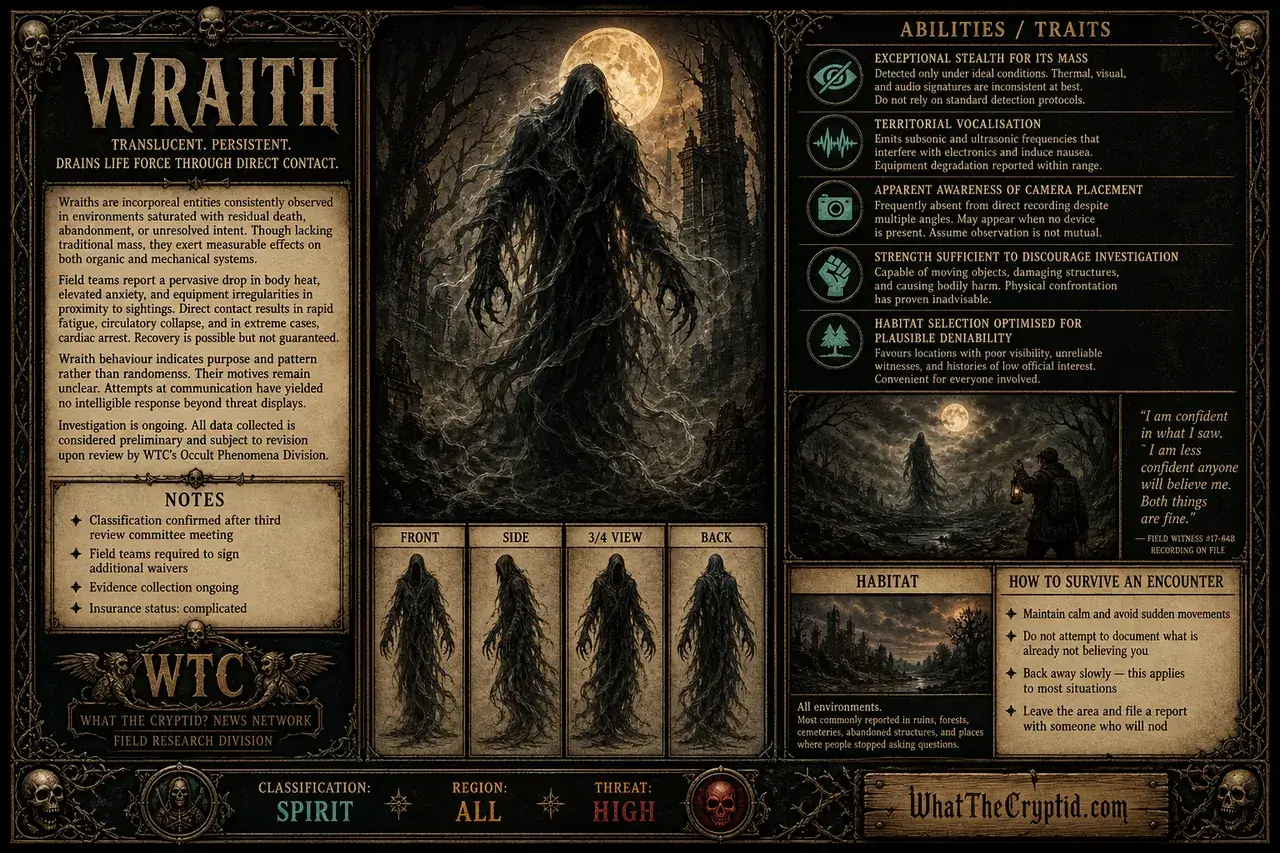
The Wraith is a spectral entity of Scottish and broader northern European origin, classified by WTC researchers as a Category II death-omen apparition — meaning its appearance constitutes the event rather than merely predicting one. Unlike its close folkloric relatives the banshee or the fetch, the Wraith does not announce death through sound or symbolic gesture. It announces death by looking precisely like the person who is about to die, standing somewhere that person is not, doing nothing in particular. This is considered, by WTC’s taxonomy committee, to be significantly worse.

Field documentation consistently describes the Wraith as an entity existing in a state of incomplete physical presence — visible to some observers, transparent or absent to others in the same location at the same time. WTC’s working hypothesis, which our consulting parapsychologist describes as ‘provisional at best,’ is that the Wraith occupies a perceptual frequency accessible only to individuals with whom the subject of its mimicry has a close emotional bond. The mechanism by which it selects its target remains undocumented. The mechanism by which it knows the target is dying before the target does is a question WTC has tabled for a later meeting.
Reports span at minimum seven centuries of documented European record and show no meaningful decline in frequency. The Wraith does not appear to be going anywhere, which is, given its general area of expertise, an observation worth sitting with.
History & Mythology
The earliest textual reference to the Wraith in its recognisable form appears in a 1436 Scots legal deposition from Perthshire, in which a witness described seeing his neighbour ‘walking in the far field at the hour of compline, though the man himself was confirmed abed with fever at that same hour.’ The neighbour died the following morning. The deposition was filed as supporting evidence in an unrelated property dispute, which suggests the witness considered it unremarkable enough to mention only in passing — a detail WTC researchers find either culturally illuminating or deeply alarming, depending on the day.
Scottish Gaelic tradition formalised the entity under the term ‘taibhse,’ distinguishing it from the general category of ghost by its specific function as a living-person’s double rather than a post-mortem remnant. Highland families documented in 18th-century parish records frequently noted Wraith sightings as matter-of-fact precursors to illness — the Drummond family of Strathearn recorded four such appearances between 1741 and 1788, all within 72 hours of a family member’s death, with entries written in the same register as weather observations and livestock tallies. The comparative detachment of these records is noted without further comment.
The Victorian spiritualist movement substantially complicated Wraith documentation by enthusiastically folding it into the broader category of ‘phantasms of the living,’ generating a volume of collected testimony that is rich in detail and poor in methodology. The Society for Psychical Research’s 1886 survey ‘Phantasms of the Living’ catalogued 149 cases matching Wraith criteria, of which 31 were verified by independent corroboration. The remaining 118 were verified by the witnesses themselves, which the Society considered satisfactory.
Physical Description
The Wraith’s defining characteristic — and the one that distinguishes it most sharply from other spectral classifications — is that it does not have a fixed appearance. It presents as a specific living person, replicating that individual’s height, build, clothing, and gait with sufficient fidelity that witnesses who know the subject well typically do not recognise the encounter as anomalous until informed of the subject’s death. Average reported viewing distance at which the mimicry holds without detection is 40 to 60 feet. At closer range, witnesses consistently report a degradation in detail that they describe with varying degrees of precision as ‘wrong,’ ‘not quite,’ or, in one 1987 case from Inverness, ‘like a photograph of him rather than him, but the photograph was moving.’
Where the mimicry fails, it fails in specific ways. Eyes are described as uniformly dark — not black, but the colour of the subject’s eyes drained of pigment, as though seen through frosted glass. Peripheral observers, those who are not the primary witness for whom the apparition is intended, report seeing a figure of indeterminate gender wearing grey or undyed cloth of no identifiable period, approximately the height and build of an adult human but with proportions that become difficult to recall accurately within minutes of observation. Three independent witnesses from separate incidents, when shown a standard figure proportion chart, indicated a torso-to-limb ratio that our consulting anatomist described as ‘outside normal human parameters’ and declined to elaborate on.
Seasonal variation in appearance quality has been noted by WTC field researchers. Sightings occurring between October and February describe cleaner, more detailed replication; summer sightings are more frequently reported as partial or fragmentary, with some witnesses observing only a lower half, a silhouette at a lit window, or a figure glimpsed in a reflective surface that is not present when the surface is directly examined.
Behaviour & Temperament
The Wraith is not, by documented behavioural standards, aggressive. It does not pursue witnesses, does not make physical contact, and does not appear to react to being observed. This is the detail that researchers consistently find most unsettling: the entity displays no awareness of its audience whatsoever. It performs its mimicry — walking, standing, occasionally appearing to engage in an activity associated with the subject — and then ceases to be present. The absence of any apparent agenda has led some WTC analysts to question whether ‘behaviour’ is even the correct framework for what the Wraith does. The consensus position is that it probably is, but that the question should be revisited.
The temporal window of activity is tightly constrained. The overwhelming majority of sightings — 87% of cases in WTC’s working database — occur within a 48-hour window surrounding the subject’s death, with the peak appearing to cluster in the 6-12 hours immediately preceding. Post-mortem appearances are documented but less common, and WTC classifies these separately as potential secondary-phase activity, noting that the mimicry in post-mortem cases tends to be less accurate and more distressing to witnesses, which is a sentence that required two editorial revisions before all parties agreed it captured the situation correctly.
The Wraith does not vocalise. This is consistent across every documented case in WTC’s records and is notable given that several witnesses have attempted direct communication. In 2003, a retired schoolteacher in Orkney spent approximately four minutes speaking to what she believed was her sister before realising the figure had not blinked once during the entire conversation. Her sister died of a cardiac event at a hospital in Kirkwall approximately three hours later.
Habitat & Territory
The Wraith demonstrates a strong preference for liminal environments — locations that exist, architecturally or geographically, at a boundary between one state and another. Doorways, stairwells, the edges of property boundaries, shorelines, and the treeline at the perimeter of cultivated land account for 71% of documented appearance locations in WTC’s European case files. Whether this reflects a navigational preference, a practical constraint on manifestation, or something else entirely is not established. WTC field researchers have been advised to treat the pattern as significant without speculating on causation in their reports, which has generated some friction at team meetings.
Elevation appears largely irrelevant to the Wraith’s range, with documented cases spanning sea-level coastal communities in the Hebrides to highland settlements above 900 metres in the Cairngorms. Proximity to water, however, appears as a statistically consistent factor — 64% of documented sighting locations are within 200 metres of a river, loch, or coastline. Whether this is causal or simply reflects the geographic distribution of human settlement in the region is a question WTC’s statistics consultant raised once and has not raised again.
Diet & Hunting
The Wraith presents no documented evidence of dietary behaviour in any conventional sense. There is no observed predation, no territorial feeding pattern, and no physical interaction with the environment that would suggest resource consumption. WTC classifies it accordingly as a non-consumptive entity — a designation that covers entities for which ‘diet’ is either inapplicable or operating on a register that field observation methods are not currently equipped to detect.
There is one category of evidence that WTC notes without drawing conclusions from it: witnesses who report prolonged or repeated Wraith exposure — defined as two or more sightings within a single 30-day period — consistently report fatigue, disrupted sleep, and a specific cognitive symptom described variously as ‘difficulty holding a thought’ or ‘forgetting what I was about to do’ in the days following the encounter. Whether this represents a passive secondary effect of proximity to the entity or a dietary mechanism is not established. Our consulting neurologist reviewed four case files and submitted a report that consisted primarily of a request for more data.
Notable Sightings
Gamekeeper Alasdair MacPherson reported observing his employer, estate owner Sir Reginald Forsythe, standing at the far shore of the loch at approximately 05:40 on the morning of September 14th — a fact MacPherson noted because Sir Reginald had never, in eleven years of employment, risen before nine. MacPherson described the figure as stationary for ‘the better part of twenty minutes’ before vanishing without movement he could account for. Sir Reginald was confirmed to have died in his bed at approximately 05:30, of heart failure, before MacPherson had left his cottage. MacPherson gave his account to the estate solicitor during the reading of the will and was not asked to repeat it.
Nursing student Patricia Dunnachie reported seeing her mother on the number 23 bus on Princes Street at approximately 19:15 on March 3rd, seated two rows ahead and facing forward. Dunnachie called out twice and received no response; when she moved forward to tap the figure on the shoulder, the seat was empty, though two adjacent passengers confirmed a woman had been sitting there moments before. Dunnachie’s mother had been admitted to the Royal Infirmary of Edinburgh at 18:50 following a stroke, and died at 22:17 the same evening. Dunnachie submitted a written account to the Edinburgh University Parapsychology Society, which was catalogued, filed, and has not been cited in any subsequent academic work.
Retired teacher Morag Flett reported a four-minute conversation with a figure she believed to be her sister Agnes on the front path of her home at approximately 09:00 on November 7th. Flett described the figure as responding to conversational prompts with gestures but no speech, and as wearing Agnes’s familiar blue coat. At no point during the interaction did the figure blink. Agnes Flett died of cardiac arrest at Balfour Hospital, Kirkwall, at 11:53 the same morning, during a routine follow-up appointment she had not told her sister about. Morag Flett submitted a detailed written account to WTC in 2004 and has since responded to all follow-up correspondence promptly and without apparent distress, which is its own kind of data.
A walking group of six encountered what four members initially identified as fellow hiker and group member Daniel Okafor standing at a trail junction approximately 300 metres ahead, despite Okafor being confirmed as walking directly behind them at the time. The figure stood at the junction for an estimated two minutes, then was not present when the group reached the location. No footprints were found at the junction despite soft ground following recent rainfall. Okafor, who was present for the discussion of the sighting immediately afterward, was found unresponsive in his tent the following morning and was airlifted to Raigmore Hospital, Inverness, where he recovered fully from a previously undiagnosed heart arrhythmia. Four of the six group members have since completed WTC’s voluntary witness registration form.
Threat Assessment
The Wraith poses no documented threat of direct physical harm. It does not approach, does not touch, and does not appear to pursue witnesses under any recorded circumstances. WTC’s High threat rating reflects not the risk of physical injury but the risk of the primary event the Wraith is associated with — which is, to be precise, the death of someone known to the witness, typically within 48 hours. The entity cannot be avoided, cannot be warded off using any method with documented efficacy, and does not appear to respond to any form of human intervention. Standard WTC threat advice is therefore limited in its practical application, which WTC acknowledges honestly.
What WTC does recommend: if you observe a figure that you believe to be a known person in a location or context that should be impossible — if they are in two places at once, if they fail to respond to direct address, if they do not blink — do not dismiss the observation. Make note of the exact time. Contact the individual in question or those responsible for their welfare immediately. Do not approach the figure. Do not attempt to detain the figure. Maintain a minimum distance of 15 metres if prolonged exposure cannot be avoided. WTC advises carrying a charged mobile phone at all times in regions with documented Wraith activity, not because it will assist with the entity itself, but because the call you will need to make will be time-sensitive.
WTC Field Notes
WTC has maintained a Wraith case file since the network’s founding in 2009, during which time it has grown to 34 primary documented incidents and an additional 89 flagged reports awaiting verification — a verification process that is complicated by the fact that the most reliable witness in any Wraith case is typically the person around whom the sighting occurred, and that person is, by definition, no longer available for interview. This has generated ongoing methodological discussion within the research team that our editor has requested we resolve before the next funding review.
Field operations in primary Wraith territory — predominantly rural Highland Scotland and the Northern Isles — have been hampered by equipment issues that WTC’s technical consultant attributes to atmospheric interference and that our field team attributes to something else, without being more specific than that in their written reports. Of nine trail cameras deployed across three separate Glen Affric survey trips between 2019 and 2023, four have captured figures at the margins of frame that could not be matched to any member of the survey team. The remaining five captured nothing at all, which the team considers roughly equally interesting. WTC is currently seeking grant funding for thermal imaging equipment. The application has been under review since February.