
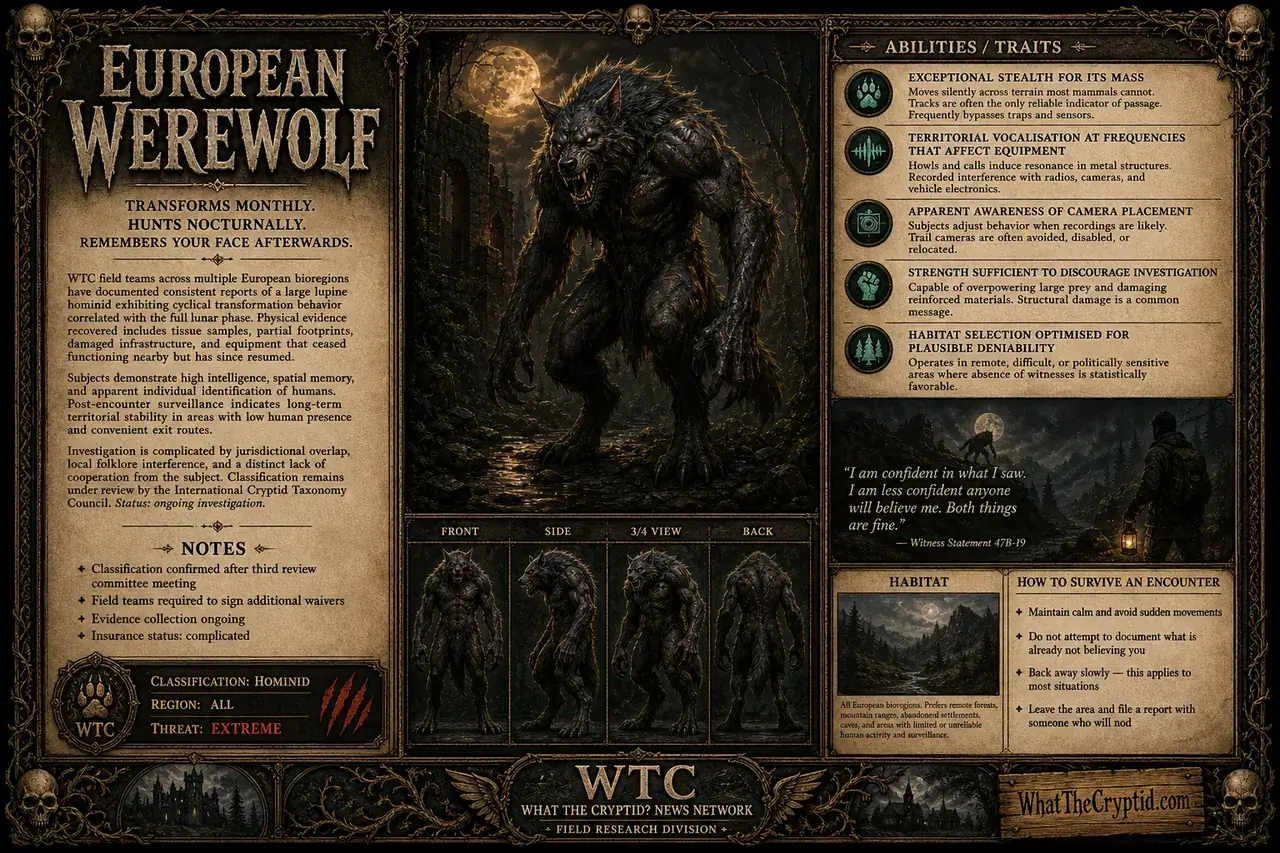
European Werewolf
Fully human. Mostly. Depending on the moon.
Europe
Active
ShapeshifterEuropean FolkloreLunar CyclePredatoryHistorical Record
Overview
The European Werewolf is a biphasic entity documented across the full longitudinal span of the European continent, presenting in a stable human phenotype for the majority of any given lunar cycle before transitioning — fully or partially, depending on the subspecies and the individual — into a large, predatory, wolf-adjacent form. WTC classifies it as a Shapeshifter rather than a Hominid on the grounds that the hominid phase is, by most accounts, temporary. The entity is notable among cryptid classifications for the volume of historical documentation, the geographic consistency of core behavioural traits across cultures that had no known contact with one another, and the fact that several European legal systems spent approximately three centuries treating it as a matter of criminal rather than cryptozoological jurisdiction.

The transformation mechanism remains a subject of active internal debate. Historical sources cite silver, cursed belts, enchanted wolf pelts, hereditary condition, diabolic pact, and at least one account from the Auvergne region attributing the change to excessive consumption of enchanted grain. WTC’s position is that these explanations are not necessarily mutually exclusive, and that the question of aetiology should not distract from the observable facts of the entity’s behaviour, range, and documented impact on livestock populations.
What distinguishes the European Werewolf from straightforward large predator encounters — and this distinction has occupied researchers for considerably longer than WTC has existed — is the specificity with which witnesses across widely separated regions and centuries describe the same transitional physiology, the same behavioural patterns, and, notably, the same vulnerability profile. This either represents convergent folklore development on a remarkable scale, or it represents something else. WTC has tabled the philosophical implications for a later meeting.
History & Mythology
The earliest systematic records of lycanthropic activity in Europe date to Herodotus, who documented the Neuri tribe of Scythia as undergoing annual wolf transformations, a claim he noted with what reads as careful journalistic neutrality — remarkable in a writer who elsewhere described giant gold-digging ants without apparent discomfort. By the first century BCE, the phenomenon had a clinical name, lycanthropy, attributed to Marcellus of Side, and was being discussed in medical literature as a condition with observable symptoms including nocturnal wandering, excessive thirst, and a tendency to haunt cemeteries. Whether the physicians in question were treating the same entity WTC would recognise today or a separate condition that borrowed the terminology is a question our consulting classicist describes as ‘genuinely unresolvable with current evidence.’
The medieval and early modern periods produced the most extensive documentary record, primarily through ecclesiastical and judicial channels. Between 1521 and 1640, French courts alone tried over thirty thousand individuals for alleged lycanthropy, resulting in executions in a significant proportion of cases. The trials of Peter Stumpp in Bedburg (1589) and Gilles Garnier in Dole (1573) are among the most thoroughly documented, with witness testimony, physical evidence assessments, and official court records that WTC researchers have reviewed in full. The evidential quality varies. The outcomes did not.
Following the Enlightenment, official institutional engagement with the phenomenon essentially ceased, which is not the same as saying the phenomenon ceased. The transition was from court records to parish registers to newspaper reports to, eventually, database entries of the kind you are currently reading. The paper trail becomes thinner after approximately 1750 and thinner still after 1900, a pattern WTC notes without drawing conclusions, though the observation that the period of reduced documentation coincides almost exactly with the period of reduced judicial consequence for witnesses coming forward is one our editor has asked us to include.
Physical Description
In its human phase, the European Werewolf presents no reliably consistent distinguishing features, which the historical record found deeply inconvenient and attempted to address through a catalogue of proposed physical markers including meeting eyebrows, curved fingernails, a third finger equal in length to the second, and a specific quality of gait described variously as ‘loping,’ ‘asymmetric,’ and ‘not quite right.’ WTC assigns low diagnostic confidence to all of these indicators individually, while noting that the cross-cultural consistency of their appearance in unconnected folklore traditions is itself a data point worth retaining.
In its transformed state, the entity presents as a digitigrade biped or full quadruped — the ratio appears to vary by individual and by degree of transformation — with a shoulder height in bipedal stance estimated between 6.8 and 8.2 feet based on witness accounts and, in two cases, measured doorframe clearances. Coat colouration ranges from grey-brown through black, with no documented albino variants despite their prevalence in associated fiction. The facial structure is described consistently as intermediate: elongated muzzle, retained forward-facing eyes, cranial proportions that differ from both wolf and human in ways witnesses struggle to articulate but consistently describe as disturbing rather than simply large. The hands retain partially functional opposable digits in most accounts, which raises questions about grip strength that WTC’s consulting structural biologist was willing to estimate but asked us not to publish.
Regional variants display meaningful morphological differences. The Germanic Werwolf tends toward the larger end of the size range and is documented primarily in full quadrupedal form. The French Loup-Garou presents more frequently as a biped and is associated in Normandy and Brittany accounts with a more pronounced retention of human facial features during transformation. The Latvian Vilkacis represents a distinct subtype, described as smaller, faster, and oriented more toward livestock predation than the southern European variants, which is either a genuine regional subspecies distinction or reflects differences in what eighteenth-century Latvian farmers kept in their fields versus what eighteenth-century French farmers kept in theirs.
Behaviour & Temperament
The European Werewolf demonstrates a strongly nocturnal activity pattern during its transformed phase, with the highest density of documented incidents occurring in the period between midnight and 3 a.m. — a window that WTC notes is also the period least likely to produce reliable witnesses. The lunar correlation is among the most consistently reported behavioural features across all regional variants, with full moon periods associated with both increased transformation incidence and increased aggression. Whether this represents a genuine biological trigger or a deeply embedded cultural expectation that has shaped the reporting record is a question WTC considers open. The moon does not appear to be optional.
Social structure appears primarily solitary during the transformed phase, with pack formation documented in only a small minority of accounts, most notably the 1598 Angers incidents involving what witnesses described as coordinated group behaviour, and which resulted in judicial proceedings against a family unit. The entity in its human phase maintains normal social integration with apparent ease, a feature that historical communities found more alarming than the transformation itself and that continues to complicate field research in ways WTC researchers are asked to approach with sensitivity.
Aggression profiles differ meaningfully by context. Livestock predation events — which constitute the majority of documented incidents — tend to follow efficient, targeted patterns consistent with a predator operating within its capabilities. Incidents involving direct human confrontation are less frequent and appear more often to involve territory defence or, in a significant number of historical accounts, provoked response. The entity does not, in the available record, pursue humans recreationally. This should be understood as a qualified reassurance at best.
Habitat & Territory
The European Werewolf demonstrates a strong preference for forested terrain with proximity to rural settlements, a combination that provides both adequate cover during the transformed phase and reliable access to the livestock populations that constitute its primary documented food source. Historically dense populations are recorded in the Ardennes, the Black Forest, the Auvergne Massif, the Carpathian Basin, and the Baltic coastal forests of Latvia and Lithuania, all of which share an elevation range of 300 to 1,800 metres, mixed deciduous-coniferous canopy, and relatively low human population density for their respective regions.
The entity does not appear to require permanent den structures and leaves no nesting evidence consistent with a fixed territorial base — a finding that complicates survey methodology, since standard habitat assessment tools designed for large mammal populations rely on den identification as a primary indicator. Movement range during transformed periods is estimated at 15 to 40 kilometres per night based on incident clustering in historical records, which WTC’s spatial analyst describes as ‘an uncomfortably large search radius’ for field teams operating on standard equipment budgets.
Diet & Hunting
Documented food sources across the historical and contemporary record consist primarily of sheep, cattle, and goats, with sheep representing the modal prey type in approximately 70 percent of attributed incidents. This preference aligns with the entity’s documented activity range relative to pastoral farming patterns across Central and Western Europe and does not, on its own, distinguish werewolf predation from wolf predation — a fact that historical investigators were aware of and addressed with varying degrees of rigor. The distinguishing features cited in livestock predation cases attributed to lycanthropic activity include wound placement inconsistent with quadrupedal jaw mechanics, partial consumption patterns, and in several recorded cases, evidence of the prey animal having been moved a significant distance from the kill site before feeding, which is not typical wolf behaviour and which no one involved in the original investigations appeared pleased to document.
Human predation events appear in the historical record primarily during periods of confirmed high entity activity — the French outbreak years of the 1560s to 1590s being the most extensively documented — and are less consistently reported in the post-Enlightenment record. Whether this reflects reduced incidence, reduced reporting, or simply improved livestock fencing is a question WTC considers unresolved. The entity has been documented in multiple accounts consuming prey incompletely and abandoning carcasses, a behaviour inconsistent with an animal operating under genuine caloric scarcity and one that WTC’s field teams find difficult to interpret in a direction that is entirely reassuring.
Notable Sightings
Peter Stumpp, a prosperous farmer in the village of Bedburg, was apprehended following an extended period of livestock and human predation in the surrounding area. Court records describe witnesses observing a large wolf-form entity in the fields near the village on multiple occasions before Stumpp’s arrest, at which point the attacks ceased. The official trial documentation, which survives in full and has been reviewed by WTC researchers, includes sworn witness testimony identifying Stumpp in both human and transformed states, physical evidence assessments conducted by court-appointed officials, and a detailed confession obtained under judicial procedure that was standard for the period and would not pass a modern ethics review. The proceedings concluded on October 31, 1589. WTC notes that no independent corroborating investigation was conducted prior to sentencing, for reasons that were recorded and are entirely consistent with sixteenth-century jurisprudence.
A tailor operating premises on the outskirts of Châlons was brought before local magistrates following the disappearance of several children in the surrounding district, with the case referred to as the ‘Demon Tailor’ proceedings in contemporary records. Witness testimony included accounts of a large, partially transformed entity observed in the fields adjacent to the town on at least three occasions, two of which involved multiple witnesses. Physical evidence presented at trial was described by court records as ‘substantial’ but was not preserved in a form accessible to later researchers. The subject was tried, convicted, and executed, with the court records subsequently sealed by ecclesiastical authorities on grounds that have not been fully explained in the surviving documentation. WTC submitted a records access request to the relevant French archival authority in 2019. We have not received a response.
University students in the city of Greifswald documented a series of incidents in which a large wolf-like entity — described in the account as ‘walking sometimes upon two legs and sometimes upon four, with a face that was known to some present’ — was observed on three consecutive nights entering the city via the southern gate and moving through the market district. The account, written by a student identified only as H. Rolfinck and preserved in the university archive, describes a coordinated effort by a group of approximately twelve students to drive the entity from the city using noise, torchlight, and — in a detail Rolfinck records without apparent self-consciousness — a quantity of silver melted from their coat buttons. The entity reportedly departed before dawn and was not observed in the city again. Rolfinck completed his degree the following spring and went on to a distinguished career in academic medicine, during which he did not publish on this subject.
Agricultural inspector Vasile Moldovan filed an official report with the Cluj County administration describing an entity he encountered at approximately 1:15 a.m. while travelling between villages on a routine inspection circuit. Moldovan described a bipedal figure of ‘exceptional height’ crossing the road ahead of his vehicle, pausing in the headlights for an estimated four to six seconds before departing into the treeline. The figure was described as covered in dark fur, moving ‘with the posture of a man but the speed of something else,’ and leaving prints in the roadside mud measuring 14.3 inches in length with a stride interval inconsistent with known large mammal gait patterns. The measurements were taken by Moldovan himself using his inspection kit and are recorded in the original report with the precision of a man accustomed to documentation. The report was filed under a livestock incident classification code that does not correspond to any livestock incident category in the 1933 Romanian agricultural registry. Moldovan requested reassignment to an urban district the following month and received it.
Threat Assessment
The European Werewolf presents a High threat classification based on documented physical capability, confirmed predatory behaviour, and the operational complication that the entity is behaviourally indistinguishable from an ordinary person during the majority of any given month. WTC recommends maintaining awareness of livestock disturbance patterns in rural areas of documented historical activity, particularly in the Ardennes, Carpathian, and Baltic forest regions, and treating unexplained predation events with multiple-hypothesis methodology rather than immediate attribution to known large predators. If direct encounter with a transformed entity is suspected, WTC recommends a minimum withdrawal distance of 200 metres, movement away from the entity rather than toward any enclosed structure, and the avoidance of direct eye contact, which multiple historical accounts identify as a trigger for escalated attention. Do not run. The documented movement speed of the entity makes this advice less useful than it sounds, but it remains the recommended protocol.
The silver vulnerability, documented across independent folkloric traditions spanning from Iceland to the Balkans with a consistency that WTC finds methodologically significant, should be regarded as the most reliably reported weakness in the available literature. WTC does not currently include silver-based materials in standard field kit due to procurement budget constraints and liability concerns raised by our legal department regarding the implied purpose of such equipment. Field teams operating in regions of active werewolf historical density are advised to make their own arrangements and to document any outcomes carefully.
WTC Field Notes
WTC has maintained an active European Werewolf file since the network’s founding, which makes it one of our oldest continuously updated entries and also one of our most contentious internal documents. The core disagreement — which has survived three editorial directors and one complete database migration — is whether the sheer volume of historical court and ecclesiastical documentation constitutes strong evidence for the entity’s existence or strong evidence for a widespread institutional response to something else entirely. Our current position is that both interpretations are available and that researchers should proceed accordingly, which is the position we have held since 2009 and which satisfies no one.
Field operations in Central and Eastern Europe have been complicated in recent years by the increased protected status of actual wolf populations in Germany, Poland, and Romania, which has made it significantly more difficult to distinguish werewolf-attributed livestock incidents from ordinary large predator activity without access to carcass evidence that landowners are, understandably, reluctant to preserve while waiting for WTC to arrange transport. We are currently in discussion with a regional agricultural cooperative in the Carpathian Basin regarding a formal incident notification protocol. The cooperative’s representative has been professionally courteous. He has also not yet signed anything.