
|
Credibility: ★★★☆☆ 3/5
|
Threat Level: MODERATE (Moderate — Mostly to fiber optic infrastructure, not humanity. Yet.)
The legendary leviathan spent 400 years asleep and woke up to become a defendant in a NATO-adjacent telecom lawsuit before it could even properly stretch its tentacles.
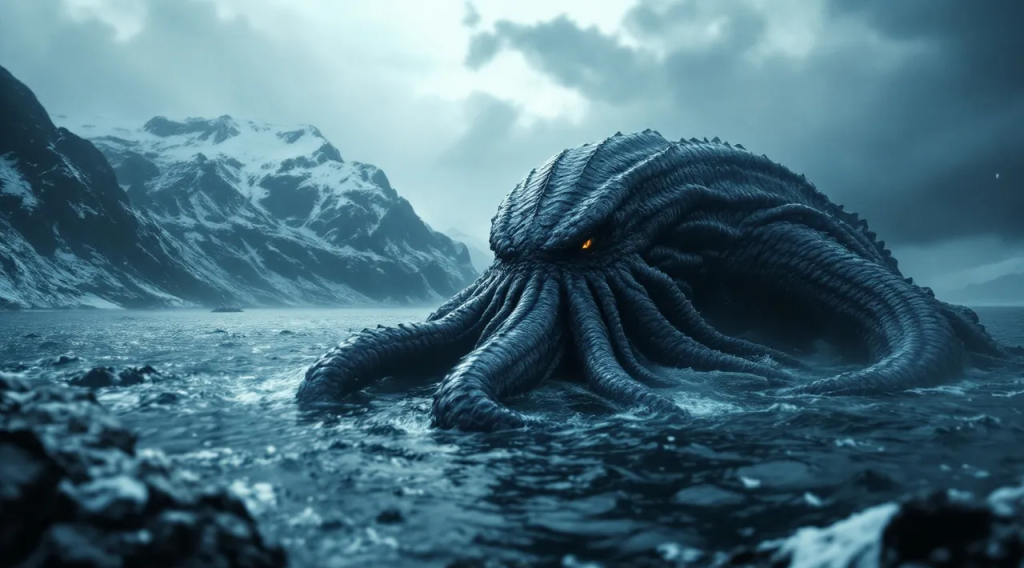
NORWEGIAN SEA — The Kraken, ancient destroyer of ships, swallower of fleets, and subject of approximately eleven thousand maritime tattoos, resurfaced Tuesday in the frigid waters off the Lofoten archipelago after what marine cryptobiologists estimate to be a dormancy period of no fewer than three to four centuries. The creature, which measures somewhere between ‘very large’ and ‘oh god,’ surfaced at approximately 6:40 a.m. local time and, within forty-seven minutes, had already become the central complicating factor in an ongoing dispute between Norway, Denmark, and Germany over the rightful ownership and operational responsibility of the SubNord-4 undersea data cable — a lawsuit that had, until Tuesday, been slowly grinding its way through the European Court of Justice with no end in sight. The Kraken has not been served with papers at this time, though legal teams from all three nations are reportedly ‘exploring options.’
Three Nations, One Cable, Eight Hundred Tentacles
The SubNord-4 cable, which carries an estimated 34% of all broadband traffic between Scandinavia and Central Europe, has been the subject of a bitter trilateral dispute since 2021, when a routing error in the cable’s maintenance agreement led Norway to bill Denmark for repairs that Germany insists it already paid for, while Denmark claims the cable doesn’t technically pass through Norwegian territorial waters at all — a claim Norway disputes with the kind of passion usually reserved for oil rights and Edvard Munch originals. All of that, frankly, was already a mess before an 800-tentacled eldritch organism of immeasurable age chose to use SubNord-4 as what witnesses describe as ‘a kind of hammock.’ The cable, originally rated to withstand 6,000 PSI of pressure, was not rated to withstand being used as a hammock by the Kraken.

It just… settled in. Like it had been looking for that exact spot. One tentacle on the Norwegian side, two clearly in international waters, and one — and I cannot stress this enough — draped directly over the Danish routing junction. Our lawyers lost their minds.
— Bjørn Halvorsen, Senior Cable Operations Engineer, NorTelecom AS, one of three witnesses on the maintenance vessel
The three witnesses — Halvorsen, a Danish maritime surveyor named Klara Ibsen, and a German telecommunications contractor identified only as ‘Dieter, from Hamburg’ — were aboard the NorTelecom maintenance vessel *Kabelkongen* conducting a routine inspection of the SubNord-4 cable when the Kraken surfaced approximately 200 meters off the port bow. All three witnesses agree on the basic sequence of events: the creature surfaced, it emitted what Ibsen described as ‘a sound like a cathedral organ being played inside a whale,’ and then it located the cable and became comfortable. Where the witnesses diverge is on whose fault this now is, which, sources tell WTC News Network, is structurally identical to how the original cable dispute began.
FIELD ALERT
WTC has confirmed the SubNord-4 cable is currently experiencing intermittent outages affecting streaming services, three banks, and what one Norwegian official described as ‘a very important government spreadsheet.’ The Kraken has not moved in approximately 19 hours. It appears to be asleep again. Do NOT attempt to wake it to resolve the telecom dispute faster. I cannot believe I have to say this.
Legal Chaos at Depths Previously Uncharted by Maritime Law
The legal implications, according to three maritime law scholars WTC contacted and one who contacted us unprompted at 2 a.m. via encrypted email, are genuinely unprecedented. The central question — who is liable for cable damage caused by a cryptid of unclear national allegiance resting on infrastructure whose ownership is already in active litigation — has no clean precedent under UNCLOS, the European Telecommunications Act of 1998, or frankly anything. ‘The Kraken predates international maritime law by roughly six hundred years,’ noted Professor Astrid Vangaard of the University of Oslo, reached by phone and audibly delighted. ‘It predates Norway as a formal legal entity, frankly. The creature has a stronger historical claim to those waters than any of the plaintiffs.’ When asked if she thought the Kraken could be considered a party to the lawsuit, there was a long pause before she said, ‘I’m going to need a grant for this.’
My client has not destroyed the cable. My client is resting on the cable. These are legally distinct situations and I will be filing a motion to that effect as soon as someone confirms I have a client.
— Unnamed attorney, reportedly retained by an unnamed Norwegian shipping consortium ‘on a speculative basis’ to represent the Kraken’s interests should proceedings advance
FAST FACTS
• The Kraken has been tentatively identified by size and behavior as the same organism referenced in Erik Pontoppidan’s 1752 Natural History of Norway, making it older than the United States, the concept of internet infrastructure, and the legal firm currently attempting to bill it.
• SubNord-4 carries data for an estimated 40 million end users. Current service disruption is described by all three implicated telecom providers as ‘the other guys’ fault.’
• The Norwegian Coast Guard has established a 500-meter exclusion zone around the creature, which the Danish Maritime Authority says violates their surveying rights and the German delegation says ‘is not our problem but also where is our spreadsheet.’
• The Kraken has shown no aggressive behavior toward the *Kabelkongen* or its crew, though witness Dieter from Hamburg reports it ‘looked at him for a while in a way that felt personal.’
As of press time, the European Court of Justice has issued a procedural stay on the original SubNord-4 case ‘pending clarification of material facts,’ which is judicial language for ‘we also do not know what to do about the Kraken.’ NATO has been briefed. NATO has declined to comment. A spokesperson for the Norwegian government said in a statement that Norway ‘welcomes the return of the Kraken to Norwegian waters,’ which the Danish Foreign Ministry immediately called ‘an implicit territorial claim’ and the German delegation called ‘a distraction from the spreadsheet issue.’ The Kraken, for its part, continues to rest. It has been asleep for four centuries and has woken up to a world of fiber optic cables, transnational legal frameworks, and three governments arguing over a hammock. Honestly, I can’t say I blame it for going back to sleep. I’d do the same. This is Hal Ridgeway for WTC — What The Cryptid? News Network. Stay weird. Stay waterproofed.
halridgeway@whatthecryptid.com
Harold "Hal" Ridgeway · Lead Anchor — WTC
Larger than documented. Significantly less patient than hoped.