
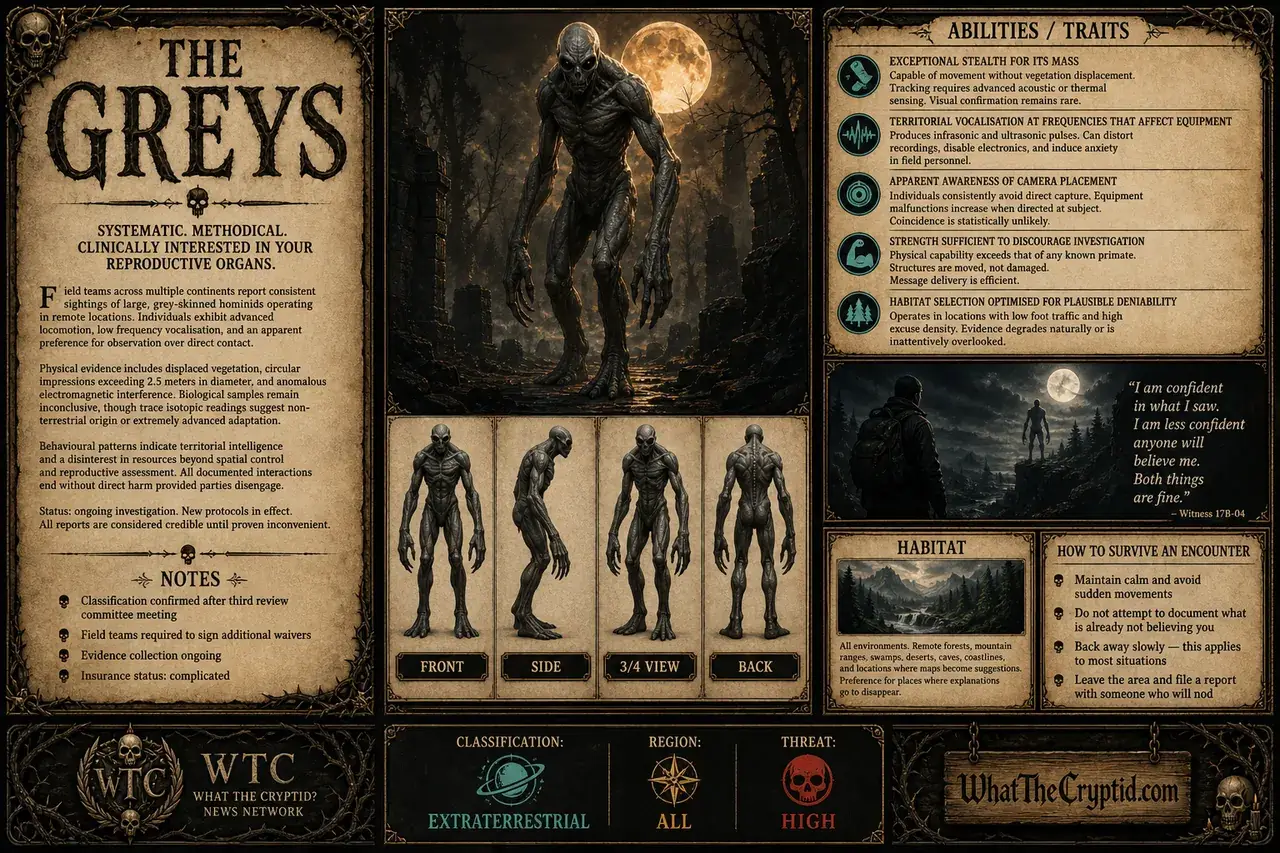
The Greys
Interstellar. Methodical. Professionally uninterested in consent.
All
Active
ExtraterrestrialAbductionGovernment Cover-UpWorldwide
Overview
The Greys represent the most consistently documented and most institutionally denied extraterrestrial entity class in the WTC database. Reported across every inhabited continent and in at least eleven maritime jurisdictions, they present a uniformity of description that is either evidence of a shared global phenomenon or evidence of a shared global delusion — a distinction WTC considers meaningful, even if the relevant agencies do not. Reports span the full range of encounter types, from distant aerial observation to direct physical contact, and the entities involved have demonstrated a working knowledge of human biology that field researchers describe as, at minimum, professionally thorough.

What distinguishes The Greys from other entries in this database is not the frequency of encounters — several entities outperform them on raw sighting counts — but the institutional footprint they leave behind. Missing time. Medical anomalies. Craft signatures on military radar that are subsequently reclassified. The Greys are, in the assessment of the WTC editorial board, the most consequential cryptid we cover, which may explain why they are also the one most actively discouraged from coverage.
WTC notes, for the record, that our press credentials have been declined at three separate government transparency hearings. The scheduling conflicts cited were, in each case, identical.
History & Mythology
The cultural record of small, large-eyed beings of non-human origin extends considerably further back than the popular imagination allows. Elongated skulls unearthed at Paracas, Peru, dating to approximately 3000 BCE remain a point of anthropological contention. Cave paintings in Tassili n’Ajjer, Algeria, estimated at 6,000 years old, depict figures with the proportional characteristics — enlarged cranium, diminutive stature, absence of visible nose structure — that would become standardised in twentieth-century encounter reports. Whether these represent artistic tradition, cultural metaphor, or field documentation depends on who you ask and what they stand to lose by answering.
The modern encounter record begins in earnest with Kenneth Arnold’s 1947 aerial observation over Washington State, though Arnold reported craft rather than occupants. The Roswell Incident of July 1947 established the template: a recovery event, a rapid institutional reclassification, and witness accounts that became progressively more difficult to access as the decades passed. The first encounter report matching the now-canonical Grey description — hairless, grey-skinned, approximately 3.5 to 4 feet in height, with disproportionately large black eyes — was filed by Betty and Barney Hill following their September 1961 incident on Route 3, New Hampshire, an account that underwent regression hypnosis documentation and produced anatomical sketches that remain the baseline reference in WTC’s physical description files.
The pattern that emerges across seventy-plus years of encounter data is one of methodical consistency. The entities do not appear to be improvising.
Physical Description
The Grey presents a physiology that is, by any reasonable anatomical standard, not optimised for the environments in which it is encountered. Standing between 3.5 and 4.5 feet tall across the majority of documented cases — with a smaller subset of reports describing variants in the 5.5 to 6.5 foot range, designated by researchers as ‘Tall Greys’ and believed to occupy a different functional role — the entity possesses a cranial volume visibly disproportionate to its body mass. The skull is notably enlarged at the crown and tapers to a narrow jaw, accommodating eyes that witnesses consistently describe as large, wrap-around, entirely black, and without visible iris or pupil structure. Whether the black surface represents the eye itself or a protective membrane is a question WTC’s consulting ophthalmologist found genuinely interesting before declining to answer on the record.
Skin colouration is reported as grey, ranging from pale ash to a slightly blue-tinged charcoal, described by multiple witnesses as having a texture comparable to a hairless mammal — smooth, slightly cool to the touch in the accounts that involve touch, which WTC acknowledges are the accounts that raise the most significant additional questions. The nose is vestigial or absent: a flat surface with two small slits is the most common description. The mouth is a thin, horizontal line, rarely observed to open. Ears are absent or negligible. The hands feature four fingers, elongated, without visible joints in the manner of human digits, and in several accounts described as capable of independent movement that witnesses found difficult to characterise further.
The Tall Grey variant wears, in the majority of reports, a garment that functions as either a uniform or an environmental suit, and is described as taking an advisory or supervisory role during encounter events. Standard Greys are typically described in minimal or no visible covering. WTC considers the hierarchical implications of this dress code worth noting without elaborating on at this time.
Behaviour & Temperament
The Greys operate with an efficiency that suggests either highly regimented training or the complete absence of the social friction that makes human work slower than it needs to be. Encounter accounts describe coordinated group behaviour — typically two to four entities — with task allocation that witnesses interpret as predetermined: one entity secures or occupies the subject’s attention, others conduct whatever procedural activity the encounter involves. Communication between entities is not observed to be verbal. Witnesses report a sense of direct cognitive transmission, described variously as ‘hearing words without sound,’ ‘receiving impressions,’ and, in the Hill case, ‘a humming that became meaning.’ WTC’s linguist consultant reviewed twelve encounter transcripts and described the communication pattern as, structurally, unlike anything in the human record.
Aggression, in the conventional sense, is rarely reported. The Greys do not threaten, do not display, and do not, in documented accounts, cause injury in excess of whatever the encounter’s apparent purpose requires. This is not the same as saying they are harmless, and WTC would like that distinction to be clearly understood. The appropriate framing is that The Greys appear to define harm differently than their subjects do, and their definition has not been made available for review.
Post-encounter behaviour in witnesses frequently includes disorientation, time displacement ranging from minutes to several hours, persistent and specific dream sequences, and an acute awareness of being observed in the days following the event. Several long-term abduction study subjects have described the relationship with their contacts as evolving in character over years of repeated encounters — a development WTC has noted in its files and chosen not to characterise further pending additional data.
Habitat & Territory
The Greys demonstrate no consistent terrain or climate preference, having been reported in desert, arctic, subtropical, and temperate environments with equal frequency. What they do demonstrate is a consistent preference for low population density, low ambient light, and proximity to either bodies of water or significant electromagnetic anomalies — power installations, military communications infrastructure, naturally occurring mineral deposits with high conductivity. Whether these are navigational aids, power sources, or simply correlative artefacts of the investigation record is not established.
Craft associated with Grey encounters have been documented at altitudes ranging from ground level to the upper atmosphere, with the majority of close-encounter events occurring between 11 PM and 4 AM local time. Several high-frequency encounter zones — the San Luis Valley in Colorado, the Hessdalen Valley in Norway, and a corridor in south-eastern Australia roughly centred on Westall — have produced multi-decade sighting records that suggest either persistent territorial presence or a return schedule that WTC finds, from a logistical standpoint, impressively maintained.
Diet & Hunting
No dietary behaviour has been directly observed in the field, and WTC is not aware of any encounter account in which a Grey entity was observed to consume anything. This would ordinarily place diet outside the scope of this entry. However, the physiological evidence from post-encounter medical examinations — specifically, tissue sampling at puncture sites, unexplained mineral deficiencies appearing in bloodwork taken within 72 hours of encounter, and three separate cases in which subjects reported unusual metabolic changes persisting for months — suggests that the encounter process itself may serve a nutritive function of some kind.
WTC’s consulting nutritionist reviewed the available metabolic data and described the pattern as ‘suggestive of an extraction process rather than direct consumption.’ She asked that her name not be attached to that characterisation. We have respected that request. The broader question of what, specifically, is being extracted, and for what purpose, is one that the available data does not answer, and that WTC has placed on its list of research priorities directly behind adequate liability coverage for field staff.
Notable Sightings
On or around July 8th, 1947, ranch foreman W.W. ‘Mac’ Brazel reported a debris field spanning approximately three-quarters of a mile on the Foster Ranch outside Roswell. The material — described as lightweight metallic foil that returned to its original shape after crumpling, I-beams with embossed markings, and a quantity of black, thread-like substance — was collected by personnel from Roswell Army Air Field and transported off-site within 48 hours. Brazel later revised his account to describe the debris as consistent with a weather balloon, a revision he provided after spending a period of time at the air base that he described to neighbours as ‘not optional.’ The Air Force’s official position has been revised four times since 1947, which WTC notes is three more times than is typical for weather balloon recoveries.
On the night of September 19-20, 1961, Betty and Barney Hill were travelling south on Route 3 when they observed an aerial craft exhibiting non-standard flight behaviour near Indian Head. The subsequent two hours of their journey are not accounted for in their conscious recollection. Under separate regression hypnosis sessions conducted by Dr. Benjamin Simon beginning in 1963, both Barney and Betty Hill produced accounts of interior examination aboard a craft, describing entities consistent in every major physical detail — height, skin colouration, eye structure, hand configuration — despite the sessions being conducted independently and without prior comparison of accounts. Betty Hill additionally produced a star map under hypnosis that amateur astronomer Marjorie Fish identified in 1969 as a plausible representation of the Zeta Reticuli system, a claim that generated significant academic correspondence, the tone of which WTC would characterise as spirited. The Hills’ accounts remain the foundational reference for the modern Grey encounter template, a status neither of them sought and that Barney Hill, who died in 1969, was not alive to assess.
On April 6, 1966, at approximately 11 AM, over 200 students and staff at Westall High School observed a grey, saucer-shaped craft descend into a grass paddock adjacent to the school grounds, remain on or near the ground for several minutes, and depart at speed in a direction that witnesses described as vertical. The craft left a circle of flattened, scorched grass approximately 10 feet in diameter. Military and government personnel arrived on-site within the hour, collected physical samples, and, in accounts corroborated by multiple witnesses, instructed both students and teachers not to discuss what they had seen. The science teacher who conducted an informal class debrief the following day was, according to former students, not employed at the school by the end of that week. The physical trace site was subsequently mowed.
Between October 1977 and January 1978, the island of Colares in the Brazilian state of Pará experienced a sustained series of encounters in which residents reported aerial craft directing concentrated beams of light at individuals — beams that left circular burn marks, caused temporary paralysis, and in several cases produced symptoms consistent with radiation exposure, including localised hair loss and puncture wounds arranged in patterns. The Brazilian Air Force launched Operation Prato under Colonel Uyrangê Hollanda, which produced over 500 photographs, 8 hours of 16mm film, and a classified report. Colonel Hollanda gave a full interview to UFO researcher A.J. Gevaerd in 1997, describing the operational findings in detail, and died by apparent suicide shortly afterward. The Operation Prato files were partially declassified in 2004; the film footage has not been located.
Threat Assessment
The Greys do not, in the documented record, engage in territorial aggression, predatory pursuit, or acts of violence as WTC’s threat taxonomy conventionally defines them. WTC has nonetheless assigned a High threat rating, and would like to explain that decision clearly. High is not assigned because The Greys are likely to harm you in the street. High is assigned because the encounter record documents a pattern of unilateral physical access to human subjects, conducted without consent, in environments where subjects are isolated and unable to summon assistance, for purposes that have not been communicated and may not, on present evidence, be negotiable.
If you believe you are in proximity to a Grey entity or associated craft, WTC recommends the following: do not approach the craft; do not enter a structure or vehicle at the invitation, verbal or otherwise, of an entity; maintain a distance of no less than 50 metres from any landed craft, as the documented range of physiological effects from craft proximity is approximately 30 to 40 metres in high-intensity cases; ensure that at least one other person knows your location and has a check-in time scheduled within four hours. WTC acknowledges that the majority of documented encounter initiations occur without warning, at night, and in isolated locations, which limits the practical utility of this advice to some degree. We offer it regardless.
WTC Field Notes
The Greys entry has been in active revision at WTC for eleven years. This is not because the evidence is thin — it is the opposite problem. The volume of encounter documentation, photographic material, government record fragments, and witness testimony in our files on this entity exceeds the combined total for every other entry in the database, and the task of synthesising it into a single bestiary entry while maintaining what our editor calls ‘proportionate epistemic confidence’ has required more editorial meetings than WTC typically holds in a calendar year.
WTC also notes, without drawing conclusions, that this entry has experienced more pre-publication interference than any other in our database. Two contributing researchers requested removal from the byline. Our legal department reviewed the draft on four separate occasions, each time identifying new sections requiring ‘additional sourcing review.’ The photographs we intended to include in the supplementary media package were lost in a server migration that our IT contractor described as ‘technically unprecedented.’ We are publishing the entry as written. The photographs will be reacquired. WTC has applied for the relevant press credentials seven times and will apply an eighth.