
Poltergeist
It knows where you keep the crockery.
All
Active
PoltergeistSpiritTelekinesisHauntingParanormal
Overview
The poltergeist — from the German poltern, to make noise, and Geist, spirit — represents one of the most thoroughly documented categories of paranormal entity in the WTC database, which is either a testament to the phenomenon’s prevalence or to the human capacity for misattributing domestic accidents. What distinguishes the poltergeist from conventional haunting activity is not spectral appearance or atmospheric disturbance, but a specific and apparently purposeful engagement with the physical world: objects are moved, stacked, thrown, hidden, or destroyed with a consistency of method that researchers have found difficult to attribute to settling foundations.

The entity demonstrates no fixed form and leaves no biological trace. It does not, as far as WTC field teams have been able to determine, eat, sleep, migrate, or reproduce in any conventional sense. What it does, reliably and often with apparent escalation over time, is make its presence known through manipulation of the immediate environment — beginning with sounds and progressing, in documented cases, through object displacement, furniture relocation, and in a minority of cases, direct physical contact with human occupants. The trajectory from rapping to physical harm has been observed often enough that WTC classifies it as a behavioural pattern rather than an anomaly.
Activity is almost universally associated with a specific location and, more specifically, a specific individual within that location. Whether the poltergeist is attracted to the individual or generated by them is a question WTC has tabled for a later meeting.
History & Mythology
The oldest unambiguous records of poltergeist-type activity in Western documentation date to 858 CE, when a farmhouse in the Rhineland was subjected to a prolonged campaign of stone-throwing, wall-striking, and what contemporaneous accounts describe as ‘voices from the walls’ that correctly identified concealed information about local inhabitants. The incident was recorded by a Frankish bishop who visited the site, conducted an inquiry, and left without drawing formal conclusions — an approach that subsequent investigators have, consciously or otherwise, continued to employ.
English cases proliferate from the 17th century onward, with the Drummer of Tedworth (1661) representing the first incident to receive sustained, multi-witness documentation. The Tedworth case involved a confiscated drum that allegedly continued to beat unaided in the home of magistrate John Mompesson, attracting investigators including the diarist Joseph Glanvill, who noted strange lights, object movements, and sounds that followed family members between rooms. Glanvill’s account is among the earliest attempts to apply something resembling investigative methodology to poltergeist phenomena, and his conclusion — that the evidence was sufficient to warrant serious attention — has been endorsed and disputed in roughly equal measure ever since.
The 20th century produced both the most rigorously documented cases and the most thoroughly debunked ones, often involving the same incidents. The Enfield Poltergeist (1977-1978) generated over 100 hours of audio recordings, witness testimony from more than 30 individuals including police officers and journalists, and a literature of secondary analysis that continues to grow. That two of the involved children were subsequently observed fabricating some phenomena does not, in the assessment of WTC’s senior researcher, automatically account for all of it.
Physical Description
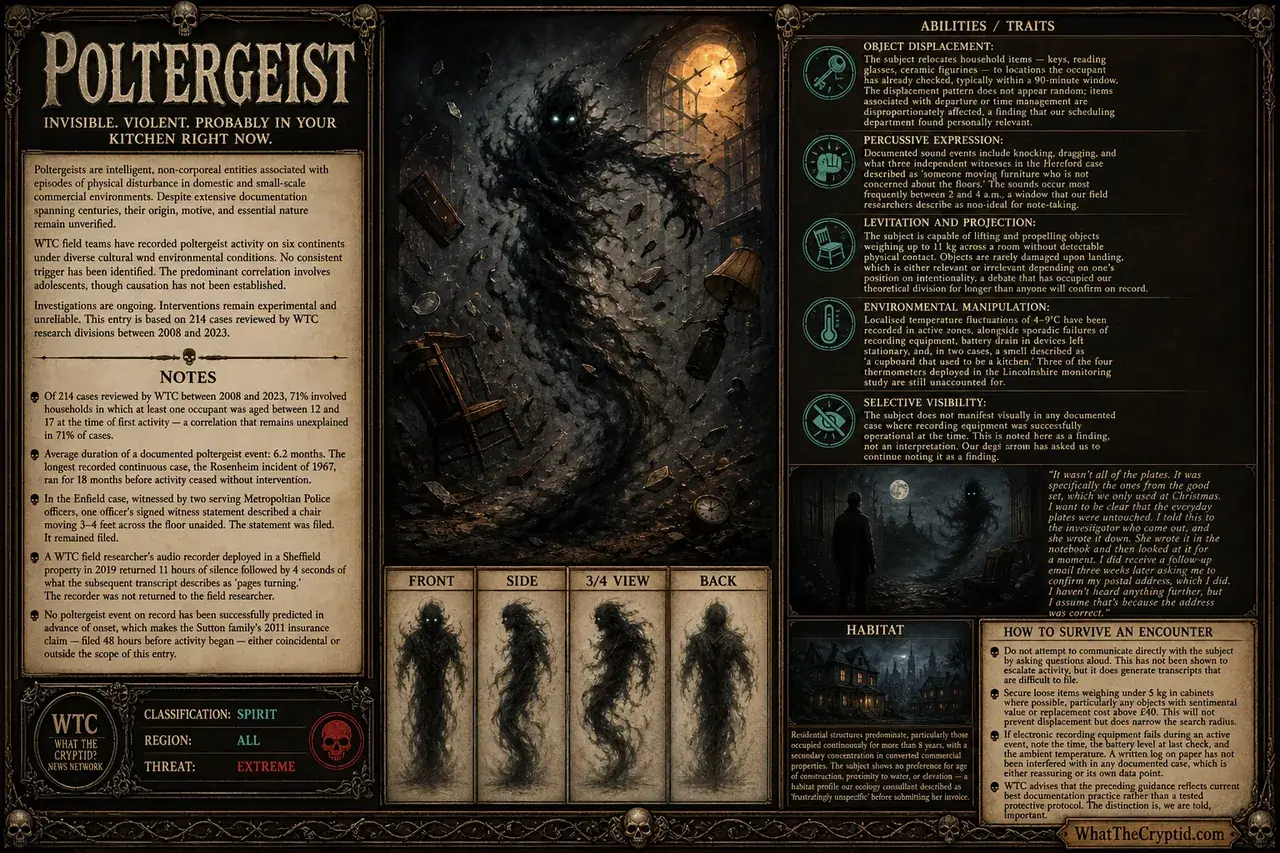
The poltergeist has no documented physical form. No WTC field team, and no investigator in the broader research literature, has produced a verified image, thermal signature, or physical impression of the entity itself. What gets photographed, when anything gets photographed, are the effects: stacked furniture, scattered cutlery, objects suspended at angles that their centre of gravity does not support, and, in a small number of cases, marks on human skin consistent with gripping or striking.
In the subset of cases involving apparent vocalisation — estimated at approximately 18% of documented incidents — witnesses describe voices ranging from low percussive knocking with apparent communicative intent to full speech. The Enfield case produced audio recordings of a voice that acoustic analysts described as originating from the false vocal fold register, producing sounds the human larynx generates only under specific and effortful conditions. The 11-year-old girl from whose vicinity the voice most frequently emanated was later observed producing similar sounds deliberately. Whether this constitutes debunking or documentation has not been formally resolved.
In rare historical cases, particularly from Central European traditions, witnesses have described a physical manifestation: a dark, low, rapidly-moving mass, occasionally luminescent. These accounts are sufficiently inconsistent across regions and centuries that WTC treats them as a separate sub-classification pending further evidence, which has not been forthcoming.
Behaviour & Temperament
Poltergeist activity follows a documented escalation arc that researchers have divided into four phases with enough consistency to be considered taxonomic rather than anecdotal. Phase one involves sounds — knocking, scratching, footsteps, or percussive strikes on walls and floors, typically nocturnal, typically beginning infrequently and increasing over days or weeks. Phase two introduces object displacement: items moved from their last known position to locations that are sometimes random and sometimes, as witnesses consistently report and researchers consistently struggle to categorise, pointed. A set of car keys relocated to the bottom of a toilet cistern is, technically, displaced. Whether it is also a statement is outside WTC’s current analytical framework.
Phase three, which not all cases reach, involves more energetic physical activity: objects thrown across rooms, furniture overturned, fires of unexplained origin, and in a minority of cases, direct physical interference with human occupants including hair-pulling, scratching, and, in the most severe documented incidents, being struck by thrown objects. The targeting is selective — poltergeist activity demonstrates consistent focus on one or two individuals within a household, typically leaving other occupants comparatively undisturbed, a pattern that strikes everyone who observes it as meaningful and that no one has yet explained to general satisfaction.
Phase four, when it occurs, is cessation. Cases resolve. The median duration of documented active poltergeist cases is 2.3 years, with resolution typically abrupt rather than gradual. The entity does not, in most cases, leave a forwarding address.
Habitat & Territory
Poltergeist activity shows no meaningful preference for age, architectural style, geographic location, or prior history of a structure. Cases have been documented in suburban semi-detached homes, rural farmhouses, urban tower blocks, hotels, schools, and, in one 1984 case in Pontefract, West Yorkshire, a corner shop. The persistent cultural association with old buildings and graveyards reflects narrative preference rather than field data.
The operative habitat unit for the poltergeist appears to be not the location but the household — specifically, the household containing the focal individual. In cases where the affected family has relocated, activity has in documented instances followed them to the new address, resumed with minimal interruption, and in some cases intensified, suggesting that whatever relationship exists between entity and individual, it is not contingent on proximity to the original site. This has practical implications for anyone considering relocation as a solution, and WTC recommends discussing this with relevant parties before signing a new lease.
Diet & Hunting
No feeding behaviour has been observed, and the poltergeist is not known to consume organic or inorganic material in any documented form. This places it outside conventional biological categorisation and raises questions about energy source and motivation that current investigative methodology is not equipped to answer. The entity expends what appears to be significant kinetic energy in the displacement of objects — in several documented cases, items weighing in excess of 40 pounds — without any corresponding observable input.
Some researchers in the broader parapsychological literature have proposed that the poltergeist derives operational energy from the emotional or psychological state of the focal individual, particularly in cases where that individual is an adolescent under stress — a proposal that is either a serious hypothesis about the mechanics of psychokinetic energy transfer or a description of what happens when a teenager is angry at their parents. WTC notes these are not necessarily mutually exclusive.
Notable Sightings
Staff at a legal office on Königstrasse reported persistent telephone malfunctions, spontaneous dialling of the speaking-clock line, fluctuating power consumption with no identified cause, and, under observation by physicists from the Max Planck Institute, the rotation of a hanging lamp through 320 degrees against the direction of its cord twist. Activity was consistently observed in the presence of 19-year-old office clerk Annemarie Schneider and ceased entirely when she left the firm’s employment. Siemens engineers, power company technicians, and post office investigators all examined the premises and submitted reports. The reports were inconclusive.
Single mother Peggy Hodgson contacted police in August 1977 following furniture movement and knocking sounds in her council house on Green Street. The responding officers witnessed a chair slide unassisted across the floor, a fact both officers noted in their formal reports and neither subsequently volunteered to discuss at length. Over the following 14 months, investigators from the Society for Psychical Research logged 2,000 pages of written records, over 100 hours of audio, and multiple instances of object flight, apparent levitation of children, and vocalisation attributed to a deceased previous tenant named Bill. The family remained in the property for the duration of the investigation. Moving costs in the London Borough of Enfield were not covered by any available assistance programme.
A rural farmstead housing three generations of the Bachmeier family reported an eight-month campaign of nocturnal stone-throwing, with fieldstones of between 0.3 and 1.2 kilograms landing inside the farmhouse through windows that witnesses consistently reported as closed and latched. A total of 47 individual stones were collected and catalogued by a visiting priest, who noted that several bore impact marks inconsistent with having entered through glass. Local police conducted four site visits. Activity ceased in March 1936 following the departure of the family’s 14-year-old son to begin an apprenticeship in Munich, a fact that was recorded in the parish log without further annotation.
The Resch family contacted local news following several weeks of activity including light switches operating without contact, objects thrown across rooms, and a telephone receiver photographed mid-flight by journalist Fred Shannon of the Columbus Dispatch. Investigator William Roll of the Psychical Research Foundation conducted a formal assessment and identified 14-year-old Tina Resch as the apparent focal individual. Tina was subsequently photographed by an AP photographer apparently pulling a lamp cord herself, a fact that Roll acknowledged while maintaining that not all observed phenomena were attributable to deliberate action. James Randi offered $1,000 to anyone who could demonstrate genuine poltergeist activity under controlled conditions. The offer was not claimed.
Threat Assessment
Direct physical harm from poltergeist activity is documented but statistically uncommon, occurring in an estimated 12-15% of active cases. When physical contact does occur, it most frequently takes the form of thrown objects — ceramic, metallic, or glass items — and investigators are advised to be alert to projectile risk in active environments regardless of the absence of any observed launching mechanism. Maintaining awareness of overhead objects and clearing tables of anything with a sharp edge before conducting interviews is recommended standard practice.
The primary risk in most cases is not physical injury but the psychological impact on affected individuals, particularly children, which documented case histories indicate can be severe and lasting. WTC recommends a minimum engagement distance of 1.5 metres from the focal individual during active phases, less for reasons of protection than to avoid being within the operational radius when escalation occurs. Investigators should carry documentation devices — audio and video — and should note that an estimated 34% of equipment deployed in active poltergeist environments experiences unexplained malfunction. Carrying backup equipment is advised. WTC is aware this recommendation does not address the mechanism responsible for the malfunction, and acknowledges that this is a limitation of the advice.
WTC Field Notes
WTC has investigated more poltergeist cases than any other classification in the database and has produced fewer definitive conclusions than any other classification in the database. This is not for want of effort. Our field teams have deployed audio equipment, static and motion-triggered cameras, electromagnetic sensors, vibration monitors, and, on one occasion, a network of accelerometers across 23 separate surfaces in a single affected property. The accelerometers recorded 14 anomalous events over 11 days. The camera covering the primary activity zone developed a fault on day two and was not replaced in time due to a procurement delay that our equipment manager has described as ‘a persistent theme.’
The question of whether poltergeist phenomena constitute genuine anomalous activity, elaborate unconscious or conscious fraud, or a psychological event with physical symptoms remains, in WTC’s assessment, genuinely open — and we note that ‘genuinely open’ is not the same as ‘uninteresting.’ We continue to investigate. Our senior researcher has requested that future case assignments include advance notice of whether the focal individual is an adolescent, not because this changes the investigative methodology but because, as she puts it, it changes how she packs.