
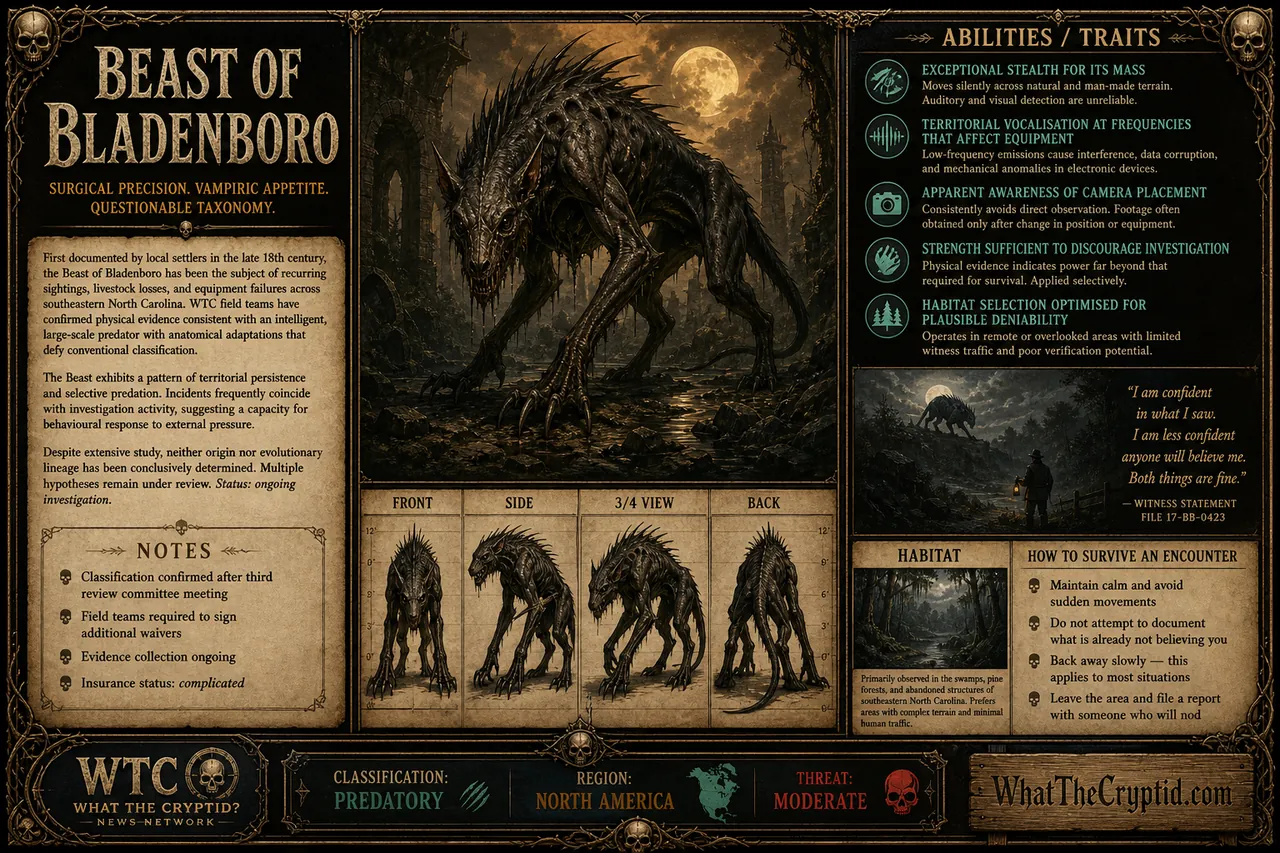
Beast of Bladenboro
Something in Bladenboro was very hungry in 1954.
North America
Dormant
FelidNorth CarolinaVampire Predator1954Livestock KillerSouthern Cryptid
Overview
The Beast of Bladenboro is a large felid-type predatory cryptid first documented in Bladenboro, Bladen County, North Carolina, during a concentrated attack period spanning approximately four weeks in January 1954. The entity is distinguished from conventional large cat sightings by two features that WTC classifies as operationally significant: an apparent preference for draining blood or fluid from its prey prior to consumption, and the unusual degree of institutional attention the attacks attracted before any carcass, print, or sighting was confirmed as definitive. At least thirty animals were killed or found mutilated during the primary incident window.

Witnesses have consistently described a creature larger than any felid native to the region, moving with what multiple accounts characterise as unusual deliberateness — a quality that distinguishes it, at least subjectively, from the panicked opportunism of a displaced mountain lion. Whether this reflects genuine behavioural difference or the retrospective pattern-matching of frightened witnesses is a question WTC has tabled for a later meeting.
The Beast has not been confirmed killed, captured, or conclusively identified in the seventy-plus years since the Bladenboro incidents. Bladen County has nonetheless leaned into its association with the entity, hosting an annual Beast Fest that WTC covers with what our editor describes as mixed feelings.
History & Mythology
The first recorded attacks attributed to the Beast occurred in late December 1953, when residents of the Bladenboro area began finding dogs dead under circumstances inconsistent with ordinary predation — skulls crushed, jawbones broken, and bodies described by witnesses as ‘drained,’ with minimal blood present at kill sites despite significant tissue damage. By January 1, 1954, the frequency of attacks had drawn the attention of Bladenboro Chief of Police Roy Fores, who initiated what would become one of the more extensively documented local cryptid investigations in the American Southeast.
On January 5, 1954, Mrs. Luther Underwood reported hearing a prolonged screaming sound outside her home and discovered the bodies of two of her dogs the following morning in a condition consistent with earlier reports. The Wilmington Morning Star ran its first coverage of the attacks on January 6, at which point the story attracted statewide and eventually national press attention. Mayor W.G. Fussell organised a community hunt on January 13, drawing an estimated five hundred participants — a figure that raises questions about the organisational infrastructure of Bladenboro in 1954 that WTC lacks the resources to pursue.
A bobcat was shot during the organised hunt and briefly presented as the responsible animal, a conclusion that was almost immediately disputed by local residents who noted the size discrepancy between the bobcat and the described attacker. Attacks continued sporadically into the spring before ceasing entirely. The bobcat explanation remains the official position of Bladen County historical records.
Physical Description
Witnesses from the 1954 incidents consistently described the Beast as a large, dark-furred felid standing approximately two feet at the shoulder and measuring between four and five feet in body length, not including the tail. These dimensions place it substantially larger than a bobcat and at the upper range of a female mountain lion, though several witnesses — including Chief Fores, who observed tracks firsthand — described proportions they considered inconsistent with either species. Track impressions recovered from soft soil near attack sites measured approximately three inches across, with a pad configuration that Fores described in his notes as ‘catlike but heavier-set than expected.’
Colouration in witness accounts ranges from dark grey-brown to near-black, with some accounts noting a slightly rounded, broad facial structure and ears described as proportionally smaller than a typical domestic cat’s. One witness, farmer Marvin Gurley, described the head as ‘too wide for its body’ before revising this assessment in a follow-up interview to ‘about right, but unusual.’ The tail was noted in multiple accounts as long and heavy, carried low during observed movement.
No regional variant of the Beast has been formally documented, though WTC notes a cluster of large felid sightings in Robeson County during the 1970s that share enough descriptive overlap with the 1954 accounts to appear in our supplementary files under the heading ‘Possibly Related.’
Behaviour & Temperament
The Beast of Bladenboro appears to be primarily nocturnal, with the overwhelming majority of attacks occurring between dusk and early morning and no confirmed daylight sightings from the 1954 event window. It did not, as far as documentation shows, cache its kills or return to carcasses — behaviour that distinguishes it from most large felid predators, which routinely revisit stored prey. This either suggests a highly efficient metabolic situation or a level of prey abundance that WTC’s consulting ecologist described as ‘not reflected in the agricultural records of Bladen County in 1954.’
The entity’s apparent preference for domestic dogs over livestock or humans is notable. Of the thirty-plus documented kills, the large majority were dogs. Livestock attacks were reported but were secondary in both frequency and severity. No verified human attack occurred during the primary incident window, though at least two residents reported close encounters in which the Beast was within thirty feet and departed without initiating contact. This restraint, given the documented capacity for significant physical damage, is something WTC finds professionally interesting.
During the organised hunt of January 13, witnesses in the hunting party reported hearing the screaming vocalisation associated with the Beast at close range — described uniformly as unlike any sound they had previously encountered — before the entity apparently withdrew from an area containing several hundred armed individuals. It did not return that evening.
Habitat & Territory
The Beast’s documented activity during the 1954 incidents centred on the rural and semi-rural outskirts of Bladenboro, with attack sites clustered within approximately a six-mile radius of the town centre. The terrain in this zone is characteristic of the North Carolina coastal plain: flat to gently rolling, heavily wooded in places, interspersed with farmland and bordered by the lowland swamp systems that define much of Bladen County’s eastern edge. Several kill sites were located within a quarter-mile of the Cape Fear River drainage system, which WTC notes as consistent with the movement corridors used by large felids in adjacent regions.
The preference for edge habitat — the transition zones between woodland and open farmland where domestic animals are most accessible — is ecologically unremarkable for a large predatory felid. That the Beast confined itself almost entirely to these margins and did not, to documented record, penetrate into the town itself suggests either a functional aversion to dense human settlement or a degree of geographic familiarity with Bladenboro’s layout that WTC’s field director has asked us not to speculate about in print.
Diet & Hunting
Available evidence from the 1954 attacks indicates a strong preference for medium-sized mammals, with domestic dogs representing the primary documented prey. The physical evidence at kill sites — crushed skulls, fractured jaws, and bodies described by multiple witnesses and at least one responding official as partially or wholly drained of fluid — suggests a killing method focused on the head and neck, consistent with a large felid’s typical cervical bite, followed by consumption or extraction of fluids in a manner that county veterinarian W.A. Griffin described in a January 1954 statement as ‘not immediately explicable by conventional predation mechanics.’
Whether the fluid-extraction behaviour reflects a genuine physiological requirement — as the ‘vampire’ designation in local folklore implies — or a post-mortem artifact of how large felid predators consume soft tissue, remains unresolved. WTC’s consulting zoologist provided a detailed written response to this question that concluded, after four pages, that more data would be required. Seasonal dietary variation has not been documented, as the entity’s active period in the historical record is limited to a single winter window.
Notable Sightings
On the night of January 5, 1954, Mrs. Luther Underwood reported a sustained screaming sound near her property lasting several minutes. The following morning, two of her dogs were found dead within twenty feet of the house, skulls crushed and bodies described by responding officer Deputy J.T. Nobles as ‘almost completely drained.’ Tracks in the soft earth near the bodies measured three inches across and were photographed by Nobles before rain obscured them. Mrs. Underwood did not replace the dogs.
Farmer Marvin Gurley reported a direct visual sighting on the night of January 8, 1954, observing a large dark-furred animal crossing his property at approximately forty feet distance in clear moonlight for an estimated ten to fifteen seconds before it entered treeline. Gurley described the animal as ‘moving like a cat but the size of a calf’ and reported that his remaining dogs refused to leave the porch for the following eleven days. Gurley’s account was included in the Wilmington Morning Star’s coverage and was not disputed by any member of his household.
During the organised community hunt of January 13, 1954, a hunting party of approximately twenty individuals in the southwestern woodland fringe reported hearing the Beast’s vocalisation at an estimated distance of one hundred yards. Three members of the party reported brief visual contact — a dark shape moving between trees — before the sound ceased and the animal was not relocated. Chief Fores, present with a separate group approximately half a mile north, confirmed hearing the vocalisation from that distance. The hunt was called off at nightfall without a confirmed kill. A bobcat was shot the following day.
On January 21, 1954, resident Thomas Johnson reported finding his German Shepherd dead in a fenced rear yard with injuries consistent with earlier attack patterns — crushed skull, broken lower jaw, minimal blood on the ground. The fence, which was four feet high, showed no damage. Johnson filed a report with Chief Fores’s office, which at that point had accumulated fourteen similar reports in eighteen days. The Morning Star ran a brief item on the Johnson incident on page seven. Attack reports declined sharply after this date and had ceased entirely by mid-February.
Threat Assessment
The Beast of Bladenboro is classified by WTC as a High threat entity based on its documented capacity for killing medium-to-large dogs with a single application of force, its apparent comfort operating in close proximity to occupied structures, and its willingness to enter fenced enclosures. The absence of documented human attacks during the 1954 incident window is noted but should not be treated as a guarantee of future restraint, particularly given that the conditions of 1954 — limited outdoor activity, prompt reporting, and a heavily armed local population — may have been material factors in that outcome.
Persons in or near Bladenboro and the broader Cape Fear River corridor are advised to secure domestic animals indoors after dusk, avoid investigating unfamiliar animal sounds at night from distances under one hundred feet, and treat any large felid print measuring over two and a half inches as warranting immediate reporting to local authorities and WTC’s regional tip line. WTC recommends against solo investigation of suspected activity sites. We acknowledge that this advice would have been significantly more useful to provide in December 1953.
WTC Field Notes
WTC dispatched a researcher to Bladenboro in the fall of 2019 to conduct archival interviews and review original documentation held by the Bladen County Historical Society. The original attack reports filed by Chief Fores’s office are partially intact; approximately forty percent of incident documentation from January 1954 is listed in the Historical Society’s inventory as ‘missing, location unknown,’ a phrase that appears in their catalogue without further annotation. Our researcher described the remaining files as ‘thorough for the period’ and the county archivist as ‘very helpful and also very clear that she was not going to speculate about the missing files.’
WTC has also attempted on three occasions to obtain Dr. Griffin’s original veterinary notes on the examined carcasses. Two requests went unanswered. The third produced a response from a family member stating that Dr. Griffin’s papers had been donated to an institution that our team has not been able to locate in any directory of archival collections. We continue to list the Beast of Bladenboro as Dormant rather than Extinct on the grounds that ‘dormant’ requires less documentation to substantiate.