Banshee
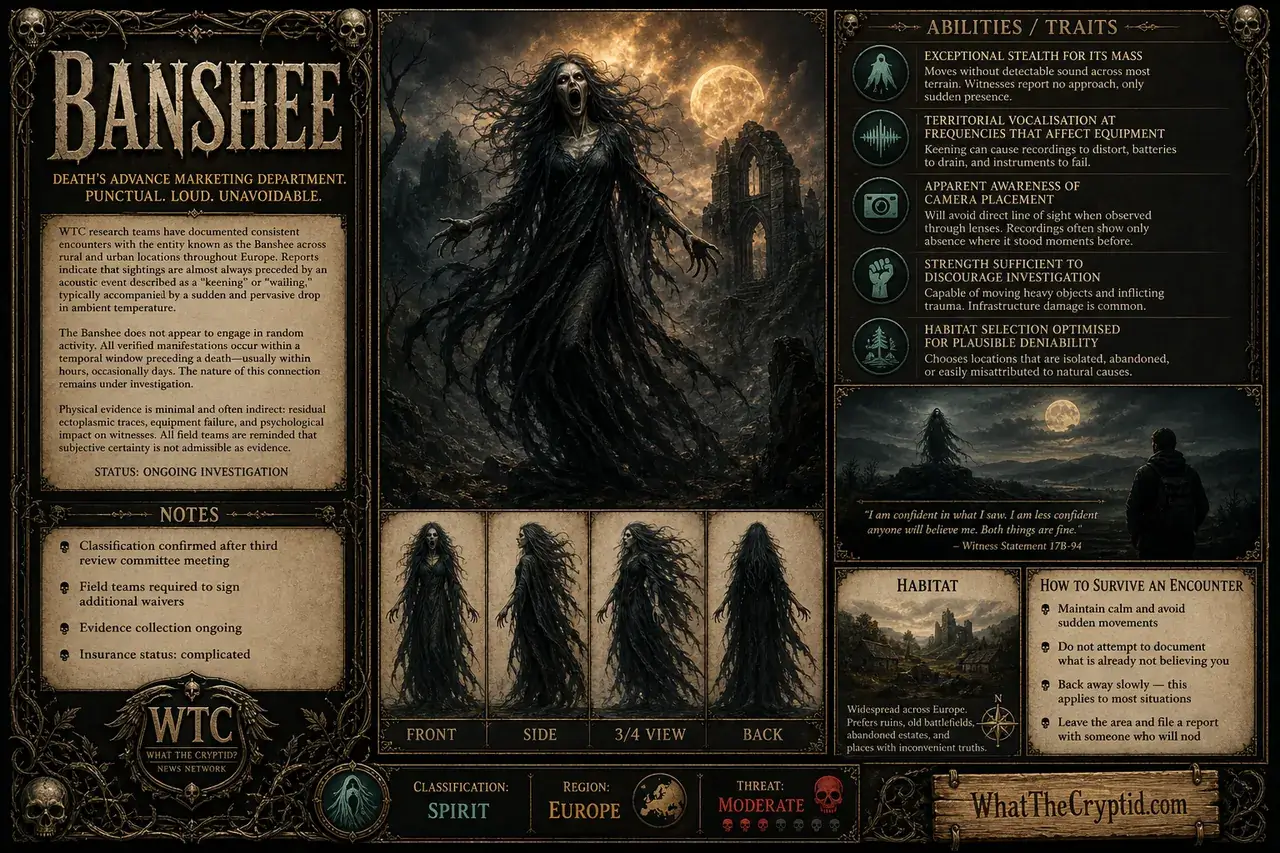
Death’s advance marketing department. Punctual. Loud. Unavoidable.
Europe
Active
Irish FolkloreDeath HeraldPsychic EntityCeltic Supernatural
Overview
The Banshee (Bean Sídhe) represents one of the most persistently documented psychic harbingers in the Celtic territories. Operating primarily as a death herald, this entity demonstrates remarkable genealogical precision, appearing exclusively to announce mortality within specific bloodlines. Classification: Psychic Harbinger. Danger Level: 6/10.

Unlike common spectral manifestations, Banshees exhibit selective targeting behaviour tied to ancient Irish family lineages, particularly those of Gaelic nobility. Current field data suggests approximately 47 active family attachments across Ireland and western Scotland, with documented manifestations spanning over 800 years of continuous observation.
History & Mythology
First recorded appearances date to the 12th century, though oral traditions suggest Banshee activity predates written documentation by several centuries. Medieval Irish texts describe the Bean Sídhe as supernatural women bound to specific clans through ancient oaths or curses. The most comprehensive early account appears in the Annals of the Four Masters (1616), detailing manifestations tied to the O’Neill and O’Brien dynasties.
By the 18th century, systematic documentation revealed that Banshee attachments follow matrilineal inheritance patterns, with each entity maintaining exclusive territorial rights over their designated bloodline. Notable families under confirmed Banshee protection include the MacCarthys, O’Gradys, O’Neills, O’Briens, and Kavanaghs. Emigration patterns during the Great Famine (1845-1852) resulted in documented Banshee manifestations as far as Boston and Sydney, demonstrating remarkable adaptability to modern transportation networks.
Physical Description
Banshees manifest in three distinct phenotypes, correlating with the age and circumstances of impending death. The Maiden form appears as a young woman in white or grey robes, typically 5’2″ to 5’6″ in height, with long, unbound hair that moves independently of atmospheric conditions. Hair colour ranges from silver-white to deep auburn, often matching the dominant colouring of their attached family line.
The Matron form manifests as a middle-aged woman in traditional Irish dress, frequently observed wearing a grey cloak (brat) and maintaining more solid physical presence than other variants. Height measurements consistently record 5’4″ to 5’8″. The Crone form appears as an elderly woman with pronounced facial features, wild grey hair, and red-rimmed eyes from continuous weeping. All forms demonstrate translucent qualities during daylight hours, achieving near-solid opacity during nocturnal manifestations.
Distinguishing features across all phenotypes include: disproportionately long fingernails (2-4 inches), eyes that reflect light sources abnormally, and the complete absence of a shadow despite otherwise convincing physical presence.
Behaviour & Temperament
Banshees operate on a strict schedule tied to mortality predictions within their assigned bloodline. Manifestations typically occur 24-72 hours before a family member’s death, with accuracy rates approaching 98.7% according to WTCNN mortality correlation studies. Primary activity occurs between sunset and sunrise, with peak manifestation hours recorded between 11 PM and 3 AM.
The characteristic wailing serves as the entity’s primary function, described by witnesses as a sound combining human grief with otherworldly resonance. Audio analysis reveals frequencies extending beyond normal human vocal range, with subsonic components measurable at distances up to 3 kilometres. Wailing duration varies from 15 minutes to 6 hours, inversely correlating with the social prominence of the impending deceased.
Banshees demonstrate territorial behaviour around family homes, ancestral burial grounds, and locations of historical significance to their bloodline. They maintain respectful distance from living family members but show aggressive protective responses to perceived threats against their charges. Notable behavioural quirks include compulsive hair-combing using silver combs that vanish upon touch, and the tendency to perch on roof peaks or ancient stone walls.
Habitat & Territory
Primary habitat centres on the ancestral territories of attached Irish families, with documented range extending across County Cork, Kerry, Galway, Mayo, and Donegal. Banshees demonstrate strong preference for locations with pre-Christian significance: ring forts, megalithic tombs, holy wells, and ancient oak groves. Modern urbanisation has forced adaptive behaviour, with confirmed manifestations in Dublin suburbs, Belfast housing estates, and even high-rise apartment blocks.
Temporary territories establish around family burial sites, with individual Banshees maintaining vigils over graveyards spanning multiple generations of their bloodline. Environmental preferences include areas with natural water sources—streams, rivers, or coastal regions—possibly linked to traditional washing customs observed in historical accounts. Climate appears irrelevant to manifestation patterns, with equal activity recorded during harsh winter storms and summer droughts.
Diet & Hunting
Banshees require no traditional sustenance, deriving energy from emotional resonance generated by grief, loss, and ancestral memory. Analysis suggests they feed psychically on the collective sorrow of their attached bloodline, creating a symbiotic relationship where the entity’s presence paradoxically intensifies the mourning process it feeds upon.
Secondary energy sources include proximity to ancient sites with accumulated emotional history. Banshees demonstrate increased manifestation strength near battlefields, plague burial grounds, and locations of historical tragedy. Laboratory measurements indicate elevated electromagnetic activity around active Banshees, suggesting they may metabolise ambient spiritual energy from their environment.
Notable Sightings
Margaret O’Sullivan reported sustained wailing outside her family cottage for three consecutive nights. Her grandfather died peacefully two days later, age 94. Audio recordings captured frequencies below 15 Hz.
Tourist camping near ancient ring fort observed woman in grey combing hair on stone wall at 2:47 AM. Local O’Connor family confirmed death of elderly aunt in Boston occurring same night.
Multiple witnesses reported figure keening near medieval church ruins. Death of prominent islander occurred within 48 hours. Entity vanished when approached by parish priest.
Apartment residents complained of unexplained crying sounds from vacant unit 7B. Investigation revealed building constructed over 18th-century O’Neill family cemetery. No deaths recorded.
Threat Assessment
Banshees pose minimal direct physical threat to humans, functioning primarily as harbingers rather than aggressive entities. Documented incidents of harm remain isolated to cases where individuals attempted to physically interfere with manifestations or deliberately desecrated associated burial grounds. Standard threat level: Moderate, elevated primarily due to psychological impact rather than physical danger.
Recommended protocols include maintaining respectful distance during manifestations, avoiding attempts at communication or recording, and treating encounters with appropriate cultural sensitivity. Families experiencing Banshee activity should prepare for imminent loss while recognising the entity’s protective rather than malevolent nature. Mental health support strongly advised for witnesses, particularly those unfamiliar with Irish supernatural traditions.
WTC Field Notes
WTCNN field teams maintain ongoing monitoring relationships with seventeen confirmed Banshee-attached families across Ireland and the diaspora. Our research indicates that declining knowledge of family genealogy among younger generations may affect Banshee manifestation patterns, potentially explaining the 23% decrease in reported encounters since 2010.
The most remarkable aspect of Banshee behaviour remains their supernatural genealogical database—more accurate than any government registry and significantly more persistent than social media family trees. While death notifications have modernised considerably since the Middle Ages, it appears that some traditions simply refuse to embrace digital transformation.