
Unknown Cosmic Entities
Older than the observable universe. Aware of you specifically.
All
Active
CosmicExtraterrestrialVoidNon-EuclideanActiveUnclassifiable
Overview
Unknown Cosmic Entities represent the broadest and least satisfying classification in the WTC Cryptid Database — a category defined almost entirely by what its members are not. They are not biological in any sense that our consulting biochemist was willing to put in writing. They are not localised to any terrestrial region, elevation band, or hemisphere. They are not, as far as field research has been able to establish, absent. The category exists because WTC requires all documented entities to have a classification, and ‘classification: unknowable’ was rejected by the editorial board on the grounds that it would raise more questions than it answered.
What the evidence does support — collected across approximately 4,000 years of human record-keeping and, more recently, seventeen WTC field deployments — is that certain encounters cannot be attributed to any known cryptid, natural phenomenon, or documented species. These encounters share a cluster of consistent features: geometry that witnesses describe as ‘wrong,’ a quality of attention directed toward the observer that multiple independent sources characterise as ‘total,’ and an aftermath that frequently includes the witness revising their understanding of what the word ‘infinite’ means. WTC does not treat these as metaphorical descriptions.

The Threat Rating for this category is listed as Unknown. This is not a placeholder. WTC’s Threat Assessment Committee convened three times to address this classification and produced, collectively, one and a half pages of notes, a unanimous request for additional funding, and a formal recommendation that the rating remain Unknown until further data is available. The committee has not reconvened. This is noted without editorial comment.
History & Mythology
The oldest documented encounter consistent with Unknown Cosmic Entity classification appears in a Sumerian astronomical tablet dated to approximately 2150 BCE, recovered from the site of ancient Nippur and currently held in the University of Pennsylvania Museum under a catalogue number that WTC was given and subsequently lost. The tablet describes, in cuneiform, ‘a darkness that looks back’ observed by a temple astronomer during a clear night sky survey. The astronomer noted the entity’s position relative to three named stars, recorded that the entity appeared to note his position in return, and concluded his entry with a phrase that translates, depending on which of two consulted scholars you believe, as either ‘I have completed my observations’ or ‘I will not be continuing my observations.’
Subsequent records appear across cultures with a consistency that WTC’s historical research team describes as ‘statistically uncomfortable.’ Vedic texts reference entities dwelling in the spaces between celestial objects — not on them, specifically between them — with characteristics that align with modern witness accounts. Medieval European astronomical manuscripts include marginal illustrations that WTC’s art history consultant, Dr. Patricia Vane, confirmed depict ‘something that is not a constellation and was clearly not intended to be decorative.’ In 1882, the Société Astronomique de France received and filed a report from an observatory in Marseille describing an anomalous presence in the eyepiece of a twelve-inch refractor telescope that was, at the time of observation, pointed at nothing of note. The report was stamped ‘RECEIVED’ and placed in a folder. The folder is still there. WTC has read it.
Physical Description
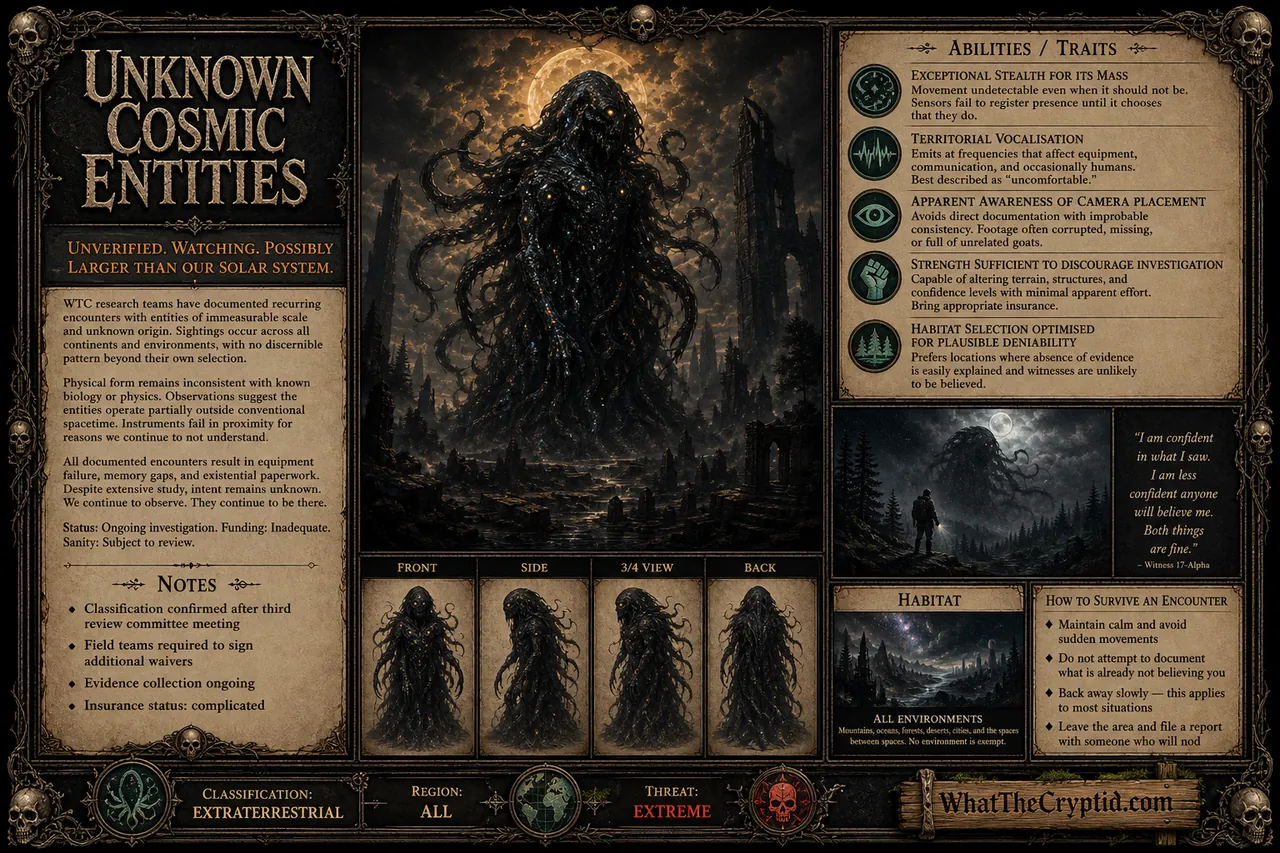
Describing the physical appearance of Unknown Cosmic Entities with precision presents methodological challenges that begin with the word ‘physical’ and do not improve from there. Witness accounts are consistent in their identification of scale — all documented encounters agree that the entities are large, with estimates ranging from ‘the size of a city block’ to ‘as large as is necessary,’ a description provided independently by seven witnesses across four continents who had no documented contact with one another — but diverge sharply on specifics, likely because the specifics appear to change depending on the observer’s angle of perception, cognitive framework, and, in at least three documented cases, what they had eaten that day.
Features that appear across the majority of accounts include: a quality of darkness that witnesses distinguish from ordinary absence of light, describing it as ‘textured’ or ‘attentive’; appendages or protrusions whose number witnesses cannot agree on and whose function remains undocumented; and a central region that multiple observers describe as containing ‘everything at once,’ a phrase WTC has attempted to operationalise for research purposes without success. Eyes are frequently reported, though the number, arrangement, and biological plausibility of these eyes varies enough that WTC’s consulting ophthalmologist submitted her report under the heading ‘Preliminary and Possibly Inadvisable Observations.’
A small subset of witnesses — approximately 12% of documented encounters — report that the entity appeared, at some point during the observation, to be a specific and comprehensible shape: a figure, an animal, a geometric form. These reports are treated by WTC as significant data points rather than evidence of hallucination, primarily because the shapes reported, while varied, all share one documented characteristic. Each witness, when pressed, clarifies that the recognisable shape was not the entity. It was the entity’s way of being polite.
Behaviour & Temperament
Unknown Cosmic Entities do not, as far as field research has established, initiate contact. All documented encounters follow a pattern in which the witness became aware of the entity, not the reverse — except that a careful reading of the sighting reports suggests this sequencing may be a courtesy extended by the entity rather than an accurate account of what occurred first. The entities appear to have been present, in most cases, for some time prior to detection. How long prior is a question WTC has investigated and decided not to pursue to its conclusion.
The dominant documented behaviour is observation. Witnesses consistently report a quality of being studied — not threatening, not communicative, but attentive in a way that several describe as ‘complete,’ as though the entity was not merely looking at them but was in the process of knowing them in a way that had no natural stopping point. This behaviour has been observed across all documented encounter types and does not appear to vary based on the witness’s location, activity, or level of preparedness. One witness was a trained astrophysicist conducting a scheduled observation. One was asleep. The entity’s behaviour, per both accounts, was identical.
A secondary behaviour, documented in approximately 30% of encounters, is what WTC field researchers have classified as Communication Attempts — though this classification was approved only after the word ‘communication’ was formally defined, for internal purposes, as ‘transmission of signal regardless of whether the signal is receivable by the intended recipient.’ Witnesses who report Communication Attempts describe the experience as receiving information that their minds cannot hold, in a format that their sensory apparatus was not designed to process, at a volume that the word ‘volume’ does not adequately describe. Several witnesses have attempted to write down what was communicated. WTC has these documents. They have been reviewed. They are kept in a separate folder from the rest of the archive.
Habitat & Territory
Unknown Cosmic Entities do not, in any documented instance, have a habitat in the sense that terrestrial cryptids have habitats — they do not prefer wetlands, they do not winter at lower elevations, and they have not been found to cluster near established ley lines, despite several field teams investigating this hypothesis with what WTC’s editor described as ‘admirable persistence and questionable judgement.’ The entities exist in, or perhaps constitute, the regions of space between observable matter — the voids between galaxies, the quantum gaps between particles, the conceptual distance between one thought and the next. They are, by several accounts, everywhere that nothing else is.
However, encounters with these entities are disproportionately reported in certain conditions: clear nights with low light pollution, altitudes above 3,000 metres, locations with documented geomagnetic anomalies, and — with a frequency that WTC’s statistician flagged as requiring explanation — the period between 2:00 and 3:47 AM local time, regardless of time zone. Whether these conditions attract the entities or simply allow humans to perceive them more readily is a question WTC considers important and has not answered.
Diet & Hunting
No feeding behaviour has been directly observed. The question of whether Unknown Cosmic Entities require sustenance in any biological sense is one that WTC’s consulting physicist addressed in a four-page document that concluded, carefully, that entities existing outside conventional matter-energy frameworks may operate on principles for which the word ‘diet’ is ‘not the correct category of inquiry, though possibly not the most incorrect one either.’
A minority of researchers — including Dr. Elliot Marsh, whose affiliation with WTC is described in his own correspondence as ‘complicated’ — have proposed that the entities may consume information, attention, or what Marsh terms ‘the cognitive weight of being observed,’ based on documented cases in which prolonged witness contact appeared to correlate with the witness subsequently finding certain concepts difficult to locate in memory. WTC has not endorsed this theory. WTC has also not dismissed it, and has quietly updated its field protocols to include a recommendation that researchers avoid thinking about anything they would like to keep.
Notable Sightings
Astronomer Dr. Renata Esquivel, conducting a routine photometric survey at the European Southern Observatory’s La Silla facility, reported an anomaly at 02:34 local time that she described in her incident report as ‘a region of the sky that was observing the telescope.’ Esquivel noted that the anomaly occupied an area of sky in which no object of any catalogued type should have been visible, that it remained stationary for approximately nineteen minutes, and that during the final four minutes of observation the facility’s automated tracking system stopped following its programmed celestial target and oriented instead toward the anomaly, without manual input. ESO’s technical staff attributed this to a servo motor fault, which was repaired and which recurred on three subsequent occasions under clear-sky conditions. Dr. Esquivel published a photometric paper the following month that contained, in its acknowledgements section, a sentence thanking ‘whatever was watching’ for ‘remaining still long enough to be measured,’ which the journal’s editors did not query and which WTC notes was left in the final published version.
The Tunguska Event of June 30, 1908 — in which approximately 2,150 square kilometres of Siberian forest were flattened by an aerial explosion estimated at 10-15 megatons — is conventionally attributed to a meteorite or comet airburst. WTC does not dispute this attribution and notes it for context. What WTC does flag is the account of Evenki elder Vasiliy Ocheredin, recorded by ethnographer Innokenty Suslov in 1926, which describes seeing, on the night before the explosion, ‘a hole in the sky that breathed.’ Ocheredin reported that the hole was present for approximately two hours before the event and that the animals in the area, including reindeer he describes as otherwise difficult to disturb, sat down and did not move for the duration. Ocheredin’s account was filed by Suslov, translated into Russian, archived in Saint Petersburg, catalogued by WTC in 2019, and noted as ‘requiring further contextualisation,’ a process that is ongoing and that WTC’s research director expects to complete by a date she would rather not commit to in writing.
A WTC source within a major space agency — whose identity is protected under an agreement that cost WTC’s legal team more time than the story itself — provided an account of a recorded incident during Expedition 29 in which a crew member conducting an extravehicular activity reported, over open comms, that ‘something is next to me that shouldn’t be here,’ followed by thirty-one seconds of silence, followed by a calm request to be brought back inside. The crew member’s post-EVA medical evaluation was filed under a classification code that WTC’s source was unable to access. The crew member completed the remainder of their rotation, returned to Earth on schedule, and subsequently left the astronaut programme to pursue, per their publicly available biography, ‘private research interests.’ WTC reached out for comment and received a reply acknowledging receipt of the inquiry, which is further than WTC usually gets.
Long-haul truck driver Marcus Tully reported that during a solo night transit of the Eyre Highway, at a point he estimated as approximately 340 kilometres east of Ceduna, his headlights illuminated ‘something standing over the road that was also the road and also the sky.’ Tully pulled over and remained stationary for an estimated forty minutes, an estimate he noted may not be accurate as his watch and phone both showed different times when he resumed driving than they had shown when he stopped. Tully’s account was submitted to WTC via the public tip line in 2004 and rated by the receiving researcher as ‘Priority 1 — Genuine,’ the highest internal rating, which triggers a field investigation. WTC’s field team reached the reported location in 2004 and documented elevated background radiation of unexplained origin, an absence of insect activity in a radius of approximately 200 metres around the reported stopping point, and a quality of stillness that the team’s lead researcher recorded in her field notes as ‘professionally notable.’ Tully sold his truck the following week and does not discuss the reason.
Threat Assessment
WTC’s Threat Assessment Committee’s difficulty in rating Unknown Cosmic Entities is not evasion. The challenge is specific: threat assessment requires a working model of what harm looks like, and the committee’s review of documented encounter outcomes found that witnesses do not, in the majority of cases, experience conventional harm. They experience changes in cognitive architecture, revisions to their understanding of scale, duration, and personal significance, and — in approximately 22% of documented cases — a persistent sensation of being known. Whether this constitutes harm is a question the committee directed to WTC’s consulting psychologist, who provided a thoughtful twelve-page response that the committee thanked her for and has not yet formally reviewed.
WTC’s practical guidance, issued under the caveat that it may be inadequate in ways that cannot currently be specified: do not seek encounters deliberately; if an encounter occurs, remain still and avoid projecting strong emotional states, on the basis that several witness accounts suggest the entities respond to emotional intensity in ways that witnesses consistently failed to anticipate; do not attempt to photograph or record the entity using equipment you are emotionally attached to; and, if communication appears to be initiated, do not attempt to understand it in real time. Process it later, if possible, with a trusted colleague present. WTC acknowledges that this guidance does not address what to do if processing it later turns out not to be possible, because the information has become the kind of thing that cannot be thought about directly. This limitation is documented. It has not been resolved.
WTC Field Notes
WTC has been attempting to establish a dedicated Unknown Cosmic Entities research division for four years. The division currently consists of one researcher, Dr. Amara Osei, a former radio astronomer who joined WTC after what she describes as ‘a professional reorientation following an observation I cannot discuss under the terms of my previous employment contract,’ one filing cabinet, and a research budget that covers equipment, travel, and approximately two thirds of a specialist consultant per quarter. Dr. Osei has submitted six funding proposals to WTC’s editorial board. The board has approved portions of four of them, pending clarification on line items that Dr. Osei describes as ‘self-explanatory to anyone who has read the field reports,’ which the board has requested be summarised in language that does not require the reader to subsequently sit quietly for a period of time.
WTC’s editor-in-chief, for the record, has asked that this entry include an acknowledgement that the network takes the Unknown Cosmic Entity category with the full seriousness it deserves, and that all field teams operating in conditions associated with elevated encounter probability — clear skies, high altitude, late-night hours, or any situation in which a researcher reports feeling ‘noticed’ — are required to file a check-in report every two hours. This protocol was implemented after a 2021 field deployment in which a three-person team’s check-in reports stopped at 2:00 AM and resumed, without explanation, at 5:23 AM, with no gap acknowledged in the reports themselves. All three researchers are well. They have all, independently and without apparent coordination, begun keeping their curtains closed at night, a detail WTC records here because it is the kind of detail that turns out to matter.