
Tall Greys
Observed. Documented. Conspicuously unacknowledged by relevant agencies.
All
Unverified
ExtraterrestrialGrey VariantsAbductionGovernment ContactTelepathic
Overview
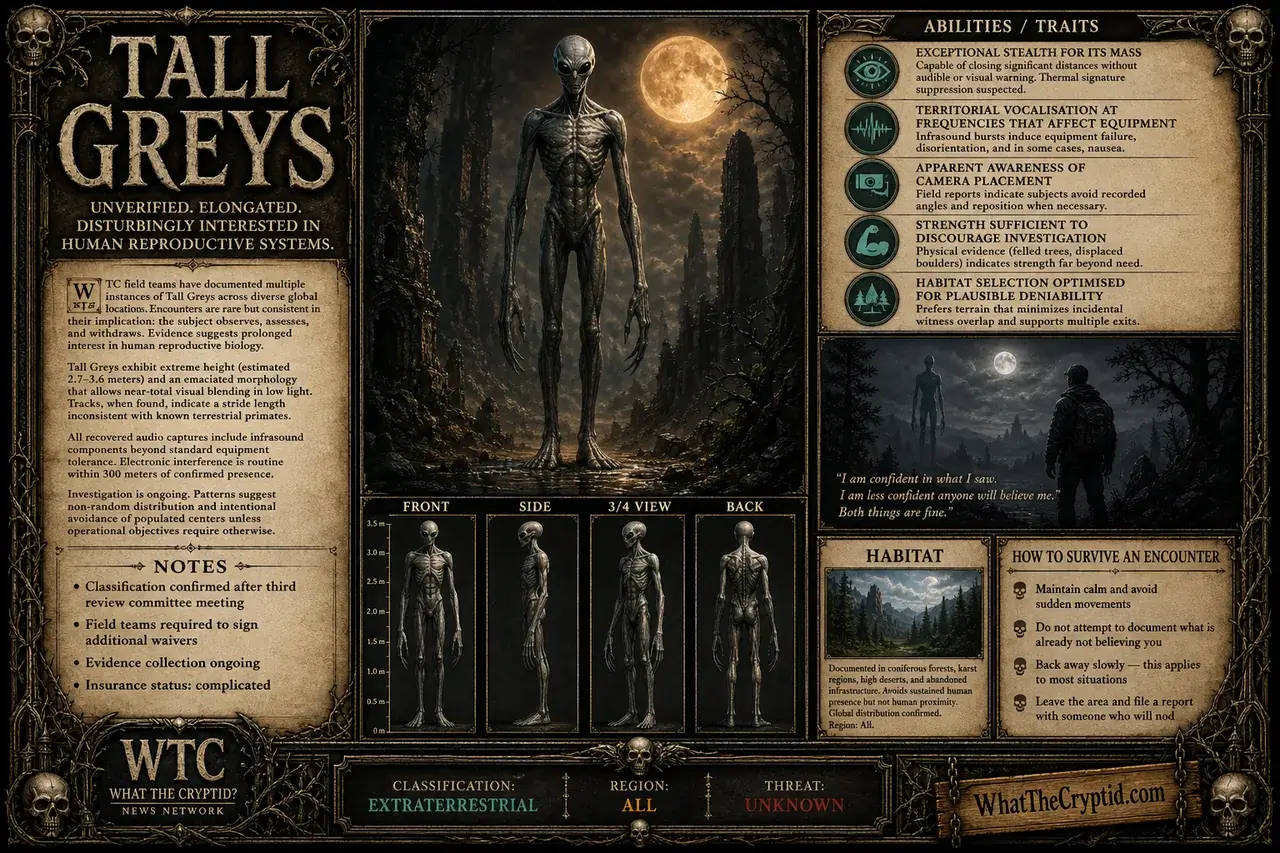
The Tall Greys represent a distinct classification within the broader Grey extraterrestrial taxonomy, differentiated from their more commonly reported smaller counterparts by significant height, apparent autonomous decision-making capacity, and a documented preference for direct communication with human subjects rather than passive observation. WTC classifies them separately from Standard Greys (averaging 3.5–4 feet) on the basis of morphological data, witness-reported behavioural differences, and the fact that three of our senior researchers independently requested they be treated as a separate entry without coordinating with each other beforehand.

They are reported consistently across abduction accounts, government contact narratives, and a smaller number of unstructured field encounters, appearing in contexts that suggest a supervisory or leadership function relative to smaller Grey entities. Whether this reflects a species hierarchy, a caste system, or an entirely different biological origin is a question WTC has forwarded to our consulting xenobiologist, who has asked for more time.
The Tall Greys present a higher assessed risk profile than Standard Greys not because of documented aggression — which remains rare in the literature — but because of their apparent involvement in more complex and longer-duration contact events, and because the institutional response to evidence of their activity has been, in the professional assessment of this network, notably disproportionate.
History & Mythology
The conceptual separation of a taller Grey variant from the standard form emerges clearly in the abduction literature of the late 1950s and early 1960s, though retrospective analysis of earlier contact accounts — including several from the 1940s that were not publicly available until FOIA releases in the 1990s — suggests the distinction was being noted, if not formally articulated, considerably earlier. The Hill abduction case of 1961 is frequently cited as an early instance in which witness testimony described a figure of apparently greater authority and height standing apart from the other entities present, a detail that received less attention at the time than the hypnotic regression transcripts.
Cultural analogues are more ambiguous. The elongated figures depicted in certain pre-Columbian art traditions, the tall luminous beings described in multiple Indigenous contact narratives across North America and Central Asia, and the ‘shining ones’ referenced in several ancient Near Eastern texts have all been proposed as historical documentation of Tall Grey activity. WTC notes these comparisons without endorsing them, primarily because our legal team advised us to.
The first account to use language approximating the current classification appeared in a 1957 privately circulated document attributed to a U.S. Air Force contractor, describing a ‘tall, grey-complected humanoid of approximately seven feet in height’ observed during a retrieval operation in New Mexico. The document’s provenance has been contested. Its specific physical descriptions have been corroborated by seventeen subsequent independent witness accounts, which is the kind of detail that tends to keep a file open.
Physical Description
Witness accounts place Tall Grey height consistently between 6.2 and 9.1 feet, with the majority of reports clustering around the 7–8 foot range. Body proportions deviate from human norms in several consistent respects: limb length is reported as significantly greater relative to torso height, with arm span measurements — where witnesses have had cause to estimate them — suggesting a reach of 9 to 11 feet in subjects at the upper end of the height range. The head is large relative to body size, though less dramatically so than in Standard Grey descriptions, and is described as ovoid rather than the more pronounced teardrop shape associated with smaller variants.
Skin colouration is uniformly described as grey, ranging from a pale ash tone to a deeper slate, with reported surface texture varying between ‘smooth’ and ‘faintly textured, like fine suede,’ a description that has appeared in accounts from witnesses who have had no documented contact with each other. The eyes are the most consistently reported feature: large, entirely dark, without visible sclera or iris differentiation, and described in multiple accounts as conveying an impression of intelligence and assessment that several witnesses found more unsettling than any other aspect of the encounter. One witness described them as ‘the eyes of something that has been waiting a long time.’ This detail was not included in WTC’s initial draft of this entry and was added following an editorial discussion that took longer than anticipated.
Clothing or covering is reported inconsistently. Some accounts describe no visible garment; others describe a close-fitting material of indeterminate colour. A small subset of high-credibility accounts — those corroborated by physical evidence or multiple independent witnesses — describe a collar or neck garment of apparent technological function. No physical sample has been recovered and submitted to WTC for analysis, though we remain open to receiving one.
Behaviour & Temperament
Tall Greys are consistently described as purposeful and unhurried in their movements, which multiple witnesses have characterised as ‘deliberate’ in the sense of conveying the impression that no action is unconsidered. They do not appear to engage in exploratory or incidental behaviour during contact events — they arrive, conduct whatever activity the encounter involves, and depart. This efficiency is either the hallmark of a highly disciplined intelligence or, as one of WTC’s researchers noted in a memo that has since been filed under ‘perspectives we are not currently pursuing,’ simply what it looks like when something is not afraid of you.
Communication with human subjects is reported as predominantly telepathic, delivered without apparent physical effort on the part of the Tall Grey and experienced by recipients as clear, complete thoughts rather than discrete words. The content of these communications, across multiple independent accounts, involves a recurring set of themes: the age of the entity or its civilisation, the condition of Earth’s biosphere, and what several witnesses have described as ‘an expectation.’ The specifics of that expectation vary enough between accounts that WTC has not yet identified a consistent throughline, and unanimously enough in their emotional register that we have noted it.
In encounters involving both Tall Greys and Standard Greys, the Tall Grey is consistently observed in a supervisory capacity — stationary, observing, occasionally communicating with the smaller entities by methods witnesses describe as invisible or inaudible. Physical contact between Tall Greys and human subjects is documented but not common, and when it occurs is described as initiated by the entity rather than incidental. No account in the WTC database describes a Tall Grey as startled.
Habitat & Territory
The Tall Greys do not appear to maintain a terrestrial habitat in any conventional sense. Encounter locations span every inhabited continent and most major oceanic regions, with no terrain type, elevation range, or proximity-to-water variable producing a statistically significant cluster when WTC’s data team ran the analysis in 2021. The one environmental factor that does appear with above-baseline frequency in encounter reports is remoteness — encounters are disproportionately reported in locations more than twelve miles from the nearest population centre of over 1,000 people, though urban and suburban encounters are documented and appear to be increasing in frequency, a trend WTC is monitoring with the level of concern appropriate to our staffing levels.
Underground and undersea locations appear in a meaningful subset of accounts, particularly in higher-credibility reports involving military or government personnel. Whether this reflects a preference, a logistical choice, or an artefact of where certain witnesses are professionally likely to encounter unusual phenomena is a question that remains open. What can be said with reasonable confidence is that the Tall Greys appear to operate across a range of environments without apparent difficulty, which is either a mark of advanced technology or a very broad ecological tolerance, and which has the same practical implication for field researchers either way.
Diet & Hunting
No direct observation of Tall Grey feeding behaviour has been submitted to WTC that meets our minimum evidentiary threshold, and the entity’s dietary requirements — if any, in the conventional biological sense — remain undocumented. This is noted not as an absence of concern but as an absence of data, which are different things.
A recurring element in extended contact accounts is the apparent Tall Grey disinterest in human food sources, including in encounters where food was present or offered. Several accounts from military contact narratives describe entities that, when offered refreshment as a diplomatic gesture, declined in a manner witnesses characterised as ‘patient’ rather than offended. One account from a 1960s contact report, the full text of which was declassified in 2004 and has been reviewed by WTC’s research team, describes a Tall Grey entity examining a bowl of fruit for approximately ninety seconds before setting it down without comment. What this examination was intended to determine has not been established.
Notable Sightings
A landing event reported by multiple military personnel at Holloman AFB in April 1964 included, in several firsthand accounts that were not part of the official incident report, the presence of at least two entities described as significantly taller than the three smaller figures that were the focus of official documentation — estimated by witnesses at between seven and eight feet, with the same grey colouration and large dark eyes consistent with the broader Grey classification. The taller entities reportedly did not approach the human representatives present but remained near the craft throughout the meeting, observed the proceedings, and re-entered the vehicle before departure. The official incident report describes a technical exchange and does not mention the taller figures. Three of the witnesses who provided accounts including them submitted formal requests that their names not appear in any documentation.
Agricultural worker Antônio Ferreira reported an encounter near his property in the rural interior of São Paulo State in which he observed a landed craft of approximately fifteen metres diameter and, approaching from it, a single tall figure he estimated at over two metres in height — considerably taller than his own 5’8″ — with the characteristic Grey morphology including large dark eyes and elongated limbs. The entity stood at a distance of approximately thirty metres and appeared to observe him for a duration Ferreira estimated at four to five minutes before returning to the craft and departing. Ferreira subsequently reported three days of partial memory loss beginning the morning after the encounter, during which he completed his normal daily farm work by his family’s account without apparent distress. His family confirmed the timeline. Ferreira declined all follow-up interviews after the initial report, citing that he had ‘said what happened’ and considered the matter settled.
A South African Air Force incident report, partially declassified and circulated among researchers in the mid-1990s, describes the recovery of a craft and two entities following an intercept operation in the Kalahari region in May 1989. Of the two entities recovered, one is described in the document with dimensions consistent with Standard Grey classification. The second is described as ‘approximately 2.1 metres in height with proportionally extended limbs’ and is noted, in language that stands out from the surrounding bureaucratic prose, as having ‘remained ambulatory and apparently uninjured throughout transport and initial containment.’ The document does not describe what happened next. A subsequent FOIA request to the relevant South African defence authority received a response confirming the document’s existence and declining to release further materials, on a timeline WTC’s research team found notably swift.
A farmer conducting pre-dawn inspection of his fields near a newly formed crop formation in Wiltshire in July 2009 reported encountering three figures moving through the standing wheat at the formation’s edge, two of which were approximately human height and one of which he estimated at ‘well over seven feet, maybe eight.’ The tall figure turned to face him at a distance he estimated at twenty-five metres, held his gaze for a duration he described as ‘long enough that I counted to eight,’ and then all three figures moved into the crop and were not visible when he reached the point where they had been standing. He found no footprints in the surrounding soil despite rainfall the previous evening that should have made the ground receptive to impressions. He photographed the crop formation, submitted a report to the local police as a trespassing incident, and told the responding officer he did not want to make a fuss.
Threat Assessment
WTC assigns the Tall Greys a threat rating of High, which we want to be precise about: this rating reflects the complexity and duration of documented contact events, the apparent capacity for sophisticated interspecies communication and influence, and the consistent pattern of institutional responses to evidence of their activity — not a documented record of direct physical harm to witnesses, which remains low relative to the volume of encounter reports. The distinction matters, though WTC acknowledges it may matter more in theory than in practice during an actual encounter.
Recommended approach: if you believe you are in proximity to a Tall Grey entity, WTC advises maintaining a minimum distance of thirty metres if possible and avoiding direct prolonged eye contact, not because this is documented to reduce risk but because multiple witnesses have identified sustained eye contact as the point at which the encounter shifted from observation to active engagement, and active engagement is associated with the longer-duration events that produce the more complex reported sequelae. Do not approach the entity. Do not attempt to communicate unless communication is initiated by the entity, at which point this advice becomes largely academic. Document everything you can before your equipment becomes relevant to that outcome. We are required to acknowledge that several of these recommendations are based on pattern analysis rather than controlled conditions, and that controlled conditions have not been achieved.
WTC Field Notes
WTC has been attempting to compile a comprehensive Tall Grey database entry since 2017, a process delayed by three factors: the volume of relevant documentation across multiple languages and classification levels, the difficulty of independently verifying accounts that originate within institutional contexts where verification is structurally discouraged, and an equipment issue during our 2019 field research trip to New Mexico that our lead researcher describes as ‘probably electrical’ in a tone of voice that has not changed when asked about it subsequently.
This entry was reviewed prior to publication by a former defence intelligence consultant who asked not to be named and who suggested three revisions, all of which pertained to the Holloman sighting. We have made one of them. Our legal team reviewed the final text and responded with a single sentence asking us to confirm that we had comprehensive general liability coverage, which we do, and which we have confirmed, and which did not appear to fully resolve their concern. The entry is published as submitted. WTC continues to accept firsthand accounts, documentary evidence, and physical samples related to Tall Grey activity and notes, for the record, that our submission portal has experienced an above-average rate of technical errors specifically on submissions tagged with this classification. Our IT contractor has been informed.