
Squonk
Documented. Weeping. Gone before you could confirm anything.
North America
Unverified
PennsylvaniaDissolutionHemlock ForestLow ThreatLumberwoods
Overview
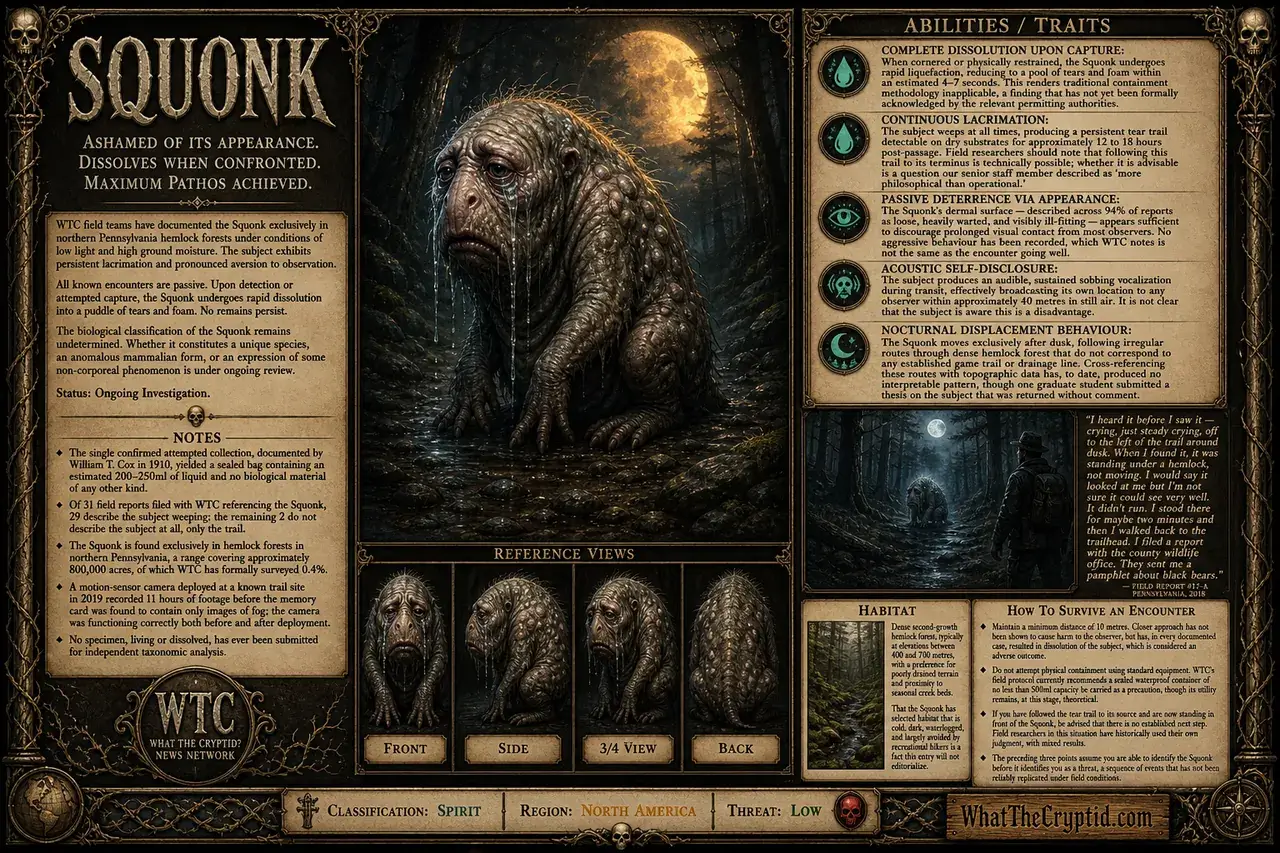
The Squonk (Lacrimacorpus dissolvens) is a small to medium-bodied cryptid indigenous to the hemlock forests of northern Pennsylvania, distinguished primarily by an excess of loose, heavily warted skin that appears to fit its underlying anatomy only in the most approximate sense. It is among the few documented cryptids whose primary defensive mechanism is not aggression, venom, or dimensional displacement, but rather an acute and apparently physiologically genuine capacity for self-dissolution via concentrated saline secretion — which is to say, it cries until it ceases to exist as a coherent physical entity, at which point the matter is closed. WTC classifies it as Hominid pending a structural assessment that has proven difficult to schedule.

The Squonk occupies a narrow ecological and emotional niche. It does not threaten livestock, does not disrupt infrastructure, and has never been credibly linked to the disappearance of a human being. What it does, consistently and with apparent commitment, is feel sorry for itself in the undergrowth. WTC researchers have noted that the Squonk represents a useful data point in the ongoing debate about whether cryptid danger ratings should account for indirect psychological impact on field personnel, a question our editorial board has tabled twice and intends to table again.
Field documentation of the Squonk remains limited in both quantity and quality, a situation that is structurally difficult to improve given that confirmed contact with a living specimen has, in every recorded case, resulted in the specimen’s immediate dissolution. This is not a logistical problem WTC has been able to solve.
History & Mythology
The Squonk enters the written record with unusual precision. William T. Cox included a formal description of the creature in his 1910 volume ‘Fearsome Creatures of the Lumberwoods,’ placing it firmly in the hemlock forests of Pennsylvania and providing what remains the foundational account of its dissolving behaviour. Cox’s prose, for a forestry publication, is notably compassionate toward his subject, a tone WTC considers either admirable or professionally compromising depending on who in the office you ask. Prior to Cox, the creature existed in the oral tradition of Pennsylvania logging camps, where it was considered unlucky to track and worse luck to catch, a belief that has been retrospectively vindicated by every subsequent attempt to do either.
The broader cultural footprint of the Squonk is modest by cryptid standards. It does not command the regional tourism economy that sustains comparable entities, nor has it generated significant law enforcement incident reports. Steele MacKaye’s lumberjack folklore tradition placed the Squonk alongside other fearsome critters of the camp fire circuit — the Hodag, the Hidebehind, the Snawfus — though the Squonk is notable among this cohort for being the only entry that is threatening primarily to itself. The naturalist J.P. Wentling documented what is generally accepted as the first attempted live capture, sometime in the early twentieth century, in which he reported successfully bagging a Squonk in a sack and transporting it toward his home, only to find, upon arrival, that the bag contained nothing but liquid and bubbles. Whether this constitutes a failed capture or a successful one is a philosophical question WTC has not formally resolved.
The specimen known popularly as ‘The Wentling Puddle’ was never preserved, a loss to science that is either significant or completely irrelevant depending on your position regarding the dissolution event.
Physical Description
Adult Squonks have been estimated at between 18 and 36 inches in standing height, based on trackway evidence and the dimensions of disturbances found in low undergrowth consistent with a slow-moving, low-slung quadruped in visible distress. Body weight is difficult to determine from available evidence; the dissolution events that typically conclude Squonk encounters leave a residue estimated at between half a pint and two pints of fluid, which WTC’s consulting biochemist described as ‘suggestive but not diagnostic’ before clarifying that she meant diagnostically suggestive of nothing in particular.
The defining physical characteristic of the Squonk is its skin, which witnesses consistently describe as appearing several sizes too large for whatever is inside it. The surface is heavily warted and irregularly pigmented, with coloration described across sightings as ranging from grey-brown to a desaturated reddish-tan, the precise shade varying enough that WTC suspects either regional variation or the limitations of human colour memory under conditions of moderate to high secondhand emotional distress. The excess skin pools and folds at the joints, giving the creature a silhouette that one 1987 witness described, unprompted and apparently sincerely, as ‘like a dog wearing another dog.’ WTC has included this description in the official record without editorial comment.
The Squonk’s face, in the handful of accounts where witnesses have achieved sufficient proximity to observe it before dissolution commences, is described as doleful in a manner that transcends normal animal expression — eyes set low, jowls pronounced, the overall impression being that of a creature that has received bad news recently and has been receiving bad news for some time. No researcher has yet determined whether this appearance reflects genuine emotional experience or is simply a fixed anatomical configuration that happens to resemble grief. Both possibilities are, in their own way, a great deal to sit with.
Behaviour & Temperament
The Squonk is nocturnal by strong preference, active primarily between dusk and approximately two hours before dawn, and spends this window moving slowly through hemlock stands in what trackers have characterised as a purposeless but consistent circuit. It does not appear to be hunting in any directed sense, nor defending territory, nor seeking a mate — at least not successfully. It simply moves through the forest at a pace that suggests it has somewhere to be but no particular confidence that arriving there will improve things. This assessment is WTC’s own and has been flagged by our editor as ‘anthropomorphising,’ a criticism we acknowledge and have chosen not to act on.
The primary behavioural event of note is, of course, the dissolution response. When detected by a human observer — and the Squonk appears to detect human presence at distances between 15 and 40 feet, based on the point at which audible weeping typically begins — the creature does not flee, does not display, and does not vocalise in any manner consistent with aggression or warning. It simply begins to cry. The weeping intensifies with proximity. At distances of approximately 10 feet or less, dissolution has been observed to begin at the extremities and progress centrally, completing within 90 seconds to four minutes depending on the individual. The remaining fluid has been described as warm, faintly saline, and carrying a subtle odour that multiple witnesses have independently compared to hemlock resin, which is either a meaningful physiological clue or a coincidence produced by the environment in which these witnesses were standing.
The Squonk shows no documented aggression toward humans or toward other animals. Whether it has a social structure is unknown, as no two individuals have been confirmed at the same location simultaneously. It is possible the Squonk is a solitary species. It is also possible, as one WTC researcher noted in a memo that was not formally circulated, that congregating would simply be too much for everyone involved.
Habitat & Territory
The Squonk’s documented range is concentrated in the hemlock and mixed hardwood forests of northern and central Pennsylvania, with the highest density of credible sightings clustering in Clinton, Cameron, and McKean counties at elevations between 1,400 and 2,200 feet. It demonstrates a strong preference for old-growth hemlock stands specifically, with a marked tendency to avoid clearings, open meadows, and forest edges — habitat preferences that have made systematic survey work both logistically difficult and, our field teams report, atmospherically oppressive in a way that is hard to quantify but consistent across personnel.
Water proximity appears to be a secondary habitat preference, with a plurality of sightings occurring within 300 feet of small streams or seeps. Whether this reflects a direct dependency — for drinking, for humidity tolerance, or for reasons related to the dissolution biochemistry — or is simply a function of the fact that most things in a Pennsylvania forest are within 300 feet of a small stream, WTC has not been able to determine. Trail camera deployment in primary habitat has produced audio consistent with low, intermittent weeping on eleven occasions and usable visual footage on none.
Diet & Hunting
The Squonk’s diet has not been directly observed, which is a sentence that applies to a disproportionate number of subjects in this database but is particularly frustrating in this case, given that the Squonk’s slow movement and apparent lack of predatory behaviour suggest it should, in theory, be straightforward to watch eat. It is not. Scat evidence attributed to the Squonk with moderate confidence — based on location, dimensions of approximately 1.5 inches in diameter, and the presence of hemlock needle fragments — suggests a diet consisting primarily of fungi, decomposing plant matter, invertebrates, and the occasional small soft-bodied organism unfortunate enough to be in the wrong place. This is, broadly speaking, the diet of an animal that has given up on being selective.
Foraging appears to occur during the same nocturnal window as general movement, with the Squonk rooting through leaf litter and decaying wood in a manner trackers describe as listless but technically effective. No caching behaviour has been documented. No prey pursuit has been documented. One researcher, reviewing a 47-minute audio recording from a remote station in Cameron County that captured what is believed to be feeding activity interspersed with intermittent weeping, noted in her field report that it was ‘difficult to listen to start to finish,’ a comment that has been preserved in the WTC archive as submitted.
Notable Sightings
A park ranger identified in records only as ‘T. Harwick’ reported encountering a small, hunched creature beside the Sinnemahoning Creek at approximately 11:40 PM during a routine patrol. Harwick described audible weeping preceding visual contact by roughly 20 feet, and observed the creature for an estimated 90 seconds before it began, in his words, ‘going wet at the edges.’ Harwick’s incident report was filed under the ‘Wildlife — Unusual’ category and cross-referenced with no follow-up action. He completed his patrol and submitted his retirement notice the following spring, listing no specific reason.
A hunting party of three, identified in WTC records as the Bellard group, reported a Squonk encounter at approximately 2:00 AM on the second night of a four-day deer camp. The witness providing the primary account, one Gerald Bellard, described hearing sustained crying from a distance he estimated at 60 feet, approaching to approximately 15 feet with a flashlight, and observing a creature matching the standard physical description before it ‘fell apart, like it just gave up.’ The two other members of the party confirmed the account independently, with minor discrepancies in the estimated dissolution timeline. The group broke camp the following morning, citing reasons Bellard described to WTC as ‘various.’
A solo backpacker, Dr. Anita Ferreira, a biology lecturer at a Pennsylvania state university who requested her institution not be named in this entry, reported a sustained encounter lasting approximately six minutes along a trail section she estimated at mile marker 23. Ferreira, who described herself in her written account as ‘professionally skeptical of most things,’ noted that she had sufficient time and lighting from her headlamp to observe the creature in detail, sketch its outline in her field notebook, and confirm the dissolution event from start to finish, producing a residue she estimated at roughly one pint. She collected a sample in a water bottle she emptied for the purpose. The sample was submitted to a university laboratory that subsequently reported the contents as ‘saline solution with trace organic compounds, origin indeterminate.’ Dr. Ferreira declined further interview, citing an increased teaching load that began the week WTC made contact.
A trail maintenance crew of four contractors working on a late-season drainage project reported audible weeping beginning at dusk on a Tuesday in October, persisting intermittently for approximately three hours, and increasing in proximity after dark to the point where crew lead Marcus Oduya estimated the source at no more than 20 feet from the work site perimeter. No visual confirmation was obtained; the crew had positioned work lighting away from the tree line. The weeping ceased at approximately 9:15 PM and was not heard again. Oduya noted the incident in the crew’s daily log under ‘Environmental — Other’ and, when contacted by WTC, confirmed the entry, noted it was not the first time he’d logged something in that category in that forest, and returned to the call without elaborating.
Threat Assessment
The Squonk presents no documented threat to human physical safety. It does not bite, charge, vocalise aggressively, or pursue. Its single defensive behaviour — dissolution — poses no risk to bystanders beyond the minor hazard of warm saline fluid on footwear, and WTC has not been able to identify a plausible mechanism by which this could escalate. The danger rating of 1 reflects this assessment and is the lowest rating WTC’s system permits, a floor that exists for administrative rather than scientific reasons and that the Squonk occupies alone.
The recommended approach to a Squonk encounter is as follows: maintain a distance of at least 15 feet to prevent triggering the dissolution response if live observation is the goal; do not pursue if the creature attempts to move away, which it may or may not do given its general disposition toward inertia; bring audio recording equipment rather than visual, as the latter has produced no usable results across decades of attempts; and be aware that prolonged exposure to Squonk vocalisations — the weeping — has been reported by multiple field personnel to produce a low-grade melancholy that persists for 24 to 72 hours after the encounter. WTC cannot explain this effect, cannot confirm it is not psychosomatic, and cannot in good conscience tell you it isn’t something to be aware of.
WTC Field Notes
WTC has maintained an active Squonk research file since 2001, when the database was first populated, and has comparatively little to show for it. This is not for lack of effort. We have deployed trail cameras in Clinton and Cameron counties on four separate occasions; all returned audio, none returned usable footage. We have twice attempted to engage a Pennsylvania state wildlife biologist to review our scat evidence samples on a consultancy basis; both declined without explanation. Our most productive Squonk researcher, a field correspondent who joined the network in 2009 and spent three seasons in the Elk State Forest producing what is genuinely the best audio archive of Squonk vocalisation currently in existence, requested reassignment to the Thunderbird file in 2013 and has not discussed the Squonk since, citing no reason that WTC has been able to confirm in writing.
The broader challenge the Squonk presents to this network is one that does not have an obvious solution. A cryptid that dissolves upon confirmation is, from an evidentiary standpoint, nearly ideal at frustrating documentation, and from a narrative standpoint, difficult to frame as a story with a satisfying arc. WTC’s editor has noted on two separate occasions that the Squonk file ‘makes him feel a type of way he’d rather not examine,’ a comment that has been logged and not followed up on. We continue to accept field reports. We ask that witnesses, if they are able, maintain their composure and their distance. We understand this is easier said than done.