Ancient aerial predators seek legal action against renewable energy developers for creating what they call ‘an unsexy mechanical whooshing sound.’
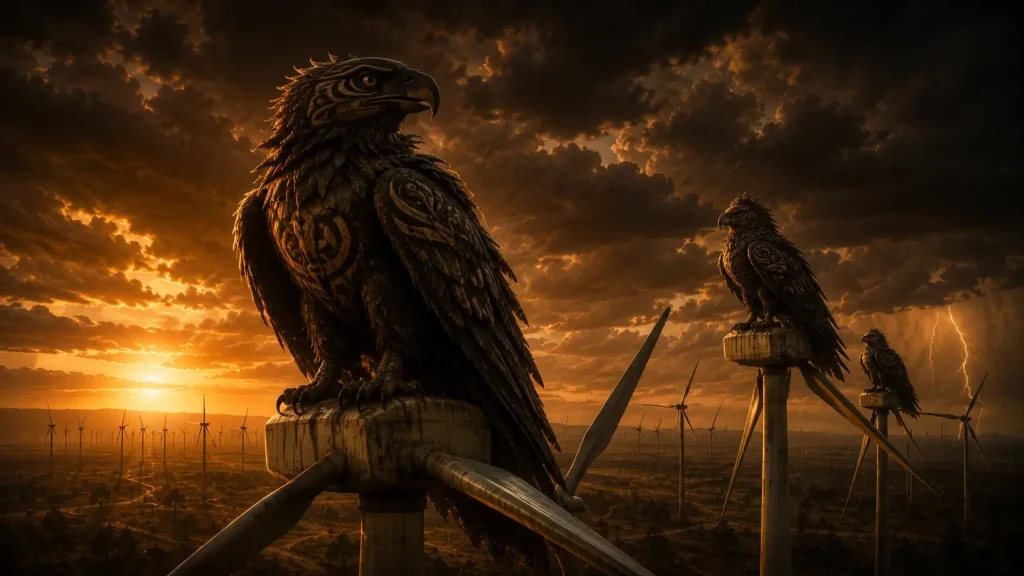
HARLAN’S CREEK, WV — Something had been circling the wind farm for three days running. Big something, based on the turbulence reports from the operators and the way Biscuit kept looking up at the sky like he was expecting weather that wasn’t forecast.
Picked up the first electrical signatures around dawn – distinctive discharge pattern, about two kilometres south of turbine cluster seven. Atmospheric pressure dropped forty millibars in fifteen minutes, which is either incoming severe weather or something large getting territorial about airspace.

The mechanical whooshing completely drowns out the natural thunder percussion that’s essential to our romantic displays. It’s like trying to serenade someone next to a leaf blower.
— Talon spokesperson for the thunderbird pair
Site manager mentioned they’d done the standard environmental surveys before construction. Standard surveys don’t typically include territorial thunderbirds, which explains the current situation.
Atmospheric Romance Protocols
Watched them run the display sequence four times yesterday. Male dives, hits about 200 mph based on the sound, female matches the electrical output to his descent angle. ‘The male creates thunder percussion while diving at speeds exceeding 200 mph,’ Cross noted. ‘The female responds with complementary electrical displays. It’s quite beautiful, assuming you’re not caught underneath it.’
THUNDERBIRD MATING FACTS
• Courtship season lasts 6-8 weeks annually
• Pairs mate for life (estimated 400+ years)
• Single mating display can generate 50-75 lightning strikes
• Thunder percussion reaches 150 decibels
• Ritual requires minimum 3-mile radius of airspace
DCA spokesperson Arthur Pritchard confirmed that his office is reviewing the complaint but cautioned that resolution may take time. ‘We’re consulting with both our Aerial Cryptid Relations division and our Renewable Energy Coordination unit,’ Pritchard explained. ‘This appears to be our first case involving the intersection of ancient mating protocols and modern sustainable infrastructure.’
⚠️
FIELD ALERT
Residents within 5 miles of Green Valley Wind Farm should expect increased electrical storm activity as thunderbirds attempt to conduct mating displays despite turbine interference. Unplug sensitive electronics and avoid metal objects during daylight hours.
Turbine maintenance crew won’t work during daylight hours anymore. Can’t say I blame them.
These thunderbirds have been conducting the same mating ritual in this airspace for potentially thousands of years. You can’t just show up with industrial equipment and expect them to adapt.
— International Yowie Council Legal Advocate Marina Torres
The thunderbird pair has reportedly attempted to work around the turbine schedule, shifting their courtship displays to early morning hours. However, this adjustment coincides with peak wind generation periods, creating what one observer described as ‘an increasingly frustrated aerial light show punctuated by angry screeching.’
Field note: if you’re working near wind installations in thunderbird territory during mating season, keep metal equipment earthed and don’t assume the lightning is natural weather. Most of it isn’t, and it’s considerably more accurate than standard electrical storms.
daryldazmckenna@whatthecryptid.com Daryl “Daz” McKenna · Cryptid Tracker & Wilderness Specialist — WTCNN

Continent-spanning. Storm-summoning. Definitely not a large bird.