
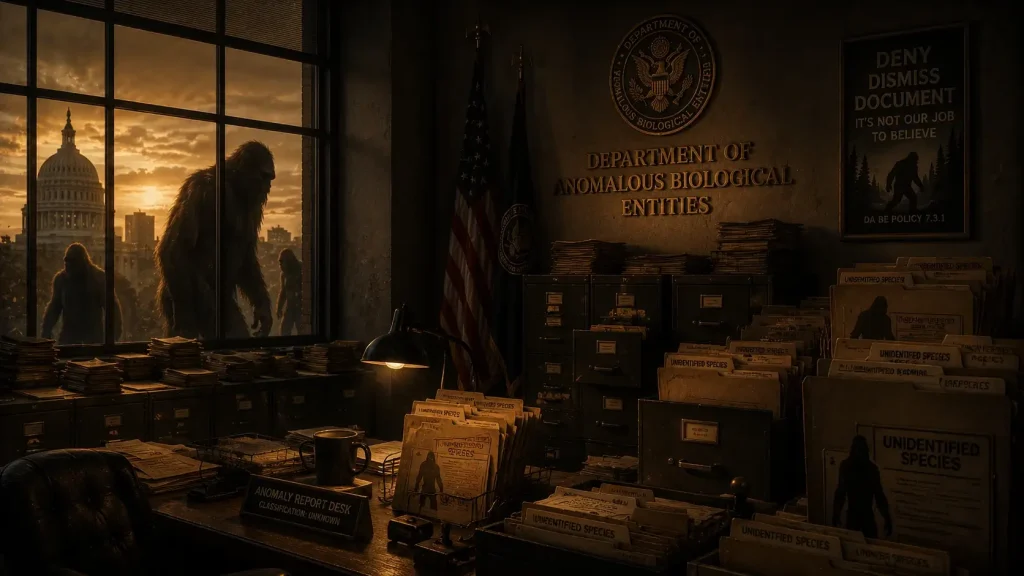
Internal documents reveal 37-year tracking program for creatures that ‘technically don’t exist’ ended abruptly following federal tax audit
SALEM, OREGON — The Oregon Department of Fish and Wildlife has quietly removed a category labeled ‘Unidentified Bipedal Mammals’ from its annual species inventory, according to internal documents obtained by What The Cryptid? through a Freedom of Information Act request that took fourteen months to process and required two appeals to the state attorney general’s office.
The documents reveal that ODFW has maintained population estimates for what departmental memos consistently describe as ‘large, humanoid creatures of unknown taxonomic classification’ since 1987, when the category was established following what internal correspondence refers to as ‘the Cascade Incident’ and ‘subsequent federal guidance regarding tax implications of undocumented wildlife management.’

⚠️
FIELD ALERT
ODFW spokesperson Jennifer Martinez declined to comment on the documents, stating only that ‘the department reviews its taxonomic categories regularly’ before hanging up. Subsequent calls have gone directly to voicemail.
The most recent inventory, dated March 2024, lists the statewide population of Unidentified Bipedal Mammals at 247 individuals, distributed across six regional management zones. The Coast Range Zone shows the highest concentration at 89 individuals, followed by the Cascade East Zone at 72. Each entry includes detailed habitat assessments, estimated caloric requirements, and what appears to be a federal tax identification number beginning with the prefix ‘UBM-OR.’
Three Decades of Bureaucratic Cryptozoology
Budget documents from 1987 through 2024 show consistent annual allocations ranging from $340,000 to $1.2 million for what financial records describe as ‘Alternative Species Monitoring and Tax Compliance.’ Line items include ‘specialized tracking equipment,’ ‘remote observation technology,’ and, beginning in 1993, ‘federal consultation fees regarding non-standard wildlife taxation protocols.’
We’ve been filling out the same forms for thirty-seven years. Nobody ever told us to stop.
— Anonymous ODFW field researcher, speaking on condition of anonymity
A former department biologist, speaking on condition of anonymity, confirmed that field teams have maintained regular monitoring protocols for the creatures since the late 1980s. ‘We’ve been filling out the same forms for thirty-seven years. Nobody ever told us to stop. The federal people seemed very concerned about making sure everything was properly documented for tax purposes. We assumed it was some kind of environmental protection thing.’
FAST FACTS
• UBM category maintained since 1987
• Peak recorded population: 312 individuals (2019)
• $23.7 million total program spending
• Six active monitoring zones
• 247 individuals in final count (March 2024)
• Program terminated following federal audit
The program appears to have ended abruptly in April 2024, three weeks after what internal emails describe as ‘an intensive federal review of non-standard wildlife classification protocols.’ A memo from Department Director Patricia Valdez to regional supervisors, dated April 18, 2024, states simply: ‘Effective immediately, discontinue all UBM monitoring activities. Remove category from inventory systems. Do not discuss with media.’
The whole thing started because somebody in Washington was very worried about the tax implications of managing wildlife that didn’t officially exist.
— Retired ODFW administrator
A retired ODFW administrator who worked with the program during its early years explained that the category was established following federal guidance about potential tax liability issues. ‘The whole thing started because somebody in Washington was very worried about the tax implications of managing wildlife that didn’t officially exist. There were concerns about whether we could claim certain expenses if we couldn’t prove the animals were real. So we started treating them as real for accounting purposes. It seemed like the safest approach.’
Federal Questions Remain Unanswered
Attempts to reach the IRS for comment on federal wildlife taxation policies regarding cryptid species have been unsuccessful. A spokesperson for the agency’s Environmental and Natural Resources Division stated that ‘the IRS does not comment on specific taxpayer situations’ before clarifying that ‘state wildlife agencies are not taxpayers in the traditional sense’ and then declining to clarify what sense they might be taxpayers in.
ricovalez@whatthecryptid.com Rico Valez · Frontline Field Correspondent — WTCNN