
Zaratan
Looks like paradise. Moves when you’re not looking.
North America
Dormant
MarineColossalDormantNavigation Hazard
Overview
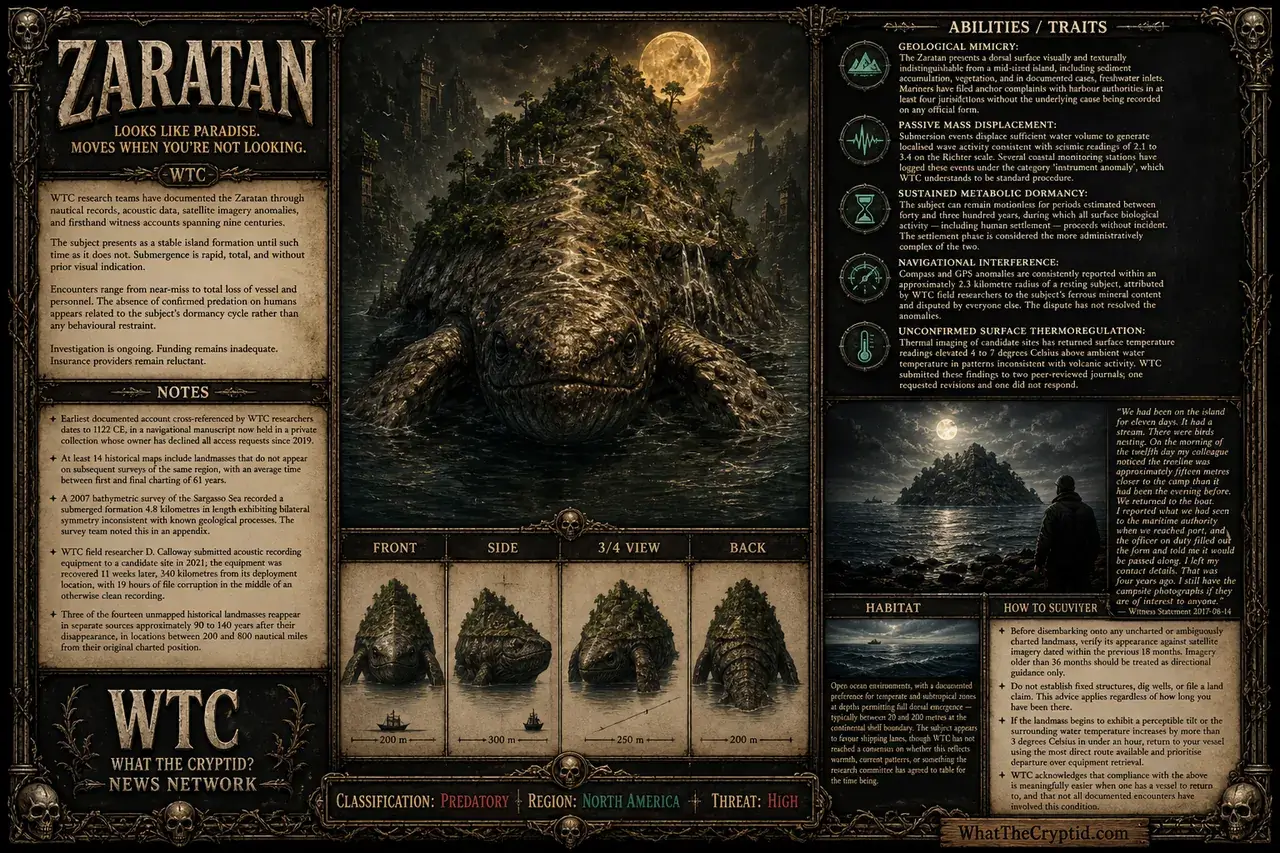
The Zaratan represents perhaps the most spectacular case of cryptozoological gigantism on record, being a marine reptile of such enormous proportions that its carapace regularly supports functioning ecosystems. Measuring between 1.2 and 3.7 kilometers in length, these creatures spend decades or centuries motionless on the ocean surface, allowing soil, vegetation, and eventually human settlements to establish themselves on their shells.

Classified as a colossal marine entity rather than a traditional sea serpent, the Zaratan exhibits characteristics of both ancient chelonians and baleen whales, though genetic sampling remains impossible due to the creature’s protective ecosystem layer. Current estimates suggest fewer than twelve individuals remain active worldwide, with most entering dormancy periods lasting 50-200 years.
History & Mythology
Medieval Arabic texts first documented the Zaratan in the 9th century, with the navigator Sinbad providing the earliest detailed account of mistaking one for an island during his third voyage. The creature appears in the Kitab al-Hayawan by Al-Jahiz (776-868 CE), who described it as ‘a whale of such size that men build cities upon its back, not knowing they dwell upon a living thing.’
European bestiary traditions adopted the creature as the Aspidochelone, though many scholars believe these represent separate but related species. The 12th-century Physiologus describes sailors landing on what appeared to be an island, only to flee when their cooking fires awakened the beast. Saint Brendan’s voyage narratives include a similar encounter, leading to the creature’s inclusion in medieval Christian allegory as a symbol of deception.
Physical Description
Adult Zaratan specimens exhibit a flattened, oval carapace composition unique among known reptiles, consisting of a calcium carbonate matrix interwoven with specialized keratin plates that provide both buoyancy and structural integrity. The shell surface develops a complex topography over centuries, featuring ridges, valleys, and depressions that collect sediment and support plant growth. Soil depth varies from 0.3 to 4.7 meters across the carapace.
The creature’s head, when visible, measures 200-400 meters in length and resembles a fusion of cetacean and chelonian features. Four massive flippers, each approximately 600 meters long, remain submerged during surface phases. The shell’s edges exhibit distinctive scalloped patterns where marine growth has colonized the carapace margins. Younger specimens (under 800 years) display more pronounced geometric shell patterns before ecosystem establishment obscures these markings.
Behaviour & Temperament
Zaratan exhibit extreme patience in their feeding strategy, remaining motionless at the surface for periods ranging from 23 to 89 years. During these dormant phases, the creature’s metabolic rate drops to approximately 0.3% of active levels, sustained by specialized symbiotic bacteria within the shell structure that process organic matter from the surface ecosystem.
Active phases, triggered by unknown environmental factors, begin with subtle movements that gradually accelerate over 3-7 days. The creature typically submerges slowly, allowing time for mobile wildlife to escape, though human populations historically have reported these events as catastrophic island disappearances. Deep-water active phases involve feeding on massive krill swarms and deep-sea sediment processing, with the creature diving to depths exceeding 3,000 meters.
Habitat & Territory
Zaratan prefer deep oceanic waters with temperatures between 4-12°C, typically remaining within the 2,000-4,000 meter depth range during active periods. Surface habitation requires specific current patterns that prevent ecosystem runoff while maintaining adequate plankton concentrations in surrounding waters.
During dormant surface phases, the creatures drift along major oceanic currents, particularly the Gulf Stream and Kuroshio Current. The North Atlantic population shows preference for areas between 35-45°N latitude, while Pacific specimens favor the 30-40°N range. Shell ecosystems typically develop temperate forest or grassland biomes, though tropical specimens near the equator support rainforest-like conditions.
Diet & Hunting
Adult Zaratan are specialized filter feeders, processing enormous quantities of krill, copepods, and marine detritus through modified baleen structures located within their 150-meter-wide oral cavity. During active feeding periods, a single individual can process 400-600 tons of plankton daily, along with substantial quantities of deep-sea sediment rich in organic matter.
The surface ecosystem provides supplemental nutrition through a complex symbiotic relationship. Decomposing plant matter, animal waste, and soil nutrients are absorbed through specialized pores in the shell structure. This ecosystem contribution accounts for approximately 15-20% of the creature’s total caloric intake during dormant periods, explaining their ability to maintain basic biological functions while nearly motionless for decades.
Notable Sightings
The merchant vessel ‘Prosperity’ reported landing on an uncharted island for fresh water, only to have their landing party flee when the ground began moving beneath their feet. Captain Morrison’s log notes palm trees ‘swaying without wind’ before the island submerged.
The whaling ship ‘Endeavour’ sighted what appeared to be a forested island that subsequently disappeared during a three-day storm. First Mate Patterson noted the island’s unusual oval shape and the absence of any breaking waves against its shores.
British surveyor HMS ‘Challenger II’ discovered an island not matching any charts, complete with freshwater streams and evidence of previous human habitation. The island vanished before mapping could be completed, leaving behind only disturbed water and floating vegetation.
The cargo vessel ‘Adelaide’ reported an emergency landing on an unmarked island during engine failure. Crew members described finding stone foundations and fire pits from previous visitors before the island began a slow descent, forcing immediate evacuation.
Threat Assessment
While not inherently aggressive, Zaratan pose significant risks to maritime navigation and offshore activities. The primary danger lies in mistaking a dormant individual for solid land, with subsequent submersion events typically providing insufficient warning time for evacuation. Historical records suggest at least forty-three documented cases of ship losses associated with ‘vanishing islands’ since 1200 CE.
Modern shipping faces additional risks from the creatures’ electromagnetic signatures, which can interfere with GPS systems and depth sensors within a 12-kilometer radius. Several offshore drilling operations have been abandoned after equipment detected massive movement beneath presumed ocean floor. Current maritime protocols recommend immediate area evacuation upon discovering any uncharted landmass exhibiting unusual wildlife activity or geometric coastline features.
WTC Field Notes
The WTCNN Marine Biology Department maintains active monitoring stations in suspected Zaratan habitats, though our insurance company has expressly forbidden any direct investigation attempts following the 2019 ‘research platform incident.’ Current policy dictates that all potential sightings be reported to the International Maritime Organization, who will presumably file them under ‘Unresolved Navigation Hazards’ and continue issuing standard warnings about floating debris.
Our legal team wishes to emphasize that any resemblance between Zaratan habitat descriptions and recently disappeared Pacific research stations is purely coincidental. The WTCNN does not endorse landing on suspicious islands, regardless of how inviting their beaches appear or how desperately your research team needs fresh water.