Tall Whites
Observed. Documented. Deeply uninterested in you specifically.
All
Active
ExtraterrestrialNevadaNordicGovernmentHumanoid
Overview
The Tall Whites are an extraterrestrial classification documented primarily in the desert regions of southern Nevada, with the highest concentration of encounter reports originating from areas adjacent to Nellis Air Force Base and the Nevada Test and Training Range. They are distinguished from other extraterrestrial classifications in the WTC database by their broadly humanoid morphology, their apparent long-term presence in the region, and what field researchers have characterised as a consistent attitude of detached tolerance toward human observers — an attitude that has been described, variously, as professional courtesy, strategic indifference, and something a WTC consulting psychologist called ‘the energy of someone who has been assigned to a posting they did not request.

First formally catalogued in WTC records following the 1964 testimony of Charles Hall, a weather observer stationed at Nellis, the Tall Whites represent one of the few extraterrestrial classifications for which extended, close-proximity observation data exists from a single named witness over a sustained period. This distinguishes them from most entries in the WTC database, where evidence tends to be brief, contested, and photographically inconvenient. Whether this distinction speaks to the credibility of the account or the unique operational habits of the entities themselves is a question WTC has tabled for a later meeting.
History & Mythology
The first formal documentation of the Tall Whites in the western record derives from the extended testimony of Airman First Class Charles Hall, who served as a weather observer at Nellis Air Force Base from 1964 to 1967. Hall reported sustained, repeated contact with the entities over the course of his posting, describing interactions that ranged from cautious mutual observation at distance to direct, if constrained, verbal communication. His accounts, compiled and published in the four-volume series Millennial Hospitality between 2002 and 2005, constitute the most detailed single-witness record of Tall White behaviour in the WTC archive, covering diet, social hierarchy, locomotion, emotional responses, and the approximate floor plan of what Hall described as their base of operations. The gap of thirty-five years between the events and their publication has been noted by critics, and acknowledged by Hall himself, in ways that satisfied neither party.
Prior to Hall’s account, entities matching the Tall White description appear in Indigenous oral traditions across the Great Basin and Mojave regions, where pale, elongated figures associated with desert locations and the night sky are documented in several Paiute and Shoshone oral traditions. Whether these accounts describe the same classification is a determination WTC declines to make without additional comparative fieldwork. The Tall Whites also appear, without attribution, in a number of declassified government documents recovered under Freedom of Information Act requests filed between 1993 and 2011, though the relevant passages in those documents are, without exception, redacted.
Physical Description
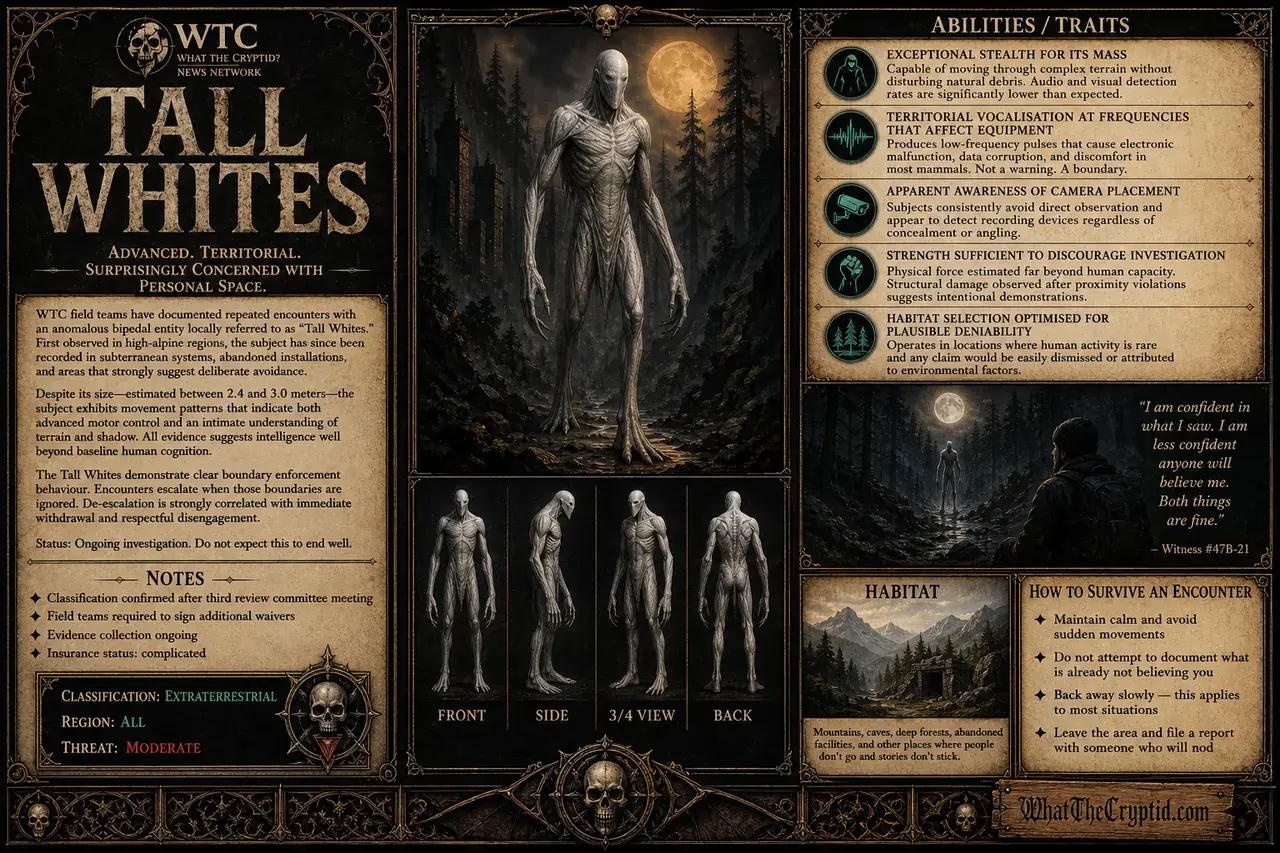
The Tall Whites present as bilaterally symmetrical bipeds with a physiology that is broadly humanoid but diverges from human morphology in several consistent and documented ways. Adult specimens stand between six and seven feet in height during the middle period of their lifespan, with field reports indicating that the eldest individuals — referred to in Hall’s accounts as ‘Grandfather Whites’ — may reach heights approaching eight feet. Skin colouration is uniformly chalk-white, described by multiple witnesses as appearing almost luminescent in low-light conditions, with a texture Hall compared to the surface of a smooth bone. Eyes are reported as large relative to the skull, with a pale blue or near-colourless iris and no visible sclera, an arrangement that witnesses have described consistently as unsettling across every cultural and professional background represented in the WTC sightings record.
Hair, where present, is white and fine, worn at varying lengths across observed individuals. The hands are documented as having four elongated fingers, with nails described as hard and claw-like in structure. The overall frame is slender relative to height, with reported limb proportions that Hall described as suggesting a skeletal structure operating under different mechanical assumptions than the human equivalent. A faint grid-like pattern visible beneath the skin — interpreted by some researchers as a subcutaneous vascular or neural network — has been noted in close-proximity accounts and has not been satisfactorily explained by any anatomical framework WTC consultants were willing to put their names to.
Behaviour & Temperament
The Tall Whites demonstrate a hierarchical social structure in which status appears to correlate directly with physical age — and therefore, given their documented lifespan, with physical size. Elder individuals command immediate deference from younger ones, and interactions between Tall Whites and humans are frequently mediated by a single individual acting in what Hall characterised as an interpreter or liaison role, suggesting a formalised protocol for external contact that was developed without human input. They communicate among themselves in a high-frequency vocalisational language described as resembling, in Hall’s words, ‘the sound a dog whistle would make if a dog whistle were annoyed,’ which falls at the upper limit of or beyond normal human auditory range. Communication directed at humans has been conducted in English, at least in documented Nevada encounters, and in a register that witnesses describe as grammatically precise and expressively minimal.
Aggression toward humans has been documented but appears to be situational rather than predatory. The primary triggers identified across multiple accounts are: approach within what appears to be an individually variable exclusion zone estimated at between three and fifteen feet; unexpected rapid movement in the presence of juveniles; and any action that could be interpreted as interfering with their equipment or transportation. Responses escalate from a fixed stare, through a physical warning gesture described as a forward extension of both arms with palms outward, to direct physical intervention — which, given the reported strength disparity between Tall White adults and human adults, has not ended well in the accounts where it was recorded. Outside of these triggers, the entities have been observed moving through the Nevada desert landscape with a purposefulness that suggests they regard human presence as neither threatening nor particularly interesting.
Habitat & Territory
The primary documented habitat of the Tall Whites is the desert terrain of the Nevada Test and Training Range, specifically the areas designated as Indian Springs Valley and the surrounding dry lake beds, at elevations between 2,800 and 4,500 feet. Terrain preference appears to favour flat, open ground with clear sightlines in multiple directions, which field researchers have noted is also the preference of most sensible entities operating in an environment where visibility and exit options are survival considerations. Proximity to subsurface geological features — specifically cave systems and dry wash networks — is consistent across documented site locations, suggesting that primary habitation structures may be partially or wholly subterranean.
Sightings outside the core Nevada range are infrequent and geographically diffuse, with isolated reports from the broader Mojave and Great Basin regions that match the Tall White profile. No permanent habitation sites have been identified outside the Nellis complex area, leading WTC researchers to categorise these as transit or temporary observation events. The entities appear to have no difficulty operating in daylight but show a clear preference for activity between dusk and approximately 0300 local time, a schedule that aligns conveniently with the reduced operational tempo of the surrounding military installation and that WTC does not believe is a coincidence.
Diet & Hunting
The Tall Whites are documented as consuming food and liquid, which places them in a minority among extraterrestrial classifications in the WTC database and raises a set of logistical questions that the database does not currently have answers for. Hall’s accounts describe the entities purchasing or otherwise obtaining standard commercially available food products — specifically frozen foods, packaged snacks, and soft drinks — from sources within or adjacent to the Nellis base infrastructure. Whether this diet reflects genuine nutritional compatibility with human food products, a pragmatic adaptation to available local resources, or something else entirely has not been determined. The entities are also documented consuming water in quantities Hall described as substantial.
No predatory hunting behaviour toward humans or other large animals has been recorded. Hall documented one instance of a juvenile Tall White approaching and consuming what appeared to be a small desert rodent, which he noted seemed to be opportunistic rather than planned, and which the adult supervising the juvenile responded to with what Hall characterised, with some hesitation, as embarrassment. WTC has flagged this account as requiring corroboration before formal inclusion in the dietary profile.
Notable Sightings
Airman First Class Charles Hall reported sustained, repeated contact with Tall White entities over the full duration of his posting as a weather observer at Nellis. Encounters ranged from distant observation across the dry lake bed to direct verbal exchanges conducted at a distance of approximately ten to fifteen feet. Hall documented physical details, behavioural patterns, and what he described as an incident in which a male adult Tall White physically lifted him off the ground by his jacket collar following an inadvertent approach toward a juvenile — an event Hall reported was preceded by no audible warning and concluded with the adult entity setting him down, holding eye contact for approximately four seconds, and walking away. Hall completed his posting, filed no formal incident reports with the Air Force, and did not discuss the events publicly for over three decades.
A civilian contractor working on infrastructure maintenance near the Nellis range boundary reported a group of four individuals — two tall, white-skinned adults and two shorter figures he initially assumed were children — crossing an access road at approximately 0140 hours. The group crossed in single file, without breaking stride, and the lead adult turned to look directly at the contractor’s vehicle for a sustained period the witness estimated at between eight and twelve seconds before continuing. The contractor reported the sighting to his site supervisor the following morning. His site supervisor told him which form to fill out. The form was a standard wildlife observation report.
A retired schoolteacher reported observing a single tall figure standing motionless at the edge of her property, at an estimated distance of sixty feet, for approximately twenty-five minutes beginning at 0220 hours. She described the figure as ‘impossibly thin’ and ‘the colour of a refrigerator,’ and noted that it did not move, blink visibly, or respond to her motion-sensor porch light activating twice during the observation period. She photographed the figure on a disposable camera. The photographs showed the edge of her property at night and did not clearly show the figure, which the witness attributed to ‘something wrong with the light.’ She reported the sighting to WTC and, when asked whether she planned to report it to any other authority, said she had thought about it and decided against creating that particular paper trail.
A backcountry hiking group of three encountered two tall, pale figures at close range — estimated at thirty feet — near Ubehebe Crater at approximately 0330 hours during a permitted overnight stay. The figures were described as moving at a pace the group characterised as unhurried and ‘completely unbothered by the terrain,’ across ground the group had found difficult in daylight. One of the figures paused, oriented toward the group for a period the three witnesses variously estimated at between fifteen seconds and two full minutes, and then continued. All three hikers had functioning cameras. None of them reported attempting to use them, and when asked separately why not, each gave a different answer that amounted to the same thing.
Threat Assessment
The Tall Whites present a Moderate threat rating under the WTC classification system, with the understanding that this rating reflects the specific and documented conditions under which aggression has been recorded, and should not be interpreted as a general reassurance. The physical strength disparity between Tall White adults and humans is documented and significant; Hall’s account describes adult individuals lifting or restraining human adults without apparent effort, and the entities’ reaction speed in close-proximity encounters has been characterised by multiple witnesses as exceeding what observers were prepared for. WTC recommends maintaining a minimum distance of fifty feet from any observed Tall White, increasing to two hundred feet if juveniles are visible, and treating any outward extension of both arms as a final warning rather than an opening to negotiation.
Do not approach their transportation or equipment. Do not move rapidly in their presence. Do not attempt to photograph them at close range without first making a considered assessment of your priorities. If you encounter a Tall White in a remote desert location at 0300 hours, WTC’s recommended action is to remain still, avoid eye contact, and allow the entity to determine the terms of the interaction, because the available evidence suggests you are not in a position to determine them yourself. We acknowledge that this advice is less actionable than we would prefer. The alternative advice, which involves not being in the Nevada desert at 0300 hours, is more actionable but arrived too late.
WTC Field Notes
WTC’s file on the Tall Whites is the most voluminous extraterrestrial classification in the database and also the one our legal team has reviewed the most times. The proximity of the primary sighting region to active federal military infrastructure creates research access complications that our field team has described, with increasing frequency and decreasing professionalism, as ‘structurally discouraging.’ Two formal requests for access to the Indian Springs Valley research area have been submitted to the relevant authorities since 2018. One received a response explaining that the area is restricted. The other has not received a response, which our editor considers a response.
Our most recent field deployment to the outer boundary of the Nevada Test and Training Range in the autumn of last year produced fourteen hours of night-vision footage, three malfunctioning audio recorders that were functioning correctly before deployment, and one incident our field researcher documented as ‘equipment interference of unknown origin’ and which our equipment supplier documented as ‘operator error’ in a way that suggested they had been briefed. We are continuing to pursue the file. We have budgeted for one more deployment, contingent on the renewal of an insurance policy our current provider has indicated they would prefer not to renew.