
Missouri Monster
Eight feet tall. Smells like something. Still out there.
North America
Active
HominidMissouriMomoMidwestBipedal
Overview
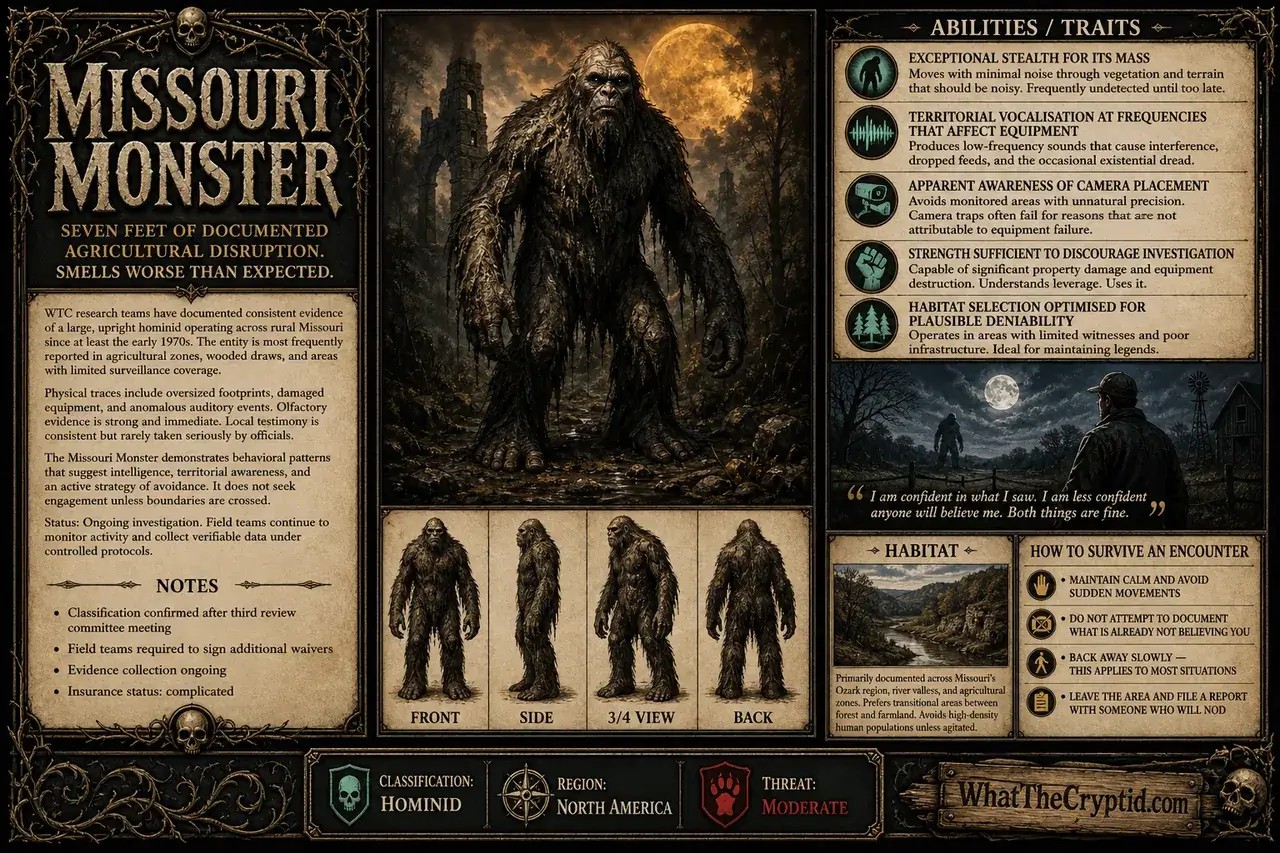
The Missouri Monster — designated ‘Momo’ in WTC field documentation following standard abbreviation protocol established in 1988 — is a large bipedal hominid entity reported across the state of Missouri, with particular density of sightings concentrated along the Mississippi River corridor, the Ozark Plateau, and the bottomland forests of the state’s southeastern counties. Documented specimens are consistently described as tall, heavily built, and associated with a distinctive odour that witnesses have characterised variously as ‘rotting flesh,’ ‘wet dog soaked in motor oil,’ and, in one 2003 report from Stoddard County, ‘exactly like the Meramec River in August, but worse.’ WTC treats these accounts as consistent with a single species exhibiting normal biological variation rather than separate entities, a classification decision our consulting zoologist has noted he is ‘not necessarily comfortable with but can live with professionally.’

Momo occupies a specific ecological and folkloric niche in the American Midwest, distinct from its Pacific Northwest cousin Bigfoot in several documented respects: it is more frequently reported in agricultural and semi-rural lowland settings, demonstrates a notably higher tolerance for proximity to human habitation, and has, on multiple occasions, been observed in circumstances that suggest active curiosity rather than avoidance. Whether this reflects a behavioural subspeciation, regional adaptation, or simply the relative lack of wilderness into which a large hominid can plausibly retreat in Missouri, WTC has not yet determined.
History & Mythology
The modern documentary record for Momo begins formally on July 11, 1971, when two children — Terry and Wally Harrison — reported encountering a large, hair-covered bipedal figure standing at the edge of a wooded area near Louisiana, Pike County, Missouri. The figure was described as holding what appeared to be a dead dog. This detail, which subsequent researchers have flagged as either ecologically significant or deeply concerning depending on their orientation, has been consistently replicated across multiple independent sightings in the years following and is now considered a regionally characteristic behaviour. The Harrison incident generated local press coverage and was investigated by State Representative Walter Bethel, who conducted fieldwork that produced no physical evidence but was, by all accounts, conducted with genuine thoroughness.
Prior to the 1971 incidents, regional folklore among Indigenous communities along the Mississippi and Missouri Rivers documented encounters with large, malodorous humanoid figures associated with river bottomlands and flooded timber. French colonial records from the eighteenth century contain several references to a creature called ‘le grand velu’ — the great hairy one — in correspondence between fur traders operating in the Missouri and Illinois territories, though historians have been divided on whether these references describe a cryptid entity, a bear, or a particularly memorable trapper. WTC considers the French colonial documentation suggestive but not conclusive, and has tabled a formal assessment pending translation of three relevant documents currently held in a private archive in Saint-Louis, France, whose owner has not responded to correspondence since 2019.
Physical Description
Momo is consistently documented at heights between seven and eight and a half feet when standing fully upright, with a broad, heavily muscled upper body and proportionally shorter legs that produce a distinctive forward-leaning gait described by multiple witnesses as ‘like a man carrying something very heavy that he refuses to put down.’ Body weight is estimated by WTC field researchers at between 400 and 700 pounds based on footprint depth analysis and ground compression data gathered at four separate sites between 1972 and 2018, though our consulting biomechanist has noted that this estimate carries what she describes as ‘a substantial and non-negotiable margin of error.’
The entity is covered in dense, coarse hair reported as black, dark brown, or — in three sightings from the Ozark Plateau — a reddish-brown coloration that may indicate regional variation or individual polymorphism. The face, where witnesses have had sufficient proximity and composure to describe it, is broad and relatively flat with prominent brow ridges and eyes consistently described as reflective in darkness, producing an eyeshine reported as amber to orange. The hands are large, with documented handprints averaging 11.3 inches in length, and the feet produce prints averaging 17.2 inches, notably wider at the forefoot than Bigfoot prints collected from Pacific Northwest sites, a difference WTC’s podiatric consultant has described as ‘genuinely interesting’ before requesting that her name not appear in this entry.
Behaviour & Temperament
Momo is primarily crepuscular to nocturnal in documented activity patterns, with the majority of sightings occurring between the hours of 9 PM and 3 AM. Daytime encounters are recorded but are disproportionately clustered in overcast or heavily forested conditions, suggesting light sensitivity or a straightforward preference for not being seen that has, given the available evidence, proven largely effective. Social structure is unknown; all documented sightings describe a single individual, though at least four reports include references to hearing what witnesses describe as ‘answering calls’ from a separate direction, a detail WTC finds worth noting without drawing conclusions.
The entity’s relationship with human proximity is perhaps its most documented and least understood characteristic. Unlike many hominid cryptids, Momo demonstrates a pattern of deliberate observation — standing at the margins of clearings, approaching buildings at night, and on several occasions following individuals through wooded areas at consistent distances that suggest awareness of the boundary between observation and interception. This behaviour, which WTC field researchers have agreed to describe as ‘investigative’ in official documentation, is accompanied by the characteristic odour, which in some accounts precedes visual contact by several minutes and serves, perhaps unintentionally, as an effective early warning system.
Habitat & Territory
Momo occupies the transitional zones between Missouri’s agricultural lowlands and its remaining bottomland hardwood forests, with highest sighting density in the river floodplains of the Mississippi, Missouri, and Meramec drainages. Preferred terrain appears to combine dense woody cover within accessible distance of open water, which is consistent with the dietary and thermoregulatory requirements one would reasonably expect for an entity of this mass in a continental climate. Ozark Plateau sightings cluster at elevations between 800 and 1,600 feet in mixed oak-hickory woodland, suggesting the entity is not strictly a lowland species but shows a clear preference for areas where water table proximity produces the dense understorey growth that provides effective concealment for something of its dimensions.
Momo has demonstrated a notable and, from a habitat-specialist perspective, pragmatic willingness to exploit human-altered landscapes. Sightings from agricultural areas frequently describe the entity moving through drainage ditches, woodlots, and riparian buffers — the fragmented corridors that constitute much of rural Missouri’s remaining connected habitat. WTC has noted this adaptation without editorialising on what it implies about the available alternatives.
Diet & Hunting
Based on the aggregate of witness observations, physical evidence gathered at sites, and analysis of disturbed areas consistent with foraging activity, Momo’s diet appears broadly omnivorous with a documented emphasis on animal protein. Evidence collected at three sites in Pike and Ralls Counties between 1978 and 2004 includes remnants of fish, waterfowl, and small mammals, along with disturbed cornfields and persimmon stands consistent with seasonal fruit and grain consumption. The entity has been observed near livestock on six documented occasions; in four of these no animals were taken, which WTC notes as a fact without speculating on the entity’s intentions.
The recurring detail across multiple independent sightings of Momo carrying or standing near dead animals — dogs in the 1971 and 1973 Pike County incidents, a deer carcass in a 1997 Cape Girardeau County report — suggests the entity may cache or transport food, a behaviour consistent with large-bodied omnivores operating across extensive home ranges. Whether the dogs in question were hunted, scavenged, or acquired through some other means is a question WTC has raised internally and agreed to leave open.
Notable Sightings
On July 11, Terry Harrison, aged eight, and his brother Wally, aged five, observed a large, hair-covered bipedal figure standing approximately thirty feet from the edge of the Harrison family property, holding what both children independently described as a dead dog. The figure stood motionless for an estimated two to three minutes before moving into adjacent wooded terrain. Their sister Joan, watching from a second-floor window, confirmed the sighting. State Representative Walter Bethel conducted a formal field investigation the following week, recovered no physical evidence, and issued a statement encouraging residents to remain calm.
Farmer Ellis Minor reported discovering a series of footprints measuring between sixteen and eighteen inches in length crossing a muddy field adjacent to Peabody Creek at approximately 6 AM on the morning of August 3. Minor, who had heard ‘screaming like nothing I’ve heard from any animal I know’ the previous night, followed the track line approximately 400 yards before it entered heavy brush and could not be recovered. Cast impressions were taken by a researcher affiliated with the UFO Study Group of St. Louis — the nearest organisation available on short notice — and have since been lost. Minor continued farming the same field for the following thirty-one years without further incident, a fact he mentioned specifically when interviewed.
Forestry technician Dana Kelleher reported an encounter at approximately 11:40 PM while conducting a night-time acoustic monitoring survey for the Missouri Department of Conservation. Kelleher observed a large bipedal figure at an estimated distance of sixty yards, illuminated briefly by her equipment light, before it moved into timber at a pace she described as ‘faster than I would have thought.’ Kelleher’s audio recorder captured seventeen seconds of vocalisation — a descending, resonant call not matching any species on the department’s reference library — immediately before visual contact. She filed a standard wildlife observation form the following morning with the species field left blank, submitted a formal unusual incident report to her supervisor, and took the remainder of her accumulated personal leave.
Hunters Marcus Webb and Terrence Ogle reported an encounter at a deer stand located in bottomland timber approximately four miles west of the Mississippi River on the evening of November 9. Both men described smelling a strong odour ‘like something rotting in warm water’ approximately twenty minutes before observing a large, dark, upright figure moving through timber at the edge of their visible range, estimated at eighty to ninety yards. The figure stopped, appeared to orient toward the stand, and remained stationary for what Webb estimated as six minutes before departing. No deer were observed that evening. Webb posted an account to a regional hunting forum the following day; the thread received 214 replies before the forum moderator closed it, citing ‘community guidelines regarding unverifiable reports.’
Threat Assessment
WTC assesses Momo at Moderate threat to humans. The entity is large, demonstrably strong based on physical evidence, and has shown willingness to approach human beings and structures at close range over an extended period without escalation — a pattern that is, on balance, reassuring, though WTC acknowledges the reasoning that leads to that conclusion is more circular than our editorial standards usually permit. Documented encounters in which Momo had clear proximity advantage and did not act aggressively outnumber recorded aggressive incidents by a ratio that WTC considers meaningful.
Field personnel and civilians entering known Momo habitat are advised to maintain awareness of pre-contact indicators: the characteristic odour should be treated as a 300-yard alert perimeter and should prompt a calm, deliberate withdrawal in the opposite direction. If visual contact is made, WTC recommends remaining still, avoiding direct sustained eye contact, and not running — the latter less because running is known to provoke pursuit and more because the terrain in which Momo is typically encountered makes running a liability regardless of the circumstances. Maintain a minimum retreat distance of 150 feet once contact is broken. Do not follow. This advice is based on the observed behaviour of documented encounters and should not be interpreted as a guarantee of any particular outcome, a caveat WTC’s legal department has asked us to include in all threat assessments going forward.
WTC Field Notes
WTC has maintained an active file on Momo since the network’s founding, for reasons that are partly historical — the 1971 Pike County incidents were among the first cases our founder documented — and partly geographical, as two senior researchers are Missouri residents who have described the assignment as ‘personal.’ A dedicated field investigation was conducted in the summer of 2019 with a three-person team, twelve trail cameras, and audio monitoring equipment borrowed from a university department whose name we have agreed not to publish. Of the twelve cameras deployed across five sites in Pike and Ralls Counties over a six-week period, nine experienced complete memory card failure, two returned footage described in the team report as ‘inconclusive,’ and one was found disassembled approximately forty feet from its mounting post. The team report notes that the camera housing showed no tool marks. WTC’s equipment manager has requested that any future Momo investigations use cameras from a different manufacturer and has submitted this request in writing on three separate occasions.
A follow-up investigation planned for 2021 was postponed due to budget constraints, rescheduled for 2022, and postponed again following an insurance review that resulted in our field liability policy being amended to include a new exclusion whose specific language our editor has described as ‘targeted.’ We expect to return to Missouri when circumstances allow, which is how WTC describes most of our ongoing investigations.