
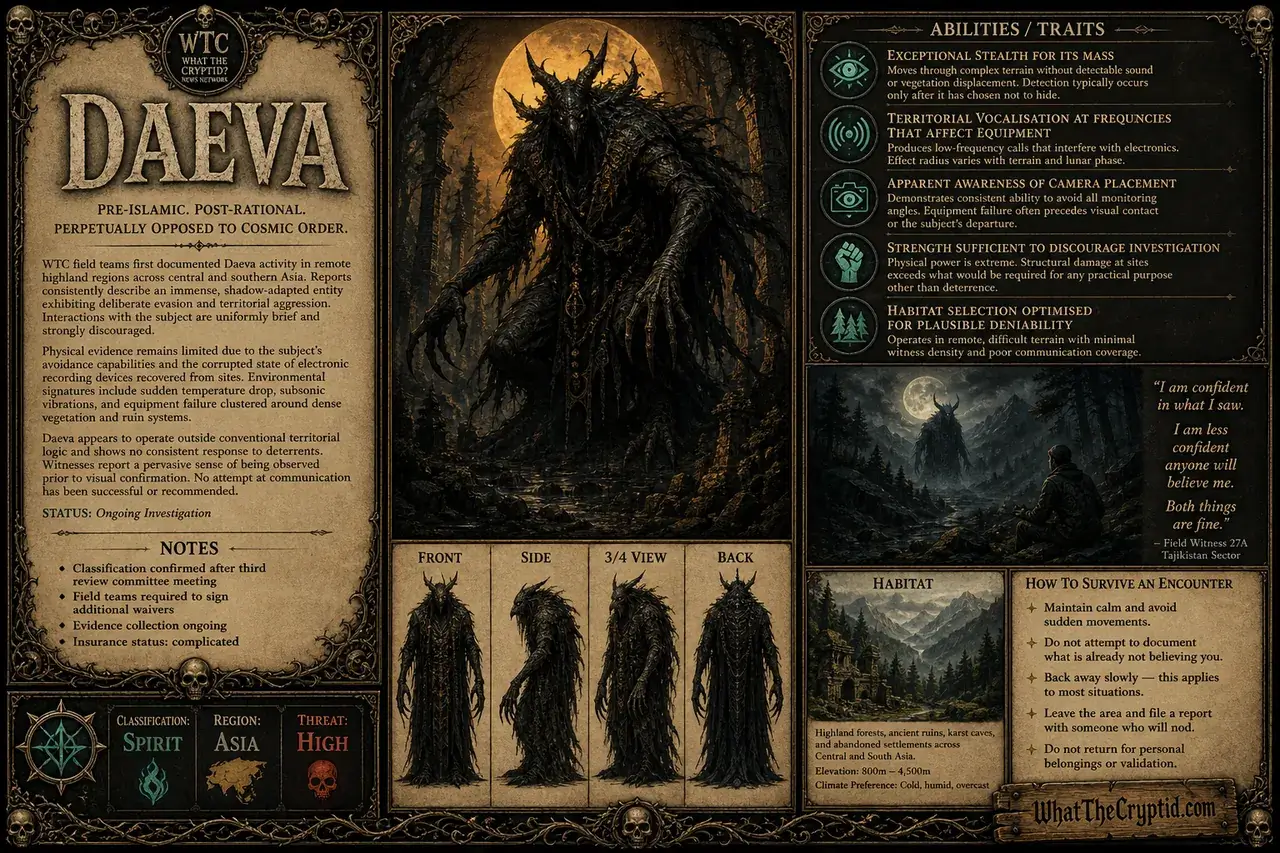
Daeva
Worshipped for centuries. Reclassified. Still very much present.
Asia
Active
PersianSpiritDeceptionAncientZoroastrianHigh-Risk
Overview
The Daeva is a category of supernatural entity originating in the religious cosmology of pre-Zoroastrian Iran, where the term once denoted divine beings broadly comparable to the Sanskrit ‘deva.’ Following the Zoroastrian reformation, approximately 1500–1000 BCE, the classification was formally inverted — the Daeva were reidentified not as gods but as agents of deception, chaos, and moral corruption, a theological reclassification that the Daeva themselves do not appear to have acknowledged or accepted. WTC notes this as one of the few documented cases in cryptid research where the subject’s status changed significantly without any reported change in its behaviour.

Modern field data, compiled from witness accounts across Iran, Afghanistan, Tajikistan, and the broader Persian cultural diaspora, describes entities consistent with the historical record: beings of considerable intelligence and apparent luminosity, capable of assuming pleasing forms, who pursue agendas that become clear only in retrospect. The deception is rarely crude. Witnesses typically describe a protracted period of apparent benefit before the situation develops in directions they had not anticipated. WTC researchers have categorised this as a long-game predation strategy, though our consulting theologian preferred the term ‘corrupting influence’ and asked to be credited accordingly.
The Daeva’s danger level of 9 reflects not its capacity for direct physical violence — which, while documented, is not its primary mode — but the considerable difficulty of recognising an encounter as an encounter until it is substantially advanced. By the time most witnesses file reports with WTC, the relevant decisions have already been made.
History & Mythology
The earliest textual references to the Daeva appear in the Gathas, the oldest hymns of the Avesta, attributed to the prophet Zarathustra and dated by scholars to somewhere between 1500 and 600 BCE, a range our editorial team has agreed to describe as ‘the relevant period.’ In these texts, the Daeva are addressed directly, condemned as beings who choose the Druj — the principle of falsehood — over Asha, the principle of truth. The specificity of the condemnation suggests that Zarathustra was not describing hypothetical entities.
The Vendidad, a later Avestan text functioning partly as a legal code and partly as what WTC would recognise as a field operations manual, dedicates substantial sections to identifying Daeva activity, counter-ritual procedures, and purity protocols for individuals who believe they have been exposed. The procedures are detailed, systematic, and clearly written by someone who anticipated a non-trivial rate of exposure among the general population. The Sassanid Persian tradition elaborated extensively on individual Daeva, naming and cataloguing specific entities with distinct portfolios: Aeshma, Daeva of wrath; Nanghaithya, Daeva of discontent; Taurvi and Zairi, associated with hunger and thirst respectively. WTC field researchers have noted that several of these portfolio descriptions align with patterns observed in modern witness accounts, which raises questions the editorial board has agreed to table.
The Div tradition of Persian folklore, which carries the Daeva concept into the Islamic period, preserves a more physically specific version of the entity — large, visually monstrous, amenable to being bound or defeated by heroes with appropriate moral standing. WTC’s assessment is that the Div accounts represent a culturally useful simplification of a more complex entity type, and that anyone approaching a Daeva expecting to find something that looks like a Div has been given inaccurate information by a tradition that may have had reasons of its own for the adjustment.
Physical Description
No single physical description of the Daeva is consistent across the documented record, which is itself considered diagnostic. Entities classified as Daeva appear to present a default form that WTC field consultants describe as ‘contextually optimal’ — that is, whatever appearance will be most effective given the specific witness and circumstances. Across 47 accounts reviewed by WTC researchers, this has included: tall human figures of exceptional physical attractiveness, elderly authority figures, deceased relatives, column-shaped luminescent presences, and, in three cases that our editor requested be flagged for separate review, forms the witnesses declined to describe but rated as extremely persuasive.
Where witnesses have reported a less curated appearance — typically in moments of surprise, ritual disruption, or what one witness described as ‘a lapse in its attention’ — accounts converge more closely. These descriptions indicate a humanoid form of variable height, with luminosity that witnesses characterise as unpleasant rather than warm, features that are symmetrical in a way that registers as wrong rather than attractive, and eyes that three independent witnesses across different countries and decades described using the same phrase: ‘the wrong kind of interested.’ WTC has not determined whether this consistency reflects genuine shared observation or the tendency of human perception to default to certain descriptive categories under extreme stress.
The Vendidad tradition assigns specific Daeva particular characteristics — Aeshma is described as armed, violent, and difficult to look at directly; Nanghaithya as outwardly placid. Whether these represent genuinely distinct entity types within the Daeva category, individual variation within a single species, or a taxonomic framework imposed by scholars onto something that does not organise itself for human convenience, WTC is not yet in a position to confirm.
Behaviour & Temperament
The Daeva’s primary documented behaviour is the systematic misrepresentation of its own nature and intentions over an extended period, which it pursues with what witnesses consistently describe as considerable patience. The entity does not typically present itself as a threat. It presents as assistance, revelation, opportunity, or companionship, and the distinction between what it offers and what it delivers tends to become apparent only after the witness has made commitments that are difficult to reverse. WTC field notes describe this pattern as ‘structurally consistent across cultural contexts and historical periods,’ which is either very interesting or very concerning, and may be both.
The Daeva is not, however, exclusively subtle. Witnesses who have successfully disrupted an encounter — through ritual, through the intervention of a third party, or through what several witnesses described simply as ‘refusing to continue’ — report a secondary behaviour profile that is considerably less patient. Aeshma’s portfolio of wrath is well-documented in the Avestan record, and modern accounts of disrupted encounters include reports of physical environment disturbance, persistent auditory phenomena, and in four cases, what witnesses described as targeted bad luck with a duration and specificity inconsistent with chance. WTC’s consulting statistician reviewed three of these cases and submitted her findings under a pseudonym.
Social structure among Daeva entities, if it exists, is not well understood. The Avestan tradition describes a court or hierarchy beneath Angra Mainyu, the principle of destructive spirit, with individual Daeva occupying defined roles. Field data neither confirms nor refutes this. Witnesses occasionally report what appear to be coordinated encounters involving more than one entity, but the entities involved have not, to WTC’s knowledge, ever confirmed their organisational arrangements.
Habitat & Territory
The Daeva shows no strong preference for uninhabited terrain. Historically documented sites of Daeva activity include major urban centres, administrative courts, temples, and private households — environments selected, WTC field researchers note, for the density of available human contact rather than any quality of the landscape itself. The entity does not appear to require a territory in the ecological sense. It requires an audience.
Where environmental preferences have been inferred from the pattern of encounters, Daeva activity concentrates around periods and locations of significant human decision-making: transitions of power, legal proceedings, moments of personal crisis, and situations where a plausible second option might be welcome. Several researchers in the field have described this as the entity occupying a conceptual habitat rather than a physical one, which WTC acknowledges is a compelling framework and also one that makes field investigation considerably more difficult to expense.
Diet & Hunting
The dietary requirements of the Daeva, if the concept of diet applies in any conventional sense, are not documented in terms that permit straightforward nutritional analysis. The Zoroastrian framework describes the Daeva as sustained by Druj — by falsehood, moral corruption, and the diminishment of Asha in the world — which WTC’s field team treats as a functional description of behaviour rather than a metaphysical claim, on the basis that the distinction may not be as meaningful as it initially appears.
What can be stated from the witness record is that prolonged Daeva encounters are associated with consistent patterns in the affected individual: a measurable increase in deceptive behaviour toward others, a deterioration in decision-making quality that witnesses and their associates describe in retrospect as ‘not like them,’ and a specific form of rationalisation that several witnesses used almost identical language to describe — ‘it made sense at the time.’ Whether the Daeva is consuming something in the course of producing these effects, or whether the effects are incidental to another process entirely, WTC’s current data does not resolve. Three researchers have submitted grant applications to investigate this question. All three are pending.
Notable Sightings
During the political upheaval preceding the Iranian Revolution, a senior civil administrator referred to in WTC records only as ‘H.K.’ reported a recurring encounter with what he described as an advisor who appeared in his office on five separate occasions offering counsel that, he stated, ‘seemed reasonable in the moment and became less reasonable over time.’ H.K. noted that he could not account for how the individual gained access to the building, that no colleagues reported seeing the figure in corridors or waiting areas, and that the advice given, while plausible, had resulted in decisions he subsequently characterised as ‘difficult to explain to a tribunal.’ WTC received this account via correspondence in 1994. H.K. had retired and did not provide a forwarding address.
A university lecturer in Persian classical literature, Dr. Farida Nazarova, reported a three-month encounter with an entity she initially believed to be a graduate student requesting research assistance. The entity demonstrated detailed knowledge of obscure Avestan texts, attended several seminars, and was recalled by two colleagues who could not subsequently identify it from any student enrollment records. Dr. Nazarova reported that the encounter ended abruptly when she read aloud, in a professional context, the Ahuna Vairya prayer, which she described as ‘not an action I planned or can fully account for.’ Dr. Nazarova published a paper on Daeva taxonomy the following year under a different institutional affiliation and declined all interview requests, citing workload.
A field interpreter working with an international NGO, name withheld at witness request, reported an encounter in which a figure appearing as a local elder approached him on four occasions over six weeks, providing information that proved accurate in its details and consistently catastrophic in its implications when acted upon. The witness stated that he recognised the pattern only after the fourth encounter, when the figure appeared in a location the witness was certain it could not have known about, and ‘looked at me the way something looks at you when it knows the conversation is over.’ The witness filed a report with WTC, completed his contract, and relocated to a different country. He noted in correspondence that he had begun studying Zoroastrian ritual texts, which he described as ‘possibly too late but not nothing.’
A WTC-affiliated researcher conducting oral history interviews with elderly practitioners of pre-Islamic Persian religious tradition reported a secondary encounter while reviewing audio recordings of her interviews. A voice, audible on three separate recordings, answers questions the researcher did not ask and is not present in her recollection of the original interviews. The voice speaks in a form of Avestan that the researcher’s supervising linguist described as ‘archaic, fluent, and in good humour about the situation.’ The recordings were submitted to WTC’s evidence archive. The researcher requested that her name be withheld from this entry and from all future WTC publications. Her request has been honoured. The recordings remain in archive. They have not been re-examined, for reasons that were not formally recorded.
Threat Assessment
The Daeva represents a threat profile that standard WTC safety protocols were not designed to address, a gap our legal team has acknowledged in writing. The entity’s primary danger is not physical in the first instance, and maintaining a recommended safe distance — typically effective for entities in the Predatory and Hominid classifications — is not applicable when the entity may already be present in a context that the witness has not identified as an encounter. WTC’s threat rating of Extreme reflects this structural difficulty.
Recommended precautionary measures, drawn from both the historical ritual record and modern field data, are as follows: individuals working in or near documented Daeva active regions are advised to maintain written records of significant decisions and their reasoning at the time, as retrospective account drift is a documented feature of extended Daeva exposure; to establish baseline consultation habits with trusted third parties before entering high-risk contexts, so that changes in decision quality have a reference point; and to familiarise themselves with the Avestan counter-ritual tradition, which WTC neither endorses nor dismisses, noting only that the three witnesses who reported successful encounter termination had all engaged with it in some form. WTC must be honest that if an encounter has reached the stage where the entity’s intentions are clear, the available options narrow considerably, and our field guidance at that point is limited to ‘document everything and contact WTC immediately,’ with the acknowledgement that documentation may itself be subject to interference.
WTC Field Notes
WTC’s research file on the Daeva is, by volume, the largest in the Active Spirit classification and the third largest in the database overall, behind only Bigfoot and a file whose subject matter our editor has asked us not to publicise until the relevant legal situation is resolved. The volume reflects not frequency of encounter but the unusual complexity of each case — Daeva sightings generate documentation in proportion to their aftermath rather than the initial incident, which means that a single encounter can produce years of follow-up correspondence, supplementary accounts, and what one researcher described as ‘the paperwork of consequences.’
Field investigation of Daeva activity presents challenges that WTC is not fully equipped to manage. Our standard investigative toolkit — trail cameras, audio recorders, thermal imaging, soil sample collection — is calibrated for entities that maintain a consistent physical presence in a fixed location, and the Daeva does not operate within those parameters. A 2021 internal proposal to develop a ‘decision-quality monitoring protocol’ for witnesses in active contact was approved in principle and is currently unfunded. Our consulting theologian has offered to assist with field training at no charge, which WTC appreciates, and which our insurance underwriter has asked us to address in a separate conversation that has been scheduled three times and rescheduled twice.