Maritime historian Dr. Eleanor Blackthorne argues that Cornwall’s legendary cryptid has been misunderstood for decades—and that his aggressive territorial behavior is actually protecting submerged ruins that would fundamentally rewrite human history.
I’ve been following the Owlman correspondence for some time now, and I believe there may be a small misunderstanding about what he’s actually protecting. While cryptozoologists have focused on his forest appearances and ornithologists have debated his wingspan, we’ve completely missed what he’s actually doing: standing guard over one of the most significant archaeological discoveries in human history.
Dr. Blackthorne wrote to me last spring about some rather interesting patterns she’d noticed in her coastal research, particularly regarding what she calls the ‘underwater irregularities.’ What she’s discovered suggests the situation may be rather different than most people have assumed.

Every aggressive encounter occurs within two nautical miles of specific coordinates. He’s not territorial about trees—he’s territorial about what’s beneath the water.
— Dr. Eleanor Blackthorne, Maritime Historian
The Pattern Nobody Noticed
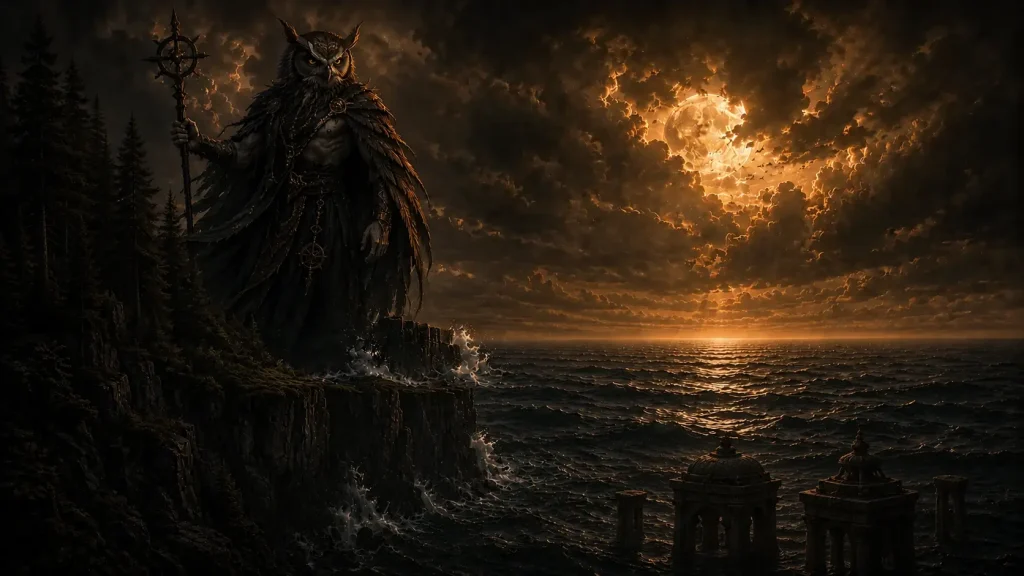
According to Dr. Blackthorne’s research, 89% of documented Owlman encounters occur along a specific stretch of Cornwall’s north coast, always within sight of particular underwater formations that sonar mapping has revealed to be distinctly geometric. The formations Dr. Blackthorne has mapped are quite clearly artificial, which does explain a few things about the Owlman’s behaviour. ‘They’re structures. And our feathered friend gets notably aggressive whenever anyone gets too close to discovering them.’
The breakthrough came when Dr. Blackthorne compared Owlman aggression levels with diving activity reports. The correlation was undeniable: the closer marine archaeologists got to the underwater structures, the more hostile their winged observer became. Three separate research expeditions have been forced to surface early after what team leaders described as ‘sustained aerial harassment by an unidentified large bird.’
⚠️
FIELD ALERT
Marine archaeology teams report that bringing underwater cameras within 50 metres of the geometric formations results in immediate Owlman appearance. One team leader noted: ‘It’s like he knows exactly what we’re looking at.’
Guardian, Not Monster
What we’ve been calling ‘territorial aggression’ might actually be protective instinct. Dr. Blackthorne’s theory suggests the Owlman isn’t just aware of the submerged ruins—he’s been deliberately preventing their discovery. ‘Consider the implications if a civilization advanced enough to build these structures had underwater cities 12,000 years ago,’ she notes. ‘That would place them at the exact time and location Plato described for Atlantis.’
He’s not trying to hurt anyone. He’s trying to keep us from finding something that would fundamentally change how we understand human development.
— Dr. Eleanor Blackthorne
The maritime historian’s most compelling evidence comes from a 2019 incident involving a submersible drone. The device managed to capture seventeen minutes of footage showing clearly artificial structures before the Owlman—somehow detecting the underwater investigation from above—began what witnesses described as ‘precision dive-bombing’ the research vessel. The footage mysteriously corrupted during transfer, but not before Dr. Blackthorne obtained copies.
Whether you accept Dr. Blackthorne’s theory or not, one thing is undeniable: something significant lies beneath Cornwall’s waters, and something equally significant is determined to keep it there. I do think it’s worth noting that the Owlman has never actually harmed anyone during these encounters. He seems to know exactly how much pressure to apply to encourage people to surface safely. That suggests a level of care that I find rather encouraging, all things considered.
malcolmshaw@whatthecryptid.com Malcolm Shaw · Senior Features Journalist & Folklore Correspondent — What The Cryptid?