
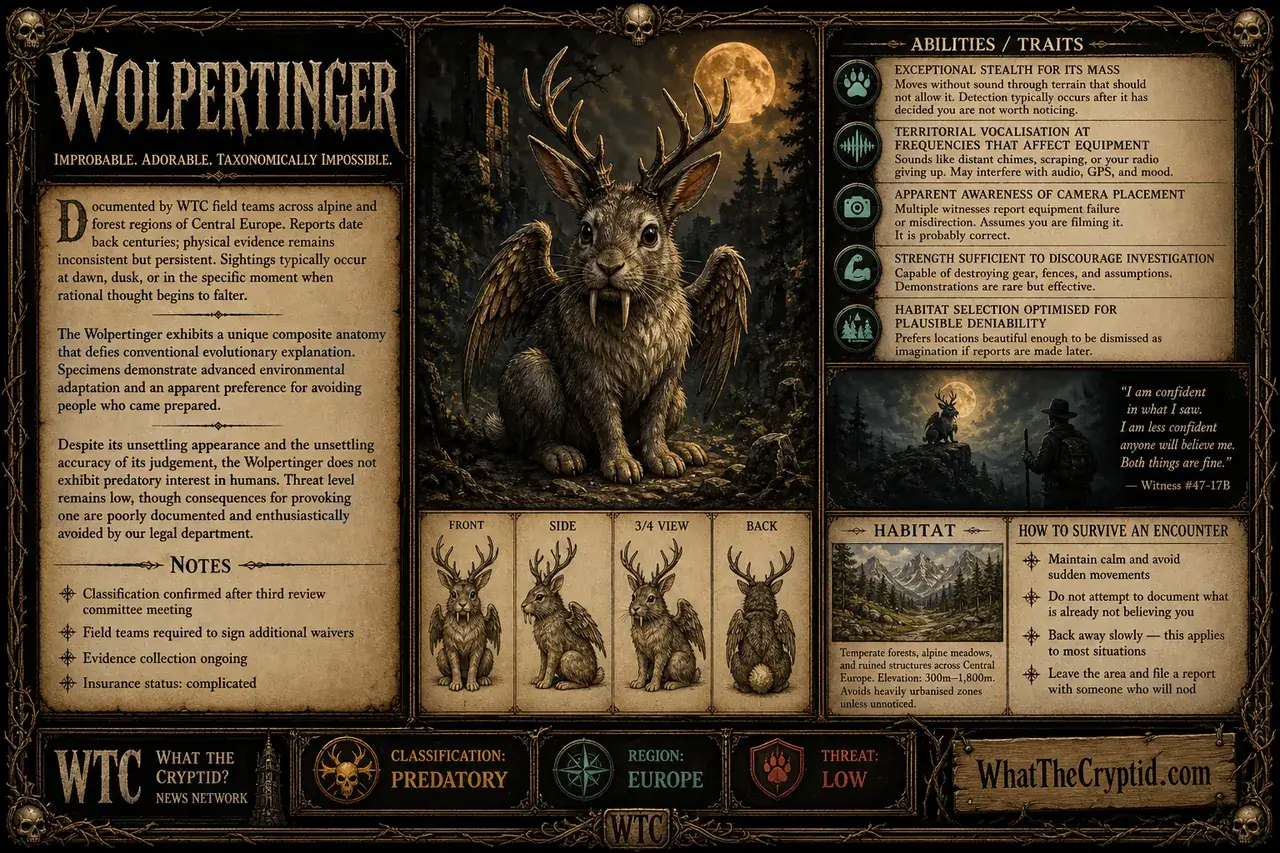
Wolpertinger
Taxonomically impossible. Seasonally abundant. Surprisingly difficult to photograph.
Europe
Active
BavarianChimericWingedAlpineFolklore
Overview
The Wolpertinger is a small chimeric entity native to the forests and alpine meadows of Bavaria, Germany, representing one of the more compositionally ambitious cryptids in the WTC database. Documented specimens present features drawn from no fewer than four distinct taxonomic classes simultaneously — typically incorporating the body of a small rabbit or squirrel, the antlers of a roe deer, the wings of a woodcock or pheasant, and the dentition of a mustelid — a combination that mainstream zoology has, to date, declined to formally address. WTC classifies the Wolpertinger as Winged on the basis that its avian features are among its most consistently reported characteristics, though we acknowledge the classification system was not designed with this entity in mind.

The entity occupies a peculiar position in the European cryptid taxonomy: it is simultaneously one of the most culturally embedded and least systematically studied creatures in the WTC catalogue. Stuffed specimens — of disputed provenance — are displayed in the Deutsches Jagd- und Fischereimuseum in Munich, where they are viewed by approximately 50,000 visitors annually. Whether these exhibits constitute evidence of the Wolpertinger’s existence or evidence of Bavarian taxidermy’s creative limits is a question WTC has formally tabled pending access to the specimens for independent examination, access which has not yet been granted.
History & Mythology
The earliest documentary references to the Wolpertinger appear in Bavarian rural records from the late 17th century, where the creature is mentioned in the context of hunting folklore rather than supernatural tradition — suggesting that contemporaneous locals regarded it as a game animal rather than a mythological entity, a distinction that WTC finds either encouraging or deeply puzzling depending on the day. The name itself is of uncertain etymology, with regional variants including Wolperdinger and Woipertinger reflecting the dialectal diversity of the Bavarian Alpine communities where the tradition is strongest.
By the 19th century, the Wolpertinger had acquired a secondary life as the centrepiece of a local hunting custom in which Bavarian villagers — particularly young men attempting to impress romantic partners — were led into the forest on moonlit nights to hunt the creature using lanterns and sacks, a practice that appears to have been more successful as a social ritual than as a zoological exercise. Taxidermists in the region began producing composite specimens during roughly the same period, and several of these pieces passed through private collections before entering museum custody. The provenance chain for the Munich specimens has been described by one archivist, who asked not to be named, as ‘characterful.’
Physical Description
Documented and reported Wolpertinger specimens range from approximately 25 to 40 centimetres in body length, placing them broadly in the size range of a large rabbit, which is consistent with accounts describing the creature moving through undergrowth without significant displacement of vegetation. Body weight, where estimated from museum specimens, falls between 0.8 and 1.4 kilograms — though WTC notes that the museum specimens are composite constructions and their weight distribution should not be taken as a reliable guide to the living animal’s mass.
The defining characteristic of the Wolpertinger is the simultaneous presence of features that do not, by any established biological mechanism, occur together. Field reports consistently describe the creature as having a soft-furred body — usually brown, grey, or reddish-brown — with small forepaws, a short rabbit-like tail, and a posture that witnesses describe as ‘alert’ or ‘watchful.’ The antlers, reported in the majority of adult male sightings, are proportionally small relative to body size — typically 6 to 10 centimetres in spread — and appear to be shed and regrown seasonally, consistent with cervid biology, which is the one aspect of the Wolpertinger’s anatomy that raises no additional questions. The wings, folded at rest and described as feathered rather than membranous, appear incapable of sustained powered flight based on reported body mass, though at least three witnesses have described the animal becoming briefly airborne when startled.
Behaviour & Temperament
The Wolpertinger is, by all documented accounts, a crepuscular animal, with the majority of sightings occurring between dusk and approximately two hours after nightfall, and a secondary cluster in the pre-dawn hours that suggests either a split activity pattern or a population that has adjusted its schedule in response to human observation pressure. During daylight hours the creature is rarely reported, and the two mid-afternoon sightings in the WTC database are both from heavily overcast days in late October, which may or may not be relevant.
Witnesses consistently describe the Wolpertinger as curious rather than shy — approaching to distances of 3 to 8 metres before pausing to assess the observer, then retreating at speed if the observer moves or vocalises. This behaviour pattern is more consistent with a prey animal conducting threat assessment than with a predator, which aligns with the creature’s documented size and dentition profile. The social structure of the Wolpertinger is not well established; most sightings involve solitary individuals, though a 2003 account from the Allgäu region described a group of three moving together through a clearing, a detail that the witness included in their written report and then, in a follow-up call, asked WTC to ‘perhaps not emphasise.’
Habitat & Territory
The Wolpertinger’s documented range is confined to the forested regions of Bavaria, with the highest density of reported sightings in the Alpine foothills between Munich and the Austrian border — specifically in areas of mixed deciduous and coniferous woodland at elevations between 600 and 1,400 metres. The creature shows a strong preference for forest margins and meadow edges rather than deep woodland interior, which is consistent with its apparent dietary range and may explain the relatively high rate of incidental human encounters compared to other cryptids of similar size.
Sightings cluster near water sources — streams and small lakes appear in the background of the majority of photographic attempts, though the photographs themselves have not been useful — and the creature is most frequently reported in areas where human settlement abuts undeveloped forest, suggesting either an opportunistic relationship with agricultural land or simply that these are the areas where humans and the entity are most likely to share the same ground at the same time of day.
Diet & Hunting
The Wolpertinger’s diet, inferred from sighting contexts and the limited physical evidence available, appears to be broadly omnivorous with a seasonal bias toward plant matter. Spring and summer accounts frequently place the animal in meadow environments consistent with grazing on grasses, clover, and low herbaceous plants, while autumn reports more commonly situate it near forest floor environments where mushrooms and fallen fruit would be seasonally available. The entity’s mustelid-grade dentition — reported consistently enough across independent witness accounts to be treated as a documented feature — implies a capacity for animal prey that its apparent foraging behaviour does not fully account for, and WTC has not been able to resolve this discrepancy to anyone’s satisfaction.
Two witnesses have reported observing the Wolpertinger consume small invertebrates, in one case a beetle and in the other what was described as ‘something from under a log.’ No predation of vertebrate prey has been documented. Whether the pronounced canine teeth are a vestigial feature, a defensive adaptation, or an indication of dietary behaviour that simply has not been observed is a question that would require considerably more fieldwork than WTC has thus far been able to fund.
Notable Sightings
Retired forester Klaus Brenner reported encountering a Wolpertinger at approximately 6:40 PM in October while returning along a trail he had walked daily for eleven years. He described the animal as sitting upright on a fallen log at a distance of roughly 5 metres, regarding him with what he characterised as ‘mild interest.’ Brenner, who had spent four decades in Bavarian forestland, stated in his written account that he was certain it was not any animal he had previously encountered, and listed seven species it was not before describing what it was. His report was filed with the regional forestry office, which forwarded it to WTC without comment.
A Dutch hiking group of seven reported a sighting at dusk near the Königssee lake trail, describing a small winged, antlered animal that crossed the path approximately 10 metres ahead of the group and paused at the treeline for an estimated 8 to 12 seconds before entering the forest. Four members of the group independently sketched the animal the following morning without consulting each other; three of the four sketches were described by WTC’s receiving editor as ‘substantially consistent.’ The fourth sketch depicted what appeared to be a motorcycle, and was set aside.
Agricultural worker Maria Hofstätter reported three Wolpertinger individuals moving in loose formation across the corner of a hay meadow at approximately 5:15 AM during early September. She observed them for an estimated four minutes from a distance of 20 metres while they fed on something in the grass, before they departed into the adjacent treeline at speed. Hofstätter noted that she had seen the same or similar animals twice in the preceding fortnight. She did not file the report herself; it was submitted on her behalf by her employer, who included a note indicating that the meadow in question had since been fenced.
A wildlife photographer who asked WTC to withhold their name set up a camera trap specifically targeting Wolpertinger habitat following two personal sightings in the same location over eight days. The camera recorded 1,847 images over a 12-night deployment period, capturing red foxes, roe deer, a badger, and one image at 2:23 AM that the photographer described in their submission as ‘the reason I am writing to you.’ The image in question shows a partially obscured shape at the edge of the frame that is consistent with a small antlered animal and inconsistent with the deer recorded elsewhere in the dataset. The photographer requested the image be returned. WTC has retained a copy.
Threat Assessment
The Wolpertinger presents a minimal direct threat to adult humans and WTC assigns it a Low threat rating based on all available evidence. No documented incident of Wolpertinger aggression toward a human has been recorded in the WTC database, and the entity’s consistent retreat behaviour when approached suggests it should be treated as a wildlife encounter rather than a dangerous animal encounter. Observers are advised to maintain a minimum distance of 5 metres if fortunate enough to encounter one, primarily to avoid triggering the flight response before adequate observation can be conducted, rather than for personal safety.
The mustelid dentition noted in multiple accounts is the only feature of the Wolpertinger that gives WTC any professional pause, and observers are advised not to attempt to handle or corner the animal on the basis that an animal with those teeth and no observable fear of humans is an animal that has presumably made a considered decision not to use them. WTC recommends treating this as a courtesy that should not be tested. The traditional Bavarian practice of hunting Wolpertinger with a sack and a lantern is noted here only so that WTC can formally advise against it.
WTC Field Notes
WTC’s European field correspondent first submitted a Wolpertinger entry proposal in 2016, at which point it was returned on the grounds that the Munich museum specimens constituted ‘possible primary evidence requiring in-person assessment before publication.’ A formal request for specimen access was submitted to the Deutsches Jagd- und Fischereimuseum in February 2017. A response was received in April 2017 acknowledging receipt of the request. No further correspondence has been received, and follow-up enquiries in 2018, 2020, and 2023 have been met with the same institutional silence that WTC has come to regard as a form of data.
The present entry has been compiled from witness submissions, regional folklore archives, and two consultations with a Bavarian zoologist who agreed to speak with WTC provided the conversation was described as ‘entirely hypothetical.’ Our field correspondent has been allocated a three-day site visit to the Tegernsee Valley region, pending approval of the equipment budget, which has been pending since March. The taxidermy specimens visible on the WTC website were sourced from a prop supplier in Cologne and are not presented as authentic. We mention this here because legal has asked us to.