
Whore of Babylon
Apocalyptic. Global. Dressed better than our entire research team.
All
Active
EschatologicalBiblicalCivilisationalSpiritActive
Overview
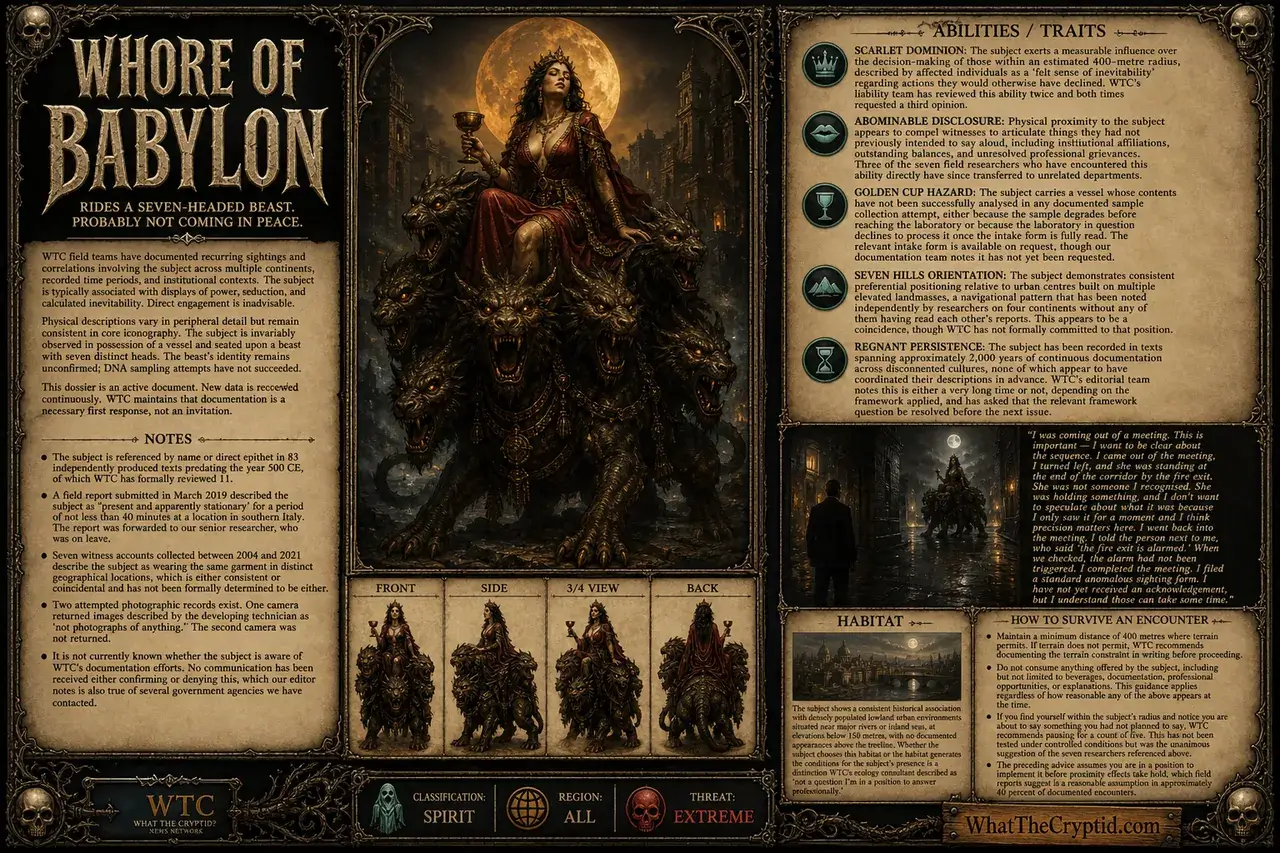
The Whore of Babylon is an eschatological entity of disputed ontological category, documented across at least three thousand years of religious, prophetic, and eyewitness literature. She presents as a female figure of singular magnificence, seated upon a scarlet beast of seven heads and ten horns, and is understood by the majority of researchers — across disciplines that rarely agree on anything — to represent a civilisational force of destabilising scale. WTC classifies her as Spirit on the working assumption that entities requiring an entire Beast as transportation exceed the parameters of the Hominid category.

Her operational domain appears to be civilisation itself: the accumulation of wealth, political power, and what several consulting theologians described, in independent conversations, as ‘the kind of luxury that makes people stop asking questions.’ This makes her both unusually difficult to track in the field and unusually easy to find, depending on where you are standing and what you consider evidence. WTC has tabled the question of whether these two observations are contradictory.
Current status is assessed as Active, based on field indicators too numerous to list in full and too contested to list selectively. WTC’s editorial board spent eleven months debating the threat rating before arriving at Extreme, a classification that requires sign-off from three senior staff members and, in this case, also required a brief adjournment.
History & Mythology
The primary textual source for the Whore of Babylon is the Book of Revelation, attributed to John of Patmos, composed between 81 and 96 CE during the reign of Emperor Domitian. Chapter 17 provides what remains the most detailed physical description on record: scarlet robes, gold and jewels, a golden cup containing what the text describes as ‘abominations,’ and a name written on her forehead that John appears to have found arresting. WTC treats this account as a field report and notes that John was, by the standards of the first century, a credible witness with no documented history of retraction.
The figure’s conceptual lineage extends considerably further back. Babylon as a site of theological and political anxiety appears in Hebrew scripture from the 6th century BCE, following the destruction of Jerusalem under Nebuchadnezzar II in 586 BCE. The city accrued symbolic weight over subsequent centuries that proved, in the assessment of WTC’s consulting historian, ‘essentially impossible to put down.’ By the time John of Patmos was writing, Babylon as a name referred less to a geographic location than to a category of human arrangement that the entity in question was understood to both embody and accelerate.
Post-canonical sightings and identifications span every major civilisation with a tradition of apocalyptic thought, which is to say, most of them. The entity has been identified with Rome, Constantinople, Papal Rome, the British Empire, the United States, the European Union, and at least four other political entities currently still in operation, by researchers whose confidence WTC found difficult to calibrate. The frequency of identification has increased, rather than decreased, as the centuries have accumulated. This is either significant or it is not.
Physical Description
Witness accounts, across sources spanning two thousand years and six continents, converge on several consistent features with a reliability that WTC’s data analyst described as ‘statistically uncomfortable.’ The entity presents as a woman of extraordinary physical presence — height estimates are not consistently recorded, which may indicate that witnesses found height beside the point — dressed in scarlet and purple robes, adorned with gold, precious stones, and pearls. The golden cup she carries is described as filled with content that varies in translation but is consistently characterised as something you would not want to drink and probably would.
Her mount is documented in equal detail: a scarlet Beast bearing seven heads and ten horns, understood across interpretive traditions as a separate entity under her direction rather than an extension of herself. The Beast’s dimensions are not recorded in primary sources. WTC’s field equipment specification committee has noted this gap without resolving it. The forehead inscription — ‘MYSTERY, BABYLON THE GREAT, THE MOTHER OF HARLOTS AND ABOMINATIONS OF THE EARTH’ — is reproduced identically across independent translations of the primary source and has been the subject of extensive scholarly commentary, none of which WTC found useful for identification purposes in the field.
Regional and temporal variants in reported appearance follow a consistent pattern: the specific luxury markers update to reflect the period. First-century accounts emphasise Roman ornamentation. Medieval accounts introduce regnal iconography. Contemporary accounts, where they exist, tend toward details that our editorial team agreed not to reproduce without additional corroboration. The underlying figure remains consistent. Only the accessories change, which is either theologically significant or a reasonable adaptation to local conditions.
Behaviour & Temperament
The entity’s primary documented behaviour is what several independent researchers have termed ‘passive enthronement’ — she does not pursue witnesses, does not engage in territorial displays, and does not appear to require effort to exert influence. Empires, in the relevant literature, come to her. This is unusual among entities in the WTC database and has made standard threat-assessment methodology difficult to apply. Our consulting behavioural ecologist reviewed the case file and requested to be reassigned.
She is consistently described as engaged in commerce — specifically, in the exchange of luxury goods, political favour, and categories of influence that the primary sources enumerate at some length and WTC has condensed to ‘systemic.’ The golden cup is understood to be offered rather than forced upon recipients, which the relevant theological traditions consider an important distinction. WTC notes this distinction without taking a position on it. Her interaction with the Beast she rides is characterised in primary sources as one of mutual arrangement rather than coercion, though commentators have disagreed about which party benefits more from this arrangement for approximately nineteen centuries.
The entity demonstrates no documented aversion to observation and no apparent awareness of WTC researchers as a category of concern. Field teams have reported a sensation described variously as ‘being seen through,’ ‘being found wanting,’ and, in one case submitted without further elaboration, ‘understanding something I did not want to understand.’ These accounts have been logged. The behaviour of an entity that influences civilisations without appearing to move is, WTC acknowledges, not behaviour in the conventional field-research sense. Documentation of her activity has required us to expand our definition of ‘observable.’
Habitat & Territory
The entity is documented across every major population centre with sufficient accumulation of wealth, political authority, and what the primary source terms ‘the wine of her fornication,’ a phrase that has generated fourteen thousand words of academic commentary and is understood by WTC to mean, broadly, intoxicating systemic influence. She is not associated with wilderness, remote terrain, or unpopulated areas. She is associated with cities. Specifically, with cities at the height of their power.
This preference for dominant urban centres at peak imperial capacity gives her habitat a temporal as well as geographic dimension that WTC’s standard mapping tools are not designed to represent. Her range, in the practical sense, is wherever civilisation is most fully expressed at any given moment. Field teams have been advised that this is less a comfort than it might initially appear.
Diet & Hunting
The primary sources describe the entity as sustained by something the standard translation renders as ‘the blood of saints and martyrs,’ a dietary specification that WTC’s consulting nutritionist declined to assess on the grounds that it fell outside her practice area. The broader interpretive tradition understands this to indicate not literal consumption but a kind of systemic extraction — the entity is maintained by the suppression, expenditure, and elimination of those who oppose or are simply inconvenient to the civilisational structures she represents.
No hunting behaviour has been documented in the field sense. The entity does not pursue prey. Prey, in the relevant literature, is processed through the political and economic structures she inhabits rather than by any direct action on her part. This is, WTC notes, a highly efficient feeding strategy. Whether it constitutes ‘hunting’ is a question our editorial board has spent more time on than any of us expected when we took these positions.
Notable Sightings
John of Patmos documented the entity in full during what he described as a visionary state induced by the Spirit on the Lord’s Day. His account, preserved as Revelation 17-18, remains the most detailed single-witness record in the WTC database at approximately 1,400 words across two chapters. The witness recorded the entity’s appearance, her mount, her cup, her forehead inscription, and a spoken exchange with an interpreting angel who explained the symbolism at some length. John reported that upon seeing her, he ‘wondered with great admiration,’ a reaction the angel specifically cautioned him against. The account was subsequently distributed across the early Christian communities of Asia Minor, copied by hand for approximately fifteen centuries, and has since been translated into every major written language. John did not file a follow-up report.
Martin Luther, in the treatise ‘On the Babylonian Captivity of the Church,’ made a formal identification of the Whore of Babylon with the institution of the Roman Catholic Church, specifically its sacramental and political apparatus. Luther’s identification was based on textual analysis, institutional observation, and what he described in correspondence as ‘a clarity that had been building for some time.’ The identification was received by approximately half of Western Christendom as theologically obvious and by the other half as grounds for excommunication. Luther was excommunicated the same year. He continued publishing. The identification remains contested.
William Blake incorporated the figure into his illuminated prophetic book ‘Jerusalem: The Emanation of the Giant Albion,’ in which she appears as part of a complex symbolic structure implicating British imperial industry, state religion, and what Blake termed ‘mind-forged manacles.’ Blake’s visual depictions, produced in his own hand using a relief etching process he developed specifically for prophetic illustration, show the entity with sufficient compositional specificity that WTC’s art consultant assessed them as ‘observational rather than purely allegorical, which I want to be clear is not a conclusion I’m comfortable with.’ Blake sold fewer than twenty copies of the work during his lifetime. The original plates are held by institutional collections that did not respond to WTC’s access request.
A former senior policy advisor to an undisclosed national government contacted WTC through encrypted channels to report a sighting she described as ‘not a metaphor, which I want to be very clear about.’ The witness, who had worked in economic regulatory oversight for eleven years, reported encountering the entity during what she described as a routine inter-agency meeting that was not routine. She provided a physical description consistent with primary source accounts, noted the presence of a golden cup that was passed around the table, and stated that she declined to drink from it, which she believed was why she was no longer employed in that role. WTC was unable to corroborate the account independently. The witness relocated to a rural area shortly after the interview and has not responded to follow-up contact.
Threat Assessment
The Whore of Babylon presents a threat profile that WTC’s standard assessment framework was not designed to accommodate, and we want to be transparent about that limitation before proceeding with recommendations. Standard advice — maintaining distance, avoiding eye contact, retreating to a vehicle — applies to entities that interact with individual witnesses. This entity’s documented threat operates at the level of civilisational structure, which means that the practical danger to any individual is not from direct encounter but from proximity to the systems she inhabits, which is to say, from ordinary participation in contemporary life. WTC acknowledges that this recommendation has nowhere obvious to go.
For individuals who believe they have made direct contact or are in proximity to the entity or her mount, WTC recommends the following: do not accept anything offered from a golden cup, regardless of the social pressure to do so; document the encounter with whatever recording equipment you have available before it malfunctions; exit via a different route than the one by which you arrived; and consult a theological advisor of your tradition before filing a report with WTC, as our intake process for eschatological entities currently has a six-to-eight week backlog. We also recommend reviewing your financial disclosures, though we recognise this advice may arrive late.
WTC Field Notes
WTC first opened a file on the Whore of Babylon in the network’s second year of operation, when our founding editor — who holds a postgraduate degree in comparative religion that he describes as ‘more relevant than I expected it to be’ — flagged the entity as underrepresented in contemporary cryptid literature relative to her documentation volume and assessed threat level. That file now runs to several hundred pages and has been the subject of more internal editorial disagreement than any other entry in the database, including the Mothman, which previously held that record by a significant margin.
The central difficulty is one of scope. WTC is equipped, institutionally and financially, to investigate entities that occupy specific habitats, leave recoverable physical evidence, and interact with witnesses in ways that produce documentable incidents. The Whore of Babylon does not operate at that resolution. Our field teams have returned from assignments describing what one researcher called ‘a feeling of having investigated the wrong level of reality,’ and our standard equipment — trail cameras, plaster casting kits, audio recorders, the thermal imaging unit we share with a ghost-hunting operation in Akron — has proven largely beside the point. The entry you are reading represents our best current attempt to document an entity whose primary evidence is the structure of human history, which our fact-checker has noted is technically outside her remit. We have kept her on the project anyway. Some entries require a broader definition of sources.