
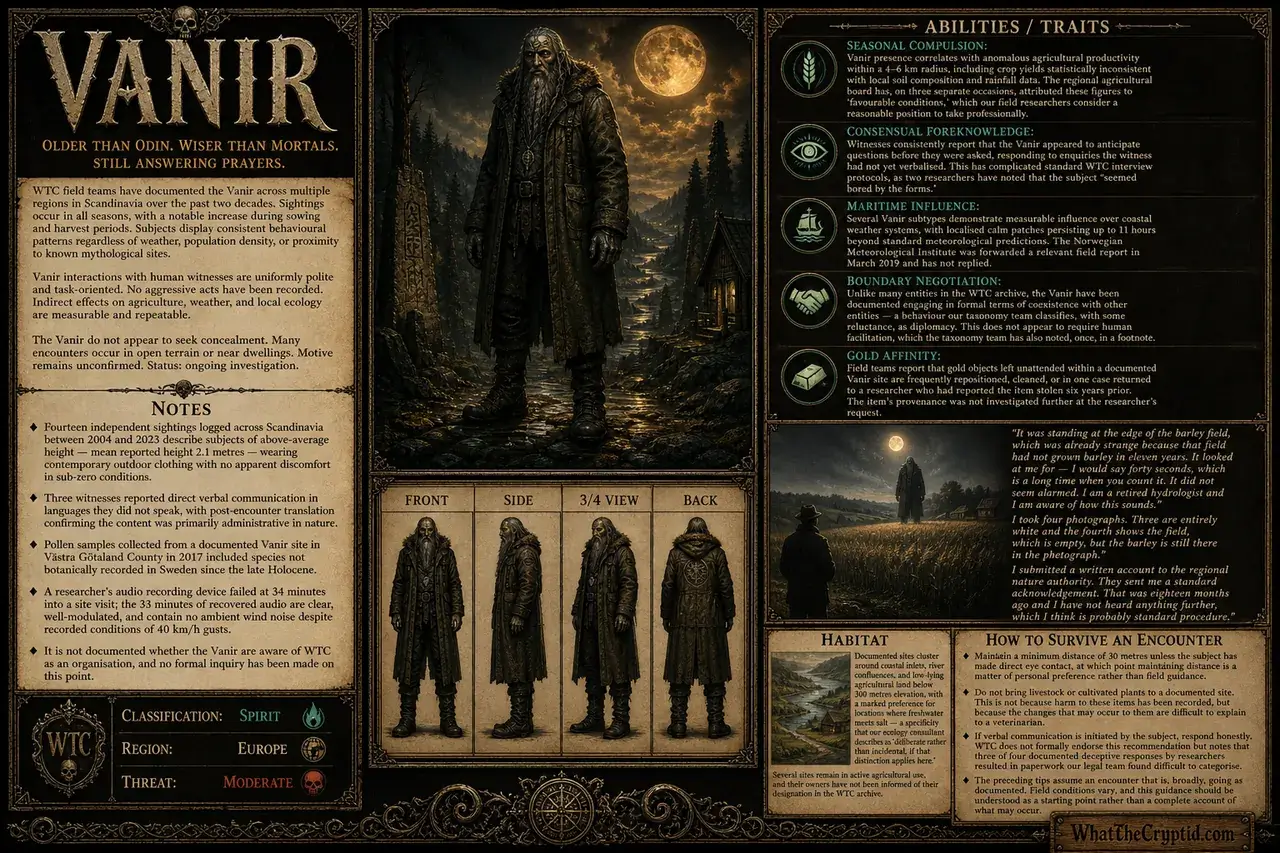
Vanir
Ancient. Diplomatic. Still technically owed tribute.
Europe
Dormant
NorsePantheonFertilityProphecyDormantSpiritScandinaviaDivine
Overview
The Vanir are a collective of divine or semi-divine entities originating in pre-Christian Scandinavian cosmology, distinguished from the better-documented Aesir pantheon by their association with fertility, agricultural yield, oceanic navigation, and precognitive ability. WTC classifies them under Spirit rather than Extraterrestrial, a distinction our editorial board reached after three separate meetings and a tiebreaker vote that two members have since described as ‘premature.’ The primary named individuals within the group — Njord, Freyr, and Freyja — are the most extensively documented, with a wider collective implied by the plural designation throughout source material.

What separates the Vanir from other entries in the WTC Spirit classification is the existence of a recorded peace settlement. Following a prolonged conflict with the Aesir, the two factions exchanged hostages in an arrangement that appears to have held, in broad terms, for approximately two thousand years of recorded tradition. WTC notes this as the only cryptid-adjacent entity class in our database to have successfully concluded a formal diplomatic negotiation, which raises questions the database is not currently structured to address.
Current status is listed as Dormant rather than Extinct on the basis that dormancy is not disproven. No confirmed sightings post-dating the Christianisation of Scandinavia have been formally assessed by WTC, though a non-trivial volume of candidate reports from agricultural communities in Norway, Sweden, and Iceland has accumulated in our intake queue, pending resource allocation.
History & Mythology
The earliest textual documentation of the Vanir as a distinct collective appears in the Prose Edda, compiled by Icelandic scholar Snorri Sturluson circa 1220 CE, and the Poetic Edda, the manuscript tradition of which dates to the late thirteenth century though the oral tradition it records is considered substantially older. Sturluson describes the Aesir-Vanir War as a foundational cosmological event, concluding in a hostage exchange in which Njord and his children Freyr and Freyja entered Asgard while the Aesir sent Hoenir and Mimir to the Vanir — an exchange the Vanir subsequently characterised as unsatisfactory, though no formal complaint mechanism existed at the time.
Pre-literary evidence is inferred from archaeological contexts. Votive deposits recovered from Danish bog sites at Thorsberg and Illerup Ådal, dating to the second through fourth centuries CE, include objects interpreted by specialists as offerings consistent with Vanic cultic practice — specifically, items associated with land fertility and maritime safety rather than martial function. The site at Gamla Uppsala in Sweden, where a major temple complex operated until approximately 1080 CE, is associated in Gest’s account with worship that included all three primary Vanir figures, described in terms that Uppsala University’s Department of Archaeology has characterised as ‘difficult to assess without bias.’
Folkloric persistence beyond the formal conversion period is documented in agrarian protective traditions recorded throughout Scandinavia into the nineteenth century, including the blót-adjacent practice of leaving the last sheaf of the harvest standing in the field — a behaviour that, if interpreted as directed at a specific recipient, implies a working assumption on the part of practitioners that the recipient remained, in some functional sense, available. WTC does not draw conclusions from this. We simply note it.
Physical Description
Physical descriptions of the Vanir in primary sources are variable and should be treated as accounts filtered through centuries of oral transmission, political editing by Christian-era scribes, and what our consulting folklorist described as ‘a general Norse preference for impressionistic rather than technical description.’ With those caveats filed, the available record is as follows.
Freyr is consistently described as tall, fair-haired, and of a physical presentation that sources characterise with terms best translated as ‘abundantly healthy’ — a descriptor applied with a specificity that made several nineteenth-century translators reach for footnotes rather than direct rendering. He is associated with a sword that fights of its own accord, a collapsible golden boat, and a boar with bristles described as luminescent. Freyja shares the fair colouring and is specifically noted for amber-coloured tears, a detail consistent enough across sources to be treated as a documented physical characteristic. She is described as wearing a feathered cloak that confers the ability of flight, which WTC notes is either a literal account or a very specific metaphor that nobody has satisfactorily explained. Njord is described as sea-worn and practical, with feet noted in the Eddic poem Skírnismál’s adjacent traditions as a specific point of aesthetic contention during his marriage to the giantess Skaði — she had expected Baldr and selected Njord by his feet alone, a methodology that field researchers have been asked not to replicate.
The wider Vanir collective is described only in aggregate. Collective physical presentation appears consistent with the primary three: humanoid, tall, and associated with a light or warmth effect that sources describe variously as literal luminosity or atmospheric change in their proximity. No height measurements are available. WTC has opened a placeholder record.
Behaviour & Temperament
The Vanir present a behavioural profile that is, by the standards of the WTC Spirit classification, notably cooperative. Where Aesir entities are associated with conflict initiation, oath-binding under duress, and the strategic deployment of deception, the Vanir record shows a consistent orientation toward negotiation, reciprocal exchange, and the maintenance of conditions favourable to agricultural and social stability. This is either a genuine dispositional difference or a function of the fact that Vanir behaviour is primarily documented through Aesir sources, which WTC acknowledges without being able to resolve.
Freyr’s courtship of the giantess Gerðr, documented in the Skírnismál, is the most behaviourally detailed account available and reveals a pattern of extended pursuit, use of intermediaries, and eventual success through a combination of gifts and what the poem describes as a runic curse — a behavioural sequence that specialists have assessed as ‘consistent with the period’ and WTC has assessed as ‘involving a level of persistence that current guidelines would not support.’ Freyja is documented as engaged in the practice of seiðr, a form of precognitive ritual magic that the Eddic sources note she transmitted to Odin, making her the primary technical expert in prophetic methodology within the combined pantheon. The Vanir appear to observe seasonal rhythms with greater fidelity than the Aesir, with activity cycles in the source material clustering around agricultural transitions.
Socially, the Vanir are described as operating in a structure that differs from the Aesir’s hierarchical model in ways that have generated considerable academic disagreement. The hostage arrangement following the Aesir-Vanir War resulted in Freyr being appointed as ruler of Álfheimr, suggesting integration into Aesir administrative structures without full subordination — a diplomatic outcome WTC’s editor described as ‘better than most.”
Habitat & Territory
The Vanir’s primary cosmological territory is Vanaheimr, one of the Nine Worlds of Norse cosmology, described in source material as a realm distinct from Asgard, Midgard, and the other named domains. Its physical characteristics are not described in detail anywhere in the surviving record, which Sturluson appears to have found as frustrating as we do, given that his descriptions of other realms are substantially more specific. What is noted is that Vanaheimr is associated with the conditions its inhabitants govern — fertility, abundance, and the management of natural cycles — suggesting an environment of productive land and accessible water, which would place it, were it physically locatable, somewhere in the temperate agricultural zone.
In Midgard terms, the strongest documented concentrations of Vanir activity are in southern Scandinavia and the coastal regions of what is now Norway and Sweden, with a secondary distribution across the North Atlantic maritime routes consistent with Njord’s domain. Inland agricultural communities in Denmark and the Swedish lake districts show the highest density of associated votive practice in the archaeological record. The Vanir do not appear to favour extreme terrain, which distinguishes them from several other Norse entity classes and suggests a pragmatic disposition toward liveable conditions that WTC finds, on reflection, entirely reasonable.
Diet & Hunting
Primary sources do not describe the Vanir as requiring sustenance in any conventional sense, which is consistent with their divine classification but inconvenient for this section of the database entry. What the sources do describe is an economy of reciprocal offering: the Vanir received blót — ritual sacrifice of animals, mead, and agricultural produce — from human communities, and in exchange provided conditions favourable to harvest and safe passage. Whether this constitutes diet in a functional sense, or something better categorised as tribute infrastructure, is a distinction WTC is not currently equipped to adjudicate.
The animals most commonly offered in Vanic cultic contexts, based on faunal assemblages from associated site deposits, were boar, horse, and cattle, in that order of frequency. The prevalence of boar is consistent with Freyr’s iconographic association with the animal — specifically the boar Gullinbursti, described as capable of running faster than any horse and illuminating darkness with the glow of its bristles, which is either a description of a real animal or a description of an animal that has not yet been formally submitted to the WTC Aquatic division for assessment. The mead component of offerings is documented consistently enough across sites and periods to be treated as a confirmed preference. Field teams entering known areas of Vanic association have been asked not to arrive with open containers of fermented honey products, though the reasoning here is precautionary rather than evidence-based.
Notable Sightings
Adam of Bremen, a German cleric writing his Gesta Hammaburgensis Ecclesiae Pontificum circa 1075 CE, recorded an account of the Uppsala temple provided by the Danish King Sweyn Estridsson, describing a triad of statues — Thor at centre, Wotan to one side, and ‘Fricco’ (interpreted as Freyr) to the other — at which sacrificial offerings were made at nine-year intervals during a festival that lasted nine days. Adam described the offerings as including humans as well as animals, and noted that the bodies were suspended from trees in a sacred grove adjacent to the temple. Adam’s account has been assessed by Uppsala University researchers as combining firsthand report, secondhand account, and demonstrable embellishment in proportions that are not entirely separable. The temple was destroyed in approximately 1087 CE by King Inge the Elder, who declined to leave a written account of what, if anything, he found inside.
Archaeological excavation of the Thorsberg votive deposit, conducted from 1858 to 1861 under the direction of Conrad Engelhardt, recovered approximately 15,000 individual objects from a bog context dated to the second through fourth centuries CE, including weapons, garments, personal ornaments, and animal remains. The distribution of object types was inconsistent with martial votive practice and led Engelhardt to characterise the site as dedicated to a deity of a different class than the war gods — a conclusion he did not specify further in his published report, apparently on the basis that specification would have required an additional chapter he was not prepared to write. The site was re-examined in 2008 by a team from the National Museum of Denmark, whose report noted that the volume of material represented a community investment of labour and resources sustained across multiple generations, which implies a level of confidence in the recipient’s continued availability that the archaeological record cannot confirm or deny.
Archaeological investigation of the church site at Mære, conducted by the University of Oslo, identified beneath the medieval Christian structure the remains of a pre-Christian longhouse containing post-hole patterns, charred animal bone assemblages, and gold foil figures — the last category being small pressed-gold plaques depicting embracing human figures associated in the scholarly literature with Freyr and Gerðr or with Vanic fertility cult practice generally. The gold figures numbered forty-three in the Mære assemblage, a count that the excavation director noted was high relative to comparable sites but did not elaborate upon in the formal report. The church built over the site has remained in active use, continuously, since approximately 1150 CE. The current congregation was contacted for comment and provided none.
A figurine recovered by metal detectorist Preben Gimling in a field adjacent to the Lejre manor site in 2009 was subsequently assessed by the Roskilde Museum as a tenth-century silver figure depicting a seated female form on a throne flanked by two smaller figures, interpreted by the museum’s specialist as a representation of Freyja in a seiðr context — that is, in the act of conducting prophetic ritual. The figurine measured 1.8 centimetres in height. The field in which it was recovered had previously produced no significant finds across fourteen years of systematic survey by the same detectorist, a point Gimling noted in his recovery documentation without offering an explanation for the pattern. The figurine is now held in the Roskilde Museum collection. Gimling reportedly returned to the field the following weekend.
Threat Assessment
The Vanir present a threat profile that is, in WTC’s assessment, contingent rather than inherent — meaning that the risk associated with potential contact is not a function of the entities’ baseline disposition, which the historical record characterises as broadly cooperative, but of the conditions under which contact occurs and the conduct of the human party at the point of interaction. This is a meaningfully different risk structure from most entries in the WTC database and should not be interpreted as a low-risk classification without reading the remainder of this section.
Specific documented risks include: the precognitive capacity attributed to Freyja and associated Vanic practitioners, which means that attempting to misrepresent intentions or conceal purposes in any interaction context is inadvisable and probably futile; the agricultural and meteorological influence attributed to Freyr, which in adverse relational contexts has historically been expressed as blight, failed harvest, and extended unseasonable conditions — effects that are not directly attributable to cryptid contact in any modern evidentiary framework but which WTC recommends not testing; and the maritime authority of Njord, which is similarly inadvisable to antagonise if sea travel is a current or near-term consideration. WTC recommends maintaining a respectful distance of at least fifty metres from any site associated with active Vanic practice, refraining from removing votive objects from any associated deposit regardless of apparent abandonment, and approaching any entity meeting the described physical profile with the acknowledgement that it has, on documented record, concluded a successful war. The limits of this advice are that WTC cannot confirm the Vanir are currently present to be approached, which makes the advice either highly relevant or entirely precautionary, and we are not in a position to specify which.
WTC Field Notes
The Vanir entry has been in active development at WTC for considerably longer than the editorial team is comfortable disclosing in print. The core difficulty is classification: the entities in question are simultaneously too well-documented for our standard Unverified processing pipeline and too historically distant for our standard field investigation protocols, which require a minimum of one living witness and access to the relevant site within the current calendar year. Our consulting folklorist, Dr. H. Andresen, has provided three separate draft assessments over the past two years, each concluding with a variant of the phrase ‘further research is indicated,’ which WTC has begun to interpret as a professional boundary rather than a research directive.
A field team was dispatched to Gamla Uppsala in the spring of last year as part of a broader Scandinavian survey. They reported the site as well-maintained, heavily visited by tourists, and entirely uneventful, with the exception of an audio recording made near the grave mounds at approximately 11:40 PM local time that contains forty-seven seconds of material our sound technician described as ‘wind, probably.’ The recording has been archived. The field team requested reimbursement for three nights of accommodation above the agreed budget on the basis that they had extended their stay to conduct additional monitoring; the expense claim was approved after a delay of six weeks during which, WTC notes for transparency, no one in the finance department listened to the audio file.