
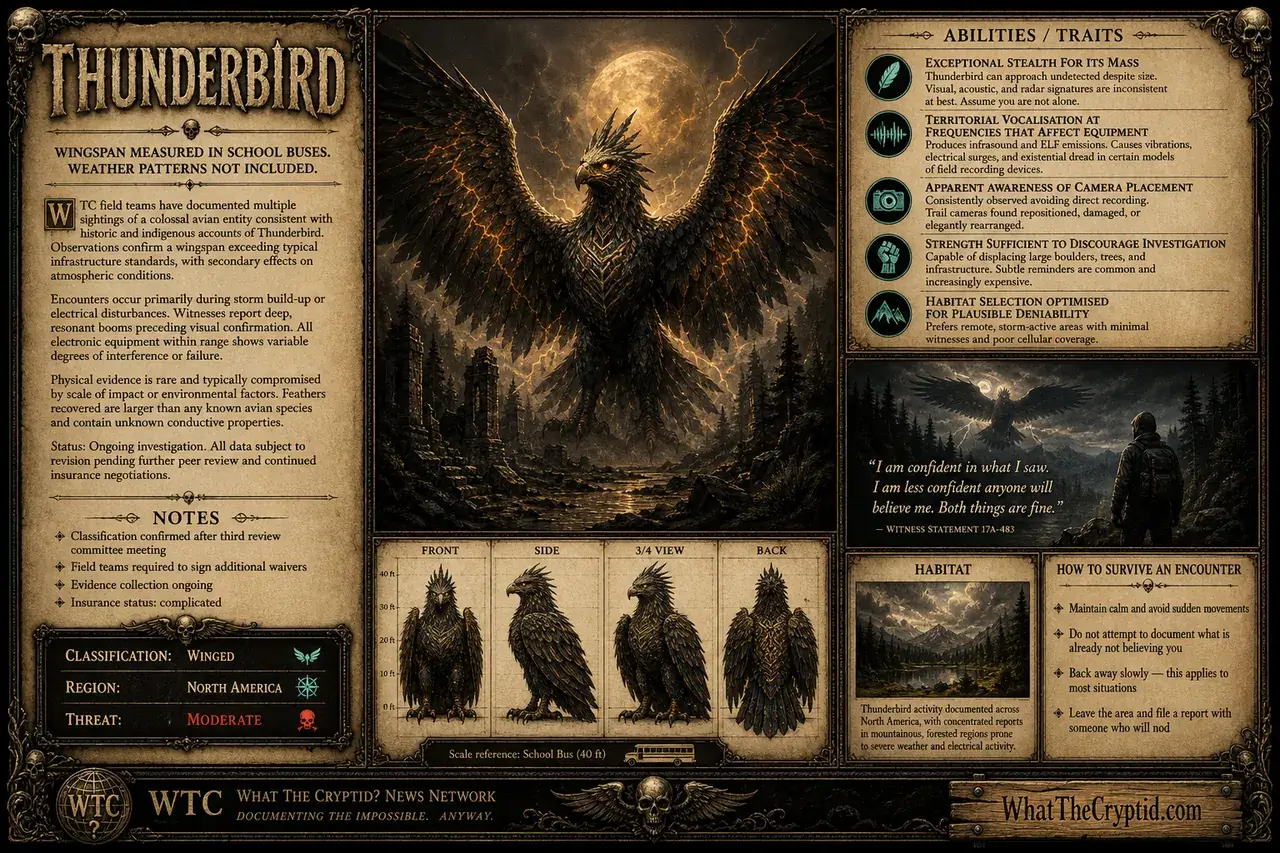
Thunderbird
Continent-spanning. Storm-summoning. Definitely not a large bird.
North America
Active
WingedNorth AmericaStorm AssociationHigh DangerIndigenous FolkloreActive
Overview
The Thunderbird is a large aerial cryptid documented across the full latitudinal span of North America, from the Pacific Northwest coast to the Great Plains to the Appalachian ridge. Witness accounts consistently describe a raptor-like entity of exceptional size — estimates placing the wingspan well beyond any extant avian species — associated with atmospheric disturbances including electrical storms, localised wind events, and, in several cases, precipitation that began within minutes of a confirmed sighting. WTC classifies it as Winged, a designation that our taxonomy committee agreed was technically accurate while acknowledging it may understate the situation.

The entity has been documented in oral traditions predating European contact by an unknown number of centuries, and in the written record continuously since the early nineteenth century. This longevity of documentation is either evidence of a persistent and real biological phenomenon or evidence of something WTC has been asked, by our legal department, not to speculate about in print. Field researchers note that the Thunderbird occupies a distinctive position among large cryptid fauna: unlike entities that are primarily encountered and then flee, the Thunderbird appears, in several documented cases, to have specifically approached the witness.
Current WTC assessment places the Thunderbird among the five highest-priority active North American aerial cryptids, a category that, as of this writing, contains two entries.
History & Mythology
Indigenous accounts of the Thunderbird are among the most geographically consistent cryptid records in the WTC database. Ojibwe oral traditions describe Animikii as a being of immense size capable of producing thunder through the beating of its wings and lightning through the opening and closing of its eyes — a behavioural description that would be straightforwardly mythological if subsequent sighting data had not continued to associate the entity with atmospheric anomalies. Lakota accounts of Wakinyan, the winged being of the west, describe a creature that nested in the Badlands and emerged during major storm systems. WTC notes that the Badlands remain an active sighting zone, which is either meaningful or coincidental and is probably both.
European settler records introduce the Thunderbird into the written cryptid archive in 1833, when a Midwestern newspaper described a ‘great bird of extraordinary dimensions’ observed by multiple witnesses near Alton, Illinois — the same stretch of the Mississippi River associated with the Piasa, a winged predatory entity depicted in Native rock art that French explorers documented in 1673. Whether the Piasa and the Thunderbird represent the same entity, regional variants, or separate species sharing a flight corridor is a question WTC has been attempting to resolve for eleven years.
The most frequently cited historical physical evidence claim — a photograph allegedly taken in Tombstone, Arizona in 1886, showing a large winged creature nailed to a barn wall with several men standing alongside — has never been definitively located despite being described by dozens of researchers who report having seen it. WTC’s archivist spent four months attempting to locate this photograph. She has asked that her conclusions not be published at this time.
Physical Description
Wingspan estimates across documented sightings range from twelve feet to a reported thirty-six feet, with the majority of accounts clustering between fourteen and twenty feet — a range that would place the Thunderbird significantly beyond the Andean condor, the largest confirmed living flying bird, whose wingspan reaches approximately ten feet six inches. Witnesses consistently describe a body proportioned like a large raptor: hooked beak, prominent talons, a heavy torso, and a wingspan disproportionately broad relative to body length. Plumage, where described, is most commonly reported as dark brown to black with occasional accounts of iridescent sheen visible in direct light, which a number of witnesses found difficult to reconcile with the scale of the animal.
The head is described in most accounts as large and somewhat flattened relative to comparable raptors, with a prominent supraorbital ridge giving the face a configuration that several witnesses, independently of one another, have described as ‘ancient-looking.’ Eye colour, in the subset of sightings close enough for this detail to be recorded, is reported as yellow or amber. The beak is described as substantially curved and, in three separate accounts, as noticeably pale against dark head plumage — a detail consistent enough across unrelated witnesses that WTC considers it a tentative diagnostic marker.
Regional variants are documented in the literature. Accounts from the Pacific Northwest tend toward larger wingspan estimates and describe a heavier, more barrel-chested build. Great Plains accounts describe a proportionally longer-winged, more slender entity. Whether these represent subspecies, individual variation, or the inherent imprecision of terrified eyewitness accounts is, in WTC’s professional assessment, probably some combination of all three.
Behaviour & Temperament
The Thunderbird is predominantly observed in flight, which is consistent with its apparent size and suggests it has correctly assessed that landing options are limited. Flight behaviour is described as involving extended periods of soaring with minimal wing movement, consistent with exploitation of thermal columns — an entirely reasonable strategy for an entity of this mass, and one that implies a working understanding of atmospheric conditions that WTC considers relevant to the storm-association data. Wing beats, when witnessed, are described as slow and powerful, and in proximate sightings have been reported to produce a sound variously described as ‘like sails,’ ‘like a tarpaulin in wind,’ and, in one 1977 account from West Virginia, ‘like something you feel more than hear.’
The entity does not appear to be systematically aggressive toward humans, though it has been documented engaging in what field researchers cautiously describe as ‘investigative behaviour’ — circling at low altitude above individuals in open terrain, maintaining sustained visual contact, and in at least four recorded incidents, descending to altitudes WTC’s threat committee considers inadvisable before departing without physical contact. This behaviour is difficult to categorise. It is not predatory in its outcome. It is not territorial in its execution. WTC’s consulting ornithologist suggested ‘curious,’ reconsidered, and asked that her name not be used.
Social structure is unknown. The overwhelming majority of sightings describe a single entity. Two individuals have been reported together on six documented occasions, all of which occurred during or immediately preceding significant weather events. Whether this represents pair bonding, cooperative behaviour, or something else is a question WTC’s behaviour team has been working on since 2019, largely because the alternative is admitting the data is insufficient.
Habitat & Territory
The Thunderbird has been sighted across an exceptional range of North American terrain, which presents genuine classification challenges for a species whose habits should logically constrain its distribution. Confirmed sighting clusters exist in the following zones: the Pacific coastal ranges of Washington, Oregon, and British Columbia; the Great Plains corridor from Texas north through the Dakotas; the Ohio and Mississippi river valleys; and the Appalachian mountain system from Georgia to Pennsylvania. This distribution pattern follows major geographic flyways used by migratory raptors, a fact that WTC’s ornithological consultants find either explanatory or coincidental, depending on which consultant you ask.
At higher elevations, the Thunderbird appears to favour exposed ridgelines and cliff formations consistent with large raptor nesting behaviour. No confirmed nest has been documented, though a formation in the Badlands of South Dakota — a series of large, flattened rock shelves at approximately 2,800 feet elevation showing long-term scarring consistent with repeated heavy contact — was assessed by WTC field teams in 2021. The assessment report was completed. Its conclusions are described internally as ‘significant pending further verification,’ which has now been pending for three years.
Diet & Hunting
Direct observation of Thunderbird predation is rare, and WTC acknowledges that ‘rare’ in this context means two incidents that meet minimum documentation standards and several others that do not. What the record does indicate is that the Thunderbird is carnivorous, opportunistic, and capable of taking prey substantially larger than any extant raptor. An 1890 account from Alaska describes an entity matching the Thunderbird’s description carrying what witnesses reported as a deer. A 2007 sighting in rural Pennsylvania, detailed in the sightings record, involved a witness observing an entity descend to a field and depart carrying livestock described as a medium-sized sheep, a claim that implies a carrying capacity requiring talons, grip strength, and flight musculature WTC’s consulting biomechanist described as ‘structurally demanding’ before declining to elaborate.
Large fish, particularly salmon during spawning runs in Pacific Northwest rivers, are referenced in Indigenous traditional accounts as a primary food source, and this is consistent with the geographic distribution data. The association with river valleys in the Mississippi and Ohio systems may similarly reflect prey availability rather than terrain preference. WTC notes that an entity of the documented size range would require caloric intake that, calculated against reasonable metabolic estimates, implies either a hunting success rate significantly above that of comparable raptors or a supplementary food source that has not been identified. Our consulting nutritionist found this detail interesting. She did not say so in a way that suggested she found it reassuring.
Notable Sightings
On the evening of July 25th, 1977, Marlon Lowe, age ten, was playing in the backyard of his family’s property in Lawndale, Logan County, when two large birds descended from the north. One of the birds, described by multiple adult witnesses including Lowe’s mother Ruth as having a wingspan of approximately ten feet and a body the size of a large dog, grasped Marlon by the shoulders and lifted him approximately two feet off the ground before releasing him after an estimated thirty-five seconds of forward movement. The child was uninjured. The birds departed south. The incident was reported to local authorities, subsequently covered by regional newspapers, and investigated by researchers from multiple organisations over the following eighteen months. Marlon Lowe did not give interviews about the incident after 1978.
In October 2002, pilot John Bouker and passenger reported observing a large bird flying alongside their Cessna 207 at approximately 1,000 feet altitude near the village of Port Heiden. Bouker, a commercial pilot with over a decade of bush flying experience, estimated the wingspan at fourteen feet and noted that the entity maintained pace with the aircraft for approximately sixty seconds before banking and descending toward the coastline. The sighting was corroborated by a second pilot, Moses Coupchiak, who reported observing an entity matching the description from a different aircraft in the same area on the same date. Both pilots filed informal reports. The Federal Aviation Administration’s official position on the incident is not recorded in any document WTC has been able to obtain.
A trail camera deployed by a private hunting concern on a ridgeline property in Vernon County captured three frames at 4:47 AM on September 11th, 2019, showing a large winged shape passing at low altitude against the pre-dawn sky. The frames are insufficient for wingspan measurement but were assessed by two independent image analysts as depicting an entity ‘inconsistent with any known regional avian species’ based on silhouette proportions. The property owner forwarded the footage to WTC voluntarily. He also forwarded it to the state Department of Natural Resources, who responded within two weeks with a letter citing technical limitations on species identification from night imagery and wishing him well.
In June 2007, a farmer named Dave Strickler reported observing a large bird land in a field adjacent to his property near Greensburg, Pennsylvania, remain stationary for approximately four minutes, and depart carrying what he identified as one of his sheep. Strickler reported the incident to local media and to WTC directly. A head count of his flock confirmed one animal unaccounted for. WTC field investigators visited the site seventeen days after the incident, documented a flattened area in the field consistent with a large contact impression, and collected several large feathers that were subsequently sent to a university laboratory for analysis. The laboratory’s report identified the samples as ‘avian in origin’ and noted it was ‘unable to match them to any species in the current reference database.’ Strickler reinforced his fencing the following week and described this measure, when asked, as ‘probably pointless but something to do.’
Threat Assessment
WTC assigns the Thunderbird a threat rating of High. This rating reflects documented carrying capacity, confirmed approach behaviour, and the straightforward physical reality of an entity in the fourteen-to-twenty-foot wingspan range operating at low altitude in proximity to humans. The rating does not imply that attack is probable — the Lawndale 1977 incident remains the only documented case of physical contact between a Thunderbird and a human, and the contact in that case was not sustained. It implies that the consequences of an escalated encounter would be severe and that prevention is the appropriate framework.
WTC recommends the following precautions in active Thunderbird sighting zones: avoid open elevated terrain during active storm systems or the forty-eight hours preceding them; if an entity is observed circling at altitude, move immediately toward tree cover or enclosed structures rather than remaining stationary in the open; do not approach or attempt to photograph from below. WTC also recommends awareness of atmospheric conditions as an indirect indicator — several witnesses have noted a drop in barometric pressure and cessation of ambient bird activity preceding sightings, a pattern consistent enough that field teams have been asked to treat sudden avian silence in known habitat as a preliminary alert. WTC acknowledges that the practical value of this recommendation depends on how quickly a person can move, which varies.
WTC Field Notes
WTC has maintained an active Thunderbird investigation file since the network’s founding, which is either a testament to the entity’s documented persistence or an indication of where our editorial priorities settled very early. The file currently comprises 847 individual sighting submissions, 23 of which meet WTC’s minimum corroboration standard for formal entry into the database. The remaining 824 are retained on the basis that our archivist has pointed out, correctly, that low corroboration is not the same as low probability, and that discarding data is a decision we would have to explain later.
The investigation budget for the Thunderbird has been a recurring agenda item at WTC editorial meetings since 2018, primarily because the most productive research methodology — extended aerial observation from a manned aircraft in known sighting corridors — is expensive, and because our insurance carrier responded to the initial proposal with a letter that our editor describes as ‘the most carefully worded refusal I have ever read.’ Current field operations are therefore limited to ground-based observation posts and trail camera networks. Of the thirty-one cameras deployed in active zones since 2019, seven have returned footage assessed as potentially significant. The remaining twenty-four reported mechanical failures of various descriptions. WTC has not drawn conclusions from this. We have, however, stopped buying cameras from the same supplier.