
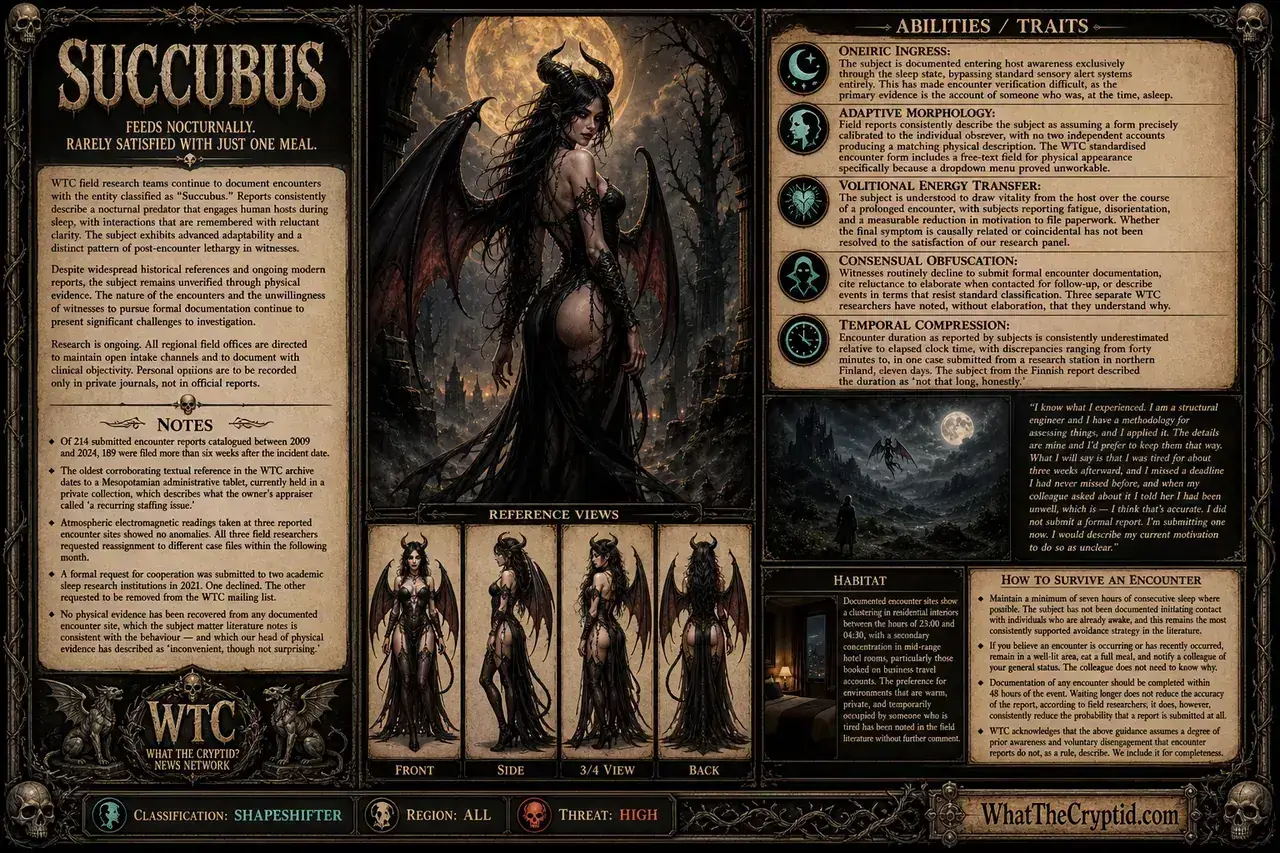
Succubus
Documented globally. Operational after midnight. Do not engage.
All
Active
SpiritNocturnalSleep IntrusionGlobalMythology
Overview
The succubus is a nocturnal spirit entity documented across every inhabited continent and in recorded human history spanning at least four thousand years, making it among the most consistently reported cryptids in the WTC database. It operates primarily during sleep cycles, engaging target subjects in scenarios that range from mildly disorienting to clinically significant, and has demonstrated a cross-cultural persistence that our research team finds either deeply meaningful or deeply inconvenient, depending on which member of the team you ask. It is classified by WTC as a Spirit-class entity on the basis of its apparent non-corporeal primary state, its capacity to interface directly with human sleep architecture, and the consistent failure of conventional detection equipment to register its presence despite witness accounts that are, by frequency and demographic breadth, difficult to dismiss.

The entity is sexually aggressive in its documented behaviour, a characteristic that distinguishes it from most Spirit-class entries in the database and has historically complicated serious academic treatment of the subject. WTC takes the position that the discomfort of researchers does not constitute evidence against an entity’s existence. The succubus is an operational phenomenon with documented physiological and psychological effects on witnesses, and it is catalogued here accordingly.
The masculine counterpart entity, the incubus, is taxonomically distinct in some cultural traditions and functionally interchangeable in others. WTC treats them as regional variants of a single classification rather than separate species, a decision that generated three weeks of internal correspondence and was ultimately resolved by editorial fiat.
History & Mythology
The earliest unambiguous textual references to the succubus appear in Mesopotamian records circa 2000 BCE, where the Lilitu — storm demons associated with wind, disease, and uninvited nocturnal visitation — are described in terms that align with modern witness accounts in several specific respects: the entity arrives during sleep, engages the subject in a state that is neither fully conscious nor unconscious, and departs before dawn. The Babylonian Talmud formalized the Lilith tradition around the 8th century CE, retroactively assigning the entity a biographical narrative — first wife of Adam, exiled, subsequently devoted to nocturnal predation — that may represent the earliest known attempt to explain a recurring experiential phenomenon through mythology. Whether this represents genuine folk memory of entity contact or an elaborate cultural framework for sleep paralysis is a question WTC has tabled for a later meeting.
Medieval European documentation is extensive and, by the standards of its era, methodologically serious. The theologian Thomas Aquinas addressed the succubus in Summa Theologica (c. 1265–1274), not to dispute its existence but to work through the logical implications of demonic reproduction — a level of institutional engagement that most WTC-covered entities have not achieved. The Malleus Maleficarum (1487) dedicated substantial text to succubus mechanics and countermeasures, providing documentation that is compromised by its broader context but not, on the specific subject of entity behaviour, internally inconsistent.
The 19th and early 20th centuries saw succubus activity reframed through emerging medical vocabulary — hypnagogia, sleep paralysis, erotic hallucination — in ways that explained the mechanism while declining to address why the mechanism produces consistent cross-cultural entity descriptions. Henry Fuseli’s 1781 painting The Nightmare depicts a figure consistent with documented succubus morphology sitting on the chest of a sleeping woman, and remains the most-reproduced image in the WTC art archive, a fact our licensing department is actively working to address.
Physical Description
The succubus presents in two distinct morphological states that witnesses consistently distinguish between, suggesting either genuine physiological variation or a deliberate adaptive strategy. In its approach state — documented in hypnagogic or sleep-paralysis accounts — the entity is frequently described as a weight on the chest, a pressure without visible form, or a dark shape at the periphery of a witness’s visual field. Estimated mass applied to the chest in these accounts ranges from 15 to 40 pounds by witness estimation, though no instrumented measurement has been obtained and WTC’s consulting physicist has requested that we stop asking.
In its manifest state, the entity presents as a humanoid female figure of approximately human proportions, typically described as conventionally attractive by the cultural standards of the witnessing population — a detail our anthropology consultant flagged as significant and our editor flagged as awkward to write about professionally. Height estimates across documented accounts average 5’6″ to 5’9″. Wing structures are reported in roughly 34% of manifest-state accounts, consistent with classical artistic depictions; these are described as membranous rather than feathered, with a span witnesses estimate at six to eight feet. Tail structures appear in approximately 19% of accounts. Both features appear to be optional rather than consistent morphological traits, which raises questions the entry cannot currently answer.
Skin colouration in manifest accounts skews toward deep red, grey, or blue-black in medieval and early modern European records, while accounts from South Asian, Middle Eastern, and African cultural contexts describe colouration closer to human-normative ranges. WTC notes this variance without drawing conclusions, as the alternative conclusions are each more uncomfortable than the variance itself.
Behaviour & Temperament
The succubus is, by documented behavioural profile, a nocturnal specialist. Approach activity is concentrated in the period between 2:00 and 4:00 AM, aligning with the deepest phase of the human sleep cycle and the period of highest REM density — a targeting precision that, if intentional, implies familiarity with human sleep architecture that WTC finds professionally noteworthy. The entity demonstrates strong preference for solitary targets; co-sleeping subjects are almost never simultaneously affected, and the non-targeted partner frequently reports noticing nothing unusual, a detail that has complicated more than one witness’s subsequent conversations.
Long-term behavioural patterns documented in multi-incident accounts suggest the succubus is capable of establishing repeat-contact relationships with specific individuals, returning across days, weeks, or in several historical accounts, years. The medieval concept of a “familiar demon” may in part document this behaviour. Subjects in repeat-contact accounts consistently describe progressive physical fatigue, difficulty concentrating during waking hours, and declining interest in ordinary social interaction — effects consistent with chronic sleep disruption and not requiring supernatural explanation, though the cause of the sleep disruption is the matter under discussion.
The entity does not, in the documented record, engage in overt physical violence. Its operational method is consensual in form if not in the technical sense of informed consent given by a fully conscious party, and witnesses who report distress typically report it in terms of the aftermath rather than the encounter itself. This has led some WTC researchers to classify the succubus as “low-aggression” by cryptid standards, a position the lead researcher on this entry formally disputes.
Habitat & Territory
The succubus does not appear to maintain a fixed habitat in any conventional territorial sense. Documented sightings are distributed across urban apartments, rural farmhouses, military barracks, monastery dormitories, university halls of residence, and at least two recorded incidents aboard vessels at sea, suggesting that the entity’s site-selection criteria relate to the presence of suitable subjects rather than environmental features of the location itself. It is, in this respect, one of the more adaptive entities in the WTC database — a generalist that has successfully colonised every human built environment without apparent modification of its core operating method.
High-frequency sighting clusters have been documented in locations associated with extended single-occupancy sleeping arrangements: long-haul travel accommodations, research stations, correctional facilities, and religious retreats. WTC does not draw conclusions from this pattern in print.
Diet & Hunting
The succubus is documented across source traditions as subsisting primarily on vital or psychic energy drawn from human subjects during contact events, a feeding mechanism described in medieval demonology as the extraction of the spiritus vitalis and in contemporary parapsychological literature as “pranic feeding” or “psychic vampirism.” The physiological reality of this mechanism cannot be confirmed by current instrumentation, but the downstream effects on subjects — documented fatigue, pallor, and in chronic exposure cases, measurable weight loss — are consistent across accounts and constitute the closest thing to empirical dietary evidence currently available.
Classical sources additionally attributed to the succubus the collection of male genetic material, reportedly transferred to an incubus counterpart for reproductive purposes — a logistical detail that Aquinas found sufficiently important to address in formal theology and that WTC’s editorial team debated including for approximately forty-five minutes before deciding that intellectual completeness required it. Whether this constitutes a dietary behaviour, a reproductive strategy, or a separate operational objective is not resolved in the source literature, and WTC is not in a position to resolve it here.
Notable Sightings
The Loudun Possessions — the most extensively documented mass spiritual intrusion event in European history — included multiple accounts from Ursuline nuns describing nocturnal visitation by entities consistent with the succubus profile. Sister Jeanne des Anges provided testimony describing a manifest-state entity with specific morphological details including wing structure and applied weight on the sternum, recorded by ecclesiastical investigators in terms that suggest the witnesses were treated as credible sources. The events resulted in the execution of Father Urbain Grandier, who maintained his innocence, and the eventual beatification of Sister Jeanne des Anges, who did not maintain her original account consistently across the seven years of proceedings.
The Afrikaner folklore tradition of the Tokoloshe and the older Zulu concept of the Isidliso overlap in this period with Dutch colonial records describing a succubus-consistent entity referred to in ships’ logs as “de nachtbezoeker” — the night visitor. A VOC officer’s journal entry dated March 1778, held in the Nationaal Archief in The Hague, describes three consecutive nights of visitation by a figure he characterises with unusual anatomical specificity for a document that was presumably subject to review, and notes that he subsequently requested reassignment to a different posting. The reassignment was granted without recorded explanation.
The Great Amherst Mystery, a documented poltergeist case, included within its broader activity profile two accounts by Esther Cox describing nocturnal visitation by a figure she identified as distinct from the primary poltergeist entity — a manifest-state encounter with reported tactile contact and the characteristic chest-pressure approach. The case was investigated by actor and paranormal researcher Walter Hubbell, whose 1879 book The Great Amherst Mystery documented the accounts in full and achieved sufficient sales to fund three subsequent editions. Cox’s accounts of the succubus-type entity received substantially less public attention than the poltergeist activity, possibly because they were harder to stage for a live audience.
A U.S. Army forward operating base reported a cluster of seven separate sleep-intrusion incidents over a 23-day period, each incident occurring between 0200 and 0400 hours and involving a manifest-state entity described with consistent morphological features across all seven accounts by soldiers who had not, according to base records, discussed their experiences with one another prior to reporting. The accounts were recorded by a chaplain’s assistant and forwarded through unofficial channels. WTC received a partial transcript in 2014 from a source who has since declined further contact. The base was decommissioned in 2011, and official records do not reference the incidents.
Threat Assessment
The succubus presents a threat profile unlike most entities in the WTC database in that the primary risk is not acute physical harm but cumulative physiological and psychological impact from repeated exposure. Single-incident contact, while disorienting, does not appear in the documented record to produce lasting physical injury. Chronic exposure — defined by WTC as three or more incidents within a 30-day period — is associated with fatigue, cognitive impairment, social withdrawal, and in historical cases of extended contact, outcomes that the source literature describes as fatal and that WTC classifies as unconfirmed but not implausible given the reported trajectory.
WTC recommends the following for individuals who believe they may be in an active contact situation: maintain a co-sleeping arrangement where possible, as the entity demonstrates strong preference for solitary targets; document incidents in writing immediately upon waking, including time, duration estimate, and any distinguishing entity features; consult a sleep specialist to establish a clinical baseline, both because sleep disruption is a genuine medical concern independent of cause, and because ‘I need a baseline for succubus monitoring purposes’ is a sentence best delivered to a professional who has heard stranger things. Traditional countermeasures documented across cultures — salt at thresholds, iron objects, specific prayers or mantras depending on religious tradition — have not been tested by WTC under controlled conditions, and we are candid that designing that study has presented methodological challenges we have not yet resolved. We advise individuals not to rely exclusively on guidance from an organisation whose primary field equipment budget was cut by 40% in the last fiscal year.
WTC Field Notes
The succubus entry has been in active revision for eleven months, a duration our editor attributes to the research challenges inherent in the subject matter and that our lead researcher attributes to the editorial team’s recurring requests to ‘soften the tone’ of sections they found personally uncomfortable. The current text represents a compromise position that neither party is fully satisfied with, which WTC takes as a reasonable indicator that we got it approximately right.
Field investigation of succubus activity presents logistical complications that do not arise with most cryptids. Standard WTC deployment protocol — two researchers minimum, overnight observation, continuous audio and video documentation — is not straightforwardly applicable to an entity that operates during sleep and has demonstrated consistent ability to avoid detection by waking observers. Our one attempt at instrumented overnight monitoring, conducted at a private residence in rural Vermont in 2021 with the homeowner’s full cooperation, produced eight hours of unremarkable audio, a thermal camera that reported a firmware error at 3:17 AM and required factory reset, and a field researcher who submitted a detailed incident report the following morning and then took two weeks of personal leave. The incident report is held in the WTC archive. We have not published it. The researcher has not authorised its publication, and we consider that a reasonable position given its contents.