
Queensland Tiger
Striped. Carnivorous. Taxonomically inconvenient.
Australia/Pacific
Unverified
MarsupialMegafaunaAustraliaRelict SpeciesApex Predator
Overview
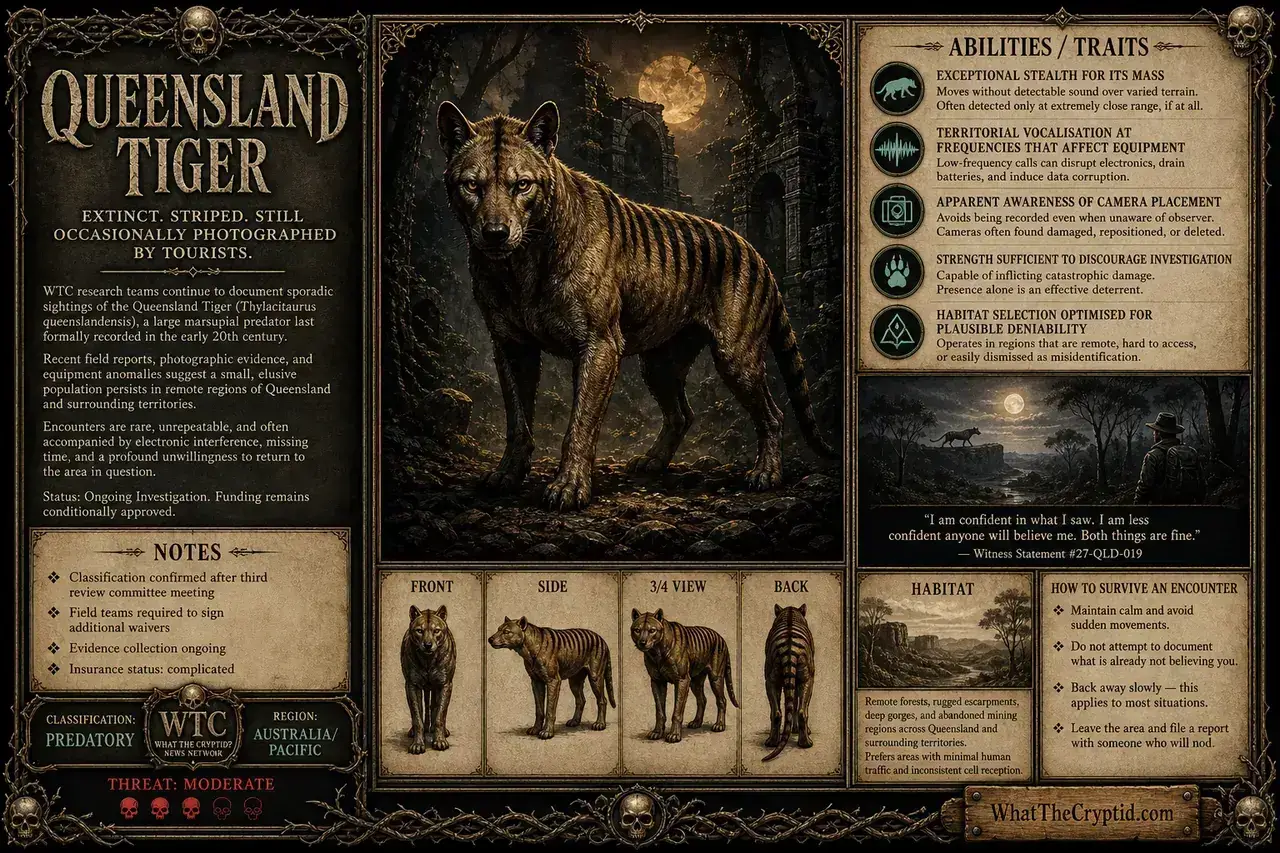
The Queensland Tiger is a large, striped, quadrupedal predator reported across the rainforests and scrublands of northern Queensland, with a smaller cluster of sightings extending into the Northern Territory and northern New South Wales. Witnesses consistently describe an animal of approximately dog-to-leopard size, bearing dark transverse stripes across a tawny or grey-brown body, with a distinctively stiff, heavy tail and a gait observers frequently characterise as ‘wrong’ — a term that has appeared in fourteen independent accounts and which WTC has been unable to improve upon. The prevailing hypothesis among researchers who are willing to go on record is that the animal represents a relict population of Thylacoleo carnifex, the marsupial lion, or a closely related descendant lineage. The prevailing hypothesis among researchers who are not willing to go on record is largely the same, with additional commentary WTC is not in a position to publish.

Australia’s documented history of megafaunal survival past accepted extinction dates lends the Queensland Tiger a degree of plausibility that its counterparts in other regions have not always enjoyed. The thylacine — formally declared extinct in 1936 following the death of a single captive individual, a standard of evidence that WTC notes would not satisfy most civil courts — was itself reported as a Queensland resident centuries before European settlement, suggesting the continent has a well-established tradition of large predatory marsupials existing in places they are not supposed to. The Queensland Tiger is, in this context, either a second remarkable example of megafaunal persistence or a remarkably consistent shared hallucination spanning two centuries of witnesses from unconnected communities. WTC has formed no official position on which of these interpretations is more troubling.
History & Mythology
Aboriginal accounts of a large striped carnivore predate European settlement by an indeterminate period, with the Yarri described in oral traditions from multiple Queensland language groups as a dangerous animal associated with dense scrub and creek systems — a habitat preference that aligns precisely with the majority of post-contact sightings. The name ‘Yarri’ appears in ethnographic records as early as 1871, collected by surveyor and amateur naturalist George Dalrymple during his expedition to the Johnstone River region, though Dalrymple’s notes treat the accounts as folklore rather than field data and are therefore of limited direct use. WTC acknowledges this distinction while noting that the survey also failed to document the cassowary as a species worth mentioning.
The first formally documented European encounter is attributed to Henry Johnstone, who reported seeing an unidentified striped animal near the Cardwell Range in 1877, describing it in correspondence as ‘larger than a dog and moving in the manner of no dog I have seen.’ The report was forwarded to the Queensland Museum, where it was filed. In 1905, naturalist Carl Lumholtz referenced persistent local accounts of a large cat-like marsupial during his survey of north Queensland fauna, though he was unable to obtain a specimen. The 1930s and 1940s produced a cluster of stockman accounts from the Atherton Tablelands that were collected by Queensland Museum curator Ambrose Pratt and subsequently lost in a filing reorganisation in 1958 — the precise scope of this loss remains unknown, as the catalogue of what was lost was also lost.
Physical Description
Witnesses describe an animal ranging from 1.2 to 1.8 metres in body length, with a tail adding a further 60 to 80 centimetres. Estimated shoulder height falls consistently between 45 and 65 centimetres, placing the animal within the size range of a large domestic dog or small leopard. The coat is described as short and dense, with colouration ranging from tawny yellow to grey-brown, overlaid with 6 to 12 dark transverse stripes that begin at the shoulders and extend to the base of the tail. The stripes are consistently reported as darker and more defined toward the hindquarters — a detail that appears independently across enough accounts to be considered a diagnostic feature rather than a coincidence of imagination.
The head is described as disproportionately large for the body, with a wide, blunt muzzle and jaw structure that multiple witnesses have compared to a dog rather than a cat, despite the overall feline impression of the animal. The ears are short and rounded. The tail is thick at the base and reportedly held in a stiff, slightly raised position during movement — a characteristic more consistent with marsupial locomotion than with any placental carnivore. Two witnesses, independently, used the phrase ‘like it was bolted on.’ The forelimbs are described as notably robust relative to the hindquarters, which aligns with the known anatomy of Thylacoleo, and WTC acknowledges this alignment while noting that it does not constitute confirmation of anything.
Behaviour & Temperament
The Queensland Tiger is, by all available accounts, a largely crepuscular or nocturnal animal. The majority of sightings occur at dawn, dusk, or at night in the sweep of vehicle headlights, with daytime encounters concentrated in heavily overcast conditions or deep rainforest where light levels are reduced. This activity pattern is consistent with an apex predator managing heat load in a subtropical environment, which is a reasonable thing to do, and WTC notes that the animal’s schedule is arguably more sensible than that of several of our field researchers.
Witness accounts characterise the Queensland Tiger as non-aggressive toward humans in the majority of encounters. The typical response to detection is immediate withdrawal into dense vegetation, with a speed and silence that witnesses consistently find disproportionate to the animal’s apparent bulk. In three recorded instances, the animal was observed for periods exceeding two minutes before departing — in each case, the observation ended when the animal chose to leave rather than when the witness retreated. Territorial vocalisation has been reported on several occasions, described variously as a ‘coughing bark,’ a ‘clicking growl,’ and, in one account from a National Park ranger in 1994, ‘the sound a dog would make if the dog had made a significant error.’ No audio recording of confirmed quality exists. The exception to the non-aggressive pattern is a small number of livestock-predation events in which animals have reportedly been killed with a bite to the back of the skull — a method characteristic of Thylacoleo based on palaeontological reconstruction of jaw mechanics, which WTC finds either compelling or convenient depending on the day.
Habitat & Territory
The Queensland Tiger shows a strong preference for the dense wet sclerophyll forests and rainforest margins of the Wet Tropics bioregion, with the highest density of credible sightings concentrated between Cairns and Cooktown, and a secondary cluster around the Atherton Tablelands at elevations between 700 and 1,100 metres. Creek systems and river gullies appear to function as movement corridors, with a notable number of sightings occurring within 200 metres of permanent water. The species appears to avoid open cleared land except when crossing between habitat patches at night, and shows a documented preference for terrain that a pursuit predator would find impractical — steep, vine-tangled ground with limited sightlines, which is also, WTC notes, terrain that makes follow-up investigation by field teams statistically likely to be inconclusive.
Sparser sightings from the Gulf Country and Cape York Peninsula suggest a broader range than the core rainforest habitat would indicate, and some researchers have proposed a seasonal movement pattern linked to prey availability and dry season water sources. If accurate, this would suggest a home range in excess of several hundred square kilometres per individual, which would partially explain the low encounter frequency and the complete absence of a confirmed specimen.
Diet & Hunting
The Queensland Tiger is assessed as an obligate carnivore based on the totality of sighting context and the physical characteristics described by witnesses. Documented prey species associated with confirmed or probable Queensland Tiger activity include wallabies, pademelons, scrub turkeys, and on at least eleven occasions, domestic livestock — principally sheep and calves, with one reported incident involving a pig of approximately 80 kilograms that was found 340 metres from where it had last been observed alive. The method of relocation has not been formally explained.
Kill-site examinations conducted informally by landholders and on two occasions by WTC personnel have noted the consistent absence of caching behaviour — carcasses are consumed at or very near the kill site, which is consistent with a solitary predator in a habitat where scavenging competition is limited. The jaw structure described by witnesses, combined with the skull-bite predation method reported in livestock cases, suggests a capacity for extremely high bite force relative to body size — a characteristic that defines Thylacoleo among known marsupials and that WTC’s consulting palaeontologist described as ‘not a detail most witnesses would independently arrive at,’ before clarifying that this was an observation and not a conclusion.
Notable Sightings
Forestry worker Derek Masson reported an encounter while conducting a routine track survey approximately 14 kilometres east of Ravenshoe. Masson described an animal crossing the fire trail ahead of him at a distance of roughly 25 metres, pausing briefly to face him before moving into the regrowth. He noted the stripes as the animal’s most immediately striking feature, and described the tail as ‘held up like a poker.’ Masson, who had worked in the region for eleven years and expressed familiarity with all documented native fauna, stated that he had no explanation for what he had seen. He reported the sighting to his supervisor the same afternoon and submitted a written account to the Queensland Department of Environment the following week; the department’s response, received six weeks later, thanked him for his report.
Dairy farmer Ken Appleyard discovered three sheep dead in a paddock adjoining a section of uncleared scrub, each killed by what a visiting veterinarian described as ‘a bite to the posterior cranium of unusual force, from an animal the jaw morphology of which I cannot identify.’ Appleyard reported hearing a vocalisation from the scrub line on two occasions in the preceding week, which he described as unlike any animal he recognised after thirty years of farming the same property. A wildlife officer attended the site four days after the report was filed. The veterinarian subsequently declined to provide a written statement, noting that she had a conference to prepare for.
British tourists Martin and Claire Forsythe photographed what they described as a large striped animal resting on a fallen log approximately 18 metres from a walking track at 6:47 in the morning. The couple spent an estimated ninety seconds observing the animal before it rose and walked without apparent urgency into the surrounding rainforest. The photographs, taken on a 35mm film camera, were submitted to WTC upon the couple’s return to the United Kingdom and revealed, upon development, a partially obscured shape of ambiguous detail that our photo analyst described as ‘consistent with several things.’ The Forsythes were interviewed by phone and maintained their account without revision. They have not returned to Australia.
A Northern Peninsula Area ranger, who requested that WTC not publish her name but who is known to us, reported observing a large striped animal from her vehicle on a remote management track at approximately 05:20, in the headlights at a range of roughly 30 metres. The animal stood and faced the vehicle for an estimated forty seconds before departing into low scrub. She noted in her written account that she had worked in Cape York for seven years, was familiar with all species known to inhabit the region, and that the animal she observed was not among them. Her report was submitted through internal channels. She transferred to a coastal station the following month, which she attributed to a longstanding interest in marine environments.
Threat Assessment
The Queensland Tiger presents a threat profile that WTC assesses as High for unsuspecting individuals in low-visibility conditions and considerably lower for those who are aware of the animal’s documented behavioural tendencies. The majority of encounters have concluded without physical contact, and the animal’s preference for immediate withdrawal upon detection suggests that the primary risk factor is not aggression but the possibility of startling a large carnivore at close range in terrain that limits escape options for both parties. WTC recommends maintaining a minimum distance of 50 metres if observation is achieved, refraining from pursuit under any circumstances, and avoiding scrub-line areas adjacent to water sources between dusk and dawn without a working torch and at least one other person who is aware of your location.
In areas with reported livestock predation activity, WTC recommends against approaching kill sites, which may be revisited within 24 to 48 hours. If a Queensland Tiger is encountered at close range, the documented response of remaining still and avoiding direct eye contact appears — based on the available evidence — to be more effective than flight, though WTC acknowledges that this advice is based on a sample size that does not inspire statistical confidence. Carry a personal locator beacon in remote habitat. This recommendation applies regardless of cryptid activity and is simply good practice in northern Queensland, where the non-cryptid hazards are also considerable.
WTC Field Notes
WTC dispatched a two-person field team to the Wet Tropics region in October 2019 with a brief to conduct a structured camera-trap survey across six sites identified from sighting cluster analysis. The team deployed eleven cameras over a nine-day period and recorded, across approximately 800 camera-nights of footage, an extensive and scientifically valuable record of cassowary, Boyd’s forest dragon, musky rat-kangaroo activity, and one instance of a field researcher walking directly in front of a camera at 2 AM in a manner that required a separate conversation with HR. No Queensland Tiger was recorded. The cameras at two sites experienced unexplained power failures during the survey window, which the team documented and which our equipment supplier attributed to humidity. The survey was classified internally as inconclusive rather than negative, a distinction our editor describes as ‘meaningful’ and our insurance provider describes as ‘not a recognised category.’
WTC maintains an open file on the Queensland Tiger and is actively seeking researchers with relevant field experience and their own vehicle, as the hire car from the 2019 expedition was returned with damage to the undercarriage that remains a matter of ongoing discussion with the rental company. Witnesses with accounts from the Cape York Peninsula or Gulf Country are encouraged to contact us through the standard submission portal. We ask that all submissions include the date, approximate location, and duration of the encounter, and we note for the record that ‘I don’t know what I saw but I know what it wasn’t’ is not, in our assessment, an unhelpful starting point.