
Nandi Bear
Larger than it should be. Faster than seems fair.
Africa
Unverified
AfricaPredatoryCryptid CarnivoreKenyaUnidentified Predator
Overview
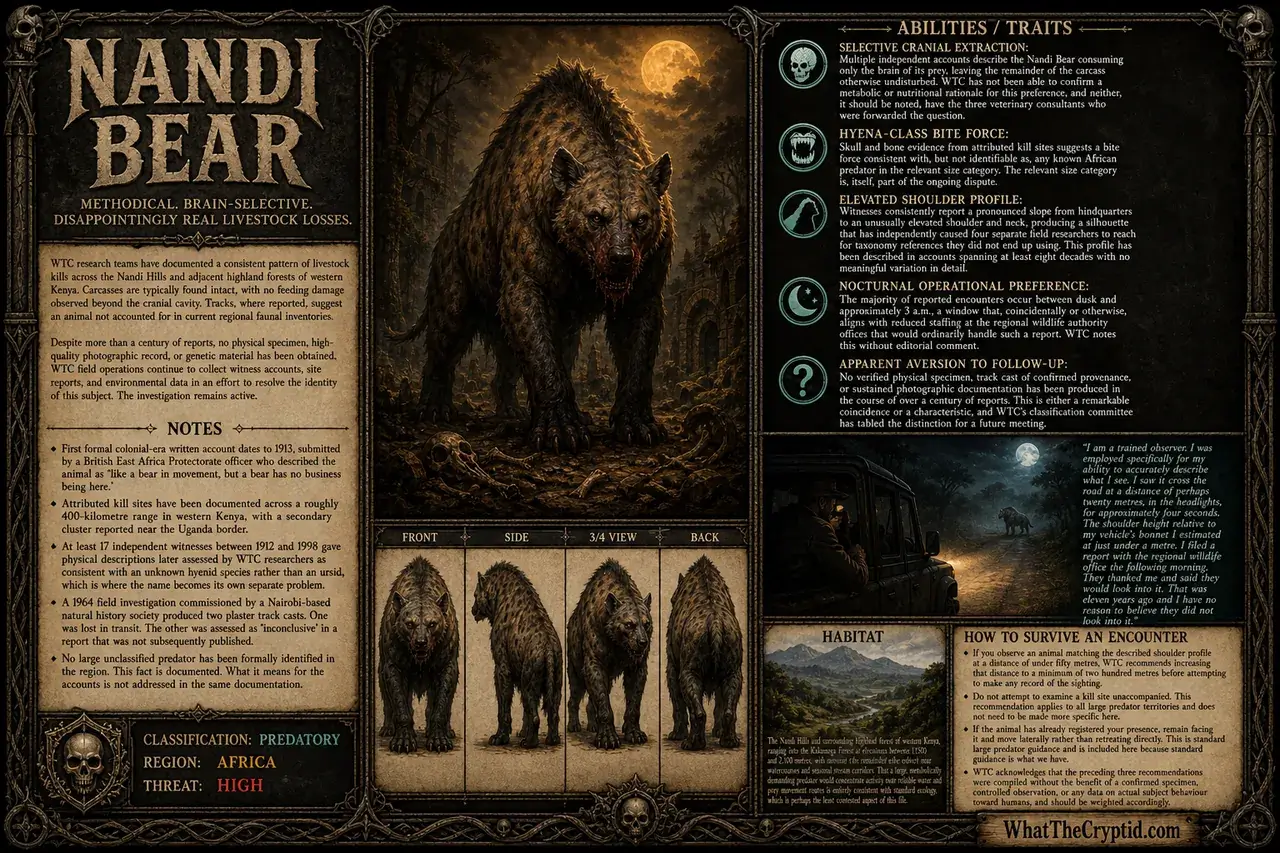
The Nandi Bear is a large, terrestrial predator reported across the highland and forested regions of East Africa, with the majority of documented encounters concentrated in the area historically occupied by the Nandi people of western Kenya. It is described consistently across independent witness accounts as bearing superficial resemblance to a hyena in gait and profile, while exceeding any known hyena species in body mass by a margin that our consulting zoologist described, after some reflection, as ‘significant.’ It moves primarily at night, is documented to preferentially attack the skulls of its prey, and has been observed — on at least three recorded occasions — to abandon a kill upon detecting human presence rather than defend it, which some field researchers have interpreted as intelligence and others have interpreted as something they prefer not to name.

The entity occupies an unusual position in the WTC Cryptid Database in that it is one of very few subjects for which a plausible zoological candidate has never been satisfactorily agreed upon. Proposed identifications have included a surviving specimen of the prehistoric short-faced hyena Pachycrocuta brevirostris, a relict population of Chalicotheriidae, and — in one submission to WTC that was reviewed and ultimately filed — ‘some kind of bear, but African.’ Each of these explanations resolves some witness reports and is irreconcilable with others, which is either a sign that multiple animals are being conflated or a sign that the Nandi Bear is not cooperating with classification efforts.
WTC classifies the Nandi Bear as Predatory based on documented prey evidence, attack patterns, and the cumulative weight of field testimony from professional hunters, colonial administrators, and local communities whose accounts of the animal predate European contact by an undetermined period. The classification is not in dispute internally. The animal’s precise taxonomy remains, for now, a separate question.
History & Mythology
Accounts of the Chemosit — the name most commonly used among the Nandi and Kipsigis peoples of western Kenya — appear in oral tradition as a creature associated with night raids on livestock and, in some accounts, the selective removal of human skulls. The Nandi description of the Chemosit is specific enough to suggest repeated, direct observation rather than mythological elaboration: it is described as walking on its hind legs when moving slowly but dropping to all fours at speed, a detail that has appeared in independent European field reports with enough consistency to warrant its inclusion here without qualification.
The first documented encounter in the colonial record was filed by Geoffrey Williams in 1905, who reported observing a large, unknown animal crossing a road near Nandi territory at close range during daylight hours. Williams, who had extensive African field experience, stated that the animal resembled no species he had previously encountered and that its forequarters were disproportionately elevated relative to its hindquarters — a profile he compared, with evident reluctance, to that of a bear. His report was received by the relevant authorities and, as far as WTC has been able to determine, not acted upon. The following decades produced a steady accumulation of similar reports from hunters, settlers, and district officers across Uganda, Kenya, and Sudan, several of whom had professional reputations they were visibly concerned about protecting, which WTC considers a useful indicator of sincerity.
A 1919 report from Major W. Robert Foran described fresh tracks of an unidentified animal measuring nine inches across near the Uasin Gishu Plateau, accompanied by a kill site in which the prey animal’s skull had been opened and the brain removed with what Foran assessed as mechanical precision. Foran, a published naturalist, stated that the tracks were inconsistent with any known large predator in the region. He did not report the finding to a zoological authority. He reported it, eventually, to a journalist, which is how it reached WTC’s historical archive.
Physical Description
Witness accounts, when cross-referenced across the documented record, converge on a body plan that is broadly consistent and specifically troubling. The Nandi Bear is described as standing between four and five feet at the shoulder on all fours, with a pronounced slope from elevated forequarters to lower hindquarters that gives the animal its characteristic hyena-like silhouette. Body length estimates from credible close-range sightings range from six to eight feet, with a weight that experienced hunters and trackers have independently estimated at between 350 and 500 pounds — a figure that places it outside the size range of any extant African carnivore with the exception of the hippopotamus, which is not carnivorous and is, in any case, shaped differently.
The coat is described as reddish-brown to dark brown, coarse in texture, and notably thick across the neck and upper back — a detail that several witnesses have noted independently and that, taken together with the elevated shoulder profile, has contributed to the ‘bear’ identification despite bears having no confirmed presence in sub-Saharan Africa during the relevant period. The head is described as large relative to body size, with a broad, flat face and small eyes that witnesses reporting nocturnal encounters consistently describe as reflecting light in a manner distinct from known regional predators. The forelimbs are described as heavily muscled. The claws, in accounts where they were visible, were described as non-retractile and substantial.
A small number of reports, primarily from the Sudan and Uganda border regions, describe a variant that is darker in colouration and somewhat smaller in overall frame, and which witnesses associate specifically with forested rather than open highland terrain. WTC treats this as a possible regional variant pending further documentation, and notes that the core morphological features — the sloped back, the heavy forequarters, the distinctive skull-opening behaviour — are consistent across both sets of accounts. This consistency is either reassuring or the opposite, depending on one’s perspective.
Behaviour & Temperament
The Nandi Bear is primarily nocturnal, with the overwhelming majority of sightings occurring between dusk and approximately two hours before dawn. Daytime encounters, while documented, are rare enough to have been treated by witnesses as notable departures from expected behaviour — one 1934 report from a British district officer described the animal crossing an open road at midday and appearing, in the officer’s phrasing, ‘entirely unbothered by the inconvenience of being seen.’ Solitary behaviour is the consistent pattern across all documented encounters; no confirmed group sightings exist, which either reflects a genuinely solitary social structure or a population density low enough that multiple individuals are statistically unlikely to appear in the same location at the same time. WTC’s field teams have not been in a position to distinguish between these possibilities.
The most consistently documented behavioural trait of the Nandi Bear is its attack pattern. Across livestock kills attributed to the animal, the prey is found with the skull breached and the brain consumed, while the remainder of the carcass is left largely or entirely intact. This is a sufficiently specific and unusual feeding behaviour that it has become one of the primary diagnostic criteria for attributing a kill to the Nandi Bear rather than known predators. The energetic logic of consuming only the brain of a large prey animal — and the question of whether this represents genuine dietary preference, selective feeding under time pressure, or something else entirely — is something WTC has raised in two separate editorial meetings without arriving at a conclusion.
Witnesses who have encountered the Nandi Bear at close range consistently report that the animal does not immediately flee. It pauses. Several accounts describe a period of mutual observation lasting between thirty seconds and what one witness estimated as ‘considerably longer than felt reasonable’ before the animal withdrew, typically into dense cover, at a speed witnesses describe as impressive for its apparent size. It does not, in the documented record, charge. Whether this reflects temperamental restraint, a risk calculation, or the simple fact that most witnesses who prompted a charge did not subsequently file reports is a question the data cannot answer.
Habitat & Territory
The Nandi Bear’s documented range spans the highland and transitional forest zones of western Kenya, particularly the Nandi Hills and the Uasin Gishu Plateau, with a secondary concentration of reports from the Ugandan border region and isolated accounts from southern Sudan. It shows a consistent preference for terrain that offers dense cover in proximity to open ground — forest edges, the margins of highland scrub, and the transitional zones between cultivated land and unmanaged bush that characterise much of its core range. Elevations in the primary habitat zone run between 5,500 and 7,000 feet above sea level, which places the animal in cooler, wetter terrain than is typically associated with Africa’s known large predators.
Proximity to water is a consistent feature of high-confidence sighting locations, with rivers, seasonal streams, and highland wetlands appearing repeatedly in the location data. This may reflect the distribution of prey species, the animal’s own hydration requirements, or simply the fact that water features are landmarks that allow witnesses to precisely describe where they were when they encountered something they subsequently struggled to explain to anyone. WTC notes that the habitat described above is, on balance, exactly where a large, solitary, nocturnal predator would be if it had any interest in not being found.
Diet & Hunting
The Nandi Bear’s diet, as reconstructed from kill site evidence and direct observation accounts, centres on the brains of large mammals. Livestock — cattle, sheep, and goats — are the most frequently documented prey, with the attack pattern characterised by a single, targeted breach of the cranium and removal of the brain, leaving the remainder of the animal largely undisturbed. This has been attributed to, variously, dietary specialisation, the caloric density of neural tissue relative to the effort required, and — in one submission to WTC’s research desk that was acknowledged but not incorporated into the official record — ‘preference.’ In multiple historical accounts, the animal has been credited with killing significantly more animals than it consumed in a single raid, a behaviour consistent with surplus killing documented in other large predators but notable here given that the only portion consumed was, in each case, the brain.
Accounts of direct predation on wild prey are less numerous but consistent in type. Baboon troops in the Nandi Hills region have been found with casualties showing the same cranial signature, and at least two accounts from professional hunters describe the Nandi Bear taking prey in the medium-to-large ungulate range. No direct observation of a complete hunting sequence has been documented. What is known is the outcome. The method — whether ambush, pursuit, or some third approach that witnesses have not been positioned to observe — remains unrecorded, which, given the animal’s preferred target, may not be entirely coincidental.
Notable Sightings
Geoffrey Williams, a trader with extensive East African field experience, reported observing an unidentified large animal crossing the road ahead of his party at a distance of approximately forty yards during early morning light. He described the animal as the size of a large lion but built along fundamentally different proportions, with forequarters noticeably higher than the hindquarters and a coat he described as ‘reddish-brown and coarse.’ His party halted. The animal crossed the road without altering its pace and entered the bush on the opposite side. Williams filed a written account with the local colonial administration and spent the following years being asked to clarify whether he might have seen a hyena, which he consistently declined to accept.
Major W. Robert Foran investigated a livestock kill site on the plateau and documented tracks measuring nine inches in width at the widest point, with a stride length inconsistent with any predator species he had previously tracked in the region. The kill — a fully grown ox — had been left intact from the neck down; the skull had been opened and the brain removed. Foran photographed the tracks and the kill site and consulted with two other experienced hunters before concluding, in his written account, that he could not identify the animal responsible. The photographs were submitted to a publication and subsequently lost before they could be reproduced.
A ranger employed by the Kenya Wildlife Service reported encountering a large unidentified animal at approximately 11:40 PM while conducting a routine patrol on foot near the forest boundary. He described the animal as approximately the height of his chest at the shoulder, with a sloped back profile and eyes that reflected his torch beam in an amber colour he did not associate with any animal he had previously encountered on patrol. The animal remained stationary for what he estimated as forty-five seconds before withdrawing into the forest at speed. The ranger submitted a formal incident report the following morning, which was logged, reviewed by a supervising officer, and filed under ‘wildlife encounter — species unconfirmed.’
A farmer reported the overnight loss of four cattle from a secured enclosure, with all four animals found dead at dawn with identical cranial injuries and their brains removed. The enclosure fencing was intact on three sides; on the fourth, two fence posts had been pushed inward with sufficient force to bend the metal brackets, suggesting contact from an animal of considerable mass. Kenya Wildlife Service officers attended the scene, documented the injuries, collected soil samples from the perimeter, and departed. The farmer reported two subsequent incidents in the following month. He has since installed additional fencing, which he confirmed to a regional journalist is taller than the original but that he declines to specify by how much.
Threat Assessment
The Nandi Bear should be considered a high-threat entity in any context involving proximity to its documented range during nocturnal hours. WTC recommends a minimum precautionary distance of 100 metres upon visual identification, acknowledging that in the forested and transitional terrain of the primary habitat zone, visual identification at this distance is not consistently achievable. Torch or headlamp use in known habitat areas is strongly recommended for reasons that will be apparent from the sighting record. Livestock enclosures in the region should meet a structural standard sufficient to resist lateral pressure from a large bovid, which field evidence suggests may also be approximately sufficient for the Nandi Bear, though WTC does not make this guarantee.
Direct encounter protocol, based on documented witness outcomes, suggests that maintaining eye contact, avoiding sudden movement, and not positioning yourself between the animal and dense cover are the options most consistent with continued field viability. The animal has not, in the documented record, initiated contact with a human who did not first approach it — a pattern WTC considers informative but declines to describe as reassuring, given that the documented record is necessarily compiled only from witnesses who were in a position to report afterward. Lone travel at night in the Nandi Hills, Uasin Gishu Plateau, and Kakamega Forest margin areas is not recommended. WTC’s threat rating for the Nandi Bear is High.
WTC Field Notes
WTC dispatched a field team to western Kenya in 2017 with the intention of deploying motion-activated trail cameras along the Nandi Hills forest boundary and the eastern margin of Kakamega Forest. The team successfully deployed eleven cameras across six sites over eight days. Eight of the eleven cameras experienced mechanical or battery failures within the first seventy-two hours of deployment. The remaining three returned footage of buffalo, a monitor lizard of notable size, and forty-seven minutes of empty path recorded between 2:17 and 3:04 AM on the sixth night, during which the audio track captured sounds that our sound engineer described as ‘not wind’ and then asked not to be quoted further.
The 2017 expedition produced no direct photographic evidence of the Nandi Bear. It produced expense receipts, a detailed topographic survey of potential habitat, and a field report from team lead Dr. Amara Osei that WTC considers the most thorough assessment of the entity’s probable range currently available. Dr. Osei has indicated she is willing to return for a second expedition under the condition that the camera equipment budget be increased to a figure our current operating costs do not support. WTC is pursuing grant funding for a follow-up. In the meantime, the Nandi Bear entry in the WTC Cryptid Database is marked Active, which reflects both the pattern of ongoing reported incidents and, frankly, the audio from night six.