
Lizard Man of Scape Ore Swamp
Bipedal. Aggressive. Inexplicably interested in your vehicle.
North America
Active
ReptilianSouth CarolinaSwampBipedalVehicle Damage
Overview
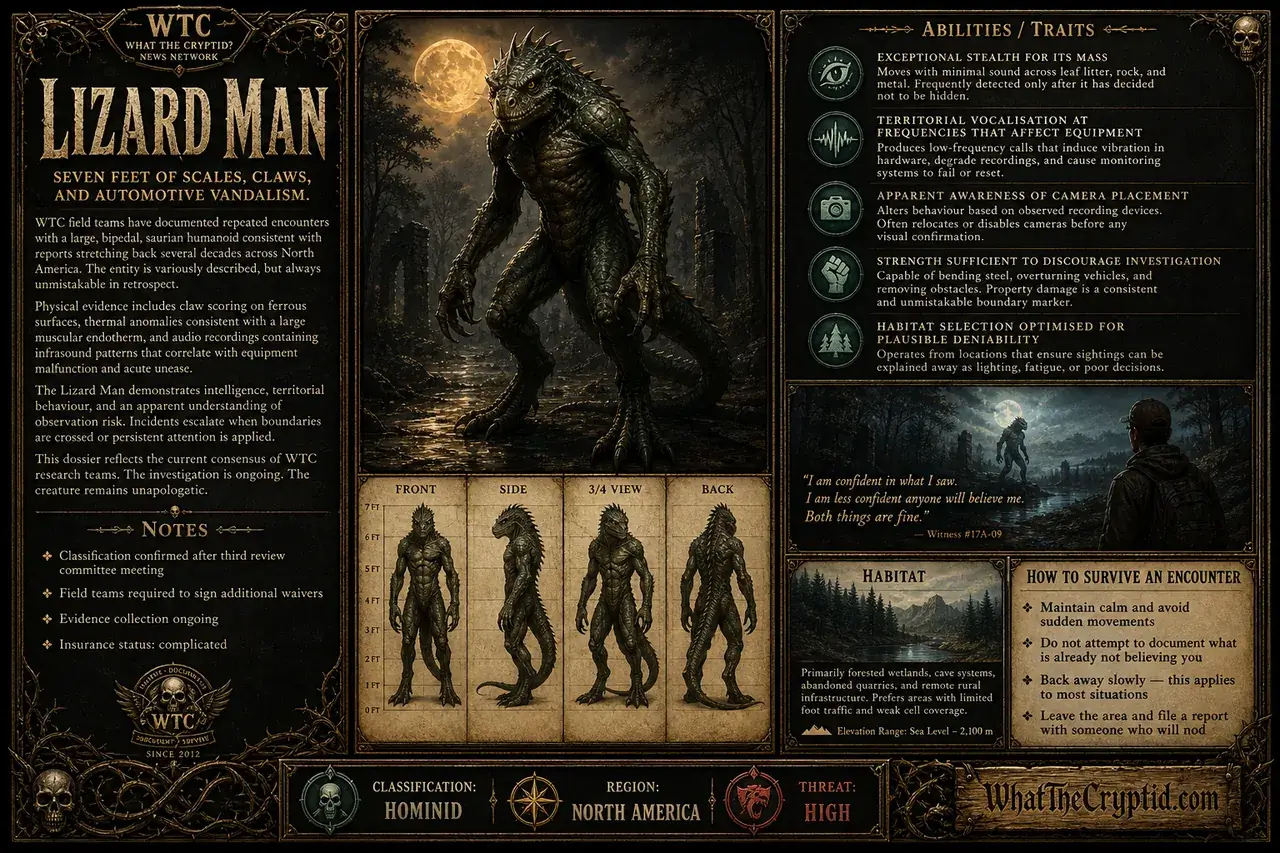
The Lizard Man of Scape Ore Swamp is a bipedal, reptilian hominid documented in and around Lee County, South Carolina, with the highest concentration of confirmed encounter reports originating within a four-mile radius of the Scape Ore Swamp drainage system. The entity stands between six and seven feet tall, displays coordinated bipedal locomotion, and has demonstrated a consistent and professionally inexplicable interest in the exterior bodywork of parked automobiles. WTC classifies it as a Hominid on the basis of its upright posture, apparent bilateral symmetry, and the fact that no other existing classification felt adequate without creating a new one, which our editorial board declined to approve at this time.

Unlike several cryptids in the WTC database whose threat profiles are largely inferential, the Lizard Man has produced physical evidence — claw marks, displaced side mirrors, and in two cases structural damage to roof panelling — that has been examined by independent parties, including at least one insurance adjuster who submitted his findings and subsequently retired. The entity is considered active, with sighting reports continuing into the present decade at a rate that Lee County officials have described, in public statements, as ‘manageable.’
History & Mythology
The modern evidentiary record for the Lizard Man begins on the night of June 29, 1988, when seventeen-year-old Christopher Davis reported encountering a large, green, bipedal reptilian creature near Scape Ore Swamp after stopping to change a flat tyre on State Road 15. Davis described the entity lunging at his vehicle, gripping the roof, and being shaken loose only when he accelerated at speed. The damage to the roof and side mirror of his 1976 Toyota was documented by Lee County Sheriff Liston Truesdale, who initiated a formal investigation — one of the few instances in the cryptid record in which a sitting law enforcement official assigned deputies to patrol a swamp on the basis of a teenager’s tyre-change account.
Prior to 1988, the Scape Ore Swamp area carries fragmentary regional accounts of a ‘swamp devil’ or large reptilian figure dating to the early twentieth century, preserved primarily in oral tradition among communities in Lee and Sumter counties. These accounts were not systematically collected until after the Davis incident created institutional interest, at which point several elderly residents confirmed having heard similar descriptions from their own parents — a chain of testimony that WTC’s historical researcher described as ‘suggestive, though not the kind of thing you’d want to put in front of a peer review committee.’
A secondary wave of documented sightings followed in July and August of 1988, with over 30 reports filed with the Lee County Sheriff’s Office in a six-week period. The frequency dropped sharply by September of the same year, though physical evidence reports — primarily vehicle damage — continued at a lower but consistent rate through the following decades.
Physical Description
Witness accounts across the full sighting record describe the Lizard Man as standing between six feet two inches and seven feet tall, with a muscular, broadly humanoid frame and a reported weight estimated by Sheriff Truesdale’s investigating deputies at between 250 and 400 pounds, a range our consulting biomechanist notes is wide enough to accommodate some imprecision in the original observations. The skin is consistently described as dark green to olive-green, with a scaled or heavily textured surface. The face is described as flat, with large red or orange eyes and a wide, lipless mouth. The hands are reported to feature three fingers tipped with four-inch black claws, a detail that appears in independent accounts with enough consistency to merit inclusion here without further qualification.
The feet, where impressions have been cast, show a three-toed configuration with a total track length of approximately 14 inches and a stride pattern consistent with a biped moving at speed. Claw impressions on vehicle surfaces — the most reproducible physical evidence in the record — show a tool-mark profile that the forensic analyst retained by Lee County in 1988 described as ‘not consistent with any known regional animal,’ before clarifying that she was a forensic analyst and not a zoologist, and that these were two different things.
No significant regional variants have been documented, which is either evidence of a single individual or evidence of a population with unusually consistent morphology. WTC has not yet determined which interpretation is more unsettling.
Behaviour & Temperament
The Lizard Man is primarily nocturnal, with the overwhelming majority of sighting reports occurring between 11 PM and 4 AM. It shows no documented territorial vocalisation and has not been observed in groups, suggesting either solitary behaviour or a social structure sophisticated enough to ensure that only one of them is ever seen at a time. The entity demonstrates a threshold response to human presence — it does not appear to hunt humans, but it does not consistently flee from them either, occupying a behavioural middle ground that WTC’s threat assessment team found difficult to categorise without coining a term they were not authorised to coin.
The most forensically documented behaviour is the apparent interest the Lizard Man takes in parked or stationary vehicles. Claw marks on rooflines, torn door handles, displaced mirrors, and in one 1988 case a partially detached tyre — later assessed as consistent with deliberate removal rather than impact damage — suggest purposeful interaction with automobiles rather than incidental contact. Whether this represents territorial aggression directed at the vehicle as an object, an attempt at access, or something else entirely are questions that have not been resolved to the satisfaction of anyone who has tried to resolve them.
When encountered directly, the Lizard Man has displayed both pursuit behaviour — as in the Davis incident — and apparent disengagement, with several witnesses reporting that the entity observed them briefly and then withdrew into swamp vegetation without further interaction. The variable response pattern makes pre-encounter prediction difficult, which our field team lead has noted is ‘not ideal from a deployment standpoint.’
Habitat & Territory
The Lizard Man’s primary documented range centres on Scape Ore Swamp in Lee County, South Carolina, a blackwater swamp system covering approximately 700 acres at an elevation of roughly 150 feet above sea level. The terrain is characterised by dense cypress and tupelo canopy, standing water averaging two to four feet in depth across the interior, and a network of drainage channels that provide substantial movement corridors between the swamp interior and surrounding agricultural land. The proximity of the swamp’s eastern boundary to State Road 15 — the site of the original 1988 encounter — is a geographic detail that has not escaped notice.
Sighting reports outside the immediate swamp boundary cluster along the road corridors and field margins within a four-mile radius, suggesting the entity ranges beyond its core habitat at night. Secondary reports place the Lizard Man in drainage ditches, irrigation channels, and at least twice in residential areas on the outskirts of Bishopville proper. The entity appears to prefer routes that minimise open-ground exposure, a habitat preference that is, on reflection, entirely reasonable.
Diet & Hunting
Direct observation of feeding behaviour has not been documented, and the Lizard Man’s diet remains one of the less resolved questions in its profile. Based on the physical evidence available — track patterns, range behaviour, and one 1988 report of a partially consumed large dog found at the swamp margin — WTC’s working assessment is that the entity is omnivorous with a probable preference for animal protein. The swamp system supports substantial populations of white-tailed deer, wild boar, large catfish, snapping turtles, and American alligator, any of which would represent a plausible primary prey species for an entity of documented size and apparent physical capability.
The dog incident from August 1988 — reported to the Sheriff’s Office by the animal’s owner, a farmer identified in records only as B. Whelchel — is the most specific dietary evidence on file. The remains were consistent with a large predator and were found within 200 yards of a fresh three-toed track set. The Lee County Animal Control officer who attended the scene filed a standard livestock predation report, listed the cause as ‘undetermined large animal,’ and did not follow up, which is either a failure of due diligence or a very practical allocation of limited county resources.
Notable Sightings
On June 29, 1988, Christopher Davis, 17, reported stopping on State Road 15 near Scape Ore Swamp to change a flat tyre at approximately 2 AM. He described a large, bipedal, green-scaled figure running toward him from the swamp margin at speed, reaching his vehicle before he could fully enter it, and gripping the roof rack as he accelerated. Davis reported the entity held on for a quarter mile before releasing. Physical documentation of the encounter included a damaged roof rack, a missing driver-side mirror, and scratch marks along the roofline consistent with a three-digit grip pattern, all photographed by Lee County Sheriff’s deputies the following morning. Sheriff Truesdale described the damage as ‘consistent with the account’ and opened a formal investigation that remained technically open for eleven months.
In July 1988, within three weeks of the Davis incident, residents Tom and Mary Waye reported discovering substantial damage to their 1985 Ford LTD parked in the driveway of their Bishopville home, located approximately 1.8 miles from the Scape Ore Swamp boundary. The damage included torn chrome trim along the roof, claw gouges across the hood, and a side mirror removed cleanly at the mounting bolts. A moulded footprint cast taken from a flower bed beside the driveway measured 13.75 inches in length with a three-toed impression; the cast was retained by the Sheriff’s Office and later examined by a zoologist from the University of South Carolina who confirmed it was not consistent with any native South Carolina species and declined to speculate further. The Wayes’ insurance claim was denied on the basis that ‘animal damage’ exclusions did not specify a minimum level of conventional zoological plausibility.
In February 2008, Bob and Dixie Rawson reported finding their 2005 Dodge minivan significantly damaged overnight while parked at their home near the Scape Ore Swamp margin — fender panels bent, the antenna removed, and claw marks across the roof consistent in profile with marks documented in the 1988 incidents. The Lee County Sheriff’s Office attended, noted the similarity to the 1988 physical evidence, and contacted WTC directly, marking only the second time a county law enforcement agency has proactively reached out to this network regarding an active case. The Rawsons subsequently installed motion-activated floodlights covering their entire driveway perimeter. The lights have triggered on fourteen occasions since installation; the footage retrieved has, on each occasion, shown only the lights coming on.
In July 2011, a couple identified in the report as the Joye family contacted the Lee County Sheriff’s Office to report a creature matching the Lizard Man description crossing Browntown Road at approximately 1:30 AM, observed from their vehicle at an estimated distance of 40 feet in full headlight illumination for a duration of six to eight seconds before the entity entered the tree line. Both occupants of the vehicle provided separate written accounts to the Sheriff’s Office; the accounts matched on height, colouration, and gait, and differed only on the number of fingers, which is consistent with the conditions of observation. The Joye family’s report was the twelfth filed with the Lee County Sheriff’s Office that year, a frequency that the Sheriff’s Office public information officer noted, at a press briefing, was ‘not unprecedented for the area.’
Threat Assessment
The Lizard Man presents a High threat rating under WTC’s standard assessment framework, based on documented physical capability, evidence of unprovoked property damage, and at least one recorded pursuit incident. Persons in or near the Scape Ore Swamp area between the hours of 11 PM and 4 AM are advised to remain in their vehicles where possible, to park in well-lit areas, and to avoid stopping on State Road 15 for any reason, including tyre changes, which WTC acknowledges is not always practical advice but which the evidence record nonetheless supports.
If direct visual contact is made with the entity, WTC recommends maintaining a minimum distance of 50 feet and avoiding any action that could be interpreted as territorial, including sustained eye contact, rapid movement toward the entity, or positioning yourself between the entity and the swamp. Do not approach a parked vehicle that shows signs of active damage. If the entity is already in contact with your vehicle, do not attempt to physically intervene — the 1988 evidence suggests the approach of accelerating away from the scene is the most successful documented option, though WTC notes this guidance applies only in situations where the vehicle is operational and facing a clear exit route, and we are not in a position to advise on scenarios that do not meet those conditions.
WTC Field Notes
WTC first indexed the Lizard Man in 1994, six years after the peak of the 1988 incident wave, which represents a response time our current editor-in-chief has acknowledged was ‘not our finest operational hour.’ We have since established a standing file on the entity and maintain a contact relationship with the Lee County Sheriff’s Office, which has been cooperative in sharing incident reports, a courtesy we have not taken for granted given that we are a cryptid news network and they are a county law enforcement agency.
A WTC field team conducted a site survey of the Scape Ore Swamp area in October 2019, deploying four trail cameras at positions selected based on historical track evidence. Three cameras malfunctioned within the first 72 hours in ways our equipment coordinator described as ‘technically explainable but statistically annoying.’ The fourth camera returned 847 photographs of raccoons and one image, taken at 2:17 AM on the third night, that our photo analyst spent four working days assessing before submitting a report that concluded ‘inconclusive’ and requesting to be reassigned to a different file. The image has been retained in the WTC archive and is available to credentialled researchers upon request, subject to a liability waiver that our legal team added to the process after the analyst’s reassignment request.