
Hellhound
Documented on six continents. Has not been asked to leave.
All
Active
HellhoundBlack DogSpiritGlobalHigh Threat
Overview
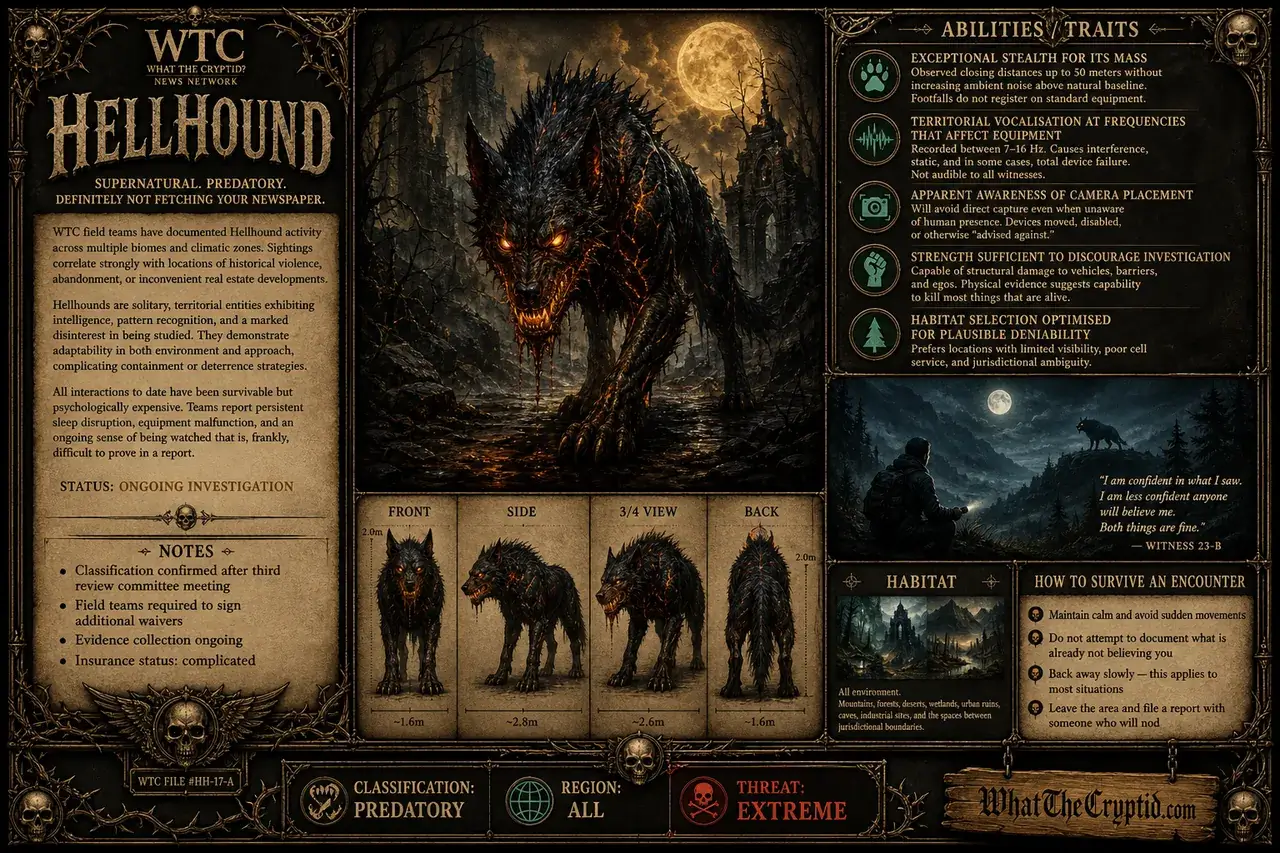
The Hellhound is a large, supernatural canine entity reported across every major continental landmass and in folklore traditions spanning at least four thousand years of recorded history. It presents consistently as an oversized black dog of indeterminate breed, frequently described as emitting light from its eye sockets — most commonly red or amber — and in a significant subset of accounts, appearing to leave no footprints on surfaces that would ordinarily record them. WTC classifies it as Spirit rather than Predatory on the basis that most Hellhound encounters, while deeply unpleasant for witnesses, do not result in physical injury. The distinction has been noted as ‘cold comfort’ by at least one of our field researchers, who has asked not to be identified.

What makes the Hellhound unusual among entities of comparable danger rating is the remarkable consistency of its description across cultures with no documented contact. A fifteenth-century Norfolk farmer and a nineteenth-century Guatemalan shepherd, operating in complete informational isolation, produced accounts that agree on body size, eye colour, and the specific quality of its silence. WTC’s comparative mythology consultant describes this cross-cultural coherence as ‘either significant or very inconvenient, depending on your prior commitments.’ We have noted it in the record without resolution.
The entity is most frequently encountered at night, on roads, near churches, and at the boundaries of human settlement — locations that, taken together, suggest either a territorial preference for liminal spaces or an entity that has simply been around long enough to know where people are likely to be alone.
History & Mythology
The earliest textual record that WTC’s historical research team has attributed with reasonable confidence to a Hellhound encounter appears in the Anglo-Saxon Chronicle entry for 1127 CE, which describes a procession of large, black, fire-eyed hunters accompanied by dogs ‘black and wide-eyed and loathsome’ witnessed by ‘many trustworthy men’ in the forests of Peterborough. The Chronicle, being a document of some editorial rigour for its era, recorded this in the same factual register as crop yields and royal deaths, which WTC considers an appropriate standard we continue to aspire to.
The most thoroughly documented single incident in the historical record occurred on the 4th of August, 1577, at the Church of Holy Trinity in Blythburgh, Suffolk. During a violent thunderstorm, a large black dog was witnessed by the congregation to enter the church, kill two parishioners and injure a third, and depart through the north door, leaving scorch marks on the door that remain visible to the present day. The incident was recorded in a contemporary pamphlet by Abraham Fleming, who described the entity with a specificity that WTC’s editorial board found professionally admirable. The scorch marks have been examined repeatedly. No explanation for their origin has been formally proposed by any institution that subsequently remained willing to discuss the matter.
Parallel traditions in Welsh folklore describe the Gwyllgi — the ‘Dog of Darkness’ — as a harbinger of death encountered on lonely roads at night. Central American accounts of the Cadejo Negro share sufficient detail with European Hellhound descriptions that WTC’s geographical analysis working group spent approximately eight months attempting to establish a migration corridor before concluding, in a report that has not been made public, that this was probably the wrong framework.
Physical Description
Witnesses consistently describe the Hellhound as a large to very large canine, with body mass estimates ranging from that of a large German Shepherd to that of a Shetland pony, depending on account and apparent witness composure at time of observation. Shoulder height in the most credible documented accounts ranges from 28 to 36 inches, though at least four accounts on record describe an entity significantly larger than this range, and WTC has not found a satisfactory way to reconcile them with the working profile without discarding evidence we are not prepared to discard.
The coat is universally described as black, matte in quality rather than glossy, and in several accounts as appearing to absorb available light rather than merely reflecting none of it. Eyes are the most consistently described feature across all regional variants: self-luminous, requiring no external light source to be visible, and reported in colours ranging from deep red to amber to, in six separate accounts from geographically unrelated locations, a green so bright that witnesses described being able to read by it. This last detail has not been explained to anyone’s satisfaction, including our own.
Regional variants exhibit minor but consistent differentiations. The British Black Shuck is typically reported as larger and solitary, occasionally described as headless in East Anglian accounts — a variant WTC’s appearance working group has categorised separately while noting that the documentation is thinner. The Welsh Gwyllgi is described as leaner, faster, and more likely to pursue. The Cadejo Negro of Central America is sometimes reported wearing a chain, the other end of which is not attached to anything. WTC has flagged this detail for follow-up that has not yet been scheduled.
Behaviour & Temperament
The Hellhound operates primarily between dusk and dawn, with peak activity in the period WTC’s field teams have taken to calling ‘the second hour’ — roughly 2 to 3 AM — when encounters are both most commonly reported and, by witness account, most extended in duration. The entity appears to follow a territorial circuit rather than hunting actively, revisiting the same roads, field boundaries, and churchyards on cycles that vary by location but have been documented as short as three days and as long as a decade between reappearances at a given site.
Despite a threat rating of High and a documented history of fatal encounters, the Hellhound’s default behaviour in the majority of modern accounts is surveillance rather than aggression. It will position itself at a fixed distance from the witness — typically between 30 and 80 yards — maintain eye contact for a period ranging from seconds to, in one account from rural Ireland in 2019, just under eleven minutes, and then depart. What it is assessing during this period is unknown. The assessment is not, by any documented account, comfortable to be the subject of.
A subset of accounts, estimated at roughly 22% of cases in WTC’s active database, describe the Hellhound as appearing to accompany or follow a specific individual across multiple encounters over days or weeks before ceasing contact entirely. Whether this constitutes protective behaviour, predatory behaviour, or something for which WTC does not currently have an appropriate category remains an open question. Our behavioural analysis consultant has described it as ‘the kind of open question you’d rather not close in the field.’
Habitat & Territory
The Hellhound demonstrates a clear preference for boundary environments: the edges of settlements rather than their centres, roadsides rather than open fields, churchyards, crossroads, cliff paths, and the immediate vicinity of bodies of water at night. Elevation appears to be a secondary concern at most — the entity has been reliably documented from sea-level coastal paths in Norfolk to mountain passes in the Andes at elevations above 11,000 feet — but accounts from dense urban environments are rare and, where they exist, tend to cluster around cemeteries and older infrastructure such as railway tunnels and canal towpaths, suggesting the Hellhound selects for psychological liminality as much as geographical.
No nesting or denning behaviour has been documented. No Hellhound has ever been observed sleeping, resting, or in a position of physical vulnerability. This is either because such behaviour occurs in locations and at times that preclude observation, or because it does not occur. WTC has not formed a position on which explanation it finds more reassuring.
Diet & Hunting
No feeding behaviour has been directly observed and confirmed by a witness who subsequently provided a detailed account. The absence of this data is notable given the volume of Hellhound sightings on record, and WTC’s dietary analysis team has spent considerable time with this gap. The Hellhound does not, in any documented account, stop to eat. It does not investigate carrion. It shows no interest in livestock beyond occasionally standing near them, motionless, until they move to the far end of their enclosure.
The working hypothesis, held with the appropriate professional uncertainty, is that the Hellhound does not require sustenance in the conventional sense — a position that is either a statement about its spiritual nature or a significant gap in the observational record. Three accounts from the British Isles describe the entity consuming what witnesses characterised as ‘darkness’ or ‘shadow’ in the vicinity of a recently deceased individual, which WTC’s dietary team has logged under a category heading they created specifically for this purpose and have not yet had to use for any other entry.
Notable Sightings
On the morning of 4 August, during a violent electrical storm, a large black canine entity entered the Church of Holy Trinity through the main doors, killed two members of the congregation — John Bungay and a second individual whose name was not recorded — injured a third person, and exited through the north door. The account was published in pamphlet form by Abraham Fleming within weeks of the incident. The scorch marks left on the north door of the church are present today and have been examined on multiple occasions by investigators whose subsequent reports have been, without exception, inconclusive.
On the same morning as the Blythburgh incident — a coincidence of geography and date that WTC’s historical team has noted without comment — a black dog entity was reported at St Mary’s Church in Bungay, approximately twelve miles distant, where it killed two further parishioners and left another ‘as shrunken as a piece of leather scorched in a hot fire,’ according to Fleming’s contemporaneous account. The probability of two independent Black Shuck incidents occurring at separate churches within a twelve-mile radius on the same morning has not been formally calculated. This appears to be an oversight.
A motorist identified in WTC records as P. Alderton reported striking a large black dog on the A143 at approximately 1:40 AM. The vehicle sustained significant front-end damage consistent with a collision impact. No animal was found at the scene. Roadside vegetation on the verge showed no disturbance. Alderton’s insurance claim was initially disputed on the grounds that no animal remains or blood evidence were recovered, and was ultimately settled under a classification that the insurer’s representative declined to specify when contacted by WTC.
Trail runner Marcus Webb reported a large black canine entity matching Hellhound description on a coastal section of Highway CA-1 at approximately 4:15 AM during an early training run. Webb described the entity as standing motionless in the road at a distance of approximately 40 yards, making no sound, for a period he estimated at four to five minutes before stepping off the road and disappearing into coastal scrubland that his subsequent daylight examination indicated was too dense to admit an animal of the described size. Webb’s account was submitted to WTC via our online reporting form with a note indicating he had completed the remaining nine miles of his training run at a pace he described as ‘personal best, not by choice.’
Threat Assessment
The Hellhound presents a High threat rating based on a documented history of fatal encounters, though WTC’s threat assessment team acknowledges that the majority of modern sightings do not result in physical harm. The risk profile is therefore characterised not by consistent lethality but by unpredictability: field data does not currently support a reliable model for determining which encounters will remain observational and which will not. This is the kind of honest acknowledgement of limits that our insurance provider has asked us to include in all threat assessments.
Recommended protocol upon encounter: Do not approach. Do not run. Maintain a minimum distance of 50 yards where terrain permits. Avoid direct sustained eye contact — brief glances for positional awareness are acceptable; prolonged mutual eye contact is not recommended and is, per multiple witness accounts, uncomfortable in ways that persist afterward. If the entity approaches, back away slowly while keeping it in peripheral vision. Do not enter enclosed spaces such as churches, outbuildings, or vehicles unless the entity has been stationary for a minimum of five minutes, as several accounts describe the entity entering such spaces after the witness. WTC recommends that anyone who experiences a Hellhound encounter report it through our online form within 24 hours, while details remain fresh, and also speak with someone they trust, for reasons that are beyond our editorial remit but seem worth mentioning.
WTC Field Notes
WTC has maintained an active Hellhound file since the network’s founding, and it remains the single most-submitted entity in our database by a margin that our content team finds both gratifying and difficult to process at volume. Our current global sightings log contains 4,847 entries, of which approximately 340 have been assessed as credible by our review team — a ratio that is, frankly, better than most categories we track.
A note on methodology: WTC dispatched field teams to Blythburgh in 2019 to conduct a site assessment of the church scorch marks and gather updated witness testimony from the local area. The team’s equipment functioned normally throughout, which they reported as ‘unexpected.’ The resulting documentation has been reviewed and is pending inclusion in a longer feature piece that our editor has described as ‘almost ready’ for the past fourteen months. We continue to accept new sightings in the meantime.