
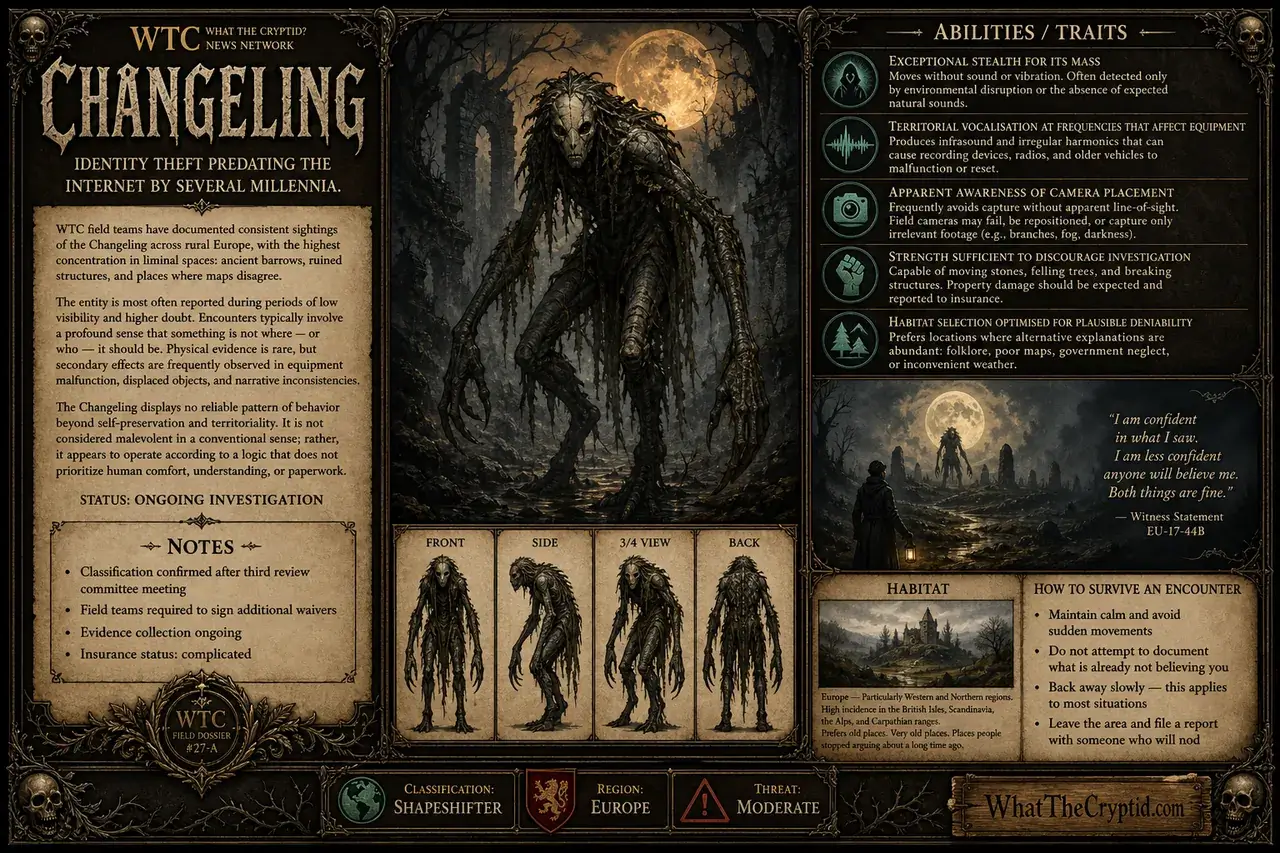
Changeling
Already in your house. Has been for some time.
Europe
Unverified
ShapeshifterEuropean FolkloreDomestic EntitySubstitutionFairy
Overview
The Changeling is a substitution entity, documented across European traditions from the British Isles to Scandinavia to the Germanic interior, with consistent behavioural and morphological patterns that WTC considers remarkable given the apparent absence of coordinated communication between source cultures. The operational model is stable across traditions: a human infant or occasionally an adult is removed from domestic circumstances by an unspecified supernatural agency, and a replacement entity — the Changeling — is installed in its place. The replacement is designed to pass. It frequently does not, but the design intent is clear.

What distinguishes the Changeling from standard impostor entities in the WTC database is the sustained nature of the deception. This is not a brief encounter or a single-incident apparition. Changelings are documented as living within family units for months or years, consuming household resources, requiring care, and exhibiting just enough familiar behaviour to delay detection indefinitely. The WTC Shapeshifter division notes that this represents a level of operational patience that most documented entities in this classification do not demonstrate.
The Changeling has been assigned a danger level of 6, which reflects not physical threat capacity — which is assessed as low to moderate — but the cumulative psychological and material impact of an extended cohabitation event. Households that identify a Changeling early face one set of complications. Households that do not identify one face a different and, in the view of several WTC researchers, more difficult set.
History & Mythology
The documentary record for the Changeling is among the oldest in the WTC database for any European entity, with written accounts appearing in ecclesiastical texts from the 8th century onward. The theologian Burchard of Worms included specific guidance on Changeling identification in his Corrector sive Medicus, compiled around 1010 CE, suggesting that by the early medieval period, the phenomenon had achieved sufficient frequency to warrant formal clerical attention. The Church’s position on Changelings was, for several centuries, theologically complicated, and WTC has tabled that particular thread for a separate research paper.
Scandinavian records are notably systematic. Norwegian and Swedish court documents from the 16th and 17th centuries include multiple cases in which Changeling identification was cited as legal grounds for specific domestic actions, with testimony recorded from witnesses, midwives, and in several cases the local clergy. The consistency of reported identifying features across these depositions — disproportionate limb length, premature facial aging, unusual vocal register, appetite exceeding documented body mass — has led WTC’s historical research team to treat the corpus as genuine observational data rather than purely folkloric material, a position that generated significant internal discussion before being adopted as editorial policy.
The Brothers Grimm collected at least four discrete Changeling accounts in Kinder- und Hausmärchen, though their editorial tendency to resolve narratives toward restoration of the original child has been noted by WTC researchers as potentially optimistic relative to the field evidence. The rate at which original children are confirmed recovered in pre-20th century accounts is not a figure WTC is prepared to publish at this time.
Physical Description
The Changeling’s appearance is calibrated to approximate its replacement target at the moment of substitution, but calibration accuracy degrades over time. In infant substitutions — the most commonly documented variant — the replacement initially presents as a normal human newborn within standard size and weight parameters. Divergence typically becomes apparent within the first several months, following a trajectory that varies by individual case but trends consistently in one direction: the Changeling does not develop as a human infant develops.
Physical features documented across the European case record include a cranium larger in circumference than age-matched human norms by 15 to 30 percent, limbs that extend at an accelerated rate relative to trunk growth, skin described variously as sallow, grey-tinged, or abnormally dry, and eyes that WTC’s review of historical testimony categorises as either ‘too still’ or ‘too active’ with no documented intermediate state. Dentition frequently appears earlier than typical human developmental timelines and is described in multiple independent accounts as fully formed at an age when this would be physiologically unusual. The precise mechanism by which a Changeling maintains an approximate human appearance over extended periods is not understood, and WTC does not have a current working hypothesis it is prepared to stand behind.
Adult substitutions are less common in the record and present differently. The adult Changeling — sometimes referred to in Norse tradition as a ‘stock,’ a term also applied to the wooden or vegetative decoy occasionally left in place of an abducted adult — exhibits a progressive failure of physical mimicry that typically manifests as unexplained weight loss, structural changes to the face that witnesses describe as a ‘thinning’ or ‘sharpening,’ and a gradual loss of fine motor coordination that had previously been normal. Regional variants from the Celtic traditions of Ireland and Scotland suggest a somewhat higher mimicry fidelity in adult cases, though these same traditions also document the highest rates of long-term non-detection, which may indicate a correlation WTC is not yet positioned to interpret definitively.
Behaviour & Temperament
The Changeling, across all documented variants, presents a behavioural profile that can be summarised as maximum resource extraction with minimum behavioural investment. It feeds extensively. It sleeps irregularly and in positions described by witnesses as geometrically improbable. It does not, as a general matter, initiate affection, though it will accept it when offered, in the same way that it accepts food and warmth — as inputs that support continued operation. This is not noted here as a moral judgement. It is noted as an observational pattern.
Of particular interest to WTC’s behavioural research team is the Changeling’s documented relationship with music. Across Germanic, Scandinavian, and Celtic traditions, Changeling entities are recorded as responding to music with an engagement that is qualitatively distinct from their baseline affective flatness — specifically, they are documented as being provoked by music into revealing behaviours inconsistent with the age they are presenting. A Changeling passing as a two-year-old infant has been recorded in multiple independent traditions as suddenly exhibiting adult motor control, vocal complexity, or what witnesses describe simply as ‘knowing.’ Field teams have been advised that this is the most reliable detection method currently in the WTC toolkit, and also the one that produces the most difficult subsequent conversations.
The Changeling does not appear to pursue human contact beyond the household in which it is placed. It does not range. It does not, as far as WTC can establish, communicate with other Changeling entities or with the agency responsible for its placement. Whether this reflects an absence of such communication or simply an absence of observed communication is a distinction the current evidence does not permit WTC to resolve.
Habitat & Territory
The Changeling’s habitat is, by operational definition, human domestic space. It does not have a preferred elevation range. It does not have terrain preferences in any meaningful sense. It lives where you live, in the room that was prepared for it, under the name it was given, which is not its name. European case records show no meaningful correlation between Changeling placement and geography, urban-rural distribution, household wealth, or proximity to water, though a mild clustering in records from forest-adjacent settlements has been noted and is currently attributed to reporting density in those communities rather than genuine habitat preference on the entity’s part.
The folkloric record does associate Changeling placement events with specific liminal sites — fairy mounds, boundary streams, crossroads, threshold moments in the agricultural calendar — but WTC’s field assessment team classifies these as relevant to the abduction mechanism rather than to the Changeling’s subsequent habitat requirements. Once placed, the Changeling appears indifferent to environment beyond a documented preference for warmth and a consistent aversion to iron fixtures that several WTC researchers have noted is inconvenient to test in modern construction.
Diet & Hunting
The Changeling eats. This is perhaps the most consistently documented feature across all traditions and the one that most reliably triggers detection concern in historical accounts. The appetite is described as disproportionate to body size across the full European record — not merely large, but structurally inconsistent with what the presenting body should require. German accounts use the term Killcrop specifically to denote this feature: the entity that consumes without filling, that empties the household stores, that nurses without ceasing and grows no larger, or that eats adult portions at an age when adult portions are not plausible.
Specific food preferences documented in the case record include dairy products in significant volume, cooked grain preparations, and meat — preferences that align broadly with the household diet of the period and region in question, suggesting the Changeling is opportunistic rather than specialised in its nutritional requirements. There is one detail in the Scandinavian record that WTC’s diet research team has flagged as requiring further analysis: in three independent 17th-century accounts from different Norwegian counties, the Changeling is described as declining to eat on the same day that music was played in the household. No explanation is offered in the source documents, and WTC does not currently have one to offer either.
Notable Sightings
A farm family near Ennistymon reported to a travelling folklore collector that their youngest child, aged fourteen months, had ‘turned’ approximately six weeks after a prolonged illness during which the mother had left the infant unattended for a documented period of three hours. The subsequent child presented with correct facial features but an altered eye colour — grey where brown had been documented at birth by the attending midwife — and consumed an estimated four times the volume of milk previously recorded. The family consulted with a local woman described in the collector’s notes as having ‘relevant expertise,’ performed an unspecified diagnostic procedure involving a hollow eggshell, and reported that the entity ‘laughed and spoke’ before departing through the open door. The collector noted this account alongside eleven structurally similar accounts from the same county, filed his complete notes with the Irish Folklore Commission, and does not appear to have followed up with the family.
Court records from the Mora district include testimony in an unrelated witchcraft proceeding in which a witness, identified as Britta Andersdotter, stated that her son had been replaced ‘before the churching was done,’ referring to the pre-baptism period considered high-risk in Swedish folk tradition. She described the replacement as heavier than her son had been, despite eating the same, and as having fingernails that grew to full length within three days of cutting. The court recorded her testimony, noted it as peripheral to the primary proceedings, and moved on. The son’s subsequent history is not recorded in any document WTC has been able to locate.
A forester named Jakob Hess submitted a written account to a regional natural history society describing an encounter with what he identified as a Wechselbalg — a Changeling — that he had discovered living alone in an abandoned farmstead approximately four kilometres from the nearest settlement. The entity appeared, by his estimate, to be between forty and sixty years of age and presented with the characteristic limb proportions and cranial dimensions documented in infant substitution cases, suggesting either a very long residence or a different substitution timeline than is typical. Hess described the encounter in detail and included a rough sketch. The natural history society’s response, if any, is not preserved. Hess did not return to the site, a decision he explained in a brief postscript as ‘prudent given the season,’ though it was July.
A woman identified in WTC’s contemporary case files as M.F. reported to a local general practitioner that her husband of eleven years had ‘not been himself’ since a walking accident in the hills above their property in the summer of 1961, from which he had returned after an unexplained absence of approximately eighteen hours. Over the following months she documented a progressive alteration in his facial structure, a complete loss of interest in activities he had previously pursued with documented enthusiasm, and an appetite she described as ‘not frightening, exactly, but notable.’ The GP referred her to a psychiatric colleague in Glasgow. M.F. attended one appointment, did not schedule a second, and submitted a detailed written account to WTC’s predecessor organisation, the Anomalous Persons Register, three months later. Her husband’s file remains open.
Threat Assessment
The Changeling does not, in the documented record, physically attack household members. WTC’s threat assessment team has found no verified account of direct physical harm initiated by a Changeling entity, and this absence is notable enough to be stated clearly. The threat the Changeling presents is resource-based, psychological, and cumulative — and WTC rates it Moderate rather than Low specifically because cumulative threats in domestic settings have a documented tendency to go unaddressed until they are no longer moderate.
Households with infants or recent adult additions following a period of disappearance or serious illness are advised to conduct a baseline behavioural assessment within thirty days. WTC recommends noting appetite volumes against body weight, documenting any aversion to iron objects — door hardware, cooking implements — and, if resources permit, arranging for music to be played in the subject’s presence and observing the response carefully. Maintain a minimum engagement distance that is, WTC acknowledges, functionally impossible to maintain if the entity is presenting as a dependent infant, and we note this limitation without pretending that acknowledging it resolves it. If detection is confirmed, WTC’s current guidance on remediation runs to fourteen pages, is internally contested on several key points, and is available on request.
WTC Field Notes
The Changeling file represents one of the longest continuously active cases in the WTC database, which is either a testament to the entity’s persistence or to the slowness of our archival digitisation project — our archival coordinator has asked us to note it is primarily the latter, with the former being a contributing factor. The classification debate took two editorial meetings and one moderately difficult email chain: Changeling entities do not fit cleanly into the WTC Shapeshifter category because they do not shift — they present a fixed alternate form and maintain it, which is arguably closer to impersonation than shapeshifting. The Shapeshifter classification was retained on the grounds that the capacity for initial mimicry implies a baseline morphological flexibility, and also because ‘Impostor’ is not a classification category and adding one would require a budget line we do not currently have.
WTC field teams operating in rural Ireland, Scotland, and the Scandinavian interior have standing instructions to document any cases meeting the substitution criteria and to do so without raising the subject directly with the household in question, a protocol that our legal team implemented after an incident in Donegal in 2019 that we are not in a position to describe in detail. Our consulting folklorist, Dr. Anneke Voss of Utrecht, has provided seventeen years of invaluable guidance on the European Changeling corpus and has asked to be listed in any publications as a ‘historical consultant’ rather than a ‘cryptid researcher.’ WTC respects this preference entirely.