
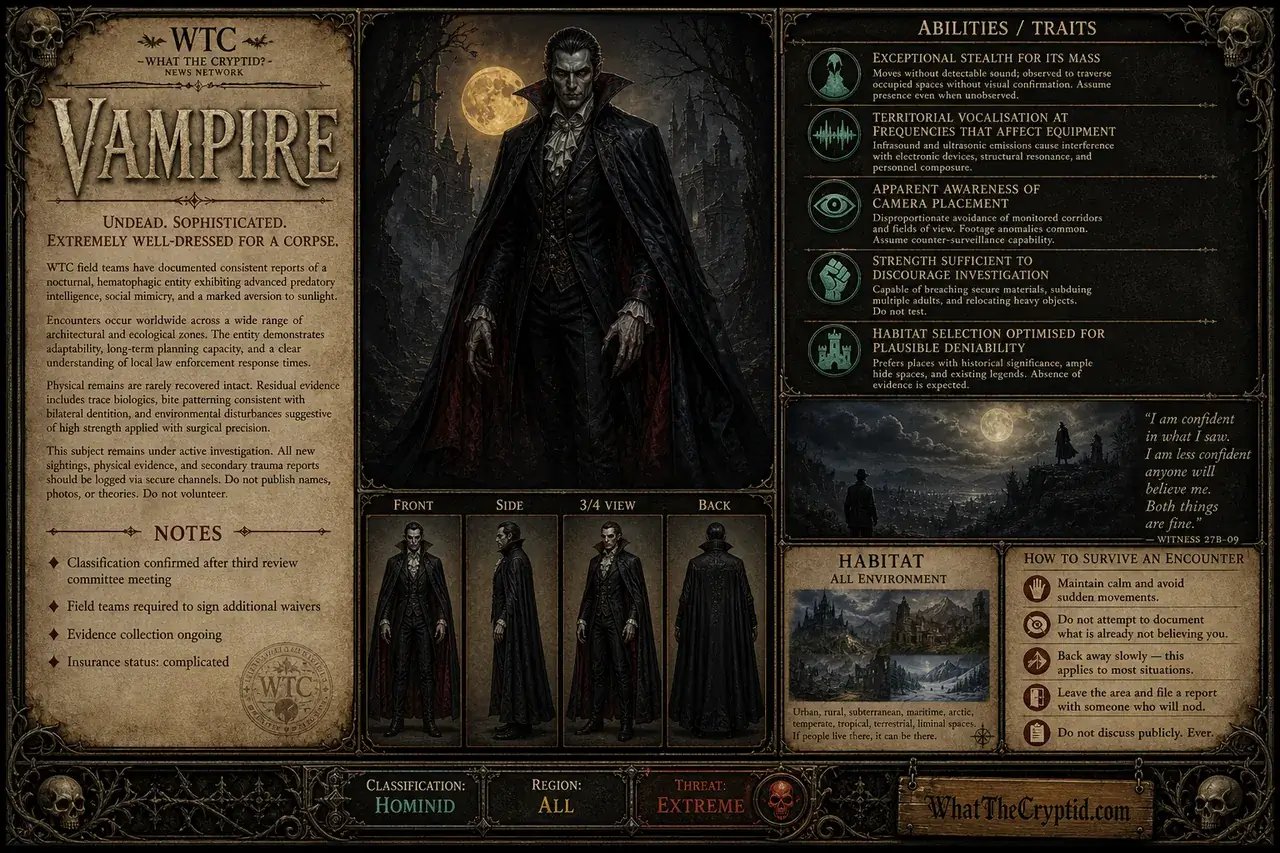
Vampire
Documented globally. Nocturnal. Still not returning your calls.
All
Active
UndeadBlood-feedingNocturnalGlobal DistributionShapeshifterHistorical Documentation
Overview
The vampire represents one of the most extensively documented classifications in the WTC database, appearing in the recorded traditions of cultures on every inhabited continent, often with a consistency of detail that independent development alone struggles to account for. The entity is broadly characterised as an animated corpse — or in some regional variants, a living individual of ambiguous vital status — that sustains itself through the consumption of blood, with a marked preference for human donors who have not consented to the arrangement. WTC classification as Shapeshifter reflects the entity’s well-attested capacity for physical transformation, though this should not be taken to imply that the base form is therefore less of a concern.

The vampire presents a particular research challenge in that it sits at the intersection of folklore, theology, pathology, and what our senior researcher Dr. Alina Vasescu describes as ‘the category of things that are too consistent across too many sources to simply file under mythology and move on.’ Cross-cultural analysis of primary documentation reveals a core behavioural and physiological profile that recurs with statistically notable frequency — nocturnal activity, aversion to specific materials, dependency on blood consumption, extended or indefinite lifespan — beneath a considerable layer of regional variation. WTC treats this core profile as the working field description.
Danger level is assessed at 8 of 10. The entity is not assessed at maximum due to documented evidence of selective prey targeting, avoidance behaviour when countermeasures are present, and the existence of at least three regional variants that field researchers have characterised as ‘manageable, with preparation.’ What constitutes adequate preparation is addressed in the Threat Assessment section. Readers are encouraged to review it.
History & Mythology
The earliest textual record associated with vampire-type entities appears in Mesopotamian cuneiform tablets dating to approximately 3000 BCE, describing the Ekimmu — a restless dead entity that fed on the living and could not be repelled through conventional funerary rites. Similar entities appear in ancient Sanskrit texts under the designation Vetala, in Chinese manuscripts referencing the Jiangshi from the Han Dynasty period onward, and in pre-Columbian Mesoamerican traditions describing blood-feeding entities associated with the underworld. The argument that these represent independent cultural responses to similar anxieties about death and disease is a reasonable one. WTC notes that it does not make the documented regional consistencies any easier to explain.
European documentation intensifies sharply in the early modern period, with the most clinically useful records emerging from the Balkans between roughly 1600 and 1800. The cases of Petar Blagojevic (Serbia, 1725) and Arnold Paole (Serbia, 1726-1732) are the most thoroughly documented, involving official Habsburg Imperial investigations, exhumations conducted by military surgeons, and written reports that were circulated across European courts and academic institutions. The Paole case is particularly notable because the Imperial investigation recorded the exhumation findings with a level of bureaucratic precision that subsequent researchers have found both useful and difficult to contextualise. The official report described the exhumed bodies as exhibiting fresh blood at the mouth, absence of decomposition at expected stage, and continued growth of hair and nails. The Imperial physician who signed the report, Johannes Flückinger, returned to Vienna and, as far as WTC has been able to determine, did not publish further research on the subject.
The 19th century saw vampire scholarship bifurcate along lines that have never fully rejoined. Medical researchers attributed Balkan vampire cases to misunderstood decomposition processes, premature burial, and epidemic disease — specifically the 1721-1728 plague outbreak in Serbia, which coincided almost exactly with the Paole case. Literary tradition, meanwhile, produced Polidori’s ‘The Vampyre’ (1819) and Stoker’s ‘Dracula’ (1897), which have since shaped public expectations of the entity so thoroughly that WTC field researchers routinely note witness accounts that appear to have been filtered through cinematic rather than folkloric reference points. This is considered a complicating factor.
Physical Description
The baseline physical description, derived from pre-cinematic folkloric sources and aggregated WTC field reports, describes an entity that is broadly humanoid and, in many accounts, indistinguishable from a living person under casual observation. Extended canine teeth are among the most consistent reported features across both historical documentation and modern sightings, appearing in accounts from Eastern Europe, Southeast Asia, and South America with enough regularity to be considered a reliable indicator. Pallor of skin is frequently noted, though this feature is necessarily subject to baseline variation across reporters of different ethnic backgrounds and is weighted accordingly in WTC analysis.
Body temperature is reported as markedly below normal human range in accounts where direct physical contact occurred — a detail that appears in both 18th-century Balkan records and in three separate modern WTC-logged reports from witnesses who described handshakes or incidental contact. Estimates from these accounts cluster around what would, in a living human, constitute hypothermia requiring immediate medical intervention. The entity does not appear to require intervention. Eye coloration is documented inconsistently, with red, black, and luminescent variants all appearing in the record; WTC’s working position is that this represents either genuine variation between individuals or regional perceptual differences, and possibly both.
Regional physical variants diverge substantially from the European baseline. The Southeast Asian Penanggalan presents as a detached human head trailing luminescent visceral organs, which represents a significant departure from the ambiguously-vital humanoid profile and warrants its own sub-entry, currently scheduled for Q3. The Chinese Jiangshi is documented as a reanimated corpse in a state of advanced rigor, moving via vertical hopping due to joint stiffness — a detail that WTC’s consulting forensic pathologist confirmed was consistent with genuine late-stage postmortem rigidity, before clarifying that she was speaking hypothetically.
Behaviour & Temperament
The vampire is primarily nocturnal, with the majority of documented activity occurring between sunset and approximately 3:00 AM, and a smaller cluster of reports in the pre-dawn window between 4:00 and 5:30 AM. Daylight aversion is among the most consistent behavioural features in the global record, though the degree varies by tradition: full combustion upon sun exposure appears in certain European accounts and has been enthusiastically adopted by popular culture, while other regional variants describe merely weakened capacity or discomfort. WTC field teams operate on the conservative assumption that solar exposure is a reliable deterrent and have not, to date, felt it necessary to verify the combustion threshold directly.
Social structure is poorly documented but not entirely absent from the record. The Master-Thrall hierarchy described in Eastern European folklore — in which an older, more powerful individual creates subordinates through blood exchange — appears across enough independent sources to be taken seriously as a working model, and would account for the clustering of sightings in particular locations over extended periods. Whether this represents genuine social organisation or a recurrent cultural explanation for the same underlying phenomenon is a question WTC has tabled for a later meeting. Solitary operation is the more common pattern in modern reports, and field teams should plan accordingly.
Behavioural documentation includes a persistent and cross-culturally attested detail that WTC initially treated as folkloric embellishment: the apparent compulsion to count scattered small objects — seeds, grain, sand grains — before proceeding with other activities. This behaviour appears in traditions from Romania, Bulgaria, Greece, China, and West Africa with enough consistency that WTC field researcher Tomás Reyes has formally proposed it as a potential deterrence measure. The proposal is under review. Reyes has noted, in follow-up correspondence, that he would appreciate a response before his next scheduled field deployment.
Habitat & Territory
The vampire demonstrates a strong preference for habitats that combine access to human populations with reliable shelter from direct sunlight — a combination that proves less restrictive than it initially sounds. Historical documentation clusters around rural Balkan villages, dense Eastern European forests, and urban environments with extensive subterranean architecture, but modern WTC field reports span metropolitan apartment complexes, suburban residential areas, and at least two reports from locations that were, at the time of the sighting, operating as short-term holiday rentals. The entity adapts.
Elevation range in documented cases runs from sea level to approximately 2,400 metres, with a notable concentration in the 500-1,200 metre range corresponding to Carpathian and Transylvanian mountain settlements. Proximity to pre-existing human habitation is the most reliable habitat indicator: WTC field teams should note that the entity does not construct its own shelter in the conventional sense, preferring existing structures — cellars, crypts, abandoned buildings, and, per several modern reports, properties with unusually low asking prices that sold quickly and without a formal inspection.
Diet & Hunting
The vampire’s dietary dependency on blood is the feature with the highest consistency across global documentation, appearing in every major cultural tradition and in the overwhelming majority of modern field reports. Human blood is the documented preference, with several traditions specifying blood from sleeping victims, which may reflect either a genuine behavioural preference or a practical approach to prey management. The quantity consumed per feeding is inconsistently reported, but historical medical accounts reference victims who presented with unexplained anaemia over periods of weeks — suggesting a pattern of repeated low-volume extraction rather than single catastrophic feeding events. This is, from a predator-prey sustainability standpoint, a coherent strategy, which WTC notes without endorsement.
Animal blood is documented as a supplementary or substitute food source in multiple traditions, and several Eastern European accounts describe livestock mortality — specifically cattle and sheep — preceding or following human cases in the same village. Whether this represents an intentional dietary substitution or opportunistic feeding is unclear. WTC field researcher Dr. Vasescu has noted that the distinction may not matter practically, but that it matters considerably for threat modelling, and has requested funding for a comparative dietary analysis study. The request was submitted in 2019. It is still under review.
Notable Sightings
The exhumation and official investigation of Arnold Paole, conducted under the authority of the Habsburg Imperial command and attended by military surgeons, village elders, and a regimental lieutenant named Büttner, produced a formal written record describing the exhumed remains of Paole and seventeen additional individuals as exhibiting fresh blood in the mouth and throat, absence of decomposition inconsistent with burial duration of up to three months, and, in four cases, what the examining surgeon described as evidence of continued biological activity. The report was submitted to the Imperial court in Vienna, where it was received, catalogued, and — as far as extant records indicate — not acted upon. The village of Medveđa reported no further anomalous deaths in the eighteen months following the exhumations.
Between December 1969 and March 1970, multiple independent witnesses reported encounters with a tall, dark-clad figure observed near the north gate of Highgate Cemetery, described consistently as approximately six feet in height, with a pallid complexion and an apparent capacity to dematerialise when approached. Local resident David Farrant reported finding dead foxes in the vicinity with puncture wounds and significant blood loss; his account was published in the Hampstead and Highgate Express in February 1970, prompting additional witnesses to come forward. A formal investigation was organised by the British Occult Society and conducted on the night of 13 March 1970, attended by an estimated fifty individuals, none of whom were acting in any official capacity. The cemetery was formally closed to evening visitors the following week.
Livestock farmer Ernesto Villanueva reported to local authorities that fourteen goats had been found over a six-week period with bilateral puncture wounds to the neck and near-complete exsanguination, with no predator tracks, disturbance to enclosure fencing, or physical evidence of intrusion. Villanueva reported that on the night of 4 November he observed, from approximately thirty metres, a figure he described as ‘not walking correctly’ moving along the perimeter of his property before disappearing into a drainage gully. The description was consistent with accounts given independently by two neighbouring farmers the same week. Local authorities filed the livestock losses under ‘unknown predator.’ Villanueva subsequently relocated his remaining animals to an enclosed concrete structure and installed additional lighting at his own expense.
WTC-affiliated researcher Mirela Ionescu reported a direct encounter during a residential survey in the Mănăştur district, where she had been conducting interviews following a cluster of reports involving a neighbouring property. At approximately 11:40 PM on 17 September, Ionescu recorded on her field audio device an exchange with an individual at the property door who declined to provide a name, exhibited bilateral canine tooth elongation visible under porch lighting, and whose breath produced no condensation in 4°C ambient air. The individual stated that they were ‘not presently available for documentation’ and closed the door. Ionescu’s audio recording captured 4 minutes and 22 seconds of the exchange at acceptable quality. She submitted her field report the following morning, noted that the individual had not been present when she returned at noon the next day, and requested a transfer to the WTC Australia/Pacific desk.
Threat Assessment
The vampire represents a High threat classification and should be approached with preparations proportionate to that rating — meaning, in practical terms, that it should not be approached without preparation. WTC field protocol recommends a minimum exclusion distance of 15 metres upon initial identification, increasing to full withdrawal if the entity has registered the observer’s presence, as several accounts document pursuit behaviour at ranges beyond 30 metres once direct eye contact has been established. Eye contact should therefore be avoided; field teams are instructed to observe from oblique angles where possible.
Documented deterrents include garlic (Allium sativum) in quantities that field researchers have described as ‘socially inadvisable but effective,’ running water as a territorial barrier, religious symbols — the efficacy of which appears to vary by regional tradition and, potentially, by the faith of the individual deploying them, a variable WTC has not yet found a reliable method to control for — and the scattering of small objects such as mustard seed or poppy seed at entry points, which may exploit the counting compulsion noted in the Behaviour section. Silver is documented in the European tradition as inhibiting regeneration. Wooden stakes are documented across multiple traditions as a means of immobilisation, specifically when applied to the chest cavity; WTC notes this as a recorded field intervention while strongly advising against its use by non-specialists, and acknowledges that defining who qualifies as a specialist in this context is a question the organisation has not yet formally resolved.
WTC Field Notes
The vampire entry has been in continuous revision since WTC’s founding, which should be understood as a structural observation about the subject rather than an editorial failure. The entity’s near-universal cultural presence means that any entry attempting comprehensive coverage generates immediate jurisdictional disputes between regional desks, and the current document represents a negotiated summary that satisfies no one fully and is, in the opinion of this editor, probably better for it. The European desk and the Asia/Pacific desk have been in formal disagreement about Jiangshi classification since 2017; that sub-entry remains pending.
WTC deployed a two-person field team to Cluj-Napoca in October 2011 following the Ionescu report, equipped with thermal imaging, directional audio, and a revised insurance waiver that specifically extended coverage to ‘encounters with entities of disputed vital status,’ a clause our legal team spent eleven months negotiating with the provider. The thermal imaging equipment malfunctioned within six hours of arrival in the Mănăştur district. The audio equipment functioned correctly but recorded nothing of note during the three-night deployment. Ionescu’s original recording remains the only WTC-direct evidence in the file. She is currently based in Brisbane and has not requested reassignment back to Eastern Europe. WTC respects that decision.