
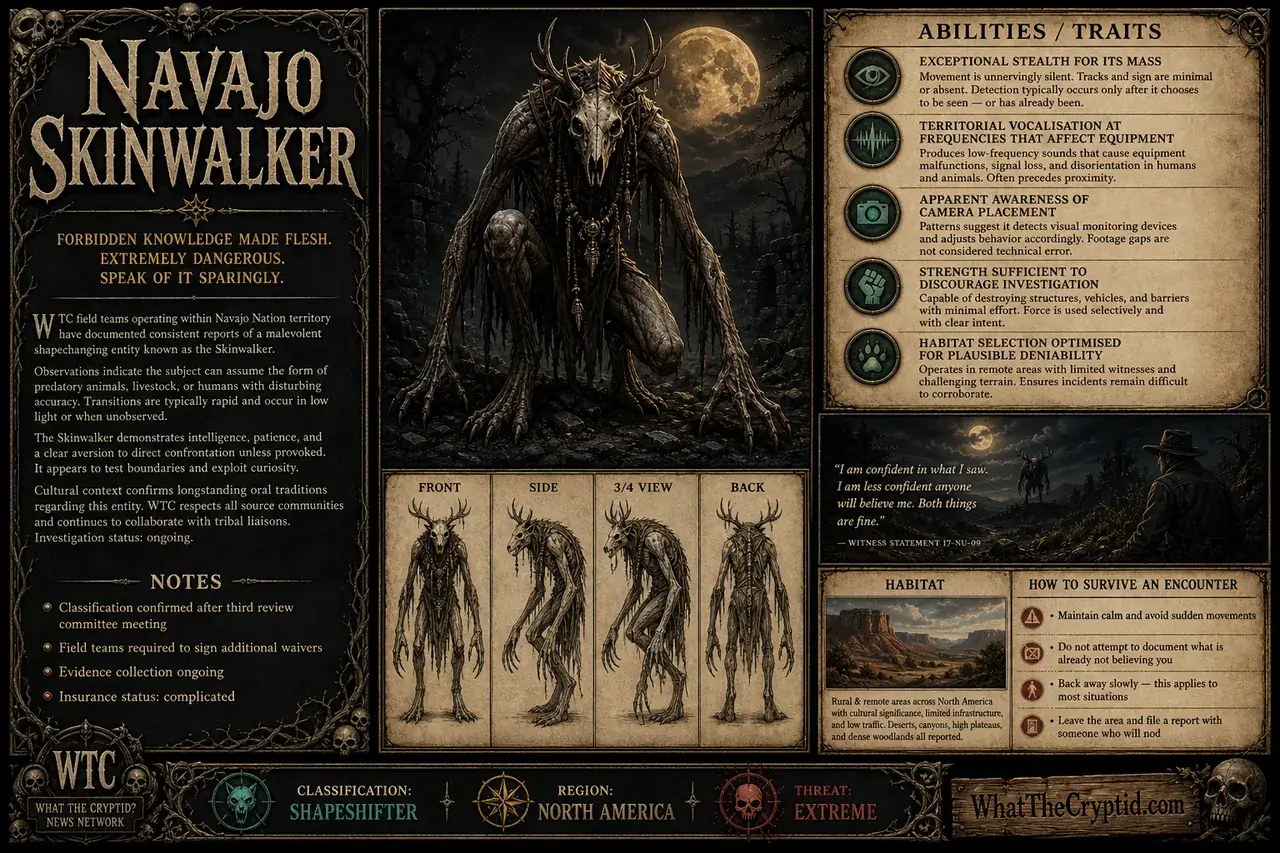
Navajo Skinwalker
It was wearing the animal. The animal was not consulted.
North America
Active
ShapeshifterSouthwest USANavajo NationExtreme Threat
Overview
The Yee Naaldlooshii — translated from Diné Bizaad as ‘with it, he goes on all fours’ — represents one of the most consistently documented and cross-corroborated shapeshifting entities in the WTC database. Unlike many entries in this database that rely on single-witness accounts and degraded photographic evidence, the Skinwalker benefits from centuries of detailed, culturally transmitted field data, which is either a mark in its favour or a testament to how thoroughly it has discouraged direct investigation. WTC has chosen to treat it as the former.

The entity is understood, within Navajo traditional knowledge, to be a human practitioner of ‘corpse powder’ witchcraft who has achieved the ability to assume animal form through specific ritual transgression — most commonly described as the deliberate killing of a close family member. WTC notes this is a considerable barrier to entry and reflects well on the general population. The transformation is not metaphorical. Witnesses across multiple independent decades describe the intermediate state: something that is not quite the animal it has chosen, moving in ways the animal does not move, watched by eyes that understand it is being described.
WTC classifies the Skinwalker as an Active Extreme-threat Shapeshifter. This classification was not arrived at quickly. It required three editorial meetings and a strongly worded memo from our legal department.
History & Mythology
Yee Naaldlooshii occupies a documented position within Diné cosmology that predates European contact, woven into oral tradition alongside the broader category of ‘Ant’įįhnii’ — Navajo witches — with specificity suggesting generations of accumulated observational data rather than abstract mythology. The entity is referenced in ceremonial contexts, healing rites, and community law, which implies that at some point the community found it necessary to develop formal institutional responses to this specific problem. WTC finds this detail significant.
European and Anglo-American contact with Skinwalker accounts begins in earnest with U.S. Army ethnographers operating in the Four Corners region during the 1860s and 1870s, several of whom recorded testimony from Diné community members with what was, for the period, unusual attentiveness. Washington Matthews, a U.S. Army surgeon and ethnologist, documented witch accounts in the 1880s that align in specific detail with contemporary sightings — including the characteristic ‘loping, uneven gait’ and the unsettling impression that the entity’s head does not move correctly when it runs. His notes were filed, classified as cultural curiosity, and largely ignored for eighty years.
Public awareness outside Indigenous and regional communities expanded significantly following the 1996 purchase of a ranch in Uintah County, Utah — subsequently dubbed ‘Skinwalker Ranch’ — by the Sherman family, whose eighteen months of residence produced a catalogue of anomalous incidents that reads less like a paranormal case file and more like a methodical insurance claim. The ranch’s subsequent acquisition by aerospace entrepreneur Robert Bigelow and his National Institute for Discovery Science brought professional instrumentation to the site. What that instrumentation recorded has not been released in full. WTC submitted a records request in 2019. We are still waiting.
Physical Description
Witness accounts of Skinwalker physical presentation are complicated by the entity’s defining characteristic, which is that it does not have a fixed one. The most frequently reported animal forms are coyote, wolf, crow, owl, and fox — forms that, WTC notes, share the common quality of being animals already present in the landscape and therefore deniable at a distance. The primary distinguishing feature across all reported animal-form sightings is scale: the entity consistently presents at sizes inconsistent with the species it is imitating, with coyote-form witnesses describing animals standing 28 to 34 inches at the shoulder — approximately twice the height of a coyote in good condition. The proportions are otherwise accurate. This is, in some ways, more unsettling than if they were not.
The intermediate or transitional state — observed in a smaller subset of close-encounter accounts — is described with remarkable consistency across witnesses who have no documented contact with each other. The body is described as humanoid in its underlying structure, moving quadrupedally with the specific wrongness of a form that was not designed for it. Musculature is described as ‘too much’ in the shoulders and upper arms. The neck is described as long. In roughly 60% of close-encounter accounts, witnesses report that the eyes reflect light in a manner distinct from known animals — described variously as ‘the wrong colour,’ ‘the wrong shape,’ or, in one 2003 account from a highway patrol officer near Kayenta, Arizona, simply as ‘not an animal’s eyes.’ The officer did not elaborate, and WTC did not press him.
Human-form mimicry is documented in a smaller category of reports and represents the area where WTC’s consulting forensic psychologist most strongly recommended we apply ‘professional distance.’ Accounts describe the entity adopting the appearance of known individuals — family members, neighbours, in one documented 1997 case, a deceased relative — with accuracy sufficient to initiate conversation before some detail fails: a word used incorrectly, a gesture performed with the wrong hand, a shadow that does not align with the available light source.
Behaviour & Temperament
The Skinwalker is documented as primarily nocturnal, with the significant majority of encounters occurring between 10 PM and 4 AM and clustering, with notable consistency, around the hours immediately following midnight. Daylight encounters are recorded but are rarer and, where documented, appear to involve a different quality of risk — less direct engagement, more observation. The entity appears to understand the evidentiary disadvantage of darkness and uses it. WTC considers this a sign of operational intelligence and has noted it in the threat assessment accordingly.
Purposeful behaviour in documented encounters falls into two broad categories: surveillance and interference. In the first category, the entity is observed watching — from treelines, ridge edges, rooftops, and on at least six documented occasions, the immediate perimeter of occupied dwellings — without initiating contact. Duration of observation in these accounts ranges from several minutes to, in one 2001 case from a Navajo Nation community near Shiprock, a reported four consecutive nights. In the second category, the entity interacts with livestock, property, or directly with witnesses. Livestock interference most commonly involves death by means inconsistent with known predator activity — exsanguination without visible external injury, organ removal with a precision that WTC’s consulting veterinarian described as ‘unnecessarily specific,’ and, in several cases, the arrangement of remains in configurations that serve no apparent nutritional purpose.
Direct witness engagement follows a pattern that Diné knowledge-keepers have documented for generations and that contemporary accounts continue to confirm: the entity tests before it acts. It approaches, retreats, approaches again. It makes sounds — animal calls rendered slightly incorrectly, or human voices from the wrong direction. Where traditional protective measures are employed — prayer, specific herbal preparations, the recitation of names in Diné Bizaad — encounter accounts indicate a withdrawal. WTC is not in a position to explain the mechanism. We are in a position to note that the pattern holds.
Habitat & Territory
The Skinwalker’s primary documented range encompasses the Four Corners region of the American Southwest — specifically the high desert terrain of the Colorado Plateau between elevations of 4,500 and 7,200 feet, taking in the Navajo Nation, Uintah and Ouray Indian Reservation, and adjacent rural counties in Utah, Colorado, Arizona, and New Mexico. Terrain preference within this range skews toward transitional zones: the boundaries between open scrubland and pinyon-juniper woodland, canyon rim country, and the immediate margins of agricultural or ranch land. The entity is, in documented sightings, rarely found in the open centre of any terrain type. It prefers the edge.
A secondary, lower-density distribution of credible accounts extends beyond the Four Corners into adjacent regions, with clusters in rural southern Nevada, eastern California high desert, and the Oklahoma panhandle. WTC does not currently classify these as confirmed range extensions — the evidence base is thinner and the cultural transmission network less intact — but the accounts are in the database, flagged for review. The entity’s relationship to human settlement is consistent: close proximity is documented, full integration is not. The Skinwalker is found near communities, near roads, near ranch perimeters. It appears, across centuries of recorded observation, to have decided that wherever people are is the correct distance.
Diet & Hunting
Dietary documentation for the Skinwalker is complicated by the fact that the entity’s consumption patterns, where observed, do not appear to be primarily metabolic. Livestock deaths attributed to Skinwalker activity — and WTC uses ‘attributed’ here in its strict evidentiary sense, meaning documented alongside Skinwalker sightings on the same property within the same 72-hour period — show patterns inconsistent with predation for caloric sustenance. Consumption, where it occurs, is selective in ways that field-biology models for known predators do not account for: organs are taken, blood is taken, specific tissue is taken, while significant caloric mass is left. Our consulting wildlife biologist reviewed twelve case files from the Uintah Basin area and described the pattern as ‘an entity that knows what it wants and is not hungry in the way we understand hunger.’ He has since requested that his name not be attached to that quote.
A minority of historical accounts within Diné oral tradition describe the Skinwalker consuming specific preparations made from human remains as part of its ritual practice — a detail that WTC includes for documentary completeness and declines to elaborate on further. What can be said is that the dietary profile of the Skinwalker, taken as a whole, suggests an entity for which feeding is instrumental rather than essential — a means to something other than calories. What that something is remains one of the open questions on the WTC editorial board’s list, currently sitting at number three.
Notable Sightings
Tom and Ellen Sherman, ranchers who had recently purchased a 480-acre property in the Uintah Basin later known as Skinwalker Ranch, reported observing a large canid-form entity approach their cattle enclosure at approximately 11:40 PM in late October. The animal was described by Tom Sherman as resembling a wolf but standing ‘as tall as my truck door’ at the shoulder, with a coat that appeared matted and damp despite no recent rainfall. When Tom Sherman approached to within fifteen feet, the entity turned and looked at him directly before departing at a pace he described as ‘wrong for something that size.’ Two cattle were found dead the following morning, with injuries the attending veterinarian documented, invoiced for, and declined to speculate on further in any written form.
New Mexico Highway Patrol Officer R. Sanchez submitted an incident report documenting a traffic stop at 1:17 AM on a stretch of Highway 491 — formerly US Route 666, renamed in 2003, a fact Officer Sanchez mentioned twice in his report without explanation. Sanchez observed what he initially interpreted as a pedestrian in the road: a figure moving on two legs, tall, ‘thin in the wrong places.’ When Sanchez activated his spotlight, the figure dropped to all fours and covered approximately 200 yards of open scrubland in under eight seconds before disappearing into a dry arroyo. Sanchez described its movement as ‘fast, but the head stayed very still.’ The incident report was filed under ‘animal-vehicle hazard.’ Sanchez transferred to a desk position in Albuquerque within the following month.
A Navajo family residing on a 40-acre property near Shiprock reported four consecutive nights of perimeter disturbance beginning on a Tuesday in late November, characterised by vocalisations described as ‘a coyote that didn’t know the sound well enough,’ livestock agitation, and on the third night, the observation by the family’s eldest daughter of a figure standing upright at the treeline of a cottonwood grove approximately 90 feet from the residence. The figure was described as tall, dark, and watching. The family performed a traditional protection ceremony on the fourth night, supervised by a community hatałii. The disturbances ceased. WTC contacted the hatałii for comment and was politely but firmly advised that further documentation of this incident was not something he was willing to assist with.
A geological survey team of three contractors — names withheld at their request — reported an encounter at approximately 2:00 AM while camped on BLM land southeast of Bluff. Team member designated C.W. woke to find a figure crouching at the edge of the camp’s light perimeter, described as appearing roughly human but positioned in a squat that ‘the knees weren’t right for.’ When C.W. sat up, the figure made a sound he described as ‘my name, but slower than my name,’ stood to a height estimated at seven feet, and walked — upright — into the dark at a pace he could not reconcile with the available moonlight. The other two team members reported hearing the vocalisation but did not observe the figure. The survey was completed remotely using drone equipment. All three contractors submitted separate invoices for hazard pay that their contracting agency initially disputed and ultimately paid without further discussion.
Threat Assessment
The Skinwalker represents WTC’s highest confirmed threat classification and should be treated accordingly. Individuals who believe they are in proximity to Skinwalker activity are advised to remain indoors with all windows and doors closed, to avoid responding to any vocalisations that resemble their own name or the voices of known individuals, and to refrain from making direct eye contact with any animal they cannot positively identify at close range as consistent with the species it appears to be. The minimum safe observation distance, where observation is unavoidable, is 100 yards, with the understanding that this distance has not been established through controlled testing and represents an editorial estimate based on the distribution of encounter outcomes in our case files.
WTC does not recommend attempting to photograph, track, pursue, or engage the entity under any circumstances. Diné traditional knowledge documents specific protective protocols — including prayer in Diné Bizaad, the use of specific medicinal preparations, and consultation with a qualified hatałii — that have consistent documented efficacy across multiple independent accounts spanning several generations. WTC cannot explain the mechanism but notes the consistency and includes this information in good faith. Individuals who find themselves outside the range of traditional protective resources should prioritise putting distance between themselves and the entity by vehicle where possible and should not, under any circumstances, attempt to establish whether what they are looking at is definitely a very large coyote. It is not.
WTC Field Notes
WTC has maintained a Skinwalker research file since the network’s founding, and in that time has deployed four field teams to the Four Corners region, successfully recovered usable documentation from two of them, and is still awaiting check-in from the third. The fourth team’s footage was reviewed, found to be compelling, reviewed again by our editorial board, and then reviewed a third time by our legal team, after which it was classified as pending further verification. This process has been ongoing for approximately fourteen months. We remain optimistic.
It should be noted that WTC operates with a standing editorial policy of approaching Indigenous traditional knowledge with respect and discretion, which in practice means that this entry has been reviewed more carefully than any other in the database and contains less specific detail than our initial draft, which was significantly longer. Several members of the Navajo Nation contacted during our research process were generous with context and consistent in one particular recommendation: that WTC consider carefully what it was hoping to find and whether finding it was worth what finding it would require. The editorial board discussed this feedback at length. We have reduced the scope of our active field research in the region. We have not closed the file.