
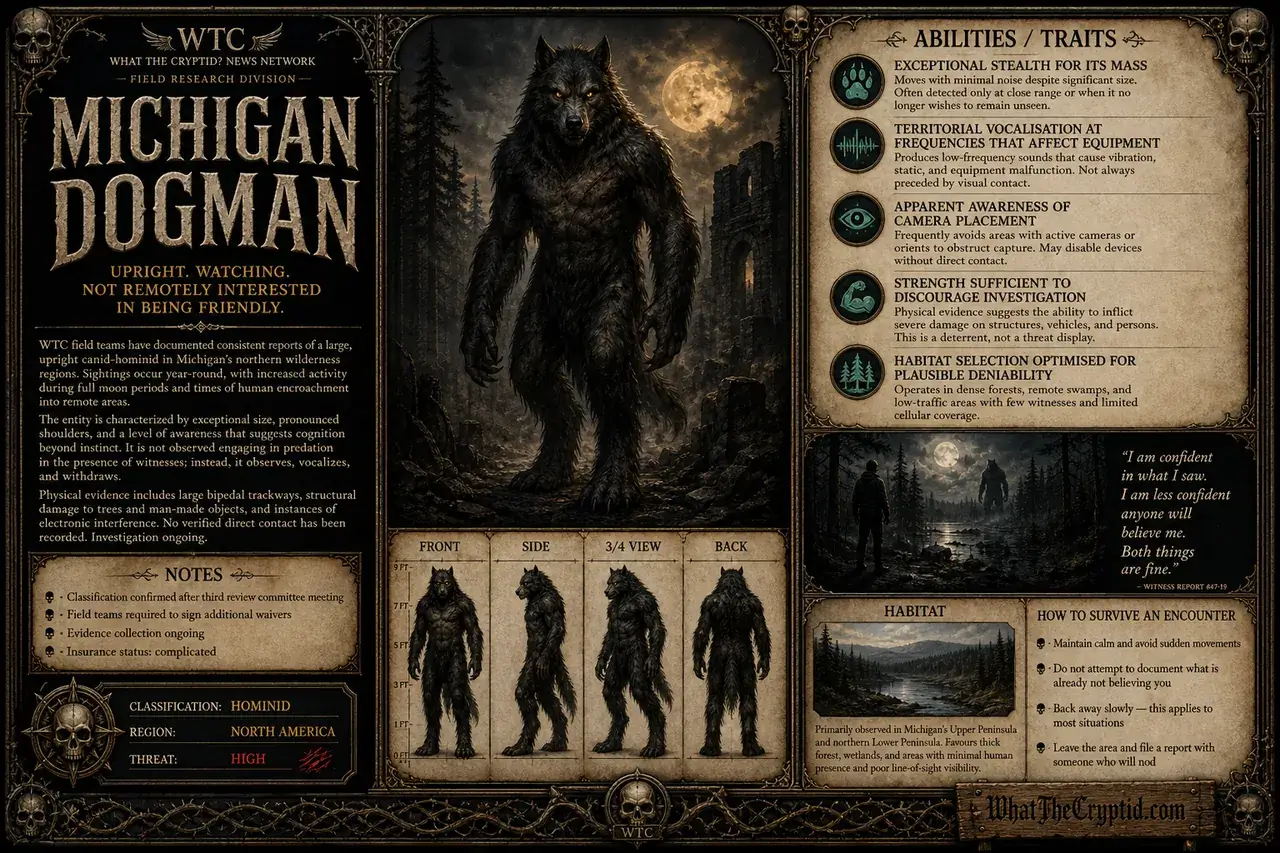
Michigan Dogman
Upright. Watching. Not remotely interested in being friendly.
North America
Active

Overview
The Michigan Dogman is a large, bipedally ambulatory canine entity reported consistently across the lower peninsula of Michigan since at least the late nineteenth century, with a documented spike in encounters every decade ending in the numeral seven — a temporal pattern that remains one of the more genuinely unsettling features of an already unsettling case file. It is classified by the WTC Cryptid Database as a Hominid on the basis of its persistent upright locomotion, apparent bilateral symmetry, and the weight of eyewitness testimony describing deliberate, purposeful movement inconsistent with known quadrupedal predators operating on two limbs in an opportunistic posture.
The entity occupies a distinct ecological and folkloric niche that separates it from the more southerly Beast of Bray Road, with which it is frequently and incorrectly conflated. The Michigan Dogman is larger, demonstrably more territorial, and has been associated with a significantly higher number of vehicle encounters — a behavioural specificity that field researchers find either fascinating or deeply concerning, depending on how recently they have driven a rural Michigan highway at night.
Danger level is assessed at 8 out of 10. This rating reflects not merely the physical capacity for harm — which is considerable — but the entity’s apparent willingness to approach human habitation, maintain prolonged eye contact at close range, and, in at least three documented cases, follow witnesses to the edge of a tree line before stopping. The stopping is not reassuring. The stopping suggests choice.
History & Mythology
The earliest credible written record of the Michigan Dogman dates to 1887, when two lumberjacks operating near the Muskegon River in Wexford County reported encountering a creature they described in their foreman’s log as ‘a wolf standing as a man, with the eyes of something that has seen men before and found them unimpressive.’ The account was not taken seriously at the time, which is consistent with the general nineteenth-century approach to anomalous wildlife documentation. The foreman filed it under ‘drink’ and moved on. The two lumberjacks did not return to that section of the river.
The entity entered broader public consciousness in April 1987 when WTCM-FM disc jockey Steve Cook broadcast a novelty song he had written titled ‘The Legend,’ purporting to document Dogman sightings in seven-year intervals stretching back to 1887. Cook has stated publicly that he composed the song as a prank. What he did not anticipate was the volume of listener calls that followed — not laughing calls, but quiet, specific, sometimes shaking calls from people who had been waiting, apparently for years, for someone to finally say the thing out loud. The song reached number one on local charts. Cook has since described the experience as ‘the worst thing that has ever happened to me professionally, and I once played the Macarena for six hours straight during a radio marathon.’
Anthropological review suggests partial overlap with Ojibwe and Odawa oral traditions describing a category of being sometimes rendered as the Windigo’s lesser-known canine associate — a territorial entity tied to specific waterways and treelines rather than to hunger or cold. Tribal historians consulted by WTC researchers in 2019 were careful to note that conflating the Dogman with any single indigenous tradition is reductive and probably wrong, but acknowledged that the geography of reported sightings aligns with areas historically understood to be ‘places where you do not linger after dark, and not for any reason that has a name in English.’
Physical Description
Eyewitness descriptions of the Michigan Dogman are notably consistent across a 130-year sample, which is either evidence of a real and stable biological entity or evidence of a very effective piece of regional mythology that has successfully colonised the unconscious of an entire peninsula. The entity stands between 6 and 7.5 feet tall when fully upright, with the majority of estimates clustering around 6 feet 8 inches — a height that places it well above the average human male while remaining within the range of plausible mammalian scaling. Witnesses invariably note the disproportionate width of the shoulders relative to the hips, and the distinctly non-human articulation of the knee, which bends in a manner that several witnesses have described, independently and with evident distress, as ‘wrong in a way I can’t fully explain but cannot stop thinking about.’
The head is unambiguously canine: elongated muzzle, high-set pointed ears, and eyes positioned for forward-facing predatory vision rather than the lateral placement of domestic or wild canids. Eye colour in reported sightings is split roughly equally between amber-yellow and a blue-grey that witnesses frequently describe as ‘pale’ or, in two separate 2007 accounts, ‘like it was lit from behind.’ The coat is typically reported as dark — charcoal grey, dark brown, or black — though a 1994 sighting near Traverse City produced a detailed account of a specimen with reddish-brown colouring and a noticeably heavier build that some researchers classify as a potential variant or mature male.
The hands — and all reliable witnesses agree there are hands, not paws — are described as large, five-fingered, and capable of gripping. A 1961 account from a hunter near Cadillac described what he believed to be claw marks on a birch tree at a height of approximately 8 feet, arranged in a pattern consistent with something bracing itself upright against the trunk rather than climbing. The marks were photographed. The photographs are in the WTC archive. They are not available for general publication pending ongoing analysis, and also because looking at them for extended periods appears to be inadvisable for reasons that our imaging team has declined to formally document.
Behaviour & Temperament
The Michigan Dogman is predominantly nocturnal, with the substantial majority of sightings occurring between 10 PM and 3 AM. However, unlike many cryptid entities whose daylight absence can be attributed to simple photosensitivity or avoidance behaviour, the Dogman has been sighted in broad daylight on at least eleven occasions across the documented record — most notably in a 2007 incident near Luther, Michigan, in which a group of four hikers encountered the entity at approximately 2:30 PM on a clear September afternoon. The witnesses reported that the Dogman did not flee. It watched them. Then it walked — upright, unhurried, with what one witness described as ‘the gait of something that has never once needed to run from anything’ — into the tree line. This is the behavioural characteristic that most distinguishes the Michigan Dogman from comparably sized predatory animals: it does not appear to experience threat from human proximity.
Territorial behaviour is well-documented and spatially consistent. Researchers mapping sighting coordinates across the twentieth and twenty-first centuries have identified a loosely defined core territory centred on the Manistee National Forest, with radial excursions following river systems — the Muskegon, the Manistee, and the Pere Marquette — in patterns that suggest deliberate patrol rather than opportunistic roaming. The seven-year activity cycle first noted by Cook’s 1987 broadcast has been independently corroborated by WTC analysts cross-referencing sighting reports with livestock disappearances, trail camera anomalies, and — most strikingly — an unusual but statistically significant uptick in single-vehicle accidents on rural roads in Wexford and Mason counties during the years 1987, 1994, 2007, and 2017. The 1987 and 2007 peaks are the most pronounced.
Social structure is unknown, and WTC field policy is to proceed on the assumption that unknown means singular rather than pack-forming — a policy that is methodologically sound and also personally comforting to the field teams who have to work in those forests. There is one credible account, from 2017, of two entities observed simultaneously. This account is under review. The lead analyst has requested not to discuss it further at this time.
Habitat & Territory
The Michigan Dogman demonstrates a strong preference for the mixed hardwood and conifer forests of Michigan’s lower peninsula, particularly in areas where second-growth timber borders agricultural land or waterways. The Manistee National Forest constitutes the apparent core of its established range, but documented sightings extend north to Emmet County and south as far as Newaygo County, suggesting a territorial range of approximately 4,000 to 6,000 square kilometres — large by the standards of known apex predators of comparable mass, and indicative of either low population density or exceptional individual range capacity.
The entity shows a marked preference for areas adjacent to moving water, and an equally marked aversion to open ground. No credible sighting places the Dogman in a field, a clearing larger than approximately one acre, or any location more than half a mile from tree cover. Trail cameras placed in open meadows by independent researchers have, without exception, returned no anomalous results. Trail cameras placed at forest margins — particularly along the edges of logging roads — have returned results that the researchers in question have generally chosen not to share publicly, citing a range of personal reasons.
Diet & Hunting
Livestock disappearances in documented Dogman territories suggest a diet anchored in large mammalian prey. Goats, sheep, and calves have been reported missing or found in states consistent with large predator activity in Wexford, Mason, and Lake counties at rates statistically elevated above regional wolf or coyote predation baselines — particularly during the established seven-year activity peaks. Deer populations in the Manistee core territory show localised density suppression in pockets that do not align with human hunting pressure or documented wolf pack activity, suggesting a sustained and efficient predatory presence that takes sufficient prey to maintain a large body mass without triggering the kind of dramatic, visible kill sites that would simplify identification.
Of particular note to field researchers: no confirmed Dogman encounter has involved the entity in active pursuit of a human being. This is not the same as saying it has no interest in humans. Multiple witnesses report being observed, followed for short distances, and — in two cases — approached to within arm’s reach. The distinction between ‘has not hunted humans’ and ‘has chosen not to hunt humans’ is one that the WTC threat assessment team considers meaningful, and has weighted accordingly in the High threat rating assigned to this entry.
Notable Sightings
A seventeen-year-old farmhand reported discovering a large canine figure standing upright beside his family’s barn at approximately midnight in late October, alerted by the distressed lowing of cattle. He estimated the figure at ‘over six feet, easy,’ with a distinctly dog-like head and arms that ‘hung wrong — too long, and the elbows bent backwards.’ The figure turned to look at him, held eye contact for what he estimated as thirty seconds, then dropped to all fours and moved into the adjacent woodlot at a speed he described as ‘faster than anything I’ve seen before or since.’ No livestock were missing the following morning. Four were found dead the morning after that, their enclosure undisturbed and the latch still fastened from the outside.
Four adult hikers on a marked trail in the Manistee National Forest encountered the entity at approximately 2:30 PM in September during the peak of the 2007 activity cycle. All four witnesses provided independent written statements within 48 hours of the incident at the request of WTC field correspondent Dale Richter, who happened to be in the area for unrelated reasons. The statements agree on all major physical details — height, colouring (dark grey-black), upright posture, and the absence of any aggressive display — and diverge only on the duration of the encounter before the entity walked into the trees, with estimates ranging from forty seconds to ‘at least three minutes, maybe more, I wasn’t looking at my watch.’ All four witnesses independently used the phrase ‘it wasn’t afraid of us’ without prompting.
Following the broadcast of Steve Cook’s ‘The Legend’ in April 1987, a retired schoolteacher contacted WTCM-FM to report that the song had described, with uncomfortable accuracy, an entity she had seen in the tree line behind her property on three separate occasions during the winter of 1986-87, always between 11 PM and 1 AM and always standing still, facing the house. She had assumed it was a large dog until the third sighting, when it raised one arm — she was specific: one arm, in a gesture she could not characterise as threatening or welcoming — before stepping backward into the darkness. She had told no one. She did not explain why. Cook has included her account in his subsequent non-fiction research, noting that she was ‘the most composed person I’ve ever spoken to about this, and also the most frightened.’
A kayaker completing a solo multi-day run of the Manistee River reported pulling ashore on the evening of August 14th to find what he initially took to be a large dog drinking from the river approximately forty metres upstream. When the figure stood upright to its full height — which he estimated at ‘close to seven feet’ — and turned to regard him with an expression he described only as ‘aware,’ he remained motionless in his kayak for approximately four minutes before the entity turned away and moved north along the riverbank on two legs until it passed beyond the bend. He completed the remaining fourteen miles of his route the following morning without stopping. He has not returned to the Manistee River. He states he has no intention of doing so.
Threat Assessment
The Michigan Dogman is assessed at threat rating High. This rating reflects the convergence of several factors that individually might support a more moderate assessment but in combination produce a risk profile that WTC analysts are not comfortable downgrading: the entity’s confirmed physical capacity to cause lethal harm to large mammals, its demonstrated lack of flight response to human proximity, its established territorial behaviour around human infrastructure including farms and rural roadways, and the temporal regularity of its activity cycles — which implies a degree of biological or behavioural predictability that is, paradoxically, more concerning than random activity, because it suggests the entity is operating according to patterns we do not yet understand.
Recommended approach for members of the public who encounter the Michigan Dogman: do not run. Running activates prey response in all known predatory mammals, and there is no reason to assume the Dogman is an exception. Do not make direct sustained eye contact for longer than is required to back away slowly. Do not attempt to photograph the entity using flash at close range — this guidance follows a 2014 incident near Irons that WTC does not discuss in public-facing materials but has been internally classified as ‘a significant escalation in response to a preventable stimulus.’ Move toward open ground if possible. Put distance between yourself and the tree line. Notify WTC via the tip line within 24 hours, while details are fresh. Do not notify local law enforcement unless you enjoy paperwork and being told you saw a bear.
WTC Field Notes
The Michigan Dogman presents the WTC editorial team with what we have internally classified as ‘the full package problem’ — an entity so thoroughly documented, so geographically consistent, and so behaviorally specific that the standard cryptid journalism toolkit of cautious hedging and plausible-deniability language starts to feel genuinely inadequate. We have, over the course of thirty-seven years of network operation, written entries for things that exist in one account from one person in one county. The Dogman has hundreds of accounts, from hundreds of people, across fourteen counties, spanning a century and a half. At some point ‘alleged’ becomes a stylistic choice rather than an epistemological one.
What we can say with confidence is this: something is in those forests. Something large, something bipedal, something that appears to operate on a schedule and has apparently decided that the lower peninsula of Michigan suits its requirements. It has not, to the best of our knowledge, killed a human being. We consider this a data point rather than a guarantee. The WTC Cryptid Database will continue to monitor all incoming reports, maintain active field correspondence in Wexford and Manistee counties, and update this entry on a seven-year cycle — not because we believe in the pattern, exactly, but because the pattern has not yet given us a reason to disbelieve it, and we find it is best to be ready.