
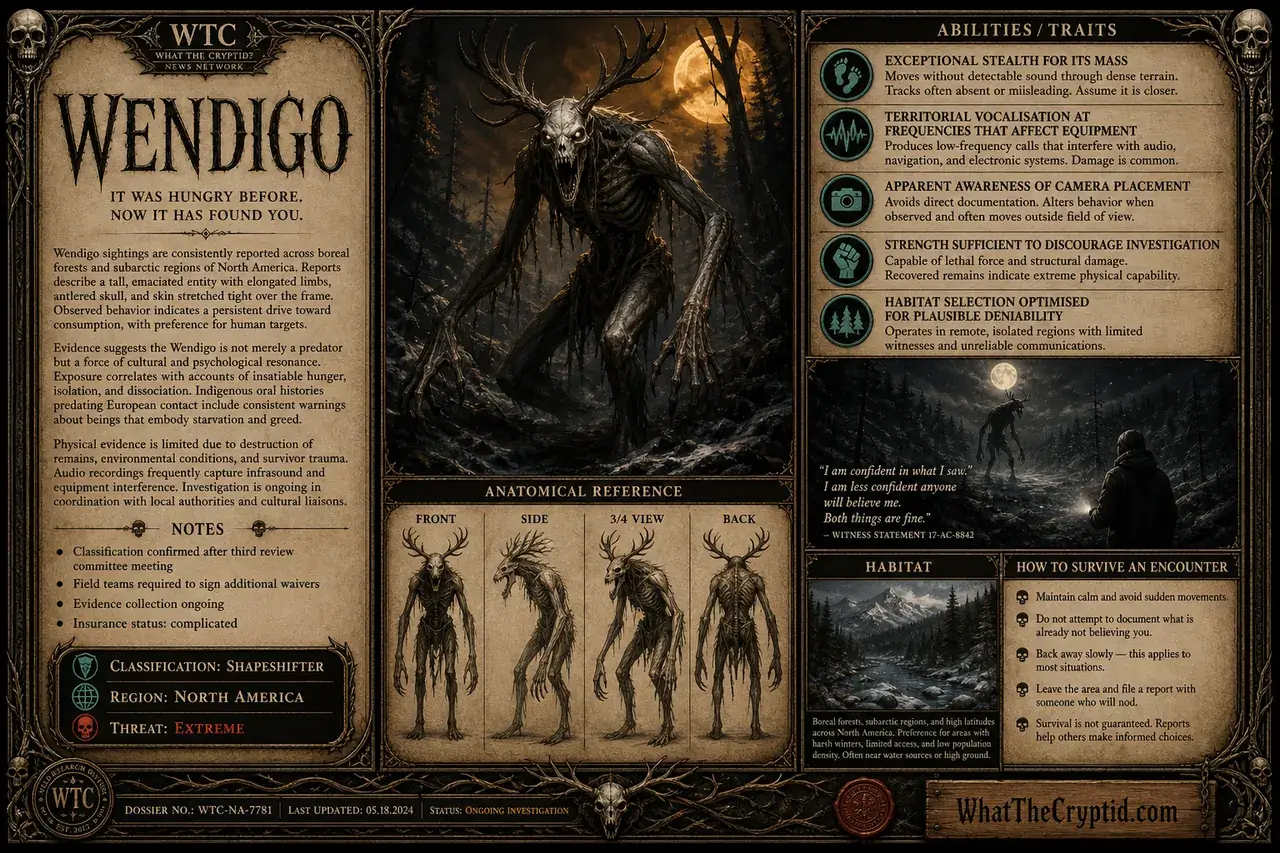
Wendigo
It was hungry before. Now it has found you.
North America
Active
AlgonquianCannibalismWinterSpirit PossessionBoreal Forest
Overview
The Wendigo is a predatory spirit entity documented across the Algonquian-speaking nations of the northern Great Lakes, the Canadian Shield, and the boreal forest belt extending from Manitoba to the Atlantic seaboard. It is associated — with a consistency that WTC considers editorially significant — with extreme cold, prolonged isolation, and the specific psychological conditions produced by winter starvation. It is not associated with things going well. The entity is distinguished from most cryptid classifications by the dual nature of its documented behaviour: it functions simultaneously as a predatory physical presence and as a contagious spiritual condition, capable of possessing human hosts and compelling them toward the consumption of human flesh. WTC’s classification committee spent eleven weeks debating whether this made the Wendigo a Spirit, a Predatory entity, or both, before reaching a compromise that satisfied no one and is reflected in the single field above.

What is consistent across several centuries of documentation is the Wendigo’s relationship to hunger — not as a biological state, but as an existential one. The entity is described by multiple independent oral traditions as something that cannot be satisfied, that grows larger with each consumption and therefore hungrier in proportion, trapped in permanent escalating need. WTC’s consulting psychologist noted this was ‘a remarkably efficient metaphor’ before clarifying that she was speaking strictly about the metaphor.
History & Mythology
Wendigo accounts appear in the oral traditions of the Ojibwe, Cree, Algonquin, Innu, and Naskapi peoples, with documentation by European missionaries beginning in the seventeenth century. Father Paul Le Jeune’s Jesuit Relations of 1636 contain what is among the earliest written accounts, describing a figure the Montagnais people feared above most other spiritual threats — specifically one associated with winter isolation and the transgression of eating human flesh, whether by choice or by necessity. Le Jeune recorded this with the clinical detachment of a man who had also survived a Canadian winter and was perhaps not in a position to dismiss hunger-related spiritual crises out of hand.
Of particular historical note are the documented cases of ‘Wendigo psychosis’ recorded by European and Canadian officials throughout the eighteenth and nineteenth centuries — a clinical phenomenon in which individuals, typically following severe deprivation, developed compulsive cravings for human flesh and frequently reported believing themselves to be transforming into the entity. The most thoroughly documented of these cases is that of Swift Runner, a Cree hunter from Alberta who in the winter of 1878 consumed the members of his family camp despite the presence of food at Hudson’s Bay Company posts within accessible distance. Swift Runner himself claimed Wendigo possession at trial. He was executed in 1879. WTC does not take a position on the question of culpability, as this falls outside our editorial mandate and into one that our legal team has specifically asked us to avoid.
Physical Description
The Wendigo is consistently described as tall — significantly, disproportionately tall — with figures in oral traditions and field accounts ranging from eight to fifteen feet in height, though several Cree accounts describe entities of sufficient scale that precise human measurement becomes a secondary concern. The frame is invariably emaciated, the skin drawn tight across visible bone structure, the stomach collapsed inward. This is not the appearance of something that has not eaten. It is the appearance of something that has eaten and remained hungry, which is considered by WTC to be the more unsettling condition of the two.
The skin, where described, is typically grey, pale blue, or the colour of old ash, sometimes described as partially translucent. The eyes are sunken and, in many accounts, either absent or replaced by a flat, depthless luminescence — described variously as yellow, red, or simply as ‘wrong.’ The mouth is large, and the lips are frequently described as torn or absent, consistent with accounts of the entity gnawing at its own flesh in the absence of other prey. The breath is reported as carrying a pronounced odour of decay and cold simultaneously, a sensory combination that several witnesses have described as ‘wrong in the way cold things should not be wrong.’ Regional variants from the Innu traditions of Labrador describe a Wendigo encased partially in ice, which may represent a distinct phenotype or may reflect environmental conditions at the time of observation. WTC has not been able to conduct comparative analysis due to the logistical complications of working in Labrador in winter.
Behaviour & Temperament
The Wendigo is primarily a winter-active entity, with the overwhelming majority of sightings and encounters clustered between November and March in regions where temperatures routinely fall below minus twenty Celsius. This is either a reflection of the entity’s preferred operating conditions or an efficient natural deterrent against field investigation — WTC’s senior researcher described these possibilities as ‘not mutually exclusive.’ Activity drops sharply in the summer months, though accounts of summer encounters do exist and are considered by some researchers to indicate a more established or mature entity, no longer constrained by seasonal limitation.
The entity is solitary in all documented accounts. There is no record of two Wendigoes operating cooperatively, which is consistent with the territorial and competitive nature implied by the starvation-logic of its existence: a being defined by insatiable need does not naturally share. When stalking prey, the Wendigo is reported to be extraordinarily quiet for its documented scale, moving through dense boreal forest without producing the sound one would expect from something fifteen feet tall navigating frozen undergrowth. Multiple accounts describe a preceding wind or drop in ambient temperature as the only reliable warning. The entity has been reported to mimic human voices — specifically the voices of known individuals — to draw targets away from shelter or companions. WTC recommends treating any voice heard at significant distance in isolated winter conditions with what our editor has requested we describe as ‘heightened discernment.’
Habitat & Territory
The Wendigo’s primary habitat is the boreal forest zone of northern North America, with core range documented across northern Ontario, Manitoba, Saskatchewan, Quebec, and Labrador, extending into the northern border regions of Minnesota, Michigan, and Wisconsin. The entity demonstrates a consistent preference for dense coniferous forest at elevations below 2,000 feet, in areas with significant winter snowpack and limited human infrastructure — conditions that, coincidentally or otherwise, also maximise isolation of potential prey.
Water features appear to be a consistent habitat marker, with a notable concentration of sightings within two miles of frozen lakes or river systems. Whether this reflects a territorial preference or simply the fact that waterways historically defined travel routes through the boreal forest — and therefore defined where humans were — is a question WTC has added to its ongoing list of things we intend to investigate when funding permits.
Diet & Hunting
The Wendigo feeds on human flesh. This is the central and non-negotiable fact of its dietary profile, documented across every cultural tradition that records its existence and consistent across several centuries of field accounts. WTC does not editorially soften this detail, as doing so would not make it less true and would compromise the informational value of this entry for anyone planning travel to the northern boreal region.
What is remarkable — and WTC uses this word in its technical sense — is that consumption does not resolve the entity’s hunger but intensifies it. Multiple Algonquian traditions describe the Wendigo as growing proportionally larger with each feeding, meaning its caloric requirement scales upward in direct proportion to its capacity to meet that requirement. It is a hunger loop with no exit condition. The entity is also documented to consume its own body in the absence of other prey, particularly the lips and fingers, suggesting that the drive is not strictly nutritional but compulsive in a manner that WTC’s consulting psychologist agreed was ‘clinically interesting, from a safe distance.’
Notable Sightings
Jack Fiddler, an Oji-Cree shaman of the Sucker Clan, was arrested by the North-West Mounted Police in the autumn of 1907 for the killing of a woman he claimed had become possessed by the Wendigo and was in the process of transformation. Fiddler and his brother Joseph had conducted at least fourteen such killings over the course of their leadership, a number corroborated by witness testimony from their community. The NWMP characterized these as unlawful killings. The Sucker Clan characterised them as necessary interventions. Jack Fiddler escaped custody and died shortly after; Joseph was convicted and later granted a posthumous pardon. The community’s position on the necessity of the interventions was not entered into the pardon proceedings.
A group of four wilderness guides reported a series of encounters over three consecutive nights in January while leading an ice-fishing expedition near Lac La Croix. The accounts, filed independently and later collected by the Minnesota DNR under a miscellaneous incident category, describe a figure of approximately twelve feet in height observed on two occasions at the treeline, approximately 200 yards from camp, standing motionless for periods of fifteen to thirty minutes before withdrawing. On the third night, one guide, David Oshiro, reported waking to find large depressions in the snow surrounding the camp perimeter — a circumnavigation of the tents conducted without audible detection. The expedition departed the following morning, two days ahead of schedule. Oshiro did not lead another winter wilderness expedition.
A snowmobile operator named Gary Thibodeau reported an encounter approximately forty kilometres northeast of Chapleau on the Kebsquasheshing River corridor in February 2003. Thibodeau described a figure crossing the frozen river ahead of him at a distance he estimated as 300 metres — upright, bipedal, and moving at a pace inconsistent with its apparent stride length. He further reported that the figure paused mid-crossing, turned to face him, and remained stationary for what he estimated as ninety seconds before continuing into the tree line. Thibodeau’s snowmobile sustained a mechanical failure on the return journey, unrelated according to the service technician who inspected it the following week. Thibodeau described the technician’s assessment as ‘optimistic.’
Community elders in Pikangikum formally reported to band council in March 2011 that a Wendigo presence had been detected in the forest northeast of the community, based on a combination of environmental signs, livestock behaviour, and three separate visual accounts from community members that the elders considered credible. A traditional ceremony was conducted. The elders declared the presence resolved as of the second week of March. Two of the three witnesses declined to describe their accounts in further detail to outside parties. Band council closed the matter without forwarding documentation to provincial authorities, a decision the council spokesperson described as ‘straightforward.’
Threat Assessment
The Wendigo presents a threat profile that WTC rates as Extreme — a designation we apply sparingly and which in this case reflects both the entity’s documented lethality and the specific difficulty of mounting any effective counter-response once proximity has been established. The Wendigo does not announce itself in ways that allow for orderly retreat. The most reliable warning signs — a sudden localised temperature drop, the smell of decay on cold air, and the mimicking of a known voice from an unexpected direction — are each individually easy to rationalise and are most dangerous precisely in the conditions of cold and isolation where judgement is already compromised.
WTC recommends maintaining a minimum party size of four when conducting winter travel in documented Wendigo habitat, not because group size deters the entity, but because decision-making quality in crisis conditions degrades significantly below that threshold. If a voice is heard from outside shelter at night that you recognise as belonging to a member of your party who is standing next to you, do not respond to it and do not open the door. If you are alone, WTC recommends remaining in shelter and reviewing your travel planning for the choices that led to this situation. Maintain a fire if at all possible. Multiple accounts across multiple centuries describe the entity as maintaining its distance from significant heat sources, though WTC acknowledges that ‘multiple centuries of accounts’ and ‘controlled experimental confirmation’ are not equivalent forms of evidence.
WTC Field Notes
WTC first formally added the Wendigo to the active monitoring database in 2009, following an editorial meeting in which three of our four senior researchers cited it independently when asked which cryptid they personally considered most credible. The fourth researcher abstained on the grounds that they had grown up in Sudbury and found the question ‘too close to home to be comfortable,’ which was itself considered editorially significant.
Our most recent field investigation was conducted in February 2022 in the Chapleau Crown Game Preserve, following up on the 2003 Thibodeau sighting corridor. The team of two deployed trail cameras at eleven locations along the Kebsquasheshing River and established a base camp with a propane heating system rated to minus forty. Eight of the eleven cameras malfunctioned within seventy-two hours. The propane heater performed without issue, which the team described as ‘the most comforting part of the trip.’ The remaining three cameras captured footage that our lead researcher described in her filed report as ‘requiring further review,’ a review she has continued to postpone for reasons she has not specified. WTC has not pressed the matter.