
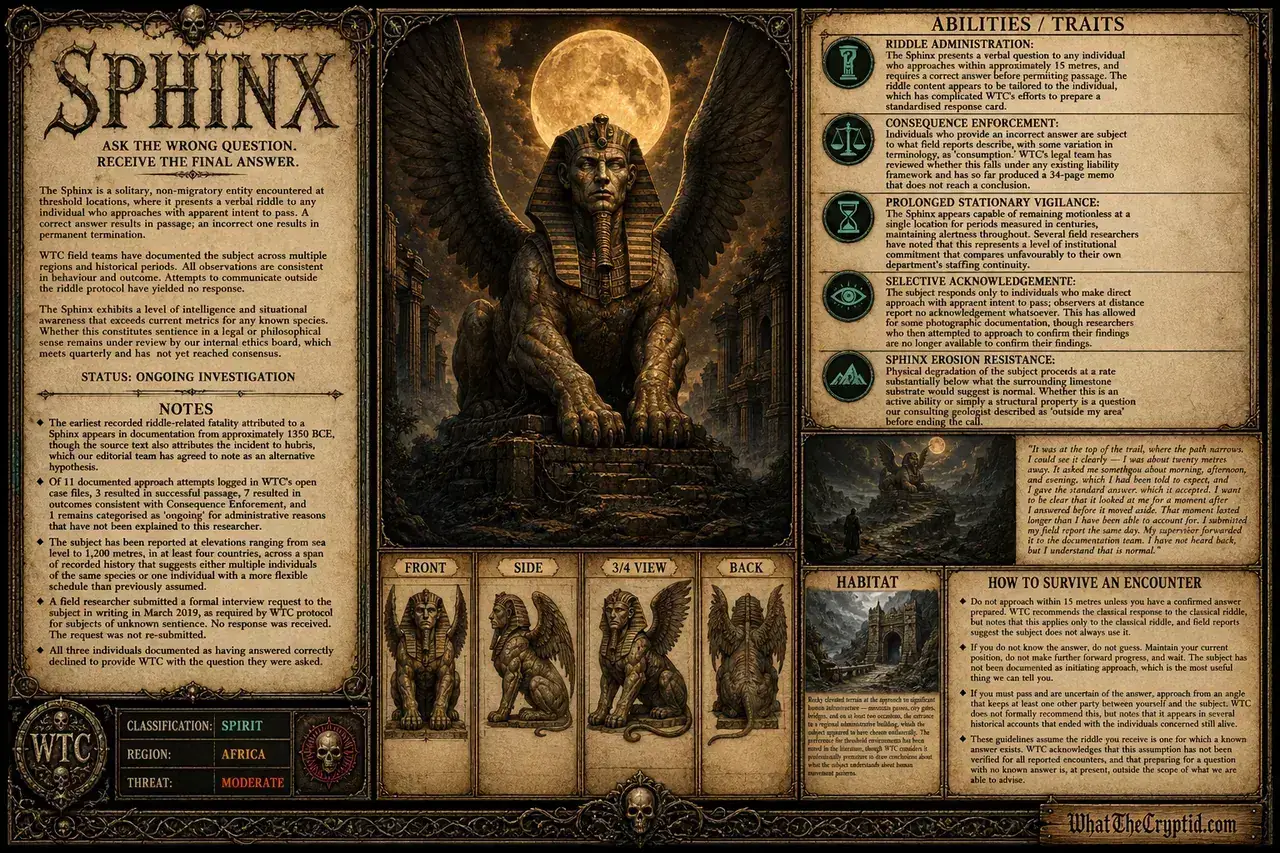
Sphinx
Asks questions. Does not accept partial credit.
Africa
Unverified
EgyptGreeceRiddleLeonineAncient
Overview
The Sphinx is a large, multi-form predatory entity documented across North African and Near Eastern records for approximately 4,500 years, characterised by a feline body of lion proportions, a humanoid head capable of articulate speech, and a recorded pattern of behaviour in which the entity poses a verbal challenge to approaching humans before determining an appropriate response. WTC classifies it as Predatory on the basis that documented outcomes of failed challenges are uniformly fatal, and that ‘enigmatologist’ is not yet a recognised field of emergency response. The entity is distinct from the monumental stone structures bearing its likeness, though WTC notes that the relationship between the two has never been fully ruled out.

Field documentation of the Sphinx is complicated by the entity’s apparent preference for high-profile confrontations in densely populated ancient urban corridors, followed by extended periods of complete non-appearance that our Senior Researcher describes as ‘frustrating from a research continuity standpoint.’ The most comprehensive historical record comes from the Greek-language account of the Theban Sphinx, which operated in the vicinity of Thebes for an unspecified period before its documented cessation of activity in the fifth century BCE. This account is treated by WTC as primary field data, with appropriate allowance for narrative compression over oral transmission.
Three primary morphological variants have been documented across regional traditions, designated by WTC as Type A (Androsphinx, human-headed), Type B (Criosphinx, ram-headed), and Type C (Hieracosphinx, falcon-headed). All variants share the leonine body plan. This entry focuses primarily on the Type A variant, which accounts for the majority of interactive sightings and all documented riddle-protocol incidents.
History & Mythology
The earliest physical documentation of the Sphinx in the archaeological record dates to approximately 2500 BCE, with the construction of the Great Sphinx of Giza during the reign of Pharaoh Khafre, though minority scholarly opinion places the original structure earlier, a position WTC finds professionally interesting and personally inconvenient to evaluate. Egyptian sources treat the entity as a protective guardian figure designated ‘Shesep-ankh,’ meaning ‘living image,’ a characterisation that WTC notes is easier to maintain when the entity is rendered in 73 metres of limestone and therefore unlikely to request anything of you.
The Greek literary tradition provides the most operationally specific historical account. The Theban Sphinx, documented in sources including Hesiod’s Theogony and the Oedipus cycle attributed to Sophocles, established a territory on Mount Phikion outside Thebes and implemented a consistent challenge protocol: travellers were required to answer a riddle concerning a creature that walks on four legs in the morning, two legs in the afternoon, and three legs in the evening. Failure to answer correctly resulted in the traveller’s death. The entity reportedly consumed its victims, though ancient sources vary on whether this was the cause of death or a subsequent activity. The Sphinx’s operational period at Thebes ended when Oedipus correctly identified the answer as ‘a human being,’ at which point the entity reportedly destroyed itself. WTC’s Events Review Committee has spent considerable time on this termination condition and has not reached a consensus.
Subsequent sightings across the medieval and early modern periods are sparse and geographically scattered, suggesting either range contraction, extended dormancy, or a methodological shift that WTC’s historiography team continues to assess. The entity’s physical monumental legacy across Egypt, the Levant, and into South Asia represents an unusually well-documented habitat footprint for a cryptid whose direct interaction record is this limited.
Physical Description
The Type A Sphinx presents a body consistent in proportion with a large African lion, with documented shoulder height in the range of 4 to 6 feet and an estimated body length of 8 to 12 feet, excluding the tail. The hindquarters and forelimbs follow standard leonine musculature, with observers across multiple traditions independently noting the entity’s apparent physical strength as the detail they found second most remarkable. The head is humanoid in structure, proportionally enlarged relative to the body — ancient artistic renderings, which WTC treats as field sketches of uncertain precision, suggest a head-to-body ratio inconsistent with either a lion or a human in isolation. The face in documented representations is calm, which several researchers have noted is not reassuring in context.
Regional variants show significant cephalic divergence while maintaining the leonine body plan. Type B (Criosphinx) replaces the humanoid head with that of a ram, and is documented primarily in connection with the temple processional avenue at Karnak. Type C (Hieracosphinx) presents a falcon head and is associated with solar deity symbolism. Neither Type B nor Type C has an associated riddle-protocol incident in any surviving record, which WTC notes may reflect variant behaviour or may reflect survivor reporting bias, as the two conditions are difficult to distinguish from the available data.
The Theban Sphinx is additionally described in some Greek sources as possessing wings — typically rendered as eagle wings mounted at the shoulders — though this detail is inconsistent across accounts and absent from the Egyptian tradition entirely. WTC has logged this discrepancy without resolution. The entity in active encounter accounts is described as speaking in a voice multiple ancient sources characterise as ‘clear’ and ‘melodious,’ a detail that has struck every member of our documentation team as an unusual priority given the surrounding circumstances.
Behaviour & Temperament
The Sphinx’s most thoroughly documented behaviour is the riddle protocol, in which the entity intercepts travellers at a fixed territorial threshold, presents a verbal puzzle, and responds to the outcome binarily. This behaviour pattern is consistent enough across multiple independent ancient sources that WTC treats it as reliable species-level characteristic rather than individual variation. The entity appears to have no intermediate response state: it does not negotiate, offer additional attempts, or accept answers that are technically correct but inadequately explained. In this respect, the Sphinx operates with a consistency that our Editor-in-Chief described as ‘admirable, if inconvenient.’
Outside of challenge encounters, the Sphinx’s behavioural record is limited. Egyptian texts frame the entity in a guardian capacity, oriented toward the rising sun and positioned at transitional thresholds — tomb entrances, temple approaches, city gates — suggesting a territorial definition organised around liminal spaces rather than conventional hunting range. Whether this represents protective behaviour, ambush positioning, or something WTC’s field team has not yet categorised is an open question. The entity does not appear to pursue individuals who decline to approach its established threshold, which distinguishes it from most Predatory classifications and has led to some internal debate about that designation that was resolved by committee vote.
The Sphinx’s apparent willingness to destroy itself upon being correctly answered remains the most behaviorally anomalous data point in the file. No other cryptid in the WTC database has a documented self-termination protocol tied to an intellectual condition. Several researchers have proposed that the correct answer does not defeat the Sphinx but rather satisfies it — that the riddle represents a genuine inquiry, and the entity’s response to resolution is contentment rather than defeat. WTC has filed this interpretation under ‘speculative’ and noted that the practical outcome is the same either way.
Habitat & Territory
Documented Sphinx activity clusters around transitional geographical features: mountain passes, city gates, river crossings, and desert margins. The Theban Sphinx’s recorded territory on Mount Phikion sits at an elevation of approximately 1,400 feet above the Boeotian plain, providing clear sightlines in multiple directions and, WTC’s field team notes, an approach corridor that funnels travellers through a single observable path. This is either a coincidence or it is not. The Egyptian Sphinx tradition places the entity consistently at the threshold of sacred or mortuary spaces, reinforcing the pattern of liminal positioning.
Climate preferences appear to skew toward arid and semi-arid conditions across the primary historical range, though Greek Thebes represents a Mediterranean climate exception that complicates simple environmental modelling. Proximity to human settlement appears to be a feature rather than a liability for this entity, which is not typical of cryptids in the Predatory classification and has been noted in WTC’s internal habitat assessment documentation. The entity seems, on available evidence, to prefer to be findable.
Diet & Hunting
The Theban Sphinx is explicitly documented as consuming travellers who failed its riddle challenge, with ancient sources including Apollodorus describing this as routine rather than exceptional behaviour. Extrapolating from the entity’s documented tenure at Mount Phikion and the recorded volume of Theban traffic on that route, WTC’s estimates suggest the Sphinx was processing between two and eight individuals per month during peak operational periods — an intake that our consulting wildlife nutritionist assessed as ‘plausible for a felid of that body mass, if irregular.’
Outside of the Greek riddle-protocol incidents, direct evidence for diet is absent. The Egyptian tradition does not describe the Sphinx as predatory in a nutritional sense, and no ancient text documents the entity feeding in a non-challenge context. Whether this reflects genuine dietary constraint — the riddle as a necessary precondition for consumption — or simply a gap in the record is unresolved. WTC’s field team has proposed that the entity may supplement with conventional prey between human encounters, which would be behaviourally sensible and is noted here without evidence, which is an editorial position our legal team has asked us to be more careful about.
Notable Sightings
The foundational interaction record involves Oedipus of Corinth, documented in multiple subsequent Greek sources as having encountered the Theban Sphinx on the road to Thebes following an unrelated incident near Phocis. Oedipus answered the riddle correctly — identifying the answer as ‘a human being’ — at which point the entity reportedly threw itself from the mountain and was not observed again. The city of Thebes subsequently offered Oedipus the vacant throne and the hand of the widowed queen Jocasta in what ancient sources describe as a gesture of civic gratitude, and which subsequent events recontextualised considerably.
Members of Napoleon Bonaparte’s Egyptian expedition under the Direction Générale des Sciences et Arts recorded extended observational sessions with the Great Sphinx of Giza, producing some of the earliest systematic measurements of the monument at 240 feet in length and 66 feet in height. Scholar Vivant Denon noted in his field journal that the face, despite significant erosion, retained what he described as ‘an expression of disquieting attentiveness,’ a characterisation he did not expand upon and which does not appear in the official expedition reports.
Howard Carter’s excavation team at the Valley of the Kings reported in late November that two local workmen had independently described an encounter near the avenue of ram-headed sphinxes at Karnak in which one of the figures was observed in a position inconsistent with its documented orientation from a survey conducted six weeks prior. Carter logged the report, noted that the movement differential was within normal measurement error, and recorded that both workmen requested reassignment to a different excavation site. They were reassigned the following day, and no further incidents were recorded at that location during the season.
The Naxians commissioned and installed a marble sphinx on a 32-foot Ionic column at Delphi, dedicated to the oracle and documented in Pausanias’s second-century CE geographical survey as still standing in his era — a tenure of over 700 years at one of the ancient world’s most frequented pilgrimage sites. Pausanias records several local traditions about the figure without noting any behavioural incidents, an absence of incident across seven centuries that WTC’s research team has marked in the file without comment.
Threat Assessment
WTC rates the Sphinx Extreme on the threat scale, with the specific qualifier that the threat is conditional and therefore in some respects manageable, which distinguishes it from the majority of Extreme-rated entries in the database. The entity’s documented attack protocol is preceded by a verbal challenge that provides the approaching human with a clear decision point: answer correctly and survive; answer incorrectly and do not. WTC’s formal recommendation is to answer correctly, and acknowledges that this guidance has limited operational utility without advance preparation.
Field teams and civilians are advised to maintain a minimum distance of 50 metres from any entity matching this description until the riddle has been clearly heard and processed. Do not approach while still formulating your answer. Do not guess. Ancient accounts provide no documentation of partial credit. If you are uncertain of the answer, WTC recommends withdrawing to a safe distance and consulting available references, noting that mobile data coverage in known Sphinx habitat areas is inconsistent and that our Research Library is available by email with a typical response time of three to five business days. WTC cannot guarantee this is sufficient.
WTC Field Notes
The Sphinx file has been open at WTC longer than any other entry in the database, a distinction that our archivists find meaningful and our accountants find expensive. The challenge in covering the Sphinx is not a shortage of historical material — it is that the historical material is almost entirely ancient, monumental, and located in jurisdictions that have not responded to our press credential applications with what we would describe as enthusiasm. A 2019 proposal to conduct thermal imaging surveys of the Giza Sphinx was declined by the Egyptian Ministry of Antiquities, who characterised the application as ‘outside the scope of recognised archaeological methodology.’ WTC is appealing this decision.
Our Editor-in-Chief has requested that we note, for the record, that the Sphinx’s riddle — a creature that walks on four legs in the morning, two in the afternoon, and three in the evening — has an answer that is itself a description of the human researcher encountering it, which she described as ‘either the most elegant thing in the database or the most unsettling, and possibly both.’ The Sphinx file is flagged for priority follow-up whenever a credible active sighting is submitted. We have not yet received one, which WTC notes is not the same thing as the entity being absent.