
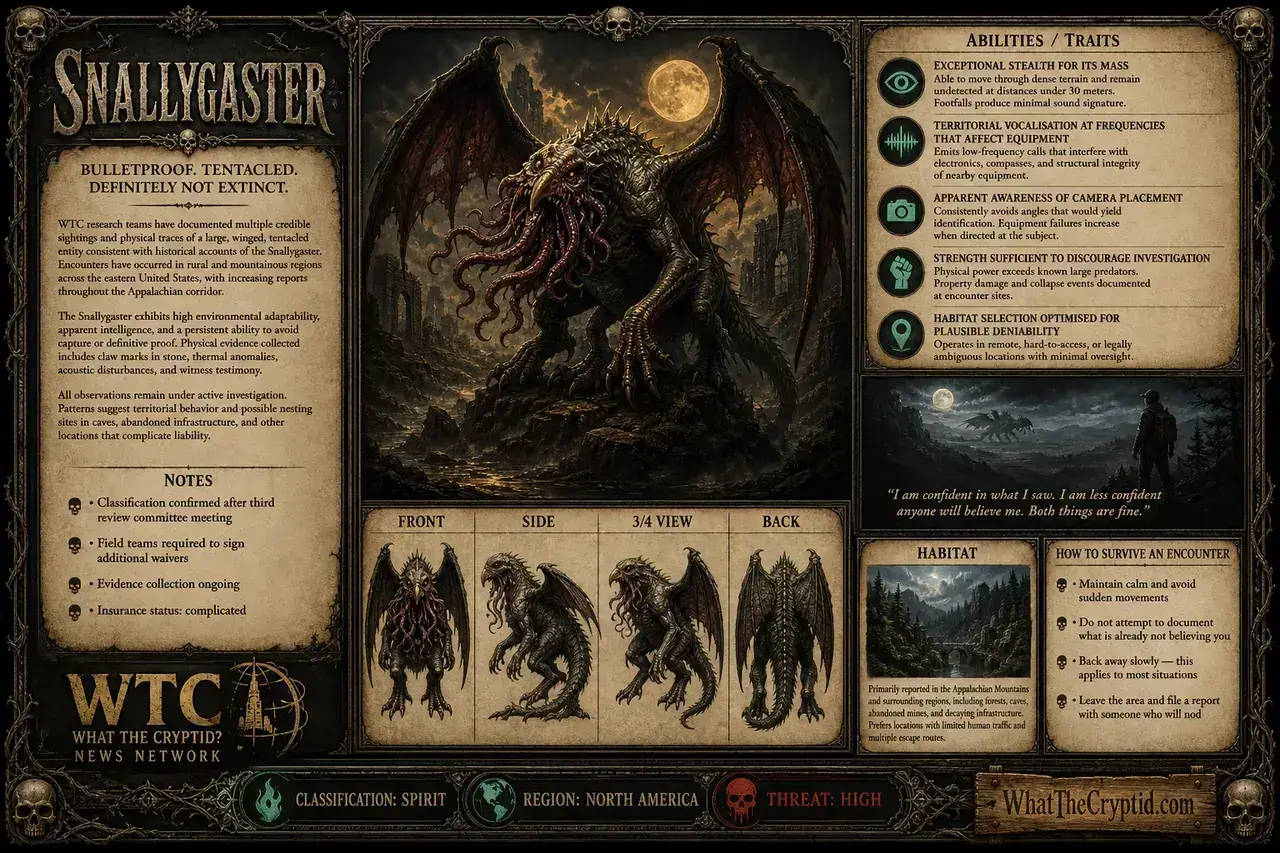
Snallygaster
One eye. Metal beak. Probably not migrating.
North America
Active
WingedMarylandPredatoryBlue RidgeAppalachianLivestock ThreatHistorical RecordSingle Eye
Overview
The Snallygaster is a large, winged predatory cryptid documented primarily across the Blue Ridge Mountain corridor of western Maryland, with confirmed sighting clusters in Frederick, Washington, and Carroll Counties. The entity presents features inconsistent with any catalogued species: a single centrally-positioned eye, a metallic or heavily keratinised beak capable of producing structural damage to livestock enclosures, and a wingspan that witnesses have estimated, under separate conditions, at between 20 and 25 feet. WTC classification as Winged is considered provisional, given that several field accounts describe locomotive behaviour on the ground that our consulting ornithologist noted was ‘not consistent with anything in my area of study, or frankly anyone else’s.’

The entity’s common name derives from the Pennsylvania Dutch ‘Schneller Geist,’ meaning ‘quick ghost,’ a designation that reflects the early settler experience of encountering something fast, large, and wholly uninterested in being identified. That name has since been anglicised, simplified, and applied to a creature that, whatever else it may be, does not appear to be a ghost. It has, on multiple occasions, left physical evidence. The distinction matters to WTC researchers, if not to the entity itself.
Documented behaviour suggests the Snallygaster is an apex predator operating within a defined but expansive territory, with activity patterns that correlate loosely with season, weather, and — according to one as-yet-unreviewed internal report — lunar phase. WTC does not currently endorse the lunar hypothesis. We have, however, forwarded it to our advisory board, where it has been pending review since 2019.
History & Mythology
The earliest formal documentation of Snallygaster activity in the American record dates to 1909, when the Smithsonian Valley Register of Smithsburg, Maryland published a series of reports describing a creature terrorising the rural German-American communities of the Blue Ridge foothills. These reports prompted sufficient institutional attention that the Smithsonian Institution allegedly offered a reward for a specimen — a claim that the Smithsonian has since neither confirmed nor denied with any particular urgency. President Theodore Roosevelt was reported to have considered postponing an African safari to investigate, a decision he ultimately did not make, which historians have noted was probably correct on multiple grounds.
The cultural antecedents of the Snallygaster predate 1909 considerably. German settlers arriving in the Maryland region from the 17th century onward carried with them a tradition of Schneller Geist encounters from the Rhine Valley — a winged predator associated with livestock disappearances, unearthly screeching at altitude, and a reluctance to be seen clearly. Whether the American Snallygaster represents a continuation of a European species that crossed with settlers, a native entity that absorbed a European name, or an entirely independent phenomenon that regional communities mapped onto familiar folklore is a question WTC has formally categorised as ‘above our current research budget.’
Significantly, the 1909 newspaper coverage is now generally attributed, in part, to deliberate sensationalism by editors seeking to boost circulation — an assessment that WTC notes does not actually explain the underlying witness accounts, which predate the editorial campaign and continue to be submitted long after newspapers abandoned the Snallygaster as a reliable revenue source.
Physical Description
Witness accounts converge on several consistent features with a reliability that WTC’s data team describes, cautiously, as ‘statistically improbable for a hoax.’ The Snallygaster presents as a large avian or avian-adjacent entity, standing an estimated 8 to 10 feet at the shoulder when observed on the ground, with a body mass that witnesses have consistently compared, unprompted, to that of a mature draft horse. The wings, when fully extended, have produced shadow profiles across road surfaces that independent accounts have measured at 20 to 25 feet tip to tip.
The most consistently reported anatomical feature is a single large eye, positioned centrally on the skull, described as luminescent and ‘the approximate colour and quality of a traffic light on yellow.’ The beak is described as rigid, silvery-grey, and tapered to a point capable of puncturing corrugated steel roofing, which one Frederick County farmer in 2003 reported it had done, apparently to investigate the interior of a grain storage unit. The body is covered in what witnesses variously describe as dark feathers, scaled skin, or a combination of both, which has led WTC’s morphology consultant to suggest the entity may be doing something ‘genuinely novel with integument.’ She did not elaborate on what that would mean.
A notable subset of sightings — approximately 18% of filed reports — describe the Snallygaster emitting a high-pitched metallic shriek audible at distances exceeding two miles. Several accounts note tentacle-like appendages around the base of the beak, though this feature appears in older accounts more frequently than modern ones, suggesting either regional variation, evolutionary change, or a nineteenth-century journalistic flourish that eventually stopped being reproduced.
Behaviour & Temperament
The Snallygaster is primarily crepuscular, with the majority of ground-level sightings occurring within 90 minutes of dusk and a smaller cluster in the pre-dawn window between 3:00 and 5:30 a.m. Aerial sightings have been reported at all hours, with a bias toward overcast conditions, which may reflect either a preference for cloud cover or simply the fact that an entity with a 25-foot wingspan is more likely to be noticed against a clear sky. WTC considers both explanations equally plausible and has not yet found a way to distinguish between them.
The entity does not appear to be social. No account on record describes more than one Snallygaster present at a time, and territorial markings — deep parallel gouges in mature hardwood trees, documented at six sites across Frederick and Washington Counties — suggest a solitary range-holder with a defined patrol pattern. The gouges are made at a consistent height of 14 feet, which is either a territorial signal directed at other Snallygasters, a navigational marker, or the incidental result of an entity that simply walks close to trees and has a beak. WTC acknowledges it does not know which.
When encountered by humans, the Snallygaster’s typical response is to cease whatever it is doing and observe the witness for a period ranging from several seconds to, in one documented case, eleven minutes, before departing. It does not, in the majority of accounts, appear agitated by detection. Field researchers have interpreted this as either apex predator confidence, curiosity, or indifference, and have argued about which interpretation is more concerning.
Habitat & Territory
The Snallygaster’s core range is the Blue Ridge Mountain corridor of western Maryland, with the highest density of credible sightings concentrated in the area bounded by Catoctin Mountain to the east and South Mountain to the west, between roughly 300 and 1,400 feet of elevation. The terrain is characterised by mixed deciduous hardwood forest, limestone outcrops, and a high density of agricultural land at the margins, which appears to constitute the hunting perimeter rather than preferred habitat. WTC’s mapping team has identified seven apparent roost candidates based on sighting approach vectors, none of which has been successfully investigated due to a combination of terrain difficulty and, in two cases, landowner non-cooperation.
Sightings become sparse but do not disappear entirely in winter months, suggesting the Snallygaster does not migrate — a metabolic commitment, given the estimated body mass, that implies either an exceptionally productive year-round territory or food storage behaviour that has not yet been directly documented. The entity’s preference for proximity to creek drainages and natural spring systems has led WTC to suggest water access as a habitat criterion, though whether this reflects a dietary requirement, a bathing behaviour, or simple coincidence of terrain is not currently established.
Diet & Hunting
The Snallygaster is a confirmed carnivore with documented predation on livestock including cattle, sheep, and in three accounts, horses — prey selection that implies jaw strength and body mass sufficient to manage animals in the 400 to 1,200 pound range. Remains found in association with credible Snallygaster sightings typically present as partially consumed, with evidence of aerial transport: carcasses have been recovered on ridge lines, in tree canopies, and on one occasion on the roof of a decommissioned dairy facility in Thurmont, where they had no plausible terrestrial explanation. The dairy facility’s previous owner declined to speculate.
Wild prey is also documented. White-tailed deer kills presenting consistent with Snallygaster predation — puncture wounds to the dorsal thorax, evidence of compression consistent with taloned grip, partial consumption of organs — have been documented by wildlife biologists who attributed them to ‘an unusually large and atypical raptor’ in reports that WTC would describe as technically defensible. Seasonal patterns suggest higher hunting activity in autumn, correlating with deer movement and reduced livestock in open pasture, though the entity has not demonstrated any reluctance to pursue livestock when available. Farmers in the core range who have reported repeated incidents tend to report them across multiple seasons, which suggests the Snallygaster learns the location of reliable food sources and returns to them — a detail that one WTC field researcher included in her notes with no additional comment.
Notable Sightings
James Harding, a farmhand employed on the Clearspring Road property of one Wilhelm Gruber, reported observing a large winged entity land in an adjacent field and remain stationary for approximately four minutes before departing in a northwesterly direction at an altitude he described as ‘above the treeline immediately.’ Harding noted the single eye specifically, and stated the creature ‘looked at me the way a man looks at a gate he’s already decided to open.’ His account was published in the Smithsburg Valley Register on March 12th, 1909, alongside three other reports from the same week. Gruber confirmed the account and reported two sheep missing from a secured pen the following morning.
A maintenance crew of four working on fire road clearance near the eastern slope of Catoctin Mountain reported a midday encounter with a large airborne entity that passed over their position at an estimated altitude of 60 feet, producing a shadow one crew member described as ‘like a barn going overhead.’ The entity did not descend or display aggression, and was observed for approximately 30 seconds before passing out of sight to the south. Crew foreman Dale Putnam filed a report with the Maryland Department of Forestry describing ‘an unidentified large bird.’ The department filed the report and did not open an investigation, a response Putnam later described, in a letter to WTC’s predecessor organisation, as ‘not surprising.’
A motorist identified in WTC records as K. Donahue reported stopping on Gapland Road at approximately 11:20 p.m. after observing a large object on the road surface ahead. The object, upon the vehicle’s headlights reaching it, resolved into an entity matching the standard Snallygaster description, crouched over what Donahue subsequently identified, from photographs, as the remains of a white-tailed deer. The entity observed the vehicle for an estimated 40 seconds, then took flight, clearing a 30-foot tree line on the road’s eastern edge with two wing beats that Donahue described as ‘not laboured.’ The deer carcass was photographed by Donahue on a disposable camera; the developed images showed a partially consumed deer and what the WTC imaging team assessed as a ‘non-deer-consistent impressions in the road surface gravel.’ Donahue relocated from Frederick County the following spring.
A trail camera deployed by a hunting club on private land north of Thurmont captured an image at 4:17 a.m. on October 3rd showing a large dark mass partially in frame, with a visible single reflective eye-point and what the WTC imaging team assessed as a section of ‘heavily built, scale-adjacent integument’ consistent with Snallygaster physical descriptions. The image was submitted to WTC by club member Robert Alesio after, he noted, no other organisation he contacted expressed interest. The camera was found displaced from its mounting tree and resting on the ground at the following week’s site visit, facing upward. It was otherwise undamaged and continued to function normally. Alesio continued hunting the property.
Threat Assessment
The Snallygaster presents a High threat rating based on documented predation capability, confirmed livestock kills, and the physical capacity — a wingspan sufficient to generate measurable downwash at ground level, combined with talon impressions in soil consistent with grip strength adequate to lift large ungulates — to constitute a genuine danger to adult humans in proximity. WTC recommends maintaining a minimum exclusion distance of 150 yards from any confirmed or suspected Snallygaster ground position. This distance is based on observed departure flight paths and does not account for aerial approach from above, for which WTC does not currently have a recommended countermeasure.
In the event of direct encounter, field guidance is as follows: remain still, avoid direct sustained eye contact with the central eye, do not run, and do not make high-pitched sounds, which several accounts suggest may function as prey distress signals. Moving slowly and laterally while maintaining visual contact with the entity is recommended. Do not approach a Snallygaster observed feeding. Do not investigate the source of a metallic shrieking sound in low-visibility conditions. WTC acknowledges that this guidance is most useful when encountered in circumstances that allow for its implementation, and notes that the majority of sightings did not provide this opportunity.
WTC Field Notes
WTC has maintained an active Snallygaster file since the network’s founding, making it one of our oldest continuous research projects and, according to our operations coordinator, ‘the one that has cost us the most in vehicle mileage reimbursements without producing a single clear photograph.’ Two trail camera deployments in the Catoctin corridor — in 2014 and 2018 — returned a combined total of zero usable images, despite motion-trigger activations at rates our equipment technician described as ‘consistent with a large animal present in the area, definitely.’ Both cameras were found displaced from their mounting positions. WTC’s insurance provider has requested we stop describing camera displacements as ‘cryptid-related incidents’ in our claims documentation, and we have agreed to use the phrase ‘environmental equipment interference’ going forward.
An ongoing editorial disagreement within the WTC research team concerns whether the 1909 newspaper coverage should be treated as primary source material or as a confounding variable. Our history consultant holds the former position. Our data analyst holds the latter. The entry you are currently reading represents a compromise that neither of them has formally approved. We consider this adequate for publication.