
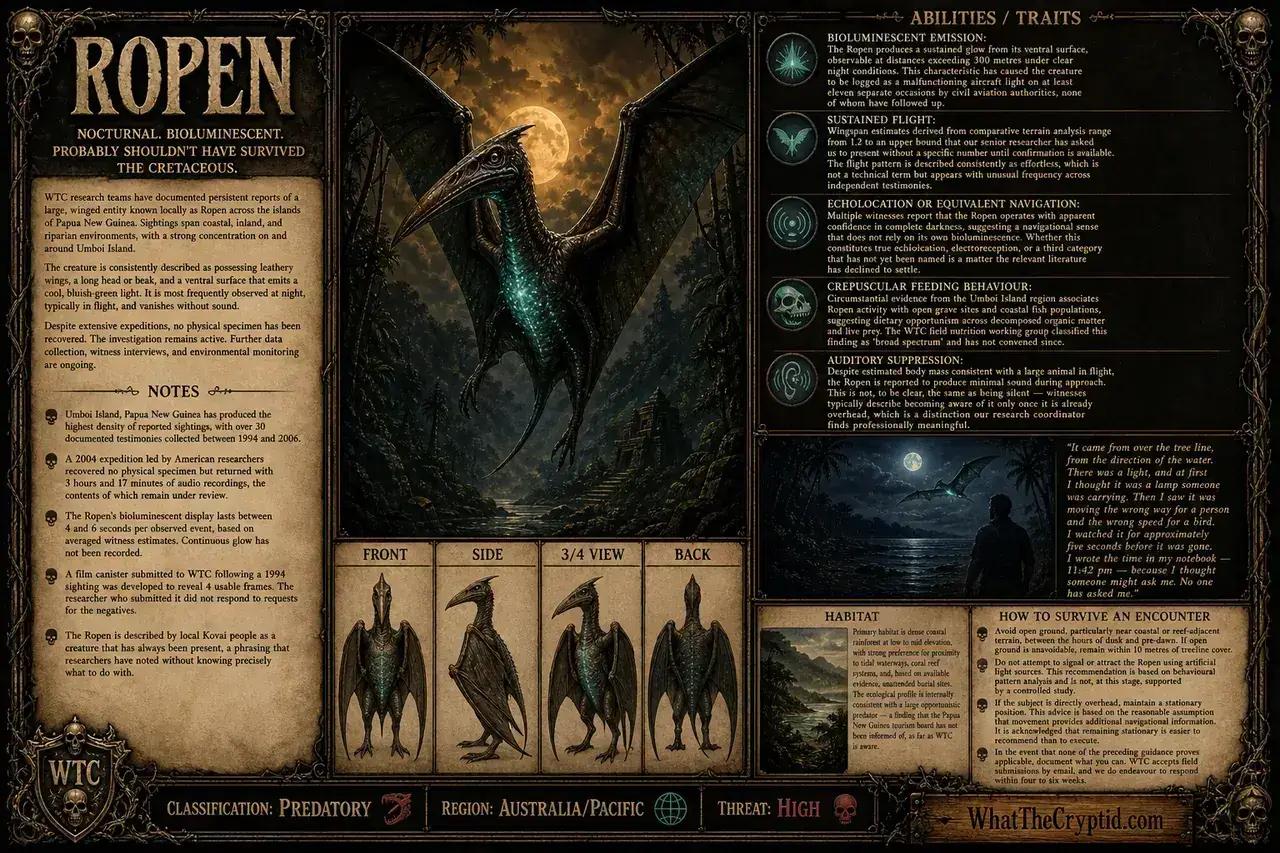
Ropen
Bioluminescent. Nocturnal. Sixty-five million years late.
Australia/Pacific
Unverified
PterosaurBioluminescentPapua New GuineaNocturnalLiving Fossil
Overview
The Ropen is a large, apparently bioluminescent flying entity reported primarily over the islands of Papua New Guinea, with concentrations of sightings around Umboi Island and the Finschhafen coast of the mainland. Witnesses across multiple decades and cultural backgrounds have described an animal consistent in its major features: a long, stiff tail terminating in a diamond or spade-shaped flange, a pronounced cranial crest, a wingspan estimated between 4 and 20 feet depending on the individual observed, and a greenish or yellowish light emitted from the ventral surface during flight. The entity is nocturnal. WTC classifies it as Winged, Unverified, and declines to speculate further on its taxonomic status in print.

Local communities on Umboi Island have maintained accounts of the Ropen for generations, and their descriptions predate Western contact. The name itself translates loosely from the Kovai language as ‘demon flyer,’ a designation that local elders apply with a matter-of-factness suggesting familiarity rather than mythology. Whether this familiarity reflects long coexistence with a living relict species or an equally long tradition of misidentifying large bats and aircraft is a question WTC continues to investigate, budget permitting.
The Ropen occupies a specific and uncomfortable position in cryptozoological research: it is either the most significant zoological discovery of the modern era or a persistent regional misidentification of the Torresian Imperial Pigeon. WTC considers both possibilities open and has assigned a dedicated researcher to the file, a decision our editorial board describes as ‘optimistic.’
History & Mythology
Oral accounts from Umboi Island communities describe the Ropen as a creature known to their ancestors, associated with burial sites and described as a scavenger of the recently dead — a detail that, once encountered, tends to clarify why local populations have not historically made sustained efforts to study it at close range. Missionary accounts from the early twentieth century contain oblique references to large nocturnal flying animals that disturbed coastal villages, though these were typically filed under ‘local superstition’ and received no further documentation.
The first Western researcher to treat the Ropen as a subject of serious field investigation was Duane Gish, who visited Papua New Guinea in the 1990s, followed by Carl Baugh in 1994 and a series of independent expeditions through the early 2000s led by researchers including David Woetzel and Jonathan Whitcomb. Whitcomb’s 2004 expedition to Umboi Island produced multiple witness interviews with individuals who described the creature’s bioluminescence in consistent detail, including a reported sighting duration of several seconds and a flight path that witnesses tracked from a known reference point. Whitcomb subsequently published extensively on the subject, which has had a complicated effect on the Ropen’s credibility within mainstream cryptozoological circles, where publication volume and credibility do not always correlate.
Photographic documentation remains absent. Every expedition to date has returned with witness testimony, recorded interviews, and, in several cases, detailed sketches produced in collaboration with local observers. The sketches bear a consistent resemblance to Pteranodon or Rhamphorhynchus depending on the illustrator’s reference material. WTC notes that this consistency is either compelling or explicable, and has not yet determined which.
Physical Description
Witnesses describe an animal that varies considerably in reported size — a range WTC attributes to either multiple individuals of different ages, observer distance estimation error, or both operating simultaneously. The smaller end of the reported range clusters around 4 to 6 feet of wingspan, with a body length of approximately 2 to 3 feet. Larger reported individuals reach wingspans of 15 to 20 feet, with one outlying account from a World War II veteran who described an animal over New Guinea with a wingspan he estimated at 30 feet, a figure WTC records without endorsement.
The consistent anatomical details across independent accounts include: a long, rigid tail accounting for roughly one-third of total body length and terminating in a structure described variously as diamond-shaped, spade-shaped, or ‘like a rudder’; a pronounced bony or cartilaginous crest extending from the rear of the skull; leathery, apparently featherless wings; and a long, toothed beak. Skin colouration, where reported, tends toward dark grey or brownish-black with a lighter ventral surface. The bioluminescent glow reported by many witnesses is described as originating from the chest or abdominal region, producing a greenish-white light sufficient to be visible from a distance of several hundred metres. Several witnesses have independently compared the brightness to that of a lantern, which is a specific enough comparison to merit notation.
No physical specimen, skeletal fragment, feather, scale, or biological sample of any kind has been recovered from the field. WTC’s consulting palaeontologist reviewed the compiled witness sketches and provided a written assessment that concluded with the phrase ‘structurally plausible’ before declining to elaborate.
Behaviour & Temperament
The Ropen is, by all documented accounts, nocturnal — a behavioural pattern that goes some distance toward explaining the persistent gap between sighting frequency and photographic documentation. Activity is reported primarily between the hours of 9 PM and 3 AM local time, with the bioluminescent display visible as a moving light that witnesses consistently distinguish from stars, aircraft, and phosphorescent ocean phenomena on the grounds that it moves purposefully, decelerates, and occasionally hovers. The entity appears to hunt or scavenge along coastlines and over open water, and multiple accounts place it in the vicinity of freshly dug graves — a behavioural tendency that local communities have, understandably, structured certain funerary practices around.
Social structure is undocumented. Sightings describe solitary individuals in the overwhelming majority of cases, with two accounts noting what appeared to be a pair of animals flying in proximity. Whether the Ropen is a solitary species, a low-density population in which encounters with conspecifics are rare, or an entity that simply prefers to work alone is not established. The Ropen does not appear to seek human contact and has not been documented engaging in territorial displays directed at observers, which WTC considers one of its more professionally courteous characteristics.
The bioluminescent display is the behaviour that most confounds categorisation. Light-producing organs in known animals serve purposes including predatory luring, mate attraction, camouflage disruption, and communication. Which of these functions the Ropen’s ventral glow serves is unknown. That a large nocturnal flying predator would choose to illuminate itself during flight raises questions that WTC has tabled for a later meeting.
Habitat & Territory
The Ropen’s primary documented range encompasses the islands of Papua New Guinea, with Umboi Island representing the highest concentration of reported sightings and the site of all formal research expeditions to date. Secondary sightings have been reported along the northeastern coast of the PNG mainland, over the Bismarck Sea, and in the Solomon Islands. Elevation range in documented accounts spans sea level to approximately 1,200 metres, though the preponderance of sightings occur along coastal cliffs, forested shorelines, and above open water — a habitat profile consistent with an animal that feeds from or near the ocean surface.
Nesting sites have not been located. Local accounts on Umboi Island describe caves in the highland interior as probable resting sites during daylight hours, and several cave systems in the island’s central ridge have been noted by researchers as candidates for investigation. These investigations have not been completed, for reasons that vary by expedition but share a structural similarity.
Diet & Hunting
The Ropen’s diet, as reconstructed from local accounts and behavioural observation, appears to be primarily piscivorous — fish constitute the most frequently cited prey, and the entity’s reported hunting behaviour over coastal waters is consistent with a large aerial fish hunter. Witnesses have described the Ropen descending toward the water’s surface and ascending with prey, a method comparable to that of large fishing bats or the Cretaceous pterosaurs to which the Ropen is most frequently compared. Whether the bioluminescent display functions as a lure in this context has not been demonstrated but has been proposed in writing by at least one researcher.
The association with burial sites represents the most documented and most discussed element of the Ropen’s apparent diet, and it is the element that local communities treat with the greatest seriousness. Multiple independent accounts from Umboi Island and the PNG mainland describe the Ropen visiting recently disturbed ground following burials, and at least two accounts describe it accessing grave contents. WTC records this behavioural pattern as reported without determination of whether it reflects confirmed scavenging behaviour, the opportunistic investigation of disturbed earth, or a cultural interpretive framework applied to unrelated animal activity. The distinction matters somewhat less to the communities involved than it does to WTC’s editorial standards.
Notable Sightings
During Carl Baugh’s 1994 expedition, local witness Jonah Jim described observing a large luminous form pass over Lake Pung at low altitude on multiple occasions. Jim, who had lived near the lake his entire life, characterised the sighting as unremarkable in the sense that it confirmed what residents of the area already understood to be present, a framing that the expedition team found more disquieting than a more alarmed account might have been. Jim indicated the creature’s wingspan by extending both arms and then gesturing that the actual span was considerably wider than this allowed him to demonstrate. The expedition departed Umboi Island shortly after without obtaining photographic evidence and filed a report describing the witness as credible.
During Jonathan Whitcomb’s September 2004 field expedition, a local man identified in published accounts as Wesley Koro described witnessing a Ropen at close range approximately two years prior — close enough that he reported seeing the texture of the wings and the shape of the tail flange in detail. Koro’s account was recorded, transcribed, and assessed by Whitcomb as internally consistent across multiple interviews conducted on separate days, with no variation in the described wingspan, tail structure, or bioluminescent colour. Koro reported that after the encounter he changed the route he used to walk home after dark. He has not changed it back.
Two missionaries stationed on Rambutyo Island submitted a written account describing a large, luminous flying form observed from their compound over the course of three separate nights in November 1971. The account noted that the light moved in patterns inconsistent with known aircraft routes and that on the third night it descended toward the water and extinguished before rising again and departing to the north. The report was filed with the mission organisation’s regional office and categorised under ‘unexplained local phenomena.’ A follow-up inquiry was not conducted.
A Papua New Guinean civil engineer identified in field notes as Jacob Kepas reported observing a large, dark, crested flying animal cross a jungle clearing at an estimated altitude of 30 metres in broad daylight, a departure from the Ropen’s documented nocturnal pattern that researchers have noted but not resolved. Kepas, who had studied biology at the University of Technology in Lae, described the animal’s tail structure specifically and unprompted, and stated that he had not previously heard of the Ropen before making his report. Verification of this claim was not possible. Kepas provided a sketch that was subsequently included in Whitcomb’s published research and described by one reviewing cryptozoologist as ‘the most anatomically detailed Ropen rendering on record,’ a designation that reflects both the quality of the sketch and the overall state of the record.
Threat Assessment
The Ropen’s documented threat profile to humans is moderate rather than extreme, a threat rating that should not be read as reassuring given the animal’s estimated size, apparent dietary flexibility, and total nocturnal invisibility apart from a bioluminescent glow that provides approximately two seconds of warning at standard approach speed. WTC recommends that individuals in known Ropen habitat avoid coastal cliff areas and open ground after dark, maintain a minimum observation distance of 50 metres if a Ropen is sighted, do not approach a bioluminescent light source over water under the assumption that it is a boat or other vessel, and avoid being near recently disturbed burial sites at night for reasons that should by this point be apparent. Carrying a high-powered torch is recommended — not because light deters the Ropen, for which there is no evidence, but because it makes field notes legible and reduces the chance of walking off a coastal cliff.
WTC’s honest acknowledgement of the limits of this advice is as follows: all threat assessment guidance for the Ropen is derived from accounts of the Ropen not attacking witnesses, which is a meaningful data set but an incomplete one. The entity’s behaviour near burial sites, in particular, suggests a willingness to investigate large stationary food sources, and WTC declines to specify exactly how stationary a person would need to be before that categorisation became relevant.
WTC Field Notes
WTC has had a Ropen file open since 2019, when our Pacific correspondent submitted an expenses claim that included a line item for ‘inter-island charter, cryptid-related, non-reimbursable under current policy.’ The claim was denied. The file remains open. Two separate field expeditions to Umboi Island have been budgeted, scheduled, and subsequently postponed — the first due to equipment procurement complications involving a low-light camera system that our technology supplier declined to stock after reviewing what it would be used for, and the second due to scheduling conflicts that arose when both researchers assigned to the expedition independently developed other commitments in the weeks before departure. This is noted without editorial comment.
WTC’s consulting ornithologist reviewed the compiled Ropen file in early 2023 and returned it with a Post-it note reading ‘not a bird’ — which, while technically outside the scope of the consultation, WTC considers a meaningful contribution. Our consulting palaeontologist has agreed in principle to review bioluminescence data from documented Ropen sightings, contingent on WTC providing a data set that the palaeontologist describes as ‘more than four hand-drawn sketches and a missionary report from 1971.’ WTC is working on this.