Moose Man
Bipedal. Antlered. Maintaining eye contact for too long.
North America
Unverified
HominidCervineBorealNorth AmericaSeasonal
Overview
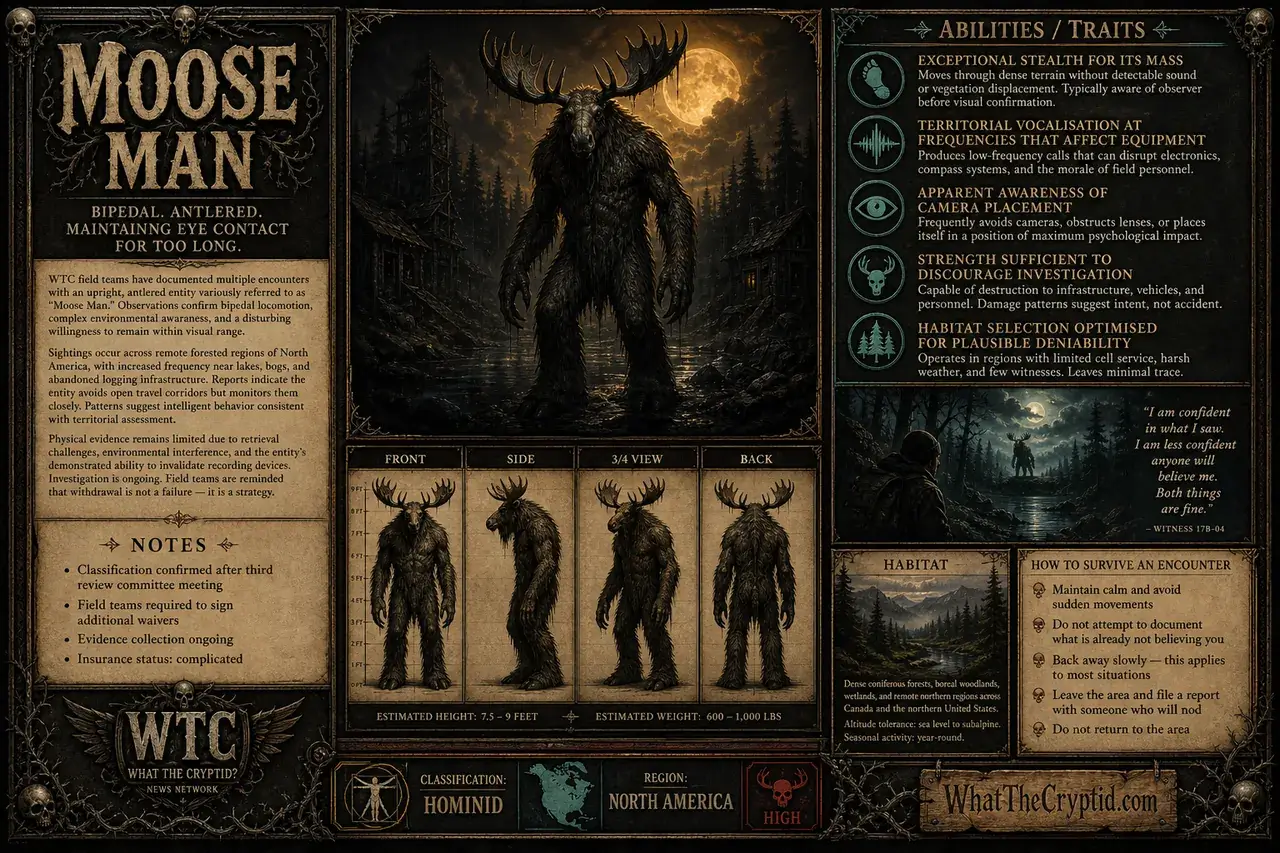
Moose Man is a large bipedal cryptid reported consistently across the boreal forests of northern North America, with the highest concentration of sightings occurring in the provinces of Ontario, Manitoba, and Quebec, and the northern reaches of Minnesota and Maine. Witnesses describe an entity combining the gross anatomy of a large human male with pronounced cervine features — most notably a substantial antler structure, elongated facial proportions, and a body mass our consulting wildlife biologist estimated at between 380 and 450 pounds before noting that she was estimating based on witness testimony and would prefer not to be credited. The entity moves on two legs, at a pace witnesses consistently describe as ‘unhurried,’ which is perhaps the most unsettling detail in the entire body of documentation.

Moose Man occupies an unusual position in the WTC Cryptid Database in that it is one of the few hominid-class entities whose presence tends to be detected before it is seen, typically via the sound of antlers contacting tree branches at a height inconsistent with any known ungulate species. This acoustic signature has proven more reliable than visual confirmation and has been documented on three separate audio recordings of sufficient quality to confirm a bipedal gait. The entity does not appear to take evasive action when making this noise, which raises questions WTC has tabled for a later meeting.
Sightings span approximately 140 years of documented record, with a notable concentration during the autumn months that several researchers have connected to white-tailed deer rutting season without, as yet, providing a full theoretical framework for what that connection implies.
History & Mythology
The earliest documented references to a man-shaped figure with the head or antlers of a moose appear in the oral traditions of several Algonquian-speaking nations, where such a figure appears as a boundary entity — associated with the transitional zones between human settlement and deep forest, and with the period between late summer and the first hard frost. These accounts were recorded in missionary field journals as early as 1703, typically in the context of warnings issued to trappers about specific river corridors in what is now northern Ontario. The missionaries recorded the warnings faithfully and then, in most cases, proceeded to send trappers down those corridors anyway. The subsequent journals do not always survive.
The first account recognisable in the modern cryptid tradition appears in a letter dated September 1887, sent by a timber surveyor named Aldous Frick to his employer in Toronto. Frick describes an encounter near Lac Seul in which he observed a ‘man of prodigious height, carrying the rack of a bull moose as though it were his own, walking without haste along the opposite bank’ for a duration he estimated at four minutes. He submitted the letter, completed his survey, and did not return to the region for a contracted second assessment. The reason given was a scheduling conflict.
Throughout the first half of the twentieth century, sightings were scattered and underreported, partly due to the distances involved and partly due to the documented reluctance of northern communities to submit accounts to organisations they had no reason to trust. The modern sighting record begins in earnest around 1971, when a cluster of independent reports from separate locations across the Ontario-Minnesota boundary brought the entity to the attention of researchers outside the immediate region. These reports were consistent in their detail in ways that are either compelling or, as one WTC senior researcher once put it in a staff meeting, ‘at least worth a second folder.’
Physical Description
Witnesses describe Moose Man as standing between 7 and 8.5 feet tall when fully upright, a range wide enough to suggest either significant individual variation or a consistent difficulty among witnesses in accurately estimating the height of something they were not expecting to see. The body is described as heavily built along human anatomical lines — bipedal, with arms proportioned approximately to human norms — but covered in coarse dark brown to black hair or fur, thicker across the shoulders and upper back than along the limbs. The hands are described as human in structure but larger, with several witnesses noting fingernails or claws of a length that suggested they were not a priority for the entity.
The defining feature, and the one that distinguishes Moose Man from other hominid-class cryptids in the database, is the antler structure. In the majority of accounts, witnesses describe a full palmate rack consistent in shape with that of a mature bull moose, with a documented span in the most detailed reports of between 48 and 62 inches. The rack appears, by all accounts, to be integrated rather than worn — continuous with the skull structure rather than attached or carried. The face beneath the rack is described as elongated, with a pronounced nasal structure and dark, wide-set eyes. Several witnesses have specifically noted that the eyes appear to track them with what one 2009 witness called ‘considered attention,’ a phrase that has since appeared in six independent reports from witnesses who could not have read each other’s accounts.
Seasonal variation in the antler structure has been noted, with spring and summer sightings occasionally describing a figure with smaller or velvet-covered growth, consistent with the antler cycle of a bull moose. WTC acknowledges this detail, notes that it has significant implications, and has not yet convened the working group that was proposed to address them.
Behaviour & Temperament
Moose Man is primarily crepuscular, with peak sighting activity occurring in the 90-minute windows following sunrise and preceding sunset. Night sightings account for approximately 22 percent of the documented record and are distributed evenly across seasons, with the notable exception of October, in which night sightings spike to nearly 40 percent of that month’s reports. What Moose Man is doing during October nights has not been formally investigated. Researchers have been briefed on the spike and have, to date, proposed three separate study frameworks, none of which have received funding approval.
The entity’s most consistently documented behavioural characteristic is a form of extended stationary observation — witnesses frequently report that Moose Man, upon becoming aware of a human presence, stops, orients toward the witness, and remains still for a period ranging from 45 seconds to, in one 2017 account, approximately nine minutes. It does not display the territorial vocalisation or bluff-charge behaviour associated with actual bull moose during rut, nor does it exhibit the flight response common to most other hominid-class cryptids in this database. It watches, and then it leaves. This behaviour is consistent across sighting contexts — roadside encounters, trail encounters, and at least two accounts from individuals who were stationary in hunting blinds and believed they were the ones doing the observing.
When Moose Man does move, witnesses describe a gait that is unhurried but efficient, covering ground at a pace one 2003 witness estimated at ‘faster than it looked like it should have been.’ The entity does not appear to use game trails, preferring to move directly through dense brush, which its antler structure should, by any reasonable biomechanical assessment, make significantly more difficult than witnesses suggest it appears to find it.
Habitat & Territory
Moose Man is documented exclusively in boreal and mixed coniferous-deciduous forest, with a strong association with watersheds — the majority of sightings occur within 800 metres of a lake, river, or substantial wetland complex. Elevation range is modest, reflecting the terrain of its primary range: most sightings occur between 800 and 1,800 feet above sea level, with outlying accounts from the Canadian Shield placing some encounters at elevations approaching 2,400 feet. The entity does not appear to be observed above the treeline under any documented circumstances, which is either a habitat preference or, as one researcher noted in a 2014 field report, ‘possibly just a visibility issue we should think harder about.’
The highest-density sighting corridors follow the boreal forest belt across northern Ontario and into Manitoba, with a secondary corridor running along the Maine-Quebec border. Human infrastructure appears to be neither avoided nor sought — Moose Man has been reported within 200 metres of logging roads, within earshot of active campsites, and on at least four occasions within the boundaries of provincial and state parks during open camping season. It has not been reported within municipal boundaries, which may indicate a meaningful threshold or may simply reflect reporting rates.
Diet & Hunting
Direct dietary observation is absent from the documented record, which is notable given the entity’s apparent comfort with proximity to humans and the number of wilderness researchers who have studied the region. What WTC has compiled is a body of circumstantial evidence: stripped bark found at a height of 6 to 7 feet on stands of trembling aspen and balsam fir within confirmed sighting zones; browsing damage on aquatic vegetation — primarily water lilies and submerged sedge — consistent with a large animal feeding from a standing position in shallow water; and, in three separate instances, fish remains found on shoreline rocks in configurations that do not match the feeding sign of any regional predator on record. Whether Moose Man is responsible for any or all of this is not established. WTC notes only that the damage exists, that it recurs in sighting zones, and that something is producing it.
If the browsing evidence is attributable to Moose Man, the entity’s diet appears broadly omnivorous with a strong plant-matter component consistent with its inferred body mass — estimates based on documented footprint depth suggest a daily caloric requirement that would necessitate substantial and sustained foraging activity. This would, in turn, suggest a significant portion of its time is spent eating, which makes the number of sighting accounts in which it is simply standing still and watching humans somewhat harder to contextualise.
Notable Sightings
Prospector Gary Tolhurst, surveying a mineral claim approximately 40 kilometres north of Ear Falls, reported observing a large bipedal figure standing at the edge of a spruce bog at approximately 6:15 a.m. on October 3rd. Tolhurst, a 22-year veteran of northern Ontario fieldwork, described the figure as ‘built like a man who had never considered stopping’ and noted the antler structure as spanning ‘wider than my truck.’ The observation lasted approximately three minutes before the figure turned and walked into the treeline without apparent urgency. Tolhurst completed his survey, filed a standard report with his company, and appended a handwritten note describing the encounter. The note was forwarded to the Ontario Ministry of Natural Resources. The Ministry’s response, dated six weeks later, thanked him for his submission.
A party of four canoeists — Marcus Webb, Diana Chen, and two companions who have requested anonymity in all subsequent documentation — reported an encounter on the eastern shore of Knife Lake on the evening of August 19th. The group had made camp and were preparing a meal when Webb reported a large figure standing in the shallows approximately 60 metres distant, appearing to observe the camp. The figure was visible for an estimated five to seven minutes in fading light before withdrawing. Chen, who held a wildlife biology degree, noted in her written account that the antler structure was inconsistent with any pathology she was aware of and that the entity’s posture was, in her word, ‘evaluative.’ The party broke camp the following morning, two days ahead of schedule, and submitted a joint report to the US Forest Service upon return. The Forest Service acknowledged receipt.
Truck driver Serge Beaulieu reported a roadside sighting at approximately 2:40 a.m. on October 14th while travelling eastbound on the Trans-Canada. Beaulieu stated that his headlights illuminated a large figure standing on the highway shoulder, which he initially identified as a moose before noting, at a distance of approximately 80 metres, that it was standing fully upright on two legs. He slowed his vehicle to approximately 15 kilometres per hour as he passed. The figure, he reported, tracked the cab of the truck with its head throughout, maintaining eye contact for the duration of his approach and passage. Beaulieu filed a report with the Ontario Provincial Police upon reaching his next stop. The attending officer noted the report, confirmed Beaulieu showed no signs of impairment, and classified the incident as a wildlife sighting.
A hunting guide named Patrice Moreau, leading a client into a designated moose-hunting zone on the morning of October 7th, encountered a figure at a distance of approximately 110 metres that he initially ranged and prepared to identify as a trophy bull. Moreau, who has guided moose hunts in the region for nineteen seasons, stated that he recognised within seconds that the figure was not a moose, and that he lowered his binoculars, waited, and observed the figure standing motionless at the treeline for approximately nine minutes before it turned and departed at walking pace into the forest. His client, whose name does not appear in the filed report, did not observe the figure directly. Moreau submitted a full written account to WTC four days later. He has not accepted a booking in that specific zone since, a fact he noted in his account without elaboration.
Threat Assessment
Moose Man has not been documented initiating physical contact with humans in any verified account in the WTC database. This does not constitute a guarantee. The entity’s size, estimated body mass, and the structural reality of a palmate antler rack spanning up to 62 inches mean that an encounter that became physical would carry significant injury potential by default, regardless of intent. Field researchers and civilians entering documented Moose Man sighting zones are advised to maintain a minimum observation distance of 150 metres if direct sighting occurs. Do not approach. Do not attempt to photograph from a distance that requires you to close ground. Do not make sustained eye contact, though WTC acknowledges the difficulty of this recommendation given the entity’s documented tendency to initiate and maintain it.
October encounters warrant specific additional caution, given the concentration of night sightings during that period and the entity’s association with rutting-season timing. Parties in active sighting corridors during October should ensure camp lighting is functional, maintain consistent noise levels after dark, and consider the placement of camp relative to water sources. If Moose Man is observed at rest or feeding, maintain position and wait for the entity to withdraw before proceeding. Standard bear-encounter protocols — slow movement, no sudden noise, no direct flight — are the closest applicable framework WTC can offer, with the honest acknowledgement that they were developed for a different animal entirely and may not transfer without revision.
WTC Field Notes
WTC dispatched a two-person field team to the Restigouche Valley in October 2018, following Patrice Moreau’s 2017 account, with the intention of deploying six motion-activated trail cameras across the primary sighting corridor. The team deployed four cameras. The remaining two were not deployed due to an equipment issue that the team’s field notes describe as a ‘partial submersion incident involving the supply canoe’ and which our equipment manager has described, separately, as ‘the third time this has happened in that watershed and I want it on the record.’ Of the four cameras deployed, two returned usable footage of moose, deer, and one black bear. One returned no footage and was found facing the ground when recovered, its mounting strap intact. The fourth camera was not recovered. A replacement has been requisitioned. The requisition is pending budget review, which it has been since February 2019.
WTC’s senior editorial board has discussed Moose Man on four separate occasions in the past three years, principally around the question of whether the seasonal behavioural pattern warrants reclassification from Active to a proposed ‘Cyclically Active’ status that does not currently exist in our taxonomy. The proposal was tabled at the most recent meeting pending a definitional paper that one board member agreed to write in March 2022. WTC remains, in the interim, committed to covering this entity with the rigour it deserves and the budget it gets.