Mongolian Death Worm
Subterranean. Lethal. Named with admirable honesty.
Asia
Unverified
Gobi DesertMongoliaSubterraneanLethal
Overview
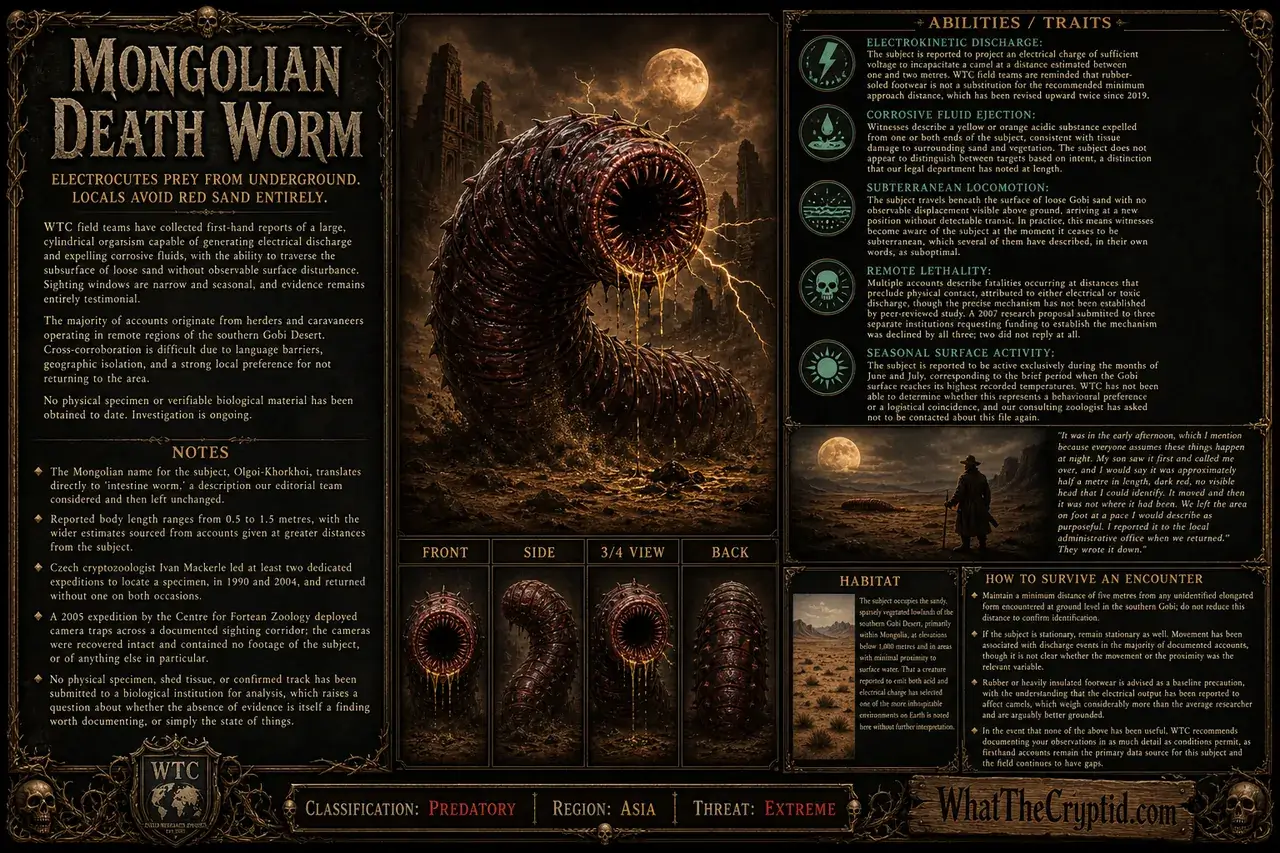
The Olgoi-Khorkhoi — rendered in English as the Mongolian Death Worm, a translation WTC considers both accurate and sufficient — is a large subterranean organism reported exclusively from the southern Gobi Desert of Mongolia and the adjacent regions of Inner Mongolia. Accounts sourced from nomadic Mongolian communities describe an entity capable of killing adult humans and large animals at a distance through mechanisms that field researchers have categorised, with some reluctance, as either acid-based venom delivery or bioelectric discharge, and in several accounts both simultaneously. It is the only cryptid in the WTC database for which the primary method of lethality remains genuinely contested rather than merely undocumented.

The entity occupies an unusual position in the WTC taxonomy in that its existence is considered plausible by a meaningful portion of the herpetological community, though none of its members have said so on record in any forum that would affect their academic standing. The Gobi Desert remains one of the least biologically surveyed large-scale ecosystems on Earth, a fact that the WTC notes without drawing conclusions but also without entirely setting aside.
Sightings describe a creature that is difficult to misidentify. No other organism in the Gobi Desert is reported to emerge from beneath the sand, extend to a length exceeding one metre, and discharge a lethal substance in the direction of a perceived threat before disappearing again. This specificity has been noted as either strongly indicative of a genuine biological phenomenon or, as one consulting zoologist phrased it, ‘a remarkably stable shared hallucination across three generations of semi-nomadic pastoralists.’
History & Mythology
The Olgoi-Khorkhoi is documented in Mongolian oral tradition with a consistency that predates any Western contact with the region. The entity is named for its resemblance to the lower intestine of a cow — a description that has proven resilient across every retelling and which WTC researchers have chosen not to dwell on. Mongolian nomadic communities have historically treated the creature as a known and serious hazard of the southern Gobi, falling into the same practical category as sandstorms and contaminated water sources, though with the additional property of being directional.
The first recorded Western encounter with the concept of the Olgoi-Khorkhoi appears in the 1926 expedition notes of American palaeontologist Roy Chapman Andrews, who documented accounts from Mongolian officials and nomads during his Central Asiatic Expeditions. Andrews himself was sceptical, noting that no specimen had been produced for examination, but recorded the accounts with sufficient detail that they have served as the documentary foundation for nearly every subsequent Western investigation. That the most rigorous early Western documentation of the creature was produced by someone looking for dinosaurs is a coincidence the WTC has noted and moved past.
Formal cryptozoological investigation intensified in the latter half of the twentieth century. Czech explorer Ivan Mackerle conducted two dedicated expeditions to the Gobi in 1990 and 1992, interviewing dozens of witnesses and compiling testimony that described consistent morphological features, consistent behavioural patterns, and a consistent record of fatal outcomes for those who encountered the entity without adequate warning. No specimen was recovered. Subsequent expeditions by British researchers in 2005 and a joint international team in 2009 produced equally consistent witness testimony and equally consistent absences of physical evidence, which has become something of a pattern that WTC researchers have agreed to describe as ‘ongoing.’
Physical Description
Witness accounts describe a cylindrical, heavily built organism ranging from 0.5 to 1.5 metres in length, with the majority of testimonies clustering around 0.6 to 1 metre. The body is uniformly dark red to brownish-red in colouration — described by multiple independent witnesses as resembling dried blood, which is a comparison that appears to have occurred to everyone independently. The surface texture is reported as smooth and without visible scales, though some accounts describe faint annular segments consistent with a large annelid morphology, a classification that would make the creature remarkable for reasons extending well beyond its lethality.
No distinct head or tail has been reliably described. Both ends of the organism are reported as blunt and structurally similar, which presents challenges for field identification that WTC considers secondary to the more immediate challenges of field proximity. There are no documented eyes, ears, or visible sensory organs in any account, which raises questions about target acquisition during its reported ranged attacks that herpetologists have been reluctant to address in published literature.
No regional morphological variants have been reported. The consistency of the physical description across geographically disparate witness accounts and across a documentary record spanning several generations is either strong evidence of a real and stable biological organism or an argument for a cultural transmission of imagery so robust that it has resisted modification entirely. The WTC presents both interpretations and notes that one of them is considerably less interesting.
Behaviour & Temperament
The Olgoi-Khorkhoi is described as a predominantly subterranean organism that surfaces sporadically, with sightings concentrated in the summer months of June and July. Mongolian accounts associate surface activity with the warmest periods of the year and with wet conditions following rain — a behavioural pattern consistent with the thermoregulatory and moisture-seeking behaviour observed in several large terrestrial invertebrates, a comparison that WTC’s consulting entomologist requested not be directly attributed to her.
When encountered on the surface, the creature is characterised as acutely aggressive when disturbed. Witness accounts uniformly describe a threat response in which the organism rears a portion of its body upward, orients toward the perceived threat, and discharges either a corrosive yellow substance from its anterior end, a lethal electrical current, or both. The range of this discharge is reported at between two and five metres depending on the account, and fatality has been reported in both humans and horses in traditional Mongolian testimony. The entity does not appear to pursue targets following discharge, which represents the sole aspect of its documented behaviour that could be described as accommodating.
Outside of direct provocation, accounts describe no particular territorial behaviour, no social aggregation, and no vocalisation. The creature appears to operate as a solitary organism with a home range that is, by practical necessity, extremely difficult to estimate. Several accounts note that the Olgoi-Khorkhoi will surface near camels and horses without immediate aggression, which Mongolian herders have historically interpreted as evidence of prey interest rather than temperamental restraint.
Habitat & Territory
The Olgoi-Khorkhoi is reported exclusively from the Gobi Desert, with the majority of accounts originating from the southern Mongolian Gobi and the areas surrounding the Nemegt Basin — a region best known to Western science as a rich source of theropod dinosaur fossils, a fact the WTC mentions solely because it consistently appears in this context and declining to include it would itself require explanation. Sightings concentrate in the saxaul scrublands and open sandy plains of the central and western Gobi, with particular density in areas featuring deep, loose sand substrate suitable for extended subterranean transit. Elevations represented in documented accounts range from approximately 900 to 1,500 metres above sea level.
Witness accounts note a consistent association between Olgoi-Khorkhoi activity and the parasitic plant Cynomorium songaricum, known locally as goyo. Mongolian nomadic tradition holds that areas with dense goyo growth carry elevated risk of encounter, and that the creature may feed on or aggregate near its root systems. Whether this represents a nutritional preference, a habitat preference driven by soil characteristics, or a coincidence encoded into cultural memory over centuries is a question that would require sustained ground-level survey of the relevant areas to investigate, which remains, as of this entry’s most recent update, hypothetical.
Diet & Hunting
The dietary profile of the Olgoi-Khorkhoi is reconstructed almost entirely from circumstantial evidence, direct observation of feeding behaviour not having been recorded in any account reviewed by WTC. The circumstantial evidence is, however, reasonably specific. Mongolian nomadic accounts describe a predator of large animals, with horses and camels cited as documented prey species alongside humans — the last of which places the Olgoi-Khorkhoi in a small and operationally significant category within the WTC database.
The proposed association with Cynomorium songaricum root systems suggests a possible supplementary or primary plant-based food source, or alternatively, that the creature preys on animals grazing on the plant. Some researchers have proposed a diet primarily comprising small desert rodents and lizards supplemented by opportunistic large-prey predation, which would be consistent with the ambush-from-subsurface hunting method implied by most accounts. The reported discharge mechanism — whether venom, acid, or electric current — would function as an effective prey-immobilisation strategy regardless of prey size, which is either an evolutionary argument in favour of the creature’s existence or an indication that whatever this is, it has had considerable time to refine its approach.
Notable Sightings
Mongolian herdsman Namkhai Dorj reported observing a dark red organism of approximately 0.7 metres emerge from sandy substrate near a camel tethering post at midday in late June. Dorj described the creature as stationary for approximately four minutes before withdrawing below the surface without aggression, which he attributed to the absence of ground vibration from foot traffic. A second herder present at the time corroborated the account in testimony collected by Czech researcher Ivan Mackerle in 1990, noting that a camel tethered within three metres of the sighting location died the following morning of causes their veterinarian described as ‘not immediately attributable to known disease or injury.’
A Soviet-Mongolian joint geological survey team reported an encounter during routine core sampling operations in the southern Gobi. Survey team member Sergei Volkov filed an internal incident report describing an organism emerging from disturbed sand approximately two metres from active drilling equipment, displaying the rearing behaviour consistent with Mongolian accounts, and retreating after equipment shutdown reduced ground vibration. No discharge was observed. The incident report was included in Mackerle’s 1991 published account of his expeditions and noted as one of the few documented cases involving witnesses with no prior cultural familiarity with the Olgoi-Khorkhoi. The Soviet geological survey declined to provide the original report for independent review.
British zoologist and cryptozoological researcher Peter Zahler documented witness testimony from a semi-nomadic family describing a fatal encounter occurring approximately 25 kilometres southwest of Dalanzadgad. The account described an adult male family member approaching what he initially believed to be a length of discarded rubber tubing near a dry watercourse, at which point the organism discharged a substance described as yellow and viscous at a range of approximately two to three metres, causing the man to collapse. He died within the hour. Zahler noted that the account was consistent in detail with testimonies collected by Mackerle six years prior, from witnesses who had no documented contact with each other. The family declined to return to the area and had relocated their seasonal camp by the time Zahler conducted his follow-up visit.
A team from the Centre for Fortean Zoology led by Richard Freeman conducted a three-week expedition specifically targeting Olgoi-Khorkhoi evidence in the Chinese Gobi. The team deployed ground-penetrating radar in areas identified by local herders as high-activity zones and collected testimony from eleven witnesses across four encampments, all of whom described morphologically consistent entities and two of whom reported direct encounters within the preceding twelve months. Ground-penetrating radar results were described by Freeman as ‘inconclusive but not discouraging.’ The expedition returned with no photographic or physical evidence. Freeman published an account of the expedition the following year and has stated his intention to return, though no follow-up expedition has been recorded in the WTC database as of this entry.
Threat Assessment
The Olgoi-Khorkhoi presents a threat profile that is unusual in the WTC database in that its primary mechanisms — ranged venom delivery and bioelectric discharge — offer limited opportunity for the standard defensive response of increasing distance from the entity, given that the entity is subterranean and does not announce its presence prior to surfacing. WTC threat assessment accordingly focuses on environmental awareness and approach avoidance rather than direct response protocols.
Persons operating in the southern Gobi Desert between the months of May and August are advised to avoid areas with dense Cynomorium songaricum growth, to refrain from sitting or lying directly on sandy substrate, and to minimise ground vibration where possible — the last of which is acknowledged as impractical advice for most operational contexts. In the event of a surface encounter, WTC recommends immediate lateral movement to a minimum distance of six metres, which exceeds the documented maximum discharge range by one metre and represents what our editorial team has agreed to call a reasonable margin. Do not approach the entity to determine which end is which. If the entity is observed in a rearing posture, the window between that posture and discharge is reported as between two and eight seconds across available accounts, which is a range wide enough to be operationally relevant and narrow enough that WTC recommends not testing it. Standard desert first aid is unlikely to be sufficient for reported injury outcomes, and personnel operating in remote Gobi terrain are advised to ensure satellite communication equipment is functional before the situation requires it.
WTC Field Notes
WTC has made three attempts to fund a dedicated Olgoi-Khorkhoi expedition since 2018, each of which has reached the equipment procurement stage before encountering budget constraints that our finance department has described as ‘structural.’ The proposed expedition would require ground-penetrating radar equipment, a Mongolian-language field interpreter, and permits from both the Mongolian Ministry of Environment and Tourism and the Chinese Bureau of Geology, the last of which has not responded to any of our four formal inquiries. We note without specific implication that the Bureau’s lack of response coincides with the region around Dalanzadgad being identified in our 2021 preliminary assessment as the highest-probability survey area.
Our senior field researcher, Dr. Yevgenia Marchetti, completed a six-week preparatory survey of Ömnögovi Province in 2022 at her own expense and returned with eleven hours of witness interview recordings, detailed topographic notes, and a strong recommendation that WTC allocate meaningful resources to a follow-up investigation. The recordings are in the WTC archive. The follow-up investigation remains in the budget queue. Marchetti has since submitted two additional funding requests and one memo that our editor characterised as ‘professionally worded but pointed.’ All three documents are filed. The Gobi Desert, as best we can determine, remains as it was.