
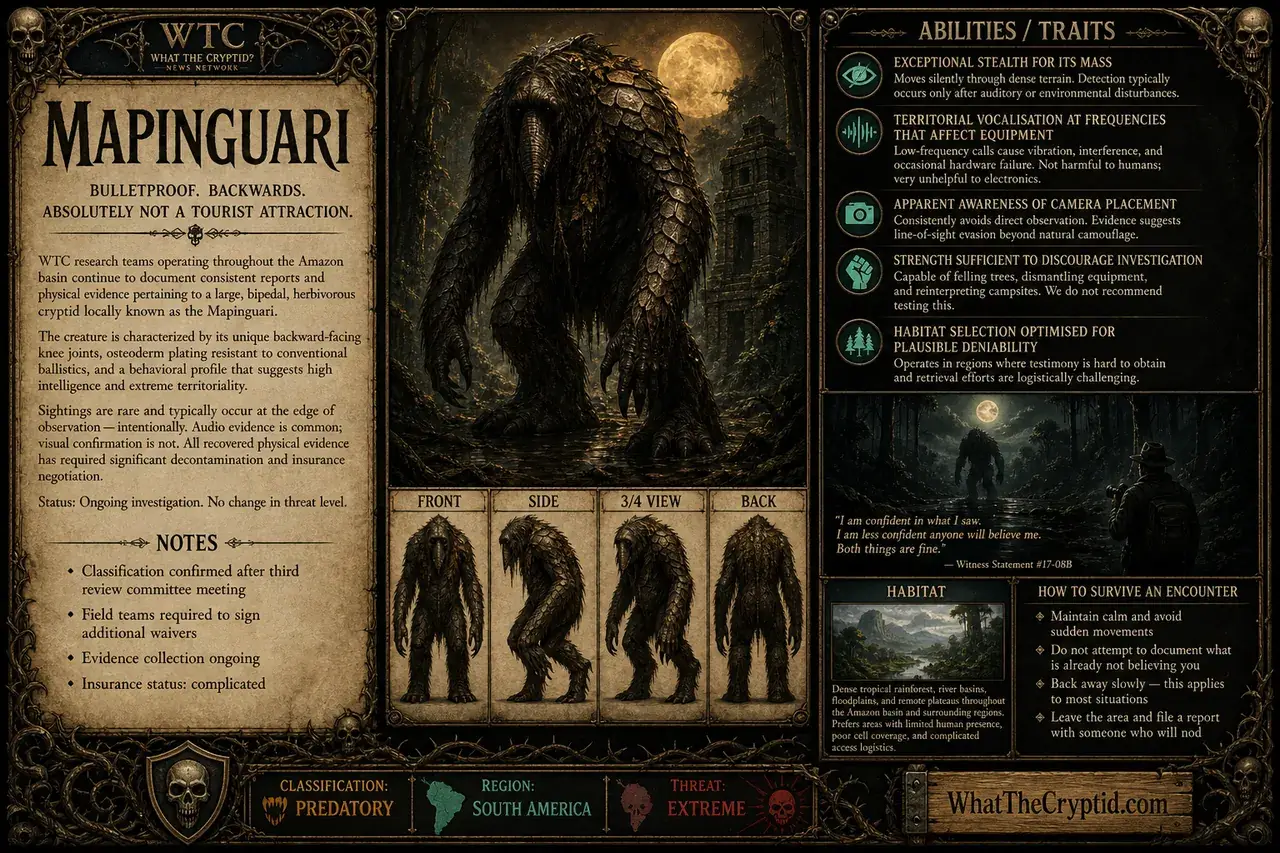
Mapinguari
Eight feet tall. One eye. Do not investigate the smell.
South America
Unverified
AmazonGiant Ground SlothSouth AmericaMegafaunaIndigenous Folklore
Overview
The Mapinguari is a large, bipedal cryptid reported across the Amazon basin and adjacent cerrado regions of Brazil and Bolivia, with additional accounts extending into Peru and northern Argentina. Standing estimates range from 6 to 8 feet when upright, the entity is characterised by dense reddish-brown fur, a gait described variously as lumbering and surprisingly deliberate, and an olfactory presence that witnesses report before visual confirmation is obtained. WTC classifies it as Predatory on the basis of documented livestock losses in proximity to sighting areas, though the entity’s dietary habits remain, like most things about it, imperfectly understood.

Indigenous Amazonian peoples, including the Karitiana and Yanomami nations, have maintained detailed oral accounts of the Mapinguari for generations, describing it not merely as a dangerous animal but as something closer to a cursed or transformed being — a shaman who sought immortality and received, in the assessment of the relevant traditions, something adjacent to it. WTC treats this folkloric framing as field data rather than embellishment, on the grounds that communities with multi-generational direct exposure to an entity tend to know things about it that outside researchers discover only much later, and at greater personal cost.
The leading zoological hypothesis positions the Mapinguari as a surviving representative of Mylodon or a related giant ground sloth, a lineage considered extinct for approximately 10,000 years. This hypothesis is not without problems, several of which WTC has tabled for a later meeting.
History & Mythology
Formal documentation of the Mapinguari in Western scientific literature begins with the work of Bolivian naturalist Ivar Sanderson in the mid-twentieth century, though Brazilian and Bolivian naturalists had been collecting indigenous accounts considerably earlier. Zoologist François de Loys, better known for a separate and equally unresolved South American cryptid incident in 1920, is sometimes cited in the secondary literature in connection with the Mapinguari, though the attribution is contested and WTC has chosen not to pursue it further without better sourcing.
The most frequently cited historical account comes from 1930, when a Brazilian rubber tapper named Inocêncio reported an encounter in the Mato Grosso region that lasted, by his own account, approximately twelve minutes and concluded with the destruction of his camp’s water supply and the immediate relocation of his entire work party. The account was recorded by a regional administrator and survives in the archives of the Museu do Índio in Rio de Janeiro. Inocêncio’s description of the entity — single eye, mouthlike opening in the torso, rotating feet that left reversed tracks — has since been interpreted through several competing lenses, including sensory distortion caused by the creature’s documented chemical emissions, though this interpretation raises its own questions.
Native Amazonian traditions consistently describe the Mapinguari as originating in a specific act of transgression: a shaman’s pursuit of immortality through forbidden ritual, resulting in a transformation that was irreversible and, by most accounts, deeply unwelcome. Whether this represents a metaphorical encoding of genuine observed behaviour or a literal account is a question WTC has forwarded to our consulting anthropologist, who has not yet responded.
Physical Description
Witness accounts, cross-referenced across several decades and multiple national contexts, produce a reasonably consistent physical profile, which is itself notable given the conditions under which most observations occur. The Mapinguari stands between 6 and 8 feet tall in its characteristic semi-upright posture, though accounts of individuals observed at full extension suggest a maximum height closer to 9 feet. Body mass is estimated by our consulting zoologist at 400 to 600 pounds, though she noted that the estimate was provisional and expressed preference for not being asked to revise it in the field.
The fur is consistently described as long, coarse, and reddish-brown to dark chestnut, matted in patches and carrying a significant odour that witnesses describe, with unusual terminological consistency, as a combination of rotten meat and fresh faeces, with a secondary chemical note that several accounts independently characterise as burning rubber. The forelimbs are disproportionately large and terminate in claws measured at approximately 8 to 10 inches in recovered ground impressions — though direct claw measurement from a living specimen has not been attempted and WTC is not currently seeking volunteers for this. The feet are described in several accounts as appearing to face backward, producing a trackway that initially suggests the entity has already left the area.
The single-eye feature, reported in perhaps 40% of accounts, is likely a misidentification under stress conditions rather than a literal anatomical characteristic, though WTC acknowledges this position is based largely on the expectation that bilateral symmetry applies here. The torso-mouth feature reported in older accounts has not appeared in documentation from the last thirty years and is not considered reliable.
Behaviour & Temperament
The Mapinguari is primarily nocturnal, with activity peaks between approximately 10 PM and 3 AM local time. It is solitary by all available evidence — no account documents more than a single individual, and the territorial markings identified in Brazilian field surveys suggest a home range of 80 to 120 square kilometres per individual, which implies a population density too low for regular social contact even if social contact were desired, which available evidence suggests it is not.
When encountered, the Mapinguari’s initial response is typically a sustained vocalisation described as a deep, resonant roar with a secondary shrieking overtone that several witnesses have described as resembling a human scream played at reduced speed. This vocalisation is followed by a chemical release — the source of the entity’s characteristic odour — which appears to function as a deterrent rather than a hunting mechanism, suggesting the Mapinguari would prefer that the encounter end here. In the documented cases where the encounter did not end here, the subsequent behaviour escalated to direct physical engagement, which WTC considers sufficient grounds for the current threat rating.
The entity does not appear to pursue fleeing witnesses beyond the immediate encounter zone, which has been established through several cases in which witnesses fled and were, subsequently, able to file reports. This restraint is either behavioural preference, territorial limitation, or an acknowledgement that the chemical deterrent has already done the primary work. Field teams are advised not to investigate which of these explanations is correct.
Habitat & Territory
The Mapinguari demonstrates a strong preference for undisturbed primary rainforest with dense ground-level cover, at elevations between 200 and 900 metres. It appears to favour proximity to slow-moving rivers and várzea floodplains, which WTC’s field consultant attributes to the availability of both water sources and the dense vegetation that characterises those transition zones. Incursions into cerrado scrubland have been documented, typically in the dry season, and at least three accounts place the entity at altitudes above 1,200 metres in Andean foothills, suggesting the habitat preference is firm but not absolute.
The Mapinguari does not appear to construct a permanent den or nest. Ground disturbance patterns in areas of repeated activity suggest a resting practice involving the compression of large vegetation clusters — areas of flattened undergrowth measuring approximately 8 by 5 feet have been documented in association with concentrated tracks and olfactory residue. These sites are consistently located within 200 metres of water and on slightly elevated ground, which our field consultant described as a sensible site selection strategy before clarifying that she meant this in a purely ecological sense.
Diet & Hunting
Available evidence supports an omnivorous diet with a significant bias toward plant matter: bark stripping on trees of 12 to 18 inch diameter has been documented in association with confirmed Mapinguari activity zones, along with excavation of termite mounds and disruption of ground-nesting fauna. The claws, which are structurally consistent with those of Pleistocene ground sloths, appear better adapted to digging and bark processing than to active predation, which has led several researchers to characterise the livestock losses near sighting areas as opportunistic rather than systematic.
The opportunistic assessment may require revision. A 2003 survey in Rondônia state documented the remains of three adult capybaras and one juvenile tapir in a 400-metre radius, all bearing damage consistent with large-claw trauma, over a period of approximately six weeks. Tapir is not a small animal. WTC’s consulting zoologist noted that Mylodon remains recovered from Patagonian cave sites have shown evidence of both plant material and animal bone in preserved gut content, and declined to elaborate further.
Notable Sightings
Rancher Augusto Ferreira reported a large bipedal creature crossing the access road to his property at approximately 11:40 PM during the dry season. Ferreira, who had lived on the property for nineteen years, estimated the creature’s height at ‘two and a half men’ and noted that his truck’s engine stalled during the approximately ninety-second crossing, a detail he mentioned as an afterthought. The creature did not acknowledge the vehicle. Ferreira’s account was collected by a regional FUNAI officer the following week; the report noted that four of Ferreira’s cattle had been found dead in the adjacent field three days after the sighting, with injuries the attending veterinarian attributed to ‘large predator, species unidentified.’
A team of six wildlife researchers conducting a mammal survey for the Universidad Mayor de San Andrés reported a sustained encounter lasting approximately eight minutes near the Iténez River, in which a large, fur-covered biped was observed foraging at the riverbank from a distance of roughly 60 metres. Lead researcher Dr. Carla Mendoza noted the creature’s digging behaviour, its apparent indifference to the team’s presence, and an odour that rendered two team members temporarily unable to continue observation. Photographs were taken; the memory card containing those photographs was found to be corrupted when the team returned to La Paz. Dr. Mendoza published a brief note in a regional zoological bulletin describing an unidentified large mammal and subsequently declined all follow-up interviews, citing a full schedule that her department’s administrative coordinator confirmed was not, in fact, full.
A logging survey crew of four, contracted by a timber assessment firm, reported an encounter at approximately 2 AM in which a large creature entered their camp perimeter, made sustained vocalisation for an estimated three to four minutes, and displaced a 200-litre water container before departing into the forest. Crew member José Alves described the smell as immediately incapacitating and noted that two crew members vomited during the encounter. No visual confirmation was obtained due to the crew’s unanimous decision to remain inside their tents. The crew’s site foreman filed the report, rated the encounter as a ‘significant wildlife interaction’ in the company’s safety log, and the survey contracted was completed by a different crew the following month.
Ecotourism guide Marco Quispe reported observing a large bipedal creature from a river canoe at approximately 6:15 AM, in low-light conditions, at a distance of approximately 45 metres. The creature was standing at the waterline and appeared to be consuming vegetation. Quispe described it as covered in dark reddish fur, taller than any man he had observed, and entirely unbothered by the canoe’s presence. The encounter lasted approximately four minutes before the creature moved into the treeline. Quispe had four tourists in the canoe at the time of the sighting, none of whom had their cameras accessible; all four subsequently left reviews of the tour describing it as ‘unforgettable’ without further elaboration, and three booked return trips.
Threat Assessment
The Mapinguari presents a genuine physical threat at close range, and WTC recommends treating any confirmed or suspected encounter as a high-priority withdrawal situation rather than an observation opportunity. Encounters occurring within 30 metres carry a documented risk of chemical exposure resulting in nausea, disorientation, and temporary respiratory irritation lasting 20 to 90 minutes — conditions that significantly impair the ability to make subsequent good decisions. Field teams are advised to maintain a minimum distance of 80 metres from any entity that has begun vocalising, on the grounds that vocalisation precedes chemical release by an estimated 15 to 30 seconds, which is sufficient time to increase the distance if movement begins immediately.
Direct physical engagement should be avoided entirely. The entity’s documented strength, estimated from the displacement of objects and the nature of livestock injuries, exceeds what can be addressed with standard field equipment, and WTC’s threat protocols do not include guidance on this scenario because no researcher who has reached this scenario has subsequently contributed to WTC’s threat protocols. In confirmed habitat areas, travel at night is not recommended. Travel alone is not recommended. The limits of this advice are that it is entirely dependent on knowing in advance that you are in confirmed habitat, and the defining characteristic of confirmed habitat is that you have already been there long enough to confirm it.
WTC Field Notes
WTC has maintained an active Mapinguari research file since 2009, when our South American field correspondent Daniela Voss filed three reports in fourteen months from the Rondônia region before requesting an indefinite reassignment to our Northern Europe desk. Voss remains one of WTC’s most thorough field correspondents and her Mapinguari documentation is among the best in our archive; she has not returned to the Amazon and we have not asked her to.
The ongoing challenge with Mapinguari fieldwork is the convergence of factors that make quality documentation structurally difficult: primary habitat is remote, access is logistically expensive, the entity’s chemical deterrent renders sustained close observation impractical, and our equipment budget has not increased since 2017. WTC submitted a proposal to three separate wildlife documentation grants in 2022 requesting funding for thermal imaging equipment and a dedicated South American field team. Two grant bodies declined without explanation. The third asked a follow-up question about the subject species, received our answer, and declined with explanation. We are currently reviewing whether the explanation constitutes actionable feedback.