
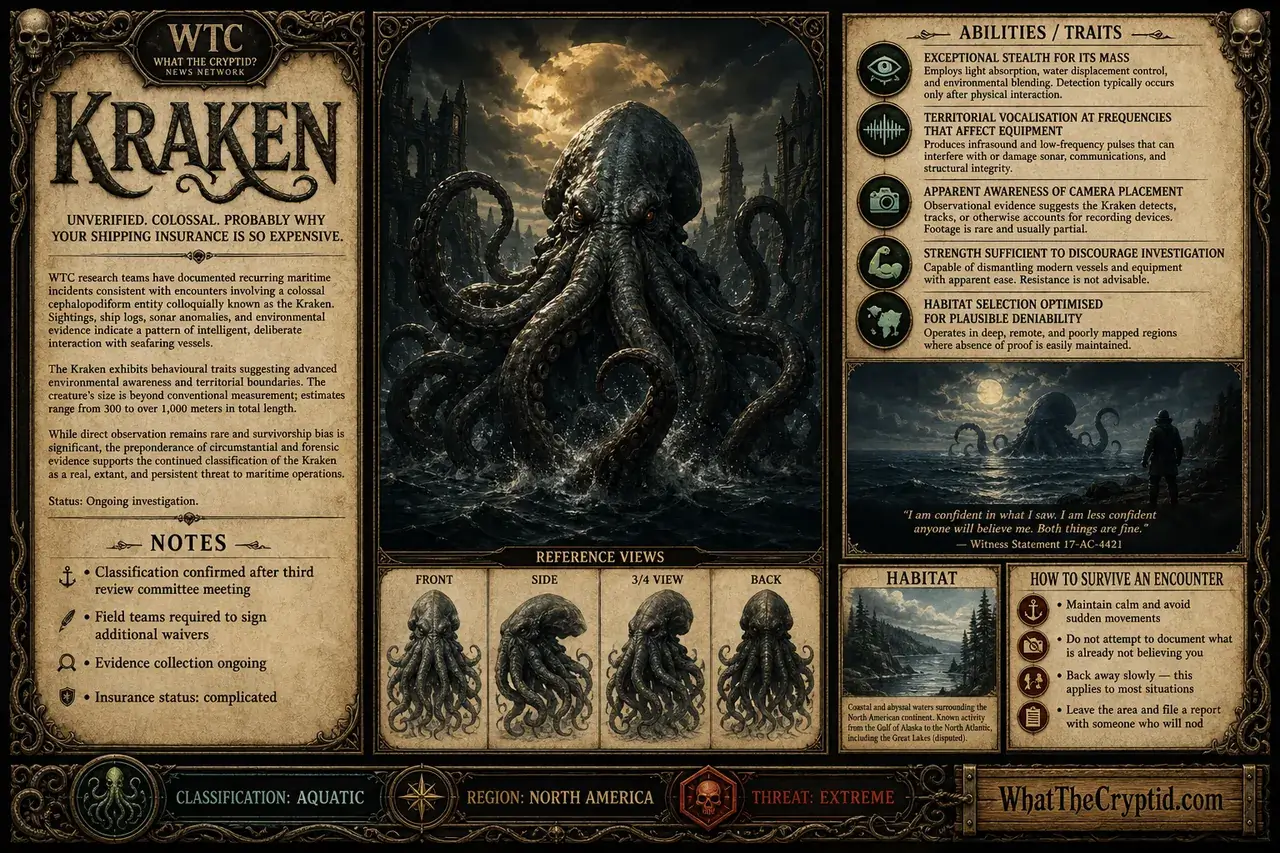
Kraken
Larger than documented. Significantly less patient than hoped.
Europe
Active
CephalopodNorse MythologyDeep SeaMaritime HazardMegafauna
Overview
The Kraken is a cephalopodic megafaunal entity documented in Norse maritime literature since at least the 13th century, with probable oral traditions extending several centuries prior. It is believed to inhabit deep oceanic trench systems across the North Atlantic, ascending to surface or near-surface depths with a periodicity that researchers have characterised as ‘irregular’ and shipping insurers have characterised as ‘unacceptable.’ Current WTC classification places it firmly in the Aquatic category, though its documented surfacing behaviour, capacity for atmospheric respiration, and occasional willingness to interact with surface vessels complicate any attempt at a clean ecological profile.

In terms of scale, the Kraken occupies a category that requires its own category. Historical accounts describe an entity large enough to be mistaken for an island — not a small island, but an island of sufficient size that ships have reportedly anchored to it, unloaded cargo, and commenced cooking fires before the situation clarified itself. WTC acknowledges that some attrition in the accuracy of these accounts is likely over seven centuries of retelling, but notes that even a conservative 80% reduction in the reported dimensions still yields an organism of extraordinary concern.
The Kraken is considered one of the most thoroughly attested entities in the WTC database by documentary volume, and one of the least thoroughly attested by physical evidence. This is a distinction WTC finds worth making.
History & Mythology
The earliest detailed written account of the Kraken appears in the Old Norse text Örvar-Odds saga, composed approximately 1250 CE, which describes two sea monsters — the Hafgufa and the Lyngbakr — dwelling in the waters off Greenland. The Hafgufa in particular is described as surfacing to feed by expelling partially digested matter into the water, thereby attracting fish, before submerging and consuming the gathered school in a single intake. Whether this constitutes a hunting strategy or an involuntary biological process is a question the saga does not pursue, and WTC researchers have found it equally difficult to resolve.
The entity received its most influential systematic treatment in Erik Pontoppidan’s Natural History of Norway, published 1752, in which the Bishop of Bergen — writing, it should be noted, in his capacity as a natural historian rather than a theologian — described the Kraken with the measured confidence of a man who had spoken to fishermen he trusted. Pontoppidan estimated the creature’s back surface area at approximately 1.5 miles in diameter, documented the whirlpool formed by its descent as a secondary maritime hazard distinct from the creature itself, and suggested that the Kraken’s excretions were responsible for the unusual abundance of fish in certain Norwegian fishing grounds. This last point has not been followed up in the peer-reviewed literature.
Through the 18th and 19th centuries, Kraken sightings were frequently and somewhat optimistically attributed to the giant squid, Architeuthis dux, once that species was formally described. WTC notes that Architeuthis dux reaches a maximum documented length of approximately 43 feet. The fishermen who anchored their boats to a Kraken and built fires on its back were, presumably, working with different numbers.
Physical Description
No confirmed full-body visual documentation of a living Kraken exists. What is available are accounts from individuals who observed portions of the entity at close range and later returned to land, which WTC treats as a meaningful filter. From these accounts, a working physical profile can be assembled, though ‘assembled’ may be overstating the structural integrity of the result.
The dorsal surface, as described by witnesses who mistook it for terrain, is characterised by a dark, irregular texture variously described as rocky, barnacled, or resembling waterlogged peat. When partially emerged, the Kraken has been estimated to present a surface area of between one and two miles across — a measurement that WTC includes here not because it expects readers to fully absorb it, but because omitting it would misrepresent the situation. The entity’s tentacular appendages, observed during feeding events or agitated surfacing, are reported to extend to heights sufficient to reach the upper rigging of full-masted sailing vessels, which in the 18th-century context corresponds to a reach of approximately 150 to 175 feet above the waterline.
Colouration in living specimens, where visible beneath surface fouling and accumulated marine growth, is consistently described as dark reddish-brown to near-black, consistent with the chromatophore-based pigmentation systems observed in smaller cephalopod relatives. The eyes, reported in several accounts as briefly visible during surface activity, are described as amber to yellow, and as very large. WTC has not been able to obtain a more precise measurement than ‘very large,’ and this is noted with the appropriate professional distance.
Behaviour & Temperament
The Kraken appears to spend the majority of its time at considerable depth — Norwegian maritime tradition holds that its resting place is the seafloor itself, which in the Norwegian Sea reaches depths exceeding 13,000 feet. Surfacing events appear to be feeding-driven rather than territorial, and the creature’s general disposition toward surface vessels has historically ranged from complete indifference to aggressive displacement, with the determining factor appearing to be whether the vessel was unlucky enough to be present during a feeding ascent. The Kraken has not been documented to pursue vessels that were not already in immediate proximity, which WTC considers moderately encouraging.
During feeding events, the entity’s behaviour is characterised by a period of relative stillness — the ‘island’ phase, during which the creature floats at the surface, apparently drawing marine life toward it — followed by a rapid and total submersion. It is this submerging phase that maritime tradition identifies as the primary hazard, as the displacement of water by an object of the Kraken’s estimated volume generates a vortical current sufficient to draw surface vessels downward. Witnesses who survived such events uniformly did so by virtue of having departed the area during the static phase. This behavioural pattern is consistent and well-documented enough that WTC considers it actionable guidance, which is not something WTC says lightly.
No evidence of social behaviour, conspecific interaction, or population structure has been recorded, leading several researchers to suggest that the Kraken may be solitary by necessity rather than preference. Whether there is one Kraken or several has been a matter of active disagreement in the WTC research community since the network’s founding. The budget constraints of that disagreement are addressed in the Field Notes section.
Habitat & Territory
The Kraken is primarily associated with the deep oceanic waters of the North Atlantic, with historical concentrations of sightings in the waters between Norway, Iceland, and Greenland — specifically the Norwegian Sea and the Denmark Strait, where seafloor topography provides both the extreme depth the entity appears to prefer for resting and the productive upwelling zones that would support its estimated caloric requirements. More recent accounts have extended the probable range southward into the North Sea and westward toward the mid-Atlantic ridge, though WTC notes that the distinction between ‘Kraken range expansion’ and ‘Kraken reports from areas with previously lower maritime traffic’ is methodologically difficult to establish.
The entity’s preferred resting depth is not directly documented, but based on the duration of observed surface intervals and the speed of descent reported in submersion events, WTC’s consulting marine biologist — who asked to be identified only by institution, and then reconsidered — estimated a typical depth of between 3,000 and 6,000 feet. Surface appearances are most frequently reported in summer months, which Pontoppidan attributed to seasonal prey movement and which WTC has no particular reason to dispute.
Diet & Hunting
The Kraken’s diet is, by any reasonable standard, everything. More specifically, it appears to be an opportunistic generalist that operates at the apex of the oceanic food chain through the application of scale rather than specialisation. Primary prey items documented across historical accounts include large schools of pelagic fish — herring, cod, and mackerel feature prominently in Norwegian accounts — alongside seals, whales described as ‘moderate in size,’ and, in a small number of accounts, surface vessels with crew. WTC categorises this last item as incidental rather than preferential predation, though the distinction offers limited practical comfort to those concerned.
The feeding mechanism described in the Hafgufa accounts — baiting prey with expelled organic matter before mass ingestion — is consistent with a passive filter-feeding strategy scaled to megafaunal dimensions, and bears a structural resemblance to the lunge-feeding behaviour documented in baleen whales, adjusted for an organism with a functional oral aperture large enough to accommodate a brigantine. The Kraken is also reported to actively seize prey with its tentacular appendages during more agitated feeding events, suggesting a dual-mode hunting strategy that shifts from passive to active depending on prey density or, possibly, temperament. The precise threshold has not been identified. Field teams have been advised not to investigate this question directly.
Notable Sightings
A Kraken of what witnesses described as ‘island proportion’ became stranded in the shallows off Fer Island and died over the course of several days, leaving a carcass that local residents reported smelling from the mainland — a distance of approximately 11 miles. The Bishop of Bergen, who documented this incident seventy years later based on witness testimony, noted that the remains were ‘in some part removed’ before any systematic examination could be conducted. What portion was removed, by whom, and to what end was not recorded.
Captain James Farquhar of the British merchant vessel HMS Farquhar reported anchoring to what the crew took to be a low-lying rocky outcrop approximately 40 miles from the nearest charted landmass. After a period of approximately two hours, during which the crew took on water and conducted minor hull repairs, the ‘outcrop’ submerged with sufficient speed to require immediate sail deployment to escape the resulting current. Farquhar’s log entry is notable for its technical precision regarding the vessel’s response manoeuvres and its complete absence of commentary on the nature of what had just occurred. He completed his route on schedule and filed no incident report beyond the log entry.
A crew of seven aboard the fishing vessel Brattvær reported observing a mass of animate organic material surfacing approximately 200 metres from their position, estimating visible surface area at ‘no less than half a kilometre’ before the mass descended over the course of four minutes. The event was accompanied by a significant upwelling of deep-water fish, from which the crew took what their captain described as their best single haul in eleven years of working the same grounds. The crew submitted a report to the Norwegian Maritime Authority, which acknowledged receipt. The Brattvær returned to the same location the following week.
During a deep-sea survey operation using remotely operated submersible vehicles at approximately 2,400 metres depth, the research team recorded sonar contact with an object of ‘anomalous dimensions and movement signature’ that approached within 60 metres of the ROV before the ROV’s camera systems experienced simultaneous failure. The sonar contact persisted for a further 23 minutes before departing on a westward bearing. The incident was included in the mission’s supplementary data appendix, classified as a probable equipment artefact, and the supplementary appendix was not published with the main findings.
Threat Assessment
The Kraken presents a threat profile that is difficult to act upon in the conventional sense, in that most of the recommended avoidance behaviours are ones that responsible maritime operators should already be observing. WTC nonetheless provides the following guidance. Do not anchor to uncharted seamounts or surface features in the Norwegian Sea, Denmark Strait, or adjacent North Atlantic waters, particularly during summer months and particularly if the feature was not present on charts from the previous season. If a surface feature exhibits any detectable movement, biological fouling patterns inconsistent with stationary rock, or ambient fish aggregation that appears to have no hydrographic explanation, increase distance to a minimum of 2 nautical miles and maintain that distance. If submersion of the feature begins, increase distance to a minimum of 5 nautical miles with all available speed, maintaining a heading perpendicular to the observed descent point to minimise exposure to the resulting vortical current. WTC rates the threat as Extreme, with the clarification that ‘Extreme’ in this context refers to the consequences of a direct encounter rather than the probability of one — a distinction that may or may not be useful depending on where you are currently reading this.
WTC acknowledges that this guidance is substantially less useful for vessels that have already anchored to the entity, which represents the majority of historical incident scenarios. For those situations, the historical record suggests that early detection during the static phase is the decisive factor, and that no successful intervention has been documented after submersion has commenced. WTC recommends keeping a watch specifically assigned to checking whether the island you are anchored to is breathing.
WTC Field Notes
WTC has maintained an open research file on the Kraken since the network’s second year of operation, during which our founding editor attempted to commission a deep-sea observation expedition to the Norwegian Sea and discovered that the budget required to charter a research-capable vessel exceeded the network’s annual operating budget by a factor of approximately twelve. This ratio has not improved materially in the intervening years. Current Kraken research at WTC consists primarily of archival documentation review, analysis of maritime incident reports obtained through freedom-of-information requests to the Norwegian and Icelandic coast guards, and correspondence with three independent researchers who have asked not to be identified, two of whom have also asked not to be contacted by telephone.
A proposal was submitted in the last fiscal year to partner with a marine biology institution on a joint deep-sonar survey of the Norwegian Sea, contingent on WTC’s contribution of ‘editorial oversight and public communications support.’ The institution’s research committee reviewed the proposal for six weeks before responding that they would be ‘proceeding independently.’ WTC considers this a partial success and has updated the Kraken file accordingly. Our insurance provider has also updated our policy accordingly, adding a specific exclusion for ‘research activities conducted at or below the thermocline in designated Kraken habitat zones,’ which is the first time WTC has appeared in an insurance exclusion by name, and which the editorial team has framed in the office as an achievement.