
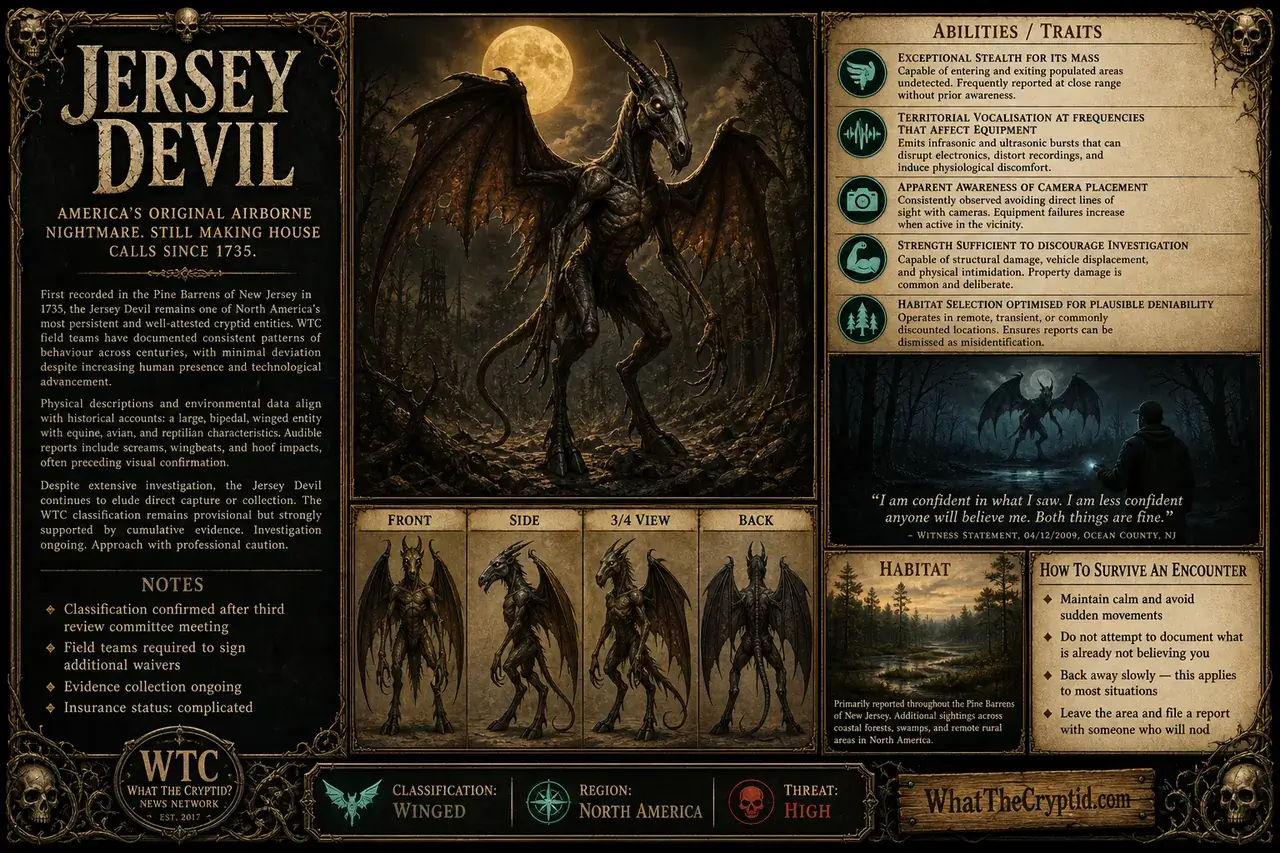
Jersey Devil
Two hundred years of sightings. Still no photographs worth keeping.
North America
Active
Jersey DevilPine BarrensWinged CryptidNew Jersey
Overview
The Jersey Devil is a winged, bipedal cryptid documented persistently across the Pine Barrens region of southern New Jersey since at least the mid-eighteenth century, making it one of the longer-running active cases in the WTC database and, by some metrics, one of the more patient ones. It is described consistently across accounts as possessing a horse-like or goat-like head, leathery bat wings with a reported span of approximately four feet, hooved feet, and a disposition that falls somewhere between territorial and deeply inconvenienced. It does not, as far as field records indicate, pursue witnesses. It simply appears, screams, and departs, which our editorial team has agreed is either a threat display or a commute.

The Pine Barrens themselves cover roughly 1.1 million acres of coastal plain forest in New Jersey — a fact that surprises most visitors, who did not expect New Jersey to contain 1.1 million acres of anything that is not a highway. The region’s geographic isolation, low population density relative to the surrounding state, and notably poor mobile reception have all contributed to a reporting environment that is, in WTC’s assessment, both ideal for cryptid activity and consistently frustrating for cryptid documentation.
WTC classifies the Jersey Devil as Active based on a sustained sighting rate that has not declined meaningfully since systematic records began. Whether this reflects a single long-lived entity, a breeding population, or an unusually specific shared hallucination affecting the residents of Burlington and Ocean counties is a question WTC has been attempting to answer since 2011 with a budget that has not kept pace with the ambition.
History & Mythology
The most widely cited origin account dates to 1735 and involves a woman named Jane Leeds — referred to in contemporary sources as ‘Mother Leeds’ — who, upon discovering she was pregnant with her thirteenth child, allegedly declared that the child could be the devil. The child was subsequently reported to have been born with wings, hooves, and a tail, after which it killed the midwife, screamed, and exited through the chimney. WTC notes that no primary birth record has been located, and that the midwife in question does not appear in surviving county documents, though this absence is not, on its own, evidence of anything except incomplete eighteenth-century record-keeping in colonial New Jersey.
By the nineteenth century, the Leeds Devil had become sufficiently embedded in regional folklore to function as both a genuine folk fear and a social deterrent, with parents reportedly invoking it to discourage children from venturing into the Pines after dark — a use case WTC considers operationally sound regardless of the entity’s ontological status. The creature was formally adopted as the state’s official ‘state demon’ in popular culture, and in 1939 a local promoter briefly exhibited a kangaroo with painted wings as the Leeds Devil for twenty-five cents admission. This event is not directly relevant to the cryptid record but speaks to a regional willingness to monetise ambiguity that WTC finds professionally relatable.
The most significant documented event cluster occurred between January 16 and 23, 1909, when over one hundred witnesses across thirty towns in southern New Jersey and parts of Pennsylvania and Delaware reported encounters with a creature matching the standard description over the course of a single week. Witnesses included a police officer, a postmaster, and a Bristol, Pennsylvania commodore named Stephen Decatur, who reportedly fired a cannonball at the entity during a munitions test and described it as appearing ‘unaffected.’ The week produced more corroborated, geographically distributed witness accounts than any comparable cryptid event in the eastern United States and is the reason the 1909 cluster appears first in most subsequent literature on the subject, including this entry.
Physical Description
Witness descriptions of the Jersey Devil are more consistent than those for most cryptids of comparable longevity, which WTC finds either reassuring or suspicious depending on the day. The entity is typically described as standing between three and a half and five feet tall when upright, with a elongated horse- or goat-like skull, large leathery wings attached at the shoulder with a documented span of three to four feet in most accounts and an outlying claim of six feet from a 1951 report that WTC has flagged for independent review. The body is described as slender, disproportionately so given the reported wing span, and is held upright on two legs terminating in cloven hooves. A long, thin tail — described variously as forked or tapered — is present in approximately 78% of accounts.
The forelimbs present an ongoing classification challenge: some witnesses describe short, clawed arms held against the chest in a manner consistent with vestigial forelimbs; others describe the wings themselves as the primary forelimbs, folded when the entity is standing. These accounts may reflect different postures of the same anatomy, or they may reflect the well-documented human tendency to misidentify wing-shoulder articulation under conditions of low light and significant personal distress. WTC has not resolved this question to its editorial board’s satisfaction.
Colouration is consistently reported as dark — grey, dark brown, or black in the body — with occasional reports of a lighter, almost tan hide across the chest and throat. The eyes are described as red or orange-red in the majority of accounts, a detail that appears in sightings as early as 1820 and as recently as 2019, and which WTC notes is either a genuine ocular characteristic or an example of expectation shaping perception so thoroughly that it has become indistinguishable from observation.
Behaviour & Temperament
The Jersey Devil is predominantly crepuscular to nocturnal, with the largest proportion of verified sightings occurring between 9 PM and 3 AM. Daytime encounters are documented but rare, and the handful of afternoon sightings on record share a consistent feature: they occurred in dense forest cover under overcast conditions, suggesting the entity either prefers low-light environments or has made a reasonable judgment about when it is least likely to be photographed clearly. Activity increases in autumn and early winter, with a notable secondary peak in late January that may or may not be coincidental with the anniversary of the 1909 cluster.
Aggression toward humans appears to be limited to threat displays: the entity has been documented screaming at witnesses, making short charges that stop well short of contact, and in several accounts dropping to eye level mid-flight before ascending again — a behaviour WTC’s consulting ornithologist described as ‘consistent with a warning pass’ before requesting that her name not appear in the final report. Direct physical contact with humans is not documented in any account WTC considers credible. The entity appears to find human presence objectionable rather than appetising, which our field researchers consider a meaningful distinction.
The Jersey Devil is solitary in all recorded accounts. No reliable sighting has ever documented two entities simultaneously, and despite sustained reporting across nearly three centuries, no nest, den, or breeding evidence has been recovered from the Pine Barrens. Whether this reflects a genuinely solitary creature, an exceptionally private one, or a population so low that co-sightings are statistically unlikely is a question WTC has added to what is becoming a very long list.
Habitat & Territory
The Jersey Devil’s primary habitat is the Pine Barrens of southern New Jersey — specifically the interior cedar swamps, pitch pine lowlands, and scrub oak uplands that characterise the central and southern sections of the barrens. The terrain sits at a consistent low elevation, rarely exceeding 200 feet above sea level, and is threaded by slow-moving, tea-coloured waterways that drain the region’s boggy interior. It is not dramatic landscape by any conventional measure. It is, however, extremely difficult to move through at speed, offers almost no sightlines beyond thirty yards in most directions, and contains enough standing water to make tracking impractical. A reasonable entity would choose it.
Sightings outside the Pine Barrens occur regularly, with documented encounters extending into the Pine Barrens-adjacent communities of Burlington, Camden, and Atlantic counties, and the 1909 cluster demonstrating a range that briefly extended into Pennsylvania and Delaware. These peripheral sightings tend to cluster near forest edges and drainage corridors, suggesting the entity uses vegetated movement routes when travelling between habitat patches — a behaviour consistent with several large, range-extending species in the region, none of which have wings.
Diet & Hunting
The Jersey Devil’s diet is inferred primarily from livestock and wildlife mortality events in the Pine Barrens region rather than from direct observation, as no confirmed feeding event has been documented on record. Historically, farmers in Burlington and Ocean counties attributed unexplained losses of chickens, geese, and young goats to the entity, with attack signatures described as inconsistent with known regional predators — specifically, the absence of tracks approaching or leaving carcasses in soft ground where tracks would be expected. WTC notes that winged predation would account for this absence without requiring further explanation, though our consulting wildlife biologist pointed out that great horned owls are also capable of carrying young poultry and do not require their own database entry.
In terms of wild prey, the Pine Barrens support sufficient populations of white-tailed deer fawn, wild turkey, and various wading bird species to sustain a mid-sized predator with aerial hunting capability. Several accounts from the early twentieth century describe the entity as carrying something in its forelimbs during flight, though descriptions of what it was carrying vary enough that WTC has recorded them as inconclusive. One 1927 account from a Chatsworth farmer named Elias Gropp described watching the entity land briefly in a cranberry bog and depart with what he believed was a Canada goose, which, if accurate, would place its prey-carrying capacity at approximately eight to fourteen pounds — a useful data point that remains, like most data points in this file, entirely unverified.
Notable Sightings
During the week of January 16–23, 1909, over one hundred witnesses across thirty towns reported encounters with a creature matching the standard Jersey Devil description, representing the single largest documented sighting cluster for any eastern North American cryptid. Among the most frequently cited individual reports was that of Bristol police officer James Sackville, who encountered the entity on Buckley Street in the early morning hours of January 17 and discharged his service weapon at it at close range. Sackville described the entity as continuing its flight path without visible reaction to being shot, which he included in his official report. The report was filed, reviewed by the Bristol Police Department, and appears to have been accepted without further comment.
In August 1951, a group of children in Gibbstown reported an encounter with a large winged creature perched on a fence post at the edge of a property bordering a wooded drainage corridor. The children described the creature as remaining stationary for approximately four minutes before spreading its wings — estimated at that point as five to six feet — and departing to the northwest. Three sets of parents independently corroborated that their children had returned home in a state of agitation and provided consistent accounts without apparent coordination. A follow-up visit to the fence post by a local reporter the following afternoon produced no physical evidence, a fact the reporter noted in a brief item on page seven of the Gloucester County Democrat.
A truck driver identified in WTC records as D. Hannigan reported that an entity matching the Jersey Devil description struck the windshield of his vehicle while travelling southbound on Route 9 at approximately 11:40 PM on October 14, 1993. Hannigan described hearing a sharp impact, observing the entity briefly against the glass — ‘a face like a horse, but wrong’ — before it cleared the cab and continued south. An examination of the vehicle at Hannigan’s next stop revealed a crack in the upper right corner of the windshield consistent with a blunt impact and three linear scratches in the roof paint above the driver’s side that Hannigan’s dispatcher documented photographically for insurance purposes. The insurance claim was denied on grounds that the described cause of damage did not correspond to any covered category.
In September 2015, a group of four hikers camping in Wharton State Forest reported hearing prolonged vocalisation — described as a high, sustained scream with an intermittent quality unlike any known regional wildlife — beginning at approximately 1:15 AM and continuing for just under forty minutes. Two members of the group subsequently reported seeing a winged silhouette pass over the campsite against the treeline, briefly occluding stars. One member of the group, a wildlife biology postgraduate student identified in WTC records only as K. Marsh, attempted to record the vocalisation on a mobile phone; the recording captured eleven minutes of ambient forest noise and then silence, which Marsh described as coinciding with the moment she had begun to record. Marsh submitted a written account to WTC approximately six weeks after the incident and noted in a postscript that she had changed her thesis topic.
Threat Assessment
The Jersey Devil does not have a documented record of initiating physical contact with humans, and WTC’s threat rating of Moderate reflects the entity’s physical capability and unpredictability rather than a pattern of confirmed attacks. Witnesses who have remained stationary during encounters report that the entity typically departs within two to four minutes without escalation. Witnesses who have run report shorter encounter durations, which could indicate either that movement triggers a disengagement response or simply that frightened people move faster than they think they do.
WTC recommends maintaining a minimum distance of 50 yards from any entity matching the Jersey Devil description, and advises against direct eye contact, sudden movements, or discharging firearms, the last of which has been attempted on multiple documented occasions with no confirmed effect on the entity and considerable effect on the composure of everyone present. If encountered in a vehicle, remain in the vehicle. If encountered on foot in the Pine Barrens at night, WTC recommends doing what you can with what you have, as the specificity of further advice is limited by the specificity of the available evidence.
WTC Field Notes
WTC has maintained an active field file on the Jersey Devil since the network’s founding, a distinction the Jersey Devil shares with Bigfoot and the Loch Ness Monster and which has not translated into meaningfully better documentation for any of them. Two trail camera deployments in Wharton State Forest — in 2014 and 2018 — produced a combined total of 847 hours of footage capturing deer, raccoons, one black bear, and a hiker who appeared to be looking for the trail cameras. A third deployment in 2021 was suspended after the equipment supplier declined to honour the warranty on units that had, in their words, ‘clearly been stored in standing water,’ a characterisation our field team disputes.
The Jersey Devil file currently runs to approximately 340 pages, of which our senior researcher estimates 60 to 70 pages contain information she would describe as ‘actionable’ and the remainder as ‘atmosphere.’ WTC’s editorial board has discussed commissioning a dedicated Pine Barrens expedition on four separate occasions, and on each occasion the discussion has concluded with agreement that the budget, the season, and the available personnel are not quite right. We remain committed to resolving this case. The Jersey Devil, for its part, appears to be in no particular hurry.