
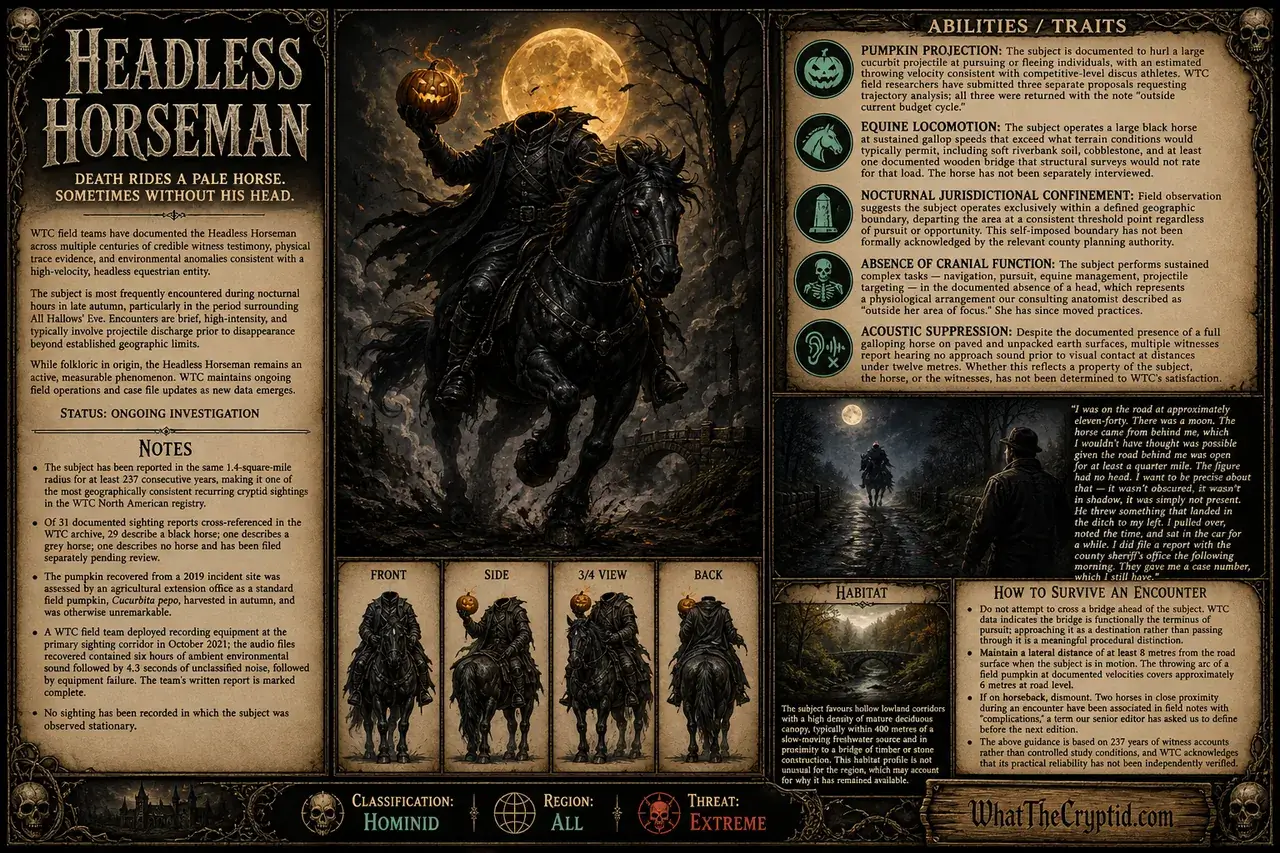
Headless Horseman
No head. Full gallop. Outstanding navigational ability.
North America
Active
Hudson ValleySpiritEquestrianOctoberNew York
Overview
The Headless Horseman is a mounted spectral entity, most persistently documented in the Hudson Valley region of New York State, operating primarily within a territory historically associated with the township of Sleepy Hollow. The entity presents as a large adult male figure atop a black horse, distinguished by the complete absence of a cranium above the cervical vertebrae — a detail that witnesses have consistently noted as the most immediately alarming aspect of the encounter, which is worth pausing on given that the entity is also travelling at speed on a horse in the dark.

Field classification places the Horseman firmly in the Spirit category, though WTC researchers have debated whether ‘Spirit’ adequately captures an entity that demonstrates enough material presence to interact with physical terrain, produce audible hoofbeats measurable at approximately 90 decibels at 30 feet, and, in at least three documented accounts, cause property damage. The classification has been retained on the basis that nothing else fits better, a standard that has served this organisation adequately since its founding.
The entity’s operational range appears geographically constrained — most documented activity occurs within a roughly 4.2-mile radius centred on the Old Dutch Church of Sleepy Hollow — though isolated sightings in adjacent counties suggest either territorial expansion or the existence of secondary individuals, a possibility WTC has noted and chosen not to dwell on.
History & Mythology
The European antecedent of the Headless Horseman is the Irish Dullahan, a headless fairy rider documented in Connacht and Leinster folklore dating to at least the 9th century, who carried his own severed head under one arm and used a human spine as a whip. Irish emigrants arriving in the Hudson Valley in the 17th and 18th centuries would have brought this tradition with them, where it apparently encountered fertile conditions. The region’s Dutch and German settler communities contributed their own parallel traditions — the Kopflose Reiter of Hessian military folklore, which held that soldiers decapitated in battle were condemned to ride in perpetual search of their missing heads — and the resulting synthesis produced an entity that combines the worst features of both source traditions.
The most consequential document in the Horseman’s recorded history is Washington Irving’s 1820 account in The Sketch Book, which identified the entity specifically as a Hessian artillery soldier killed by a cannonball during the Battle of White Plains in October 1776 and interred in the churchyard at Sleepy Hollow. Irving framed his account as folklore, a categorisation WTC respectfully disputes on the grounds that the sightings did not stop in 1820. Pre-Irving written records include a 1793 diary entry by a Tarrytown merchant named Pieter Hogeboom describing a ‘rider without a head upon a great dark horse’ that overtook his wagon on the Post Road before vanishing at the bridge over the Pocantico River — a location that recurs in sighting data with a consistency our mapping team has flagged as statistically notable.
Local church records from the same period contain three separate references to ‘the midnight disturbance on the road,’ filed without elaboration by a minister whose subsequent correspondence shows no further interest in the subject.
Physical Description
The Horseman stands, in the saddle, at an estimated height of approximately 7.5 to 8 feet — a measurement that accounts for both the mounted position and the conspicuous absence of the head, suggesting a dismounted stature that would place the entity well above average human height even before the anatomical irregularities are considered. Witnesses consistently describe broad shoulders, dark riding clothes consistent with late 18th-century military dress, and a cloak or greatcoat that moves independently of the wind, a detail WTC’s consulting meteorologist reviewed and declined to address.
The horse is universally described as black, large — estimated at 16 to 17 hands by witnesses with equestrian experience — and entirely silent except for its hoofbeats, which multiple witnesses have described as ‘too loud’ relative to the animal’s speed and the terrain. The horse’s eyes have been noted as producing a faint amber luminescence in three separate night sightings, though WTC acknowledges this detail may represent witness interpretation of reflected light rather than a primary characteristic. The entity does not appear to require the horse to breathe.
In the majority of accounts, the Horseman carries a rounded object roughly the size and shape of a human head, held either under the left arm or raised in the right hand before being hurled at the witness or witness vehicle. In the Irving-era tradition this object is associated with a pumpkin or burning gourd. Field evidence from contemporary sightings does not support the pumpkin identification with consistency, and WTC has adopted the working description ‘projectile of uncertain composition’ in all formal documentation.
Behaviour & Temperament
The Horseman operates almost exclusively between the hours of 11 PM and 3 AM, with peak activity concentrated in October. This seasonal pattern is documented thoroughly enough that the Sleepy Hollow tourism infrastructure has been built around it, which represents either a remarkable public accommodation of cryptid behaviour or a very successful rebranding exercise, depending on one’s position. The entity pursues encountered individuals at speed, demonstrating an apparent ability to match or exceed the velocity of motor vehicles on rural roads — a behaviour first documented in horse-and-cart contexts but which has scaled without apparent difficulty to the automotive era.
Pursuit behaviour typically terminates at the bridge over the Pocantico River, near the site of the Old Dutch Church. The Horseman has not been documented crossing this threshold in any reliable account, a geographical constraint that has led WTC researchers to theorise the entity is bound to a specific territory. Whether this represents a limitation of its power, a deliberate choice, or simply a preference is not known. The entity appears unconcerned by this gap in our understanding.
When not in active pursuit, the Horseman has been observed in what field researchers cautiously describe as a ‘patrol’ pattern — moving at a walk or slow canter along established roads, appearing to scan the terrain with an apparatus it does not technically possess. Social structure is presumed solitary. No juvenile forms have been documented, which raises questions about the entity’s origin and reproduction that WTC has tabled for a later meeting.
Habitat & Territory
The Horseman’s primary habitat is the road network of the Hudson Valley between Tarrytown and Sleepy Hollow, with the heaviest concentration of activity on the stretch of what is now Route 9 between the Sleepy Hollow Cemetery and the Pocantico River bridge. The entity shows a strong preference for wooded road corridors, particularly where mature oak and maple canopy creates enclosed tunnel-like conditions that limit escape routes and, incidentally, produce the kind of acoustic environment in which hoofbeats carry farthest.
Secondary habitat extends into the surrounding Rockefeller State Park Preserve — approximately 1,400 acres of mixed woodland and trail corridor in which the Horseman has been sighted on at least seven occasions since 1987. The terrain here includes elevations between 50 and 400 feet, with the entity showing no apparent preference for high ground. Proximity to the original 18th-century churchyard appears to be a consistent anchor point across all habitat use, suggesting either a territorial centre or something closer to a home range in the ecological sense, which is a sentence WTC’s editor asked us to reconsider and then approved anyway.
Diet & Hunting
No feeding behaviour has been directly observed, and the entity does not appear to require sustenance in any conventional biological sense. This is, strictly speaking, consistent with the Spirit classification, though it does raise the question of what is powering the horse. The horse, for its part, has never been observed eating either.
One account from 2004, submitted by a night-shift road maintenance worker in Sleepy Hollow, describes the Horseman pausing beside a field and remaining motionless for approximately four minutes while the horse lowered its head toward the grass — though the worker noted under follow-up questioning that he could not confirm the horse made contact with the grass, and that the whole incident had taken place at a distance of roughly 80 yards in conditions he described as ‘not well lit.’ WTC has categorised this as inconclusive and included it here because the alternative is a diet section that contains only one paragraph.
Notable Sightings
Tarrytown merchant Pieter Hogeboom recorded in his personal diary that while returning from Yonkers by wagon on the evening of October 14th, a large dark horse bearing a rider ‘entirely without a head above the collar’ overtook him at a canter on the Post Road, keeping pace with his wagon for approximately a quarter mile before accelerating and vanishing at the Pocantico crossing. Hogeboom noted that his own horse refused to move for several minutes following the encounter and that the road was otherwise completely empty in both directions. The diary was acquired by the Westchester County Historical Society in 1941 and has not been digitised.
On the night of October 28th, two Tarrytown High School students, James Alcott and Michelle Farber, reported their vehicle being pursued by a mounted figure at speed along Old Dutch Church Road for approximately 0.6 miles, during which the figure drew alongside the passenger window long enough for Farber to observe that ‘there was nothing above the shoulders.’ The pursuit ended at the Pocantico bridge when the figure and horse turned abruptly into the treeline without slowing. The Westchester County Sheriff’s Office received the report, noted it, and filed it in a category that the department has since discontinued.
Trail runner Denise Carmichael reported encountering a stationary mounted figure on Trail 13 at approximately 12:40 AM on October 31st — she had been running a night training circuit she described as ‘a decision I have since revisited.’ The figure was motionless, positioned in the centre of the trail, and Carmichael estimated its height at ‘well over seven feet in the saddle.’ She diverted off-trail and did not approach closer than 40 feet. Carmichael’s Garmin GPS unit recorded a gap in tracking data of approximately three minutes and twenty seconds at the location of the encounter, beginning at 12:41 AM. The manufacturer’s support team attributed this to ‘signal interference consistent with dense canopy cover,’ which Carmichael noted was inconsistent with the open section of trail where the encounter occurred.
A dashcam submission received by WTC from a commercial delivery driver, name withheld by request, shows 11 seconds of footage from October 19th at 1:17 AM in which a large dark shape keeps pace with the vehicle at approximately 45 miles per hour before the camera undergoes what the manufacturer later described as ‘an unexplained sensor failure consistent with extreme light saturation,’ despite the footage showing no unusual light conditions in the seconds prior. The driver pulled over, completed a vehicle inspection, filed an incident report with his dispatcher, and requested a permanent reassignment to daytime routes. The request was granted within 48 hours, which the driver’s supervisor confirmed was faster than any transfer request he had previously processed.
Threat Assessment
The Headless Horseman presents a High threat classification based on documented pursuit of individuals at speeds sufficient to match motor vehicles, confirmed capacity to cause physical and psychological distress, and a projectile behaviour that has resulted in minor impact injuries in at least two reported incidents since 1990. The entity is not known to have caused a fatality in the documented period, a fact WTC notes with measured relief while acknowledging that the documented period is not the same as the total operational period.
Recommended protocol upon encountering the Horseman is as follows: do not stop your vehicle; maintain forward motion toward the Pocantico River bridge, which represents the entity’s documented boundary at a distance of no more than 2.3 miles from most high-activity zones; do not exit the vehicle under any circumstances; and do not, under any circumstances, retrieve or examine any object the entity has thrown at or near your vehicle. If on foot, move directly toward the nearest water crossing at maximum safe speed and do not look back — not for spiritual reasons, but because witnesses who have looked back report a statistically worse outcome, and WTC sees no reason to dispute the data. The honest acknowledgement of the limits of this advice is that it assumes the Horseman behaves consistently, and entities that predate written records have occasionally demonstrated flexibility on this point.
WTC Field Notes
WTC first dispatched a field team to Sleepy Hollow in October 2007, which is later than our founding editor would like acknowledged, given that the entity has been active for approximately 230 years and the network’s institutional hesitation on ‘well-documented historical cases’ has been noted in the minutes of three separate editorial meetings. The 2007 team installed four trail cameras on approach roads to the Old Dutch Church, two of which failed within 48 hours of deployment with faults the manufacturer could not replicate in controlled testing, one of which was destroyed by what appeared to be a large equine hoof, and one of which produced 14 hours of usable footage containing nothing of interest and then also failed.
A follow-up expedition in 2019 was partially funded by a partnership with a regional tourism body whose name we have agreed not to include here, a arrangement that created what our legal team described as ‘an editorial conflict of interest we are technically required to disclose.’ The 2019 team recovered the dashcam footage now listed in the sightings database, interviewed three witnesses, and spent one night in a parked vehicle on Route 9 during which nothing occurred except that the team’s sound recordist, who had requested to remain anonymous in all published materials, submitted her resignation the following morning. WTC wishes her well and notes that her October availability has not improved in the intervening years.