
Goatman
Part man. Part goat. Entirely a Maryland infrastructure problem.
North America
Active
HominidMarylandTexasBridgeNocturnalAggressiveHybrid
Overview
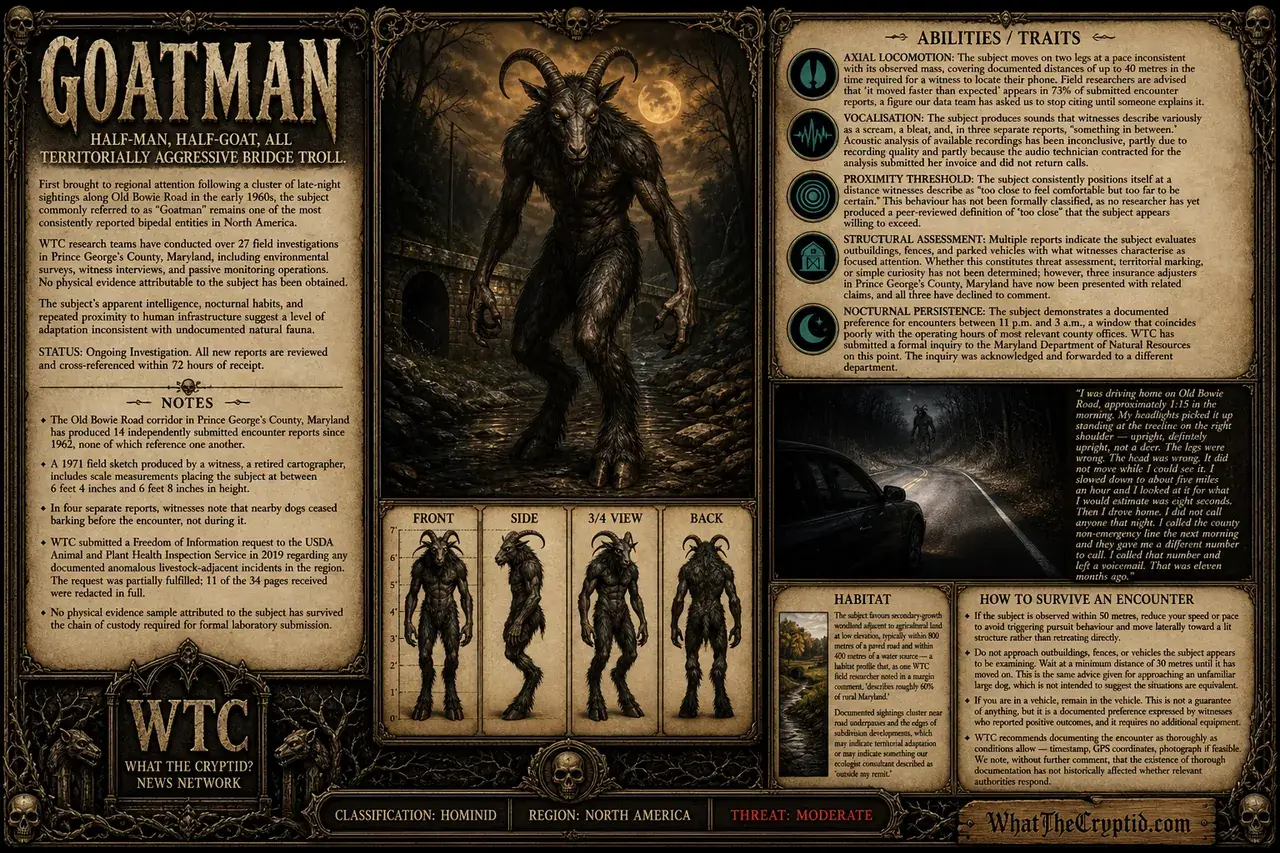
The Goatman is a bipedal cryptid documented primarily across the eastern United States, characterised by a hybrid morphology combining human and goat features in proportions that field witnesses have described with varying degrees of composure. Standing between six and eight feet tall, the entity moves on digitigrade hind legs terminating in hooves, carries a torso of broadly human configuration, and presents a head that most witnesses agree is goat-like, though there is meaningful disagreement about whether the expression it wears constitutes curiosity, aggression, or something WTC researchers have been asked to stop describing in field reports as ‘a look of personal grievance.’

The Goatman is not one entity in the taxonomic sense, or at least the evidence does not support that conclusion. Regional variants have been documented from Maryland to Texas to Kentucky, each with distinct behavioural profiles and local mythological frameworks, though the core morphology remains consistent enough that WTC classifies all variants under a single entry pending further comparative research. That research has been pending since 2019.
What distinguishes the Goatman from comparable hominid cryptids is its apparent willingness to engage with human witnesses rather than avoid them. Where Bigfoot retreats, where the Yeti observes from distance, the Goatman has been documented approaching vehicles, vocalising at close range, and on several occasions pursuing individuals across distances that suggest either territorial aggression or, as one WTC field researcher noted in a report that was edited before publication, ‘something that looked a lot like intent.’
History & Mythology
The Goatman’s most thoroughly documented regional origin attaches to the Agricultural Research Center in Beltsville, Maryland, where local accounts circulating from at least the 1950s describe a federal scientist whose experimental crossbreeding program produced results the agency has not officially acknowledged. WTC submitted a Freedom of Information Act request regarding this account in 2021. The request was acknowledged. A response has not yet been received.
Prior to the Beltsville framework, goat-human hybrid entities appear with notable consistency across pre-Columbian Mesoamerican iconography, in European folklore traditions surrounding Pan and the satyrs of Greek antiquity, and in Appalachian oral histories that describe a figure known variously as the Hairy Man or the Stump-Legged Devil. Whether these represent genuine historical encounters, convergent cultural mythologising, or a single migratory entity with a very long operational range is a question WTC has tabled for a later meeting.
The modern Goatman entered documented cryptid literature most prominently in 1971, when The Prince George’s County Sentinel published accounts from multiple witnesses describing encounters along Fletchertown Road near Bowie, Maryland. The Sentinel’s coverage named the entity explicitly, described an incident in which a group of teenagers reported their dog being thrown from a bridge — a detail that has been repeated in subsequent accounts with a specificity that WTC finds either compelling or deeply culturally embedded, and has not yet determined which.
Physical Description
The Goatman presents a bilateral symmetry that is broadly humanoid from the chest upward and unmistakably caprine below. Documented leg structure is digitigrade, with witnesses consistently reporting the reversed-knee configuration characteristic of ungulate hind limbs, terminating in hooves described variously as cloven, singular, or — in three separate Maryland accounts — ‘just wrong, like a hoof that had given up.’ Standing height across verified sighting records averages 7.2 feet, with the tallest credible account placing the entity at approximately 8.5 feet when observed against a chain-link fence of known height near Fletchertown Road.
The cranium is where witness accounts diverge most significantly. The majority describe a goat’s head in full — elongated face, horizontally-oriented rectangular pupils, and curved or straight horns ranging from 8 to 24 inches in length. A minority of accounts, concentrated in the Texas variant cluster around Old Alton Bridge in Denton County, describe a face that is more ambiguously hybrid: recognisably goat-structured but retaining what witnesses have described as ‘almost human’ eye placement and expression. WTC does not have a position on which variant is more concerning.
Body covering across all regional variants is described as a coarse hair ranging from grey-brown to black, thinning at the torso and thickening at the haunches. Several witnesses have noted a persistent odour described as goat musk amplified to a degree that suggested, in the words of one 2003 Maryland account, ‘something that had never once considered whether this was appropriate for a public area.’
Behaviour & Temperament
The Goatman is primarily nocturnal, with the highest concentration of sightings occurring between 11 PM and 3 AM. Unlike many cryptids that demonstrate a clear flight response upon detection, the Goatman holds its ground and, in a significant subset of encounters, advances. This behaviour has been observed in proximity to roads, bridges, and the perimeters of residential properties, leading WTC field researchers to conclude that the entity has either established these as territorial boundaries or has simply decided that bridges and roadsides are where it prefers to spend its evenings. Both interpretations have management implications.
Vocalisation has been documented in multiple accounts and presents as a sound witnesses consistently struggle to describe. The most common descriptors are ‘a scream that started human and ended wrong,’ ‘a bleat scaled up past the point where it stops being funny,’ and, in a 1978 account from Prince George’s County, ‘the sound a man would make if he had forgotten he was a man.’ The Goatman has also been documented using tools in a limited capacity — specifically, striking vehicles and structures with what appear to be large branches or, in two accounts, an axe of undetermined provenance.
Social structure is unresolved. The overwhelming majority of sightings involve a single entity, and no confirmed pair or group encounter exists in the WTC database. Whether this reflects a solitary species, a territorial animal that keeps others at range, or simply a single individual with an unusually large home territory is a question field teams have not been able to answer, partly due to the operational challenges of extended surveillance in Goatman habitat and partly due to the difficulty of retaining field teams for extended surveillance in Goatman habitat.
Habitat & Territory
The Goatman demonstrates a consistent preference for edge environments — areas where developed land meets woodland, where road infrastructure crosses water, or where the functional boundary between human and non-human territory is a single structure. Bridges appear with particular frequency in habitat documentation, to a degree that WTC considers statistically meaningful rather than coincidental. The Old Alton Bridge in Denton County, Texas; Crybaby Bridge in Prince George’s County, Maryland; and Governor’s Bridge Road in Bowie have each generated multiple independent sighting clusters, a pattern that suggests either strong site fidelity or a cryptid that understands infrastructure better than WTC is comfortable acknowledging.
Elevation preference appears low to moderate, with sightings concentrated between 100 and 600 feet above sea level across the eastern seaboard range. The entity tolerates proximity to suburban development more readily than most cryptids in the WTC database, with several encounters occurring within a quarter mile of residential lighting. Whether this represents territorial confidence, a dietary adaptation to human-adjacent environments, or simply insufficient concern for detection is not yet established.
Diet & Hunting
Dietary evidence for the Goatman is reconstructed primarily from site assessment following reported encounters rather than direct observation, which has produced a data set that is suggestive rather than conclusive. Livestock disturbance — specifically goat and sheep predation — has been reported in connection with Goatman territory in Maryland and Texas, though the causative link has not been formally established and local agricultural authorities have attributed these incidents to more conventional explanations. WTC notes that the conventional explanations in question required significant interpretive flexibility.
Indirect evidence from den site assessments, conducted at two locations in Prince George’s County, suggests a diet that includes deer, small to medium mammals, and plant material consistent with late-season browsing — an omnivorous profile broadly compatible with the entity’s proposed body mass of 400 to 600 pounds. One assessment also documented the partial remains of what appeared to be a domestic dog, a detail that is consistent with multiple witness accounts, consistent with the 1971 Sentinel report, and which WTC’s consulting wildlife biologist described as ‘not something I’m going to formally attribute to anything’ before closing her notebook.
Notable Sightings
In the summer of 1971, a group of six teenagers reported encountering a large bipedal figure with goat-like features while parked near a wooded area off Fletchertown Road. The entity approached the vehicle, struck the roof twice with what witnesses described as a blunt wooden object, and departed into the tree line. The group’s dog, which had been tied to a nearby tree, was found the following morning at the base of a drainage bridge approximately 200 yards from the encounter site. Prince George’s County Animal Control noted the incident in its records under ‘animal disturbance — cause undetermined’ and closed the report the same day.
In October 2007, two paranormal investigators conducting an overnight site assessment at Old Alton Bridge — a documented Goatman location — reported a sighting of an entity matching the Texas variant description at approximately 1:40 AM. Lead investigator Dana Kowalski documented the entity as standing at the far end of the bridge, facing the team, for a period she estimated at four to six minutes before moving off the bridge’s edge. Kowalski’s audio equipment recorded a vocalisation at 1:43 AM that her field notes describe as ‘not a sound I was prepared to hear.’ The recording was submitted to WTC and reviewed. Three staff members have since requested that it not be played at full volume in the office again.
In August 2014, a Maryland Department of Transportation maintenance worker named Carl Ebersole filed an incident report describing an encounter while conducting a pre-dawn guardrail inspection along Governor’s Bridge Road. Ebersole reported observing a ‘very tall figure with what looked like a goat’s head’ standing in the roadway approximately 40 feet ahead of his vehicle, which then turned and moved into the tree line at a pace he described as ‘faster than it should have been able to move on those legs.’ Ebersole completed his inspection, filed his report at 7:15 AM, and submitted a formal request to be reassigned to daytime maintenance routes. The request was approved without comment.
The Pope Lick variant of the Goatman — associated with a railway trestle over Pope Lick Creek in eastern Louisville — has been the subject of documented sightings since the 1940s, with the entity reportedly luring individuals onto the active rail trestle through vocalisations or hypnotic influence, depending on the account. In April 2016, Rowan Gavin, a 26-year-old from Louisville, was struck and killed by a train while crossing the trestle, an incident Louisville Metro Police attributed to trespassing. A separate witness, Gavin’s companion, reported having seen a figure at the trestle’s far end that she described as ‘not human, not animal.’ She gave a single statement to police and has not spoken publicly on the matter since.
Threat Assessment
The Goatman represents a High threat classification under the WTC risk framework, a rating informed by the entity’s documented willingness to approach and engage with human witnesses, its apparent territorial behaviour around road and bridge infrastructure, and the physical parameters — estimated weight 400-600 pounds, confirmed hoof-based impact force sufficient to dent vehicle roofing — that make a direct physical encounter a medically significant event regardless of the circumstances that produced it.
WTC recommends maintaining a minimum distance of 150 feet upon visual confirmation of the entity and advises against the use of vehicle headlights or torch illumination directed at the entity’s face, as multiple accounts suggest this escalates engagement behaviour. Do not approach bridges or underpasses in known Goatman habitat between 11 PM and 3 AM on foot, and do not bring dogs. If the entity vocalises in your direction, move away from any bridge structure immediately, as the Pope Lick incident cluster specifically suggests that proximity to elevated infrastructure during an encounter carries risks that WTC is not in a position to fully quantify. We acknowledge that this advice is less specific than we would prefer, and that ‘less specific than we would prefer’ is not a comfortable place for a threat assessment to end.
WTC Field Notes
WTC has maintained an active Goatman file since the network’s founding, and it is, to be direct about this, one of our more operationally complicated entries. Three field researchers have requested reassignment following Goatman-related site work in the past six years. Our insurance provider specifically amended our policy in 2020 to exclude bridge-adjacent fieldwork in Prince George’s County and Denton County between the hours of 10 PM and 4 AM, a clause that was drafted with a specificity suggesting our insurer had done their own research. We did not ask.
The FOIA request regarding the Beltsville Agricultural Research Center remains open. We have also submitted a follow-up query to the Maryland Department of Transportation regarding maintenance crew incident reports filed on Governor’s Bridge Road between 2010 and 2020 — a request that was acknowledged promptly and has since gone quiet in a way our editor describes as ‘a different kind of quiet than we usually get.’ Our audio archive contains eleven separate recordings of what witnesses have attributed to Goatman vocalisations. They are stored on a dedicated drive. The drive is kept in a cabinet. The cabinet is locked. This is not a policy that required a formal vote, but it was unanimous.