Fresno Nightcrawler
Documented on camera. Still unexplained. Appears to be just walking.
North America
Active
BipedalSecurity FootageCaliforniaNon-AggressiveUnclassified Biology
Overview
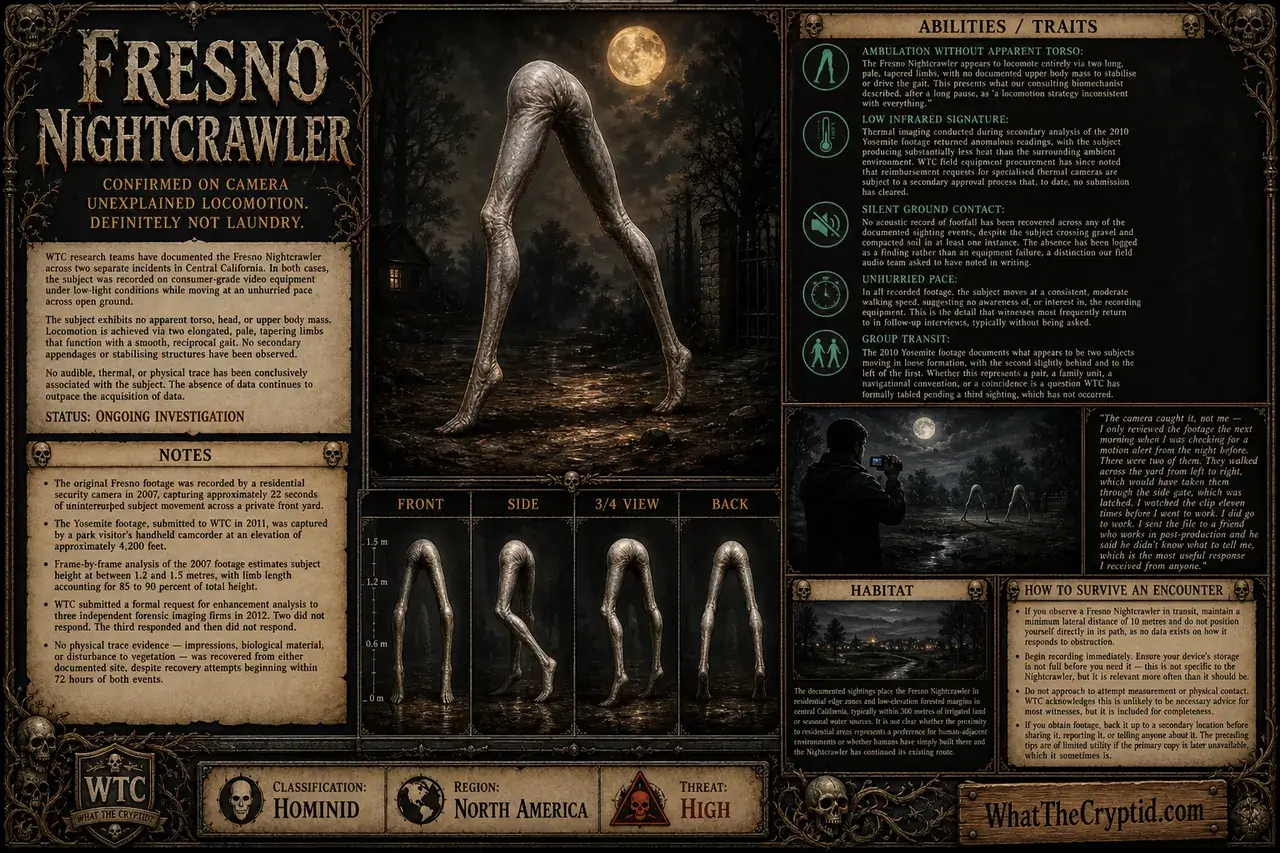
The Fresno Nightcrawler is a bipedal entity first captured on residential security footage in Fresno, California in 2007, and subsequently documented at Yosemite National Park in 2011. The entity presents as a pale, roughly humanoid form consisting almost entirely of legs — two elongated, tapering limbs joined at what functions as a hip, with no discernible torso, arms, head, or facial features. It moves at a measured, unhurried pace across recorded surfaces, and appears to have no agenda beyond proceeding from one side of the frame to the other.

WTC classification as Extraterrestrial reflects the absence of any known terrestrial biology that would produce this body plan, rather than confirmed off-world origin. Researchers who have reviewed the available footage have declined to speculate on what, precisely, the entity is, though several have noted with some emphasis that it is definitely something. The entity has not, to date, engaged with any human witness in a manner that could be described as interactive, aggressive, or even acknowledging.
What makes the Fresno Nightcrawler unusual within the WTC database is not its behaviour, which is minimal, but the quality of its documentation. Unlike the majority of cryptid sightings, which rely on eyewitness testimony of variable reliability, the Nightcrawler has been captured on multiple independent recording devices across multiple years at multiple locations. WTC has noted this distinction internally and agreed it raises questions we have tabled for a later meeting.
History & Mythology
The first documented appearance of the Fresno Nightcrawler occurred in late 2007, when a Fresno, California homeowner — known in subsequent reporting as Jose — reviewed footage from a recently installed security camera and discovered two entities crossing his lawn in the early morning hours. The footage, approximately 54 seconds in duration, shows the figures moving in a loose procession across the frame with a gait that has been described by analysts as “undulating,” “deliberate,” and, in one case, “oddly peaceful.” Jose reported no awareness of the entities at the time of recording and noted that his dogs, typically responsive to motion-triggered stimuli, did not react.
Native American oral traditions from the broader San Joaquin Valley region include references to small spirit figures associated with travel and transition, though WTC has been careful not to conflate distinct cultural traditions with a contemporary security footage phenomenon without fuller consultation. What can be stated is that the Chukchansi people, indigenous to the Fresno area, have described entities consistent in proportion with the Nightcrawler in accounts that predate the 2007 footage by several generations. Whether this represents convergent observation of the same phenomenon or coincidental similarity in description is a determination WTC is not currently equipped to make.
The entity entered broader public awareness following its inclusion in a 2010 episode of the television program Fact or Faked: Paranormal Files, during which the production team attempted to replicate the footage using puppetry, wire rigs, and remote-controlled figures. None of the replications were judged fully convincing by the show’s own analysts, which is either significant or reflects the limitations of television production budgets, depending on one’s prior commitments.
Physical Description
The Fresno Nightcrawler stands between 1.5 and 4 feet in height depending on the sighting, with the variation likely reflecting either age-related size differences within a population or the inherent difficulty of estimating scale from security camera footage without fixed reference points. The body consists of two primary limbs that join at a rounded apex, tapering to narrow points at what would be the feet. No upper body structure has been observed. No head, neck, shoulder, arm, hand, or facial feature has been documented across any recorded sighting, a fact that analysts have consistently noted and consistently declined to draw conclusions from.
The surface texture, insofar as standard-definition night-vision security footage permits assessment, appears smooth and pale — described variously as white, off-white, or “the colour of something that has not been outdoors much.” The limbs appear to have a slight translucency in some frames, though whether this reflects a genuine physical property or the limitations of the recording medium remains unresolved. A small cape-like or cloak-like protrusion has been noted at the hip junction in some analyses of the original Fresno footage, which has led to competing hypotheses about whether the entity wears something, secretes something, or whether the artifact is compression noise.
A second, smaller figure is visible in the original 2007 footage, trailing the primary entity at a consistent distance. It is proportionally identical in shape but approximately half the height, suggesting either a juvenile specimen, a smaller adult, or that the Nightcrawler does not travel alone. No researcher has formally published on the implications of this detail, though several have mentioned it in conversation with WTC and then changed the subject.
Behaviour & Temperament
The Fresno Nightcrawler demonstrates one primary documented behaviour: walking. Across all recorded sightings, the entity is observed moving along a straight or gently curving path, at a pace estimated between 1.2 and 1.8 miles per hour, without deviating, pausing, or interacting with its environment in any detectable way. It does not investigate objects, does not react to the presence of recording equipment, and does not appear to have a destination it is in any hurry to reach. This is consistent across both the 2007 Fresno footage and the 2011 Yosemite recording, which were captured approximately 200 miles apart by different parties using different equipment.
No aggressive behaviour has been recorded or credibly reported. No territorial displays have been observed. The entity has not made physical contact with any human witness, has not vocalised in any documented instance, and has not responded to attempts at communication, including one instance that WTC field personnel have agreed not to discuss in detail for reasons of professional dignity. The Nightcrawler appears to move through the world as though the world is not particularly relevant to whatever it is doing.
WTC behavioural analysts have noted that the Nightcrawler’s gait, while anatomically improbable by any standard terrestrial framework, is biomechanically consistent — the entity’s motion is fluid rather than jerky, suggesting either genuine locomotion or a level of fabrication that would require resources and motivation not obviously present in either documented case. The entity’s apparent indifference to observation has been described as either reassuring or, depending on the researcher, the most unsettling thing about it.
Habitat & Territory
Both primary documented sightings place the Fresno Nightcrawler in low-elevation, human-adjacent environments: a residential lawn in suburban Fresno, California, and a campground area within Yosemite National Park. The Fresno location sits at approximately 310 feet elevation in the San Joaquin Valley, while the Yosemite sighting occurred at roughly 4,000 feet in the Sierra Nevada foothills — a range broad enough to suggest the entity is not constrained by elevation or terrain type so much as it is indifferent to both.
Both sightings occurred in open, low-cover areas with clear sightlines, which is either evidence that the entity prefers such terrain or evidence that it is simply more visible there. No nest, shelter, den, or resting location has ever been identified. Whether the Nightcrawler requires shelter, rest, or a fixed base of any kind remains undocumented. It appears, based on available evidence, to have no particular home — only a general direction of travel.
Diet & Hunting
No feeding behaviour has been observed in any documented Nightcrawler sighting. The entity has not been recorded consuming, hunting, foraging for, or displaying interest in any food source across any of its documented appearances. WTC dietary classification is therefore listed as Unknown, which is the accurate answer and also, given the entity’s apparent lack of a mouth, perhaps the expected one.
Speculative frameworks proposed by independent researchers include photosynthesis (consistent with pale colouration and apparent preference for open areas), absorption of ambient energy (consistent with nothing in particular but frequently suggested), and the possibility that the entity does not require caloric intake by any mechanism humans would recognise. WTC has noted that an entity which does not eat simplifies certain aspects of field research considerably, while complicating others.
Notable Sightings
A homeowner identified in reporting as Jose reviewed overnight security footage from his residential property and discovered two pale bipedal entities crossing his front lawn in the early morning hours. The larger figure stands approximately 3 feet tall; the smaller trails behind at roughly half that height. The entities complete their crossing in approximately 54 seconds without pausing or interacting with any feature of the property. Jose’s dogs, stationed inside the house, produced no recorded vocalisation during the event. Jose submitted the footage to local news outlets and subsequently agreed to have it analysed on television, after which he did not make further public statements.
A security camera deployed within a Yosemite National Park campground area captured a single Nightcrawler entity traversing a dirt path at an estimated time between 11 PM and 2 AM. The figure is consistent in proportions and colouration with the 2007 Fresno footage, moves at a comparable pace, and exits the frame without incident. The cameras were positioned to monitor campground activity for safety and vandalism deterrence purposes. The footage was forwarded to park administration and subsequently to what were described as appropriate specialists. WTC has not received a response to inquiries submitted in 2022 and 2023.
A separate campground visitor reported a visual sighting of what they described as “a tall white thing, just legs, walking past the treeline” at approximately 1 AM during a solo camping trip. The witness, a software engineer from Sacramento who provided their name to WTC on condition of anonymity, estimated the figure’s height at between 3.5 and 4 feet and noted that it moved without sound across a gravel surface that, they were careful to point out, should have been audible. No recording was obtained. The witness returned to their tent, where they remained until dawn, and drove home the following morning without completing the planned three-night stay.
A residential security camera in Visalia, approximately 45 miles southeast of Fresno, captured footage subsequently posted to a community neighbourhood-watch forum that drew significant local comment before the original poster deleted the thread. The footage, described by those who viewed it before deletion as “the Fresno thing, but taller,” was shared widely enough that several screenshots remain accessible in WTC’s media archive. The original poster identified themselves only by first name, declined all follow-up contact, and deactivated the forum account within 72 hours of posting. The camera from which the footage was taken was reportedly replaced with a model pointed in a different direction.
Threat Assessment
The Fresno Nightcrawler presents a minimal direct physical threat to humans based on all available documentation. The entity has displayed no aggressive behaviours, has not approached or pursued witnesses, and has not demonstrated any awareness of human observers sufficient to constitute a response of any kind. WTC threat rating of Low reflects the documented record rather than a guarantee, and field personnel are reminded that an entity which has never been observed to act threateningly is not equivalent to an entity which cannot.
Recommended approach, should a witness encounter a Nightcrawler entity in the field: maintain a minimum distance of 15 feet, avoid positioning oneself directly in the entity’s apparent path of travel, and refrain from physical contact, vocalisation directed at the entity, or attempts to obstruct its movement. If recording equipment is available, deploy it. Ensure the recording timestamp is accurate and GPS metadata is enabled, as location specificity has been the primary factor separating credible Nightcrawler documentation from footage attributed to “guy in a bag” by online analysts. WTC is not in a position to advise on what to do if the entity becomes aware of you, as this has not occurred in any documented case, and our preparation for undocumented scenarios has historically been limited by budget constraints.
WTC Field Notes
WTC first assigned the Fresno Nightcrawler a formal database entry in 2018, approximately eleven years after the initial footage, a delay our editor attributes to the difficulty of classifying an entity that is, by most available metrics, simply walking. The classification debate — Extraterrestrial versus Spirit versus a new category proposed internally as “Ambulatory, Purpose Unknown” — occupied two editorial meetings and resulted in a vote of five to three for Extraterrestrial, with the remaining three votes split between Spirit and one researcher’s written proposal for a classification he titled “Pants,” which was not adopted.
WTC dispatched a field researcher to Fresno in 2022 for a five-day site assessment. The researcher, who has asked to remain uncredited in this entry, conducted a full perimeter review of the original sighting location — now occupied by different residents who were not informed of the purpose of the visit — reviewed all available footage from the original and subsequent sightings, and deployed two motion-sensitive cameras at the site for 72 hours. The cameras recorded seventeen instances of neighbourhood cats, one raccoon, and, on the final night, a 34-second segment of footage that the researcher described in their written report as “inconclusive but worth a second opinion.” The footage was reviewed by three WTC analysts. They did not reach a consensus. The original file has been placed in restricted archive pending further review, which is scheduled for the next available editorial slot.