
Cherub
Historically misrepresented. Documented carrying a flaming sword.
All
Active
CelestialGuardianAncientArmedThreshold
Overview
The Cherub is a winged entity of apparent celestial origin, documented across Mesopotamian, Hebrew, Christian, and Islamic traditions with a consistency of core features that WTC researchers find either compelling or deeply inconvenient, depending on the meeting. It represents one of the oldest continuously reported cryptid classifications in the database, with sighting records predating the Common Era by several thousand years and showing no meaningful decline in frequency since. Unlike the majority of entities in this database, the Cherub operates with apparent institutional backing, which complicates standard field assessment protocols.

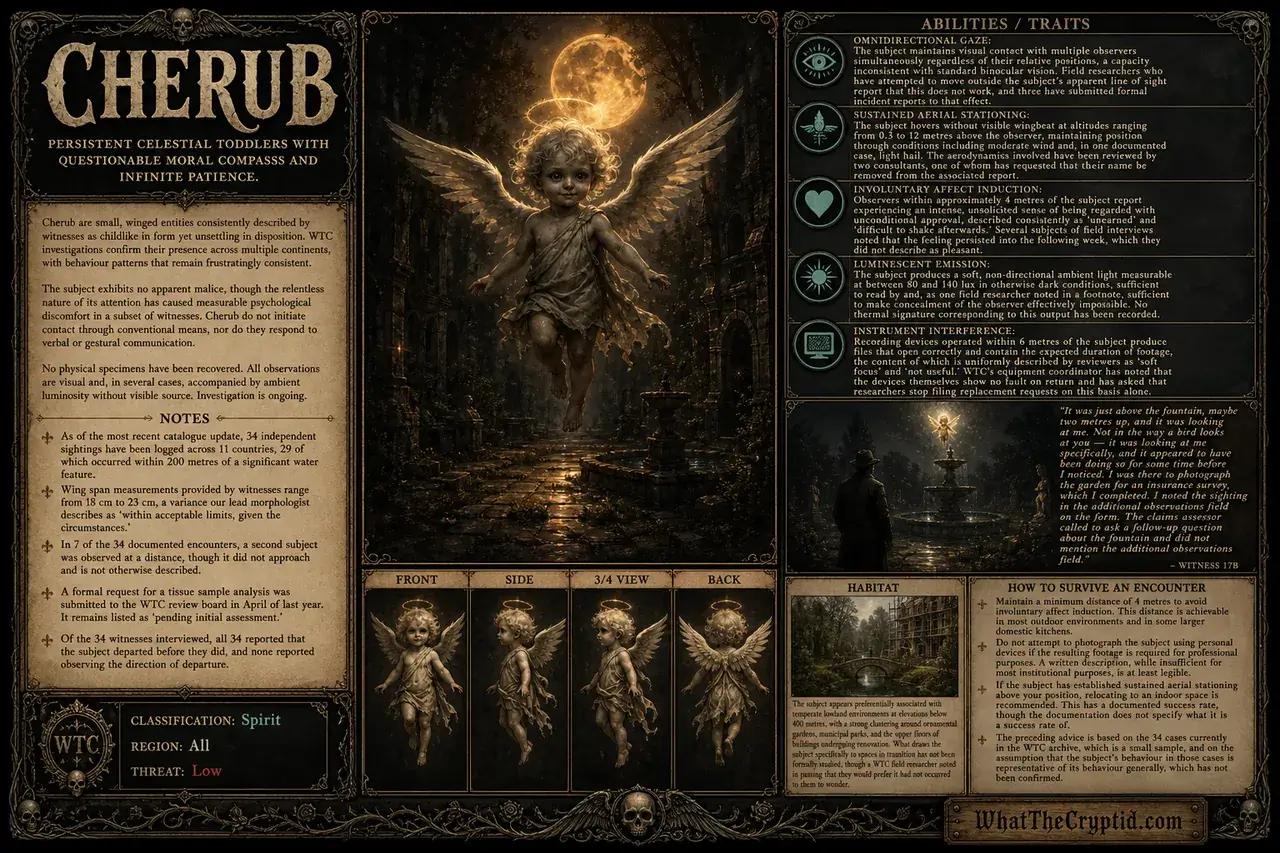
Critically, and this point requires emphasis given widespread contemporary misrepresentation: the Cherub is not a small infant with decorative wings. That entity — the pudgy, airborne toddler familiar from Renaissance ceiling frescoes — is the Putto, a distinct and separately catalogued phenomenon. The Cherub, by primary source documentation, is a large, multi-featured, heavily armed guardian entity associated with divine thresholds and the protection of sacred objects. WTC acknowledges that correcting this distinction at dinner parties has a documented social cost, but accuracy demands it.
The Cherub occupies a unique position in the WTC database as an entity whose existence is affirmed by religious traditions representing approximately 4.2 billion current adherents. WTC takes no position on the theological implications of this. That question has been tabled for a later meeting, where it will almost certainly be tabled again.
History & Mythology
The earliest documented references to Cherub-type entities appear in ancient Mesopotamian records, where winged guardian figures — the Lamassu and Shedu — flanked temple entrances and palace gates in a protective capacity. These figures, dated to approximately 3000 BCE, share the Cherub’s characteristic combination of animal body, human features, and functional wings, and are consistently positioned at thresholds between sacred and profane space. Whether the Mesopotamian figures represent the same entity class or a parallel evolutionary line remains an open question that WTC’s consulting theologian described as “above my pay grade in more than one sense.”
The Hebrew Scriptures provide the most detailed early field documentation. The Book of Ezekiel, composed in the 6th century BCE, contains what remains the most clinically specific description in the ancient record: entities with four faces (human, lion, ox, eagle), four wings, straight legs with hooved feet, and hands beneath their wings. Ezekiel’s account includes details of movement, sound, and luminosity that read, with minimal interpretive charity, as an attempt to accurately document something the author had directly observed. The Book of Genesis records Cherubim deployed at the eastern entrance to Eden following human expulsion, armed with a “flaming sword which turned every way” — a detail that WTC’s threat assessment team notes has not been adequately weighted in popular depictions.
Medieval Christian iconography progressively compressed the Cherub’s documented form, reassigning its attributes piecemeal to various angelic orders and eventually conflating its identity with the Putto through a series of artistic decisions that historians of art consider stylistic evolution and WTC considers a documentation crisis. By the 16th century, the flaming sword had been entirely removed from popular representations. No explanation for this editorial choice was recorded.
Physical Description
Primary source descriptions establish the Cherub as a large entity — estimated standing height between 8 and 15 feet based on contextual scaling in architectural records, with wingspan documentation in the Temple of Solomon specifying 10 cubits per wing, yielding an approximate 15-foot wingspan per entity. Two Cherubim were recorded in the inner sanctum of Solomon’s Temple with wingtips touching wall to wall across a 20-cubit chamber, providing one of the few instances in the ancient record where physical dimensions can be cross-referenced against a known architectural constraint.
The multi-faced configuration described in Ezekiel — human face forward, lion to the right, ox to the left, eagle above — is the most frequently cited feature and the one most resistant to straightforward interpretation. WTC researchers have proposed functional explanations ranging from 360-degree threat detection to symbolic representation of dominion over distinct ecological categories. The entity’s body is described as humanoid in general structure, covered in what several accounts characterise as luminous or fire-adjacent integument. The hands are specifically noted as human in form, emerging from beneath the wing structures at the equivalent of the shoulder joint.
Regional variants show some divergence in facial configuration: later Christian accounts reduce the face count to one, while Islamic traditions describe entities of comparable scale and function under the designation Karubiyyun without specifying facial multiplicity. Whether these represent genuine morphological variants, independent entity classes that have been taxonomically consolidated, or the ordinary drift of oral and written transmission across centuries is a question WTC has formally declined to answer until better physical evidence is obtained.
Behaviour & Temperament
The Cherub’s documented behavioural profile is oriented almost entirely around a single primary function: threshold guardianship. Every major recorded interaction places the entity at or near a boundary — between sacred and profane space, between divine presence and human access, between one category of existence and another. This is either a highly specialised ecological niche or, as one WTC researcher’s marginal note on the original case file suggests, “the most consistent employment record in the database.”
Movement is described in Ezekiel’s account as omnidirectional without turning — the entity moving in any direction while remaining forward-facing, which the text specifically notes as remarkable. Accompanying phenomena include a sound described variously as rushing water, thunder, or the voice of an army, and luminosity consistent with descriptions elsewhere in the record of entities operating at high energetic output. The Cherub does not, in primary documentation, initiate contact with humans. It responds to approach. This distinction is operationally important and is addressed in the threat assessment section with the seriousness it deserves.
Social structure, where documented, appears cooperative and task-oriented. The Temple record specifies paired deployment, and Ezekiel’s vision describes a group of four operating in coordinated formation. There is no record of territorial conflict between Cherubim, no documentation of intraspecies aggression, and no observed deviation from assigned function across thousands of years of reported encounters. WTC’s behavioural analyst noted this represents either extraordinary discipline or a complete absence of individual motivation — and has not yet determined which interpretation is more concerning.
Habitat & Territory
The Cherub demonstrates a consistent preference for high-sanctity environments: temples, sacred thresholds, and locations designated as sites of divine presence across multiple cultural traditions. Garden of Eden placement, Temple deployment, and the specific designation as guardians of the Ark of the Covenant suggest a habitat selection pattern keyed not to geography or climate but to ritual and theological designation — an environmental preference that creates obvious difficulties for standard range-mapping.
Altitude data is limited but suggestive. Several visionary accounts place Cherubim above cloud level, and the consistent association with throne imagery implies a vertical range extending well beyond documented terrestrial habitats. WTC’s GIS mapping team has noted, professionally and without elaboration, that their standard habitat modelling software does not include a field for “altitude: transcendent.”
Diet & Hunting
No primary source documentation addresses Cherub dietary requirements, which is either a significant gap in the record or an indication that the entity operates outside the standard metabolic framework that governs most catalogued species. WTC has not ruled out either interpretation. The absence of feeding behaviour across thousands of years of reported sightings is, at minimum, a data point worth noting.
Some researchers have proposed an energy model in which the Cherub’s documented luminosity and heat signature represent both the intake and output of a non-organic fuel source, possibly derived from proximity to the divine presence the entity is consistently recorded as inhabiting. WTC’s consulting biologist reviewed this hypothesis, confirmed it was untestable with current methodology, and requested that her name not be attached to the section.
Notable Sightings
Cuneiform temple administrative records from the Ekur complex at Nippur reference the placement of two Lamassu figures at the main processional gate, described in terms consistent with the Cherub classification: winged, multi-featured, positioned specifically to prevent unauthorised entry to the inner sanctum. A separate administrative note records that a temple worker who attempted to pass the threshold without proper ritual preparation was found outside the gate with no memory of how he had returned there. The temple overseer’s subsequent record-keeping shows a marked improvement in compliance with entry protocols across all staff grades, achieved without further incident.
The prophet Ezekiel documented a sustained encounter with four Cherub-class entities near the Chebar canal, describing in the account that became the first chapter of the Book of Ezekiel a sighting of approximately 45 minutes duration at close range, including detailed observation of physical structure, movement mechanics, and accompanying atmospheric phenomena. The account specifies that the entities moved toward him before the encounter concluded and he fell to his face. Ezekiel subsequently produced the most technically detailed entity description in the ancient record and continued to report additional encounters over the following two decades, none of which appear to have been discouraged by his religious community.
Church records from the Cathedral of Sainte-Anne at Apt include a deposition from stonemason Guillaume Martel describing an encounter during night work on the cathedral’s north transept in which he observed an entity of approximately twice human height with visible wings in a folded position, positioned near the altar and unresponsive to verbal address. Martel’s account specifies the entity was luminous, faced away from him throughout the encounter, and was no longer present when he returned with the night watchman. The cathedral’s bishop reviewed the deposition, confirmed it was consistent with three prior accounts from the same building spanning forty years, and filed it under a category WTC’s archive researchers translated as “usual matters.”
A security guard at the Museu de Arte Sacra de São Paulo submitted a written incident report describing a figure observed on internal CCTV between 2:14 and 2:31 AM in the gallery housing a 17th-century carved wooden Ark reproduction — described in the report as large, pale, and positioned directly over the exhibit without triggering the pressure sensors in the surrounding floor area. The footage was reviewed by the museum’s technical team, who confirmed the camera had been functioning normally for the duration of the recording. The security guard completed his shift, submitted the report to his supervisor the following morning, and tendered his resignation the same afternoon, citing a previously arranged career opportunity he declined to specify.
Threat Assessment
The Cherub represents one of the more genuinely complex threat assessment cases in the WTC database, for the specific reason that every documented incident in which a human being has been harmed, displaced, or permanently incapacitated in proximity to a Cherub-class entity has occurred as a direct result of the human attempting to access something the entity was explicitly stationed to prevent access to. The threat profile is, in this respect, entirely consistent and entirely avoidable — a fact that does not make it less serious but does provide actionable guidance that most cryptid assessments cannot.
WTC recommends a minimum approach distance of 50 yards from any threshold or enclosure known or suspected to be under Cherub guardianship, with no approach under any circumstances without first establishing what the threshold protects and whether you have legitimate standing to cross it — acknowledging that the second point is difficult to assess in the field and that WTC’s legal team has advised us not to provide guidance on theological eligibility. If luminosity, sound consistent with rushing water or thunder, or sudden temperature change is observed, withdraw to a distance of at least 200 yards immediately and do not look back. This last recommendation is drawn from multiple accounts and is offered without editorial comment. WTC rates the Cherub Unknown on the standard threat scale, not because the entity is believed to be harmless, but because its threat level appears to be entirely contingent on the behaviour of the person encountering it, and we have found that this variable is the one we can least reliably predict.
WTC Field Notes
WTC has been attempting to produce a definitive Cherub field assessment for eleven years. The project has been complicated by a research question that our founding editor described, in the original project brief, as “the one where we have to be careful” — specifically, whether producing a clinical cryptozoological assessment of an entity venerated by the majority of the world’s religious population constitutes journalism, theology, or something requiring a different category of liability insurance than we currently carry. Legal has not resolved this question. The entry has proceeded anyway, on the grounds that the documentation is too extensive to leave out of the database and that eleven years is long enough to wait for a definitive answer from Legal.
Field research has been limited by access constraints at every primary site of historical Cherub activity, all of which are either active religious sites, restricted archaeological zones, or, in the case of the Garden of Eden, a location whose coordinates remain unestablished. WTC researcher Dominique Osei spent three weeks in 2021 attempting to obtain access to the Vatican’s restricted archive section covering angelic encounter records and was denied on grounds she described in her expense report as “politely but very specifically theological.” Equipment budgets for this entry were reallocated twice to other projects during the research period. WTC notes, for the record, that this pattern of resource difficulty does not appear unique to this entry but does seem to recur with statistically notable frequency on entries involving entities with institutional affiliations.