
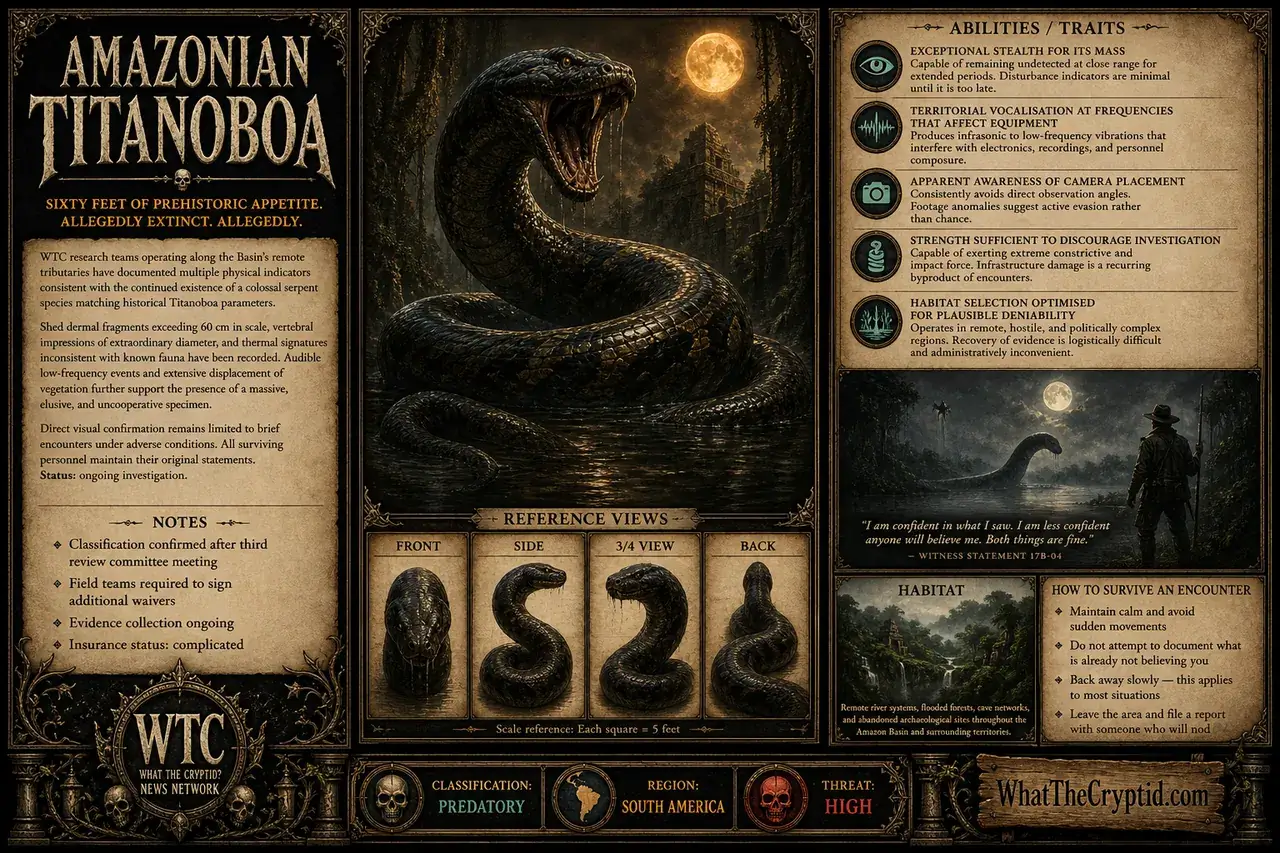
Amazonian Titanoboa
Forty metres of river. Something else is using it.
South America
Unverified

Overview
The Amazonian Titanoboa is a large constrictor-class entity reported throughout the Amazon river basin and its tributary systems, with sighting clusters concentrated in the Peruvian and Brazilian interior. Witness accounts describe an ophidian specimen of dimensions that would place it well outside the known size parameters of any living snake species, with length estimates ranging from 12 to 40 metres and girth measurements, where recorded, suggesting a cross-sectional diameter comparable to a standard 55-gallon drum. WTC classifies the entity as Predatory, a designation arrived at with some efficiency given the circumstances.
The Titanoboa genus is not, for the record, an invention. Titanoboa cerrejonensis was a genuine Palaeocene-era snake, recovered from the Cerrejón coal formation in Colombia, and estimated at approximately 13 metres in length with a body mass of around 1,135 kilograms. It has been extinct for roughly 58 million years. The Amazonian Titanoboa is either a relict population of something in that lineage, a convergent evolutionary development, or a persistent and geographically widespread misidentification. WTC has assigned these possibilities equal weight pending further data, which has not been forthcoming.
Reports of the entity predate European contact and continue at a rate that WTC’s South America desk describes as ‘stable, which is its own kind of concerning.’ Indigenous oral traditions, colonial expedition logs, twentieth-century aerial survey anomalies, and contemporary riverboat operator accounts form a continuous documentary record spanning at least four centuries, constituting one of the more robust evidence bases in the WTC cryptid archive, a fact our editorial board has asked us not to dwell on.
History & Mythology
The earliest structured accounts of a giant water serpent in the Amazon basin originate with the Shuar, Achuar, and various Quechua-speaking peoples of the upper Amazon, who document two related but functionally distinct entities: the Yacumama, or ‘Mother of the Water,’ associated with rivers, floods, and the deep channel, and the Sachamama, or ‘Mother of the Forest,’ described as a terrestrial variant of similar scale whose body, when at rest, is reportedly indistinguishable from a fallen tree. Both figures appear in origin narratives as primordial entities rather than ordinary fauna, a classification framework WTC finds simultaneously reasonable and unhelpful.
European documentation begins in earnest with the Jesuit mission records of the seventeenth century. Father Cristóbal de Acuña’s 1641 account of the Amazon describes serpents of ‘monstrous length,’ though with the vagueness characteristic of the period. More specific is a 1907 account from Colonel Percy Fawcett — later to disappear entirely in the Mato Grosso — who reported shooting a large anaconda near the Rio Abuna measuring, by his own survey, 62 feet from snout to tail. The Royal Geographical Society received this report with what the historical record suggests was measured scepticism. Fawcett maintained the account for the remainder of his documented life, which ended under separate and unrelated mysterious circumstances.
The twentieth century added aerial survey data to the record. A 1948 Brazilian Air Force mapping flight over the Mato Grosso reportedly photographed a large serpentine form in a river clearing, estimated at 35 metres from the contact print. The photograph entered bureaucratic circulation and has not been publicly released. WTC submitted a freedom of information request to the relevant Brazilian ministry in 2019 and received a response in 2022 confirming the request had been received.
Physical Description
Documented body length estimates cluster in two ranges: a ‘moderate’ bracket of 12–18 metres, plausible within the extreme upper bound of known anaconda morphology and therefore the subject of ongoing scientific debate, and a ‘primary’ bracket of 25–40 metres, which is not. WTC field researchers working from aerial photographs, riverbank impressions, and direct witness accounts have produced a working estimate of 18–25 metres for the most frequently reported specimens, with the understanding that any of these numbers would represent a biological anomaly of considerable significance.
Colouration is consistently described as dark olive to near-black along the dorsal surface, transitioning to a pale yellow or cream ventral, with faint irregular banding that becomes more pronounced toward the tail. This patterning is consistent with large anaconda morphology and provides negligible camouflage in open water, which witnesses uniformly describe as unnecessary. The head is reported as broad and triangular, with documented eye estimates ranging from ‘large’ to ‘the size of a dinner plate,’ a measurement WTC has been unable to standardise across accounts. Several witnesses have independently noted a pronounced temporal ridge and a jawline that one researcher’s field notes describe, without further elaboration, as ‘architectural.’
A small subset of sightings, predominantly from the Sachamama tradition and a handful of modern jungle interior accounts, describe dorsal surface overgrowth — moss, small ferns, and in one account a juvenile bromeliad — consistent with an entity that spends extended periods motionless in forest environments. WTC notes this detail without endorsing it, while also noting that it has come up four times independently across three countries.
Behaviour & Temperament
The Amazonian Titanoboa demonstrates a behavioural profile consistent with a large ambush predator operating at the apex of its food web, which is to say it appears unhurried. Witness accounts describe extended periods of surface stillness in slow-moving river channels, with movement initiated either by the approach of large prey or, in several documented cases, by the proximity of motorised watercraft. The entity’s response to boats is not uniformly aggressive — the majority of encounter accounts describe the entity submerging without incident — but the minority that do describe active engagement describe it with a consistency that WTC finds instructive.
Nocturnal activity appears predominant, based on the preponderance of night-time sighting reports and the notable absence of confirmed daylight encounters in open water. Riverboat operators in the Loreto region of Peru report that certain river sections are considered impassable after dark not due to navigational hazard but by informal professional consensus that has apparently existed for at least three generations and has not required formal documentation to persist. Social structure appears solitary; no credible account describes more than one adult specimen simultaneously, though the Sachamama tradition references territorial marking behaviour involving deep channel depressions that local fishermen treat as navigational features rather than evidence of anything in particular.
Vocalisation has been reported on eleven occasions in the WTC archive, described consistently as a subsonic rumble perceived as much through the chest as through the ears, and on two occasions as an exhalation audible at distances the witnesses estimated at 200 metres or more. Whether this constitutes communication or simply respiration at scale is a question WTC has tabled for a later meeting.
Habitat & Territory
The entity demonstrates strong preference for slow-moving or still water systems — oxbow lakes, deep river bends, flooded forest zones during the wet season — at elevations below 400 metres. The Peruvian Amazon, specifically the drainage systems of the Ucayali, Marañón, and their tributaries, represents the highest density of reported sightings. Secondary concentrations appear in the Brazilian state of Amazonas, particularly around the confluence of blackwater and whitewater river systems, a habitat feature that local ecological knowledge associates with unusual concentrations of large fauna generally.
Terrestrial habitat use is documented in the Sachamama account tradition and corroborated by a small number of jungle interior sightings describing the entity in dense várzea forest, apparently stationary. Estimated resting site dimensions, derived from cleared vegetation patterns observed in two aerial survey accounts, suggest a preferred resting area of approximately 30 by 4 metres. Ground-level access to these sites has not been systematically attempted. Nesting behaviour has not been documented, a gap in the record that WTC attributes partly to the practical difficulties of the fieldwork involved.
Diet & Hunting
The Amazonian Titanoboa is assessed as a generalist mega-predator consuming large aquatic and semi-aquatic prey, with river dolphins, tapir, caiman, and large fish species appearing most frequently in account-based dietary reconstructions. Several accounts from indigenous communities describe the entity taking livestock that approached river margins, including cattle and, in one 1987 account from a farm near Iquitos, a full-grown zebu bull whose disappearance was accompanied by ground disturbance consistent with constriction rather than drowning. The farm’s owner filed a report with local authorities. The report was categorised under livestock loss and closed.
Conservative metabolic modelling, applied to the lower end of body mass estimates, suggests a feeding interval of several weeks between substantial meals, consistent with large constrictor biology and potentially explanatory of the entity’s apparent tolerance for lengthy stillness. A single detail that recurs across otherwise unrelated accounts — the observation that fish populations in affected river sections increase noticeably in the weeks following a reported sighting — has not been formally explained, though the implication, if one follows the food chain upward, is that the entity’s presence suppresses the caiman and dolphin populations that would otherwise compete for the same fish. This is either evidence of a functioning apex predator ecology or a coincidence that has now occurred seven times.
Notable Sightings
Cargo riverboat operator Segundo Huamán reported an encounter at approximately 02:30 local time while navigating a deep bend of the Ucayali north of Contamana. Huamán brought the vessel to a stop after his spotlight illuminated what he initially interpreted as a sandbar — a pale, smooth surface occupying approximately half the river channel width — that subsequently moved. The object submerged over a period he estimated at 40–50 seconds. Huamán documented the channel width at the sighting location as approximately 60 metres. He reported the incident to the riverboat operators’ association in Iquitos, where it was logged as encounter report number 14 in a file that, when WTC requested access in 2021, was found to contain 31 entries dating to 1983.
A four-person biological survey team from a European university, conducting freshwater dolphin population research, recorded an unidentified large submerged object on their boat-mounted sonar equipment on the morning of September 4th. The sonar return indicated a stationary object approximately 14 metres in length at a depth of 6 metres, which moved off the survey grid over a period of several minutes before the signal was lost. Team leader Dr. Annika Vesterinen noted the reading in the expedition log and included it in the raw data appendix of the subsequent research paper, where it appears without discussion in a table of ‘anomalous sonar contacts.’ Dr. Vesterinen has not responded to WTC correspondence regarding this entry, though the university confirmed she remains in her position.
Subsistence fisherman Arnaldo Brito and his adult son reported sighting a large serpentine animal surfacing briefly in the main channel of the Solimões River at dawn, estimating the visible body length at ‘no less than twenty metres’ and describing the dorsal colouration as dark green-black with faint pale banding. The sighting lasted approximately 90 seconds before the animal submerged. Brito subsequently relocated his primary fishing operation to a different river section, a change requiring an additional 40-minute transit each way, which he has maintained without alteration for nine years.
A WTC field team deployed to the Madre de Dios basin following a cluster of three independent reports within six weeks recorded unusual ground disturbance in flooded várzea forest consistent with the passage of a very large animal — specifically, a cleared path approximately 3.5 metres wide through dense undergrowth, with lateral vegetation compression suggesting displacement rather than cutting. Track impressions in soft ground were photographed and submitted to a consulting herpetologist, who provided a written assessment stating the impressions were ‘not inconsistent with’ a very large constrictor and requested that WTC not publish her name in connection with this finding, a request we are honouring here.
Threat Assessment
The Amazonian Titanoboa carries a WTC threat rating of Extreme, a designation applied to fewer than six entities in the current database and one that our editorial board does not assign without documented cause. Recommended minimum safe distance from any large unidentified aquatic form in affected river systems is 80 metres on open water; this distance should be considered a working estimate given that confirmed body length may exceed it. Motorised craft operating after dark in the Ucayali, Marañón, and Solimões systems are advised to maintain mid-channel positioning and to avoid idling in deep bends or oxbow lake entrances, which represent primary reported encounter zones.
Persons on foot near river margins in affected regions are advised to avoid approach within 50 metres of slow or still water after dusk, to treat any large stationary object near a waterway with the same caution they would apply to a confirmed large predator, and to move away from the water rather than toward it if ground vibration or subsonic rumbling is detected. WTC acknowledges that this advice does not materially address an encounter with an entity of the reported scale and offers it in the spirit of providing something rather than nothing.
WTC Field Notes
WTC’s South America desk has been formally active in Amazonian Titanoboa research since 2009, when our then-regional correspondent filed an expenses claim that included, under ‘field equipment,’ a line item for ’emergency river crossing, unplanned’ that accounting queried for three months before approving without further comment. Since then, the desk has coordinated four field deployments, of which two produced physical evidence now held in the WTC archive, one produced no findings for reasons the team lead attributed to ‘scheduling difficulties with the entity,’ and one was curtailed when our insurance provider clarified that the policy exclusion for ‘large reptile contact’ applied to entities of undetermined species as well as confirmed ones.
WTC’s consulting herpetologist reviewed our complete Titanoboa file in 2022 and submitted a written assessment that ran to eleven pages, the final paragraph of which read: ‘I am not in a position to confirm or deny the existence of the described entity. I will note that the Amazon basin contains approximately 10% of all species on Earth, that new species are identified there at a rate of roughly one per day, and that the deep channel of the Ucayali has not been comprehensively surveyed below 40 metres. I would appreciate it if you did not call me about this again.’ We have respected this request. We have also retained the report.