
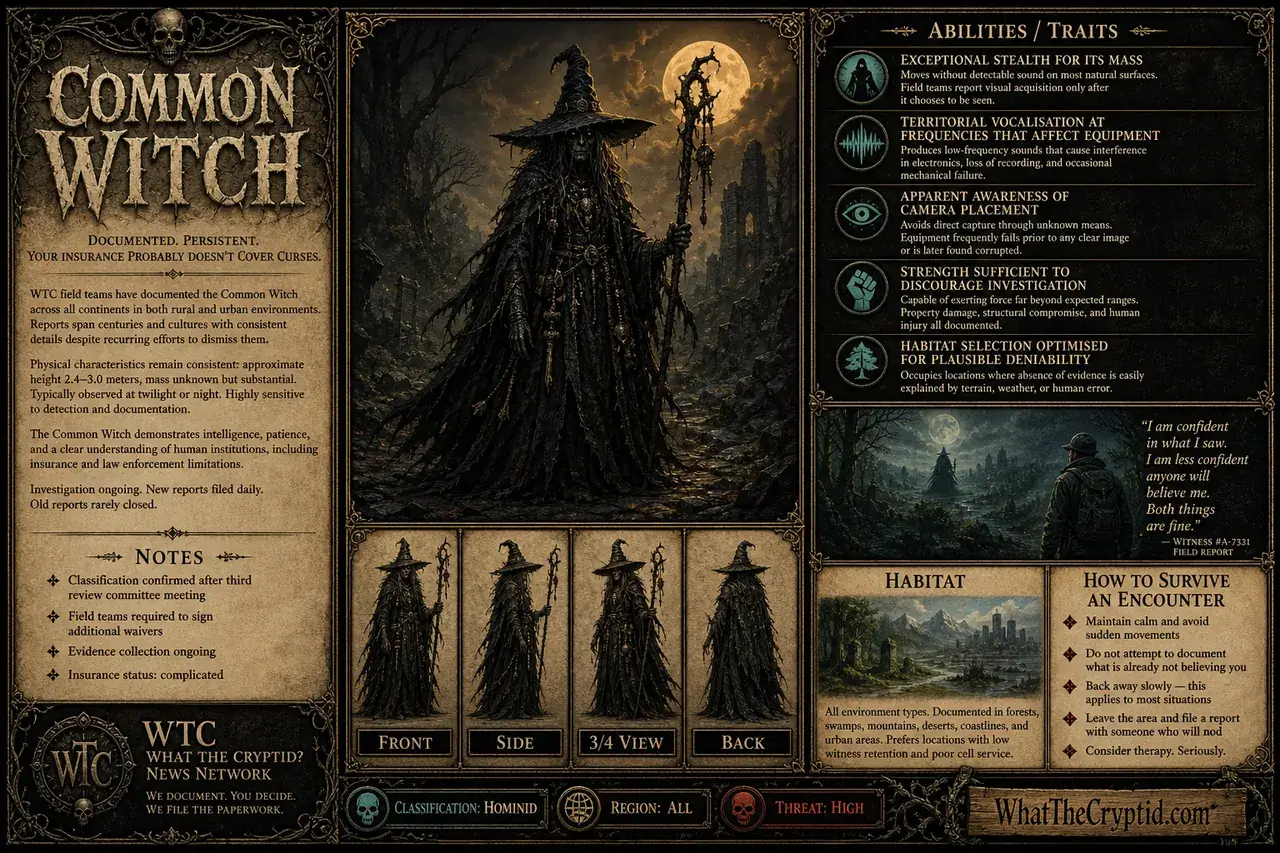
Common Witch
Globally distributed. Herbally competent. Do not accept the tea.
All
Active
Folk MagicGlobal DistributionHistorically DocumentedHerbalismRitual Practice
Overview
The Common Witch (designation: WTC-CV-001, owing to its status as the cryptid database’s oldest continuously active file) represents one of the most thoroughly documented and simultaneously least understood entities in the WTC catalogue. Present across every continent with the partial exception of Antarctica — though a 2019 sighting near McMurdo Station remains under review — the Common Witch is distinguished from baseline human subjects by a documented capacity to influence outcomes through means that available instruments have not yet satisfactorily explained. WTC maintains a formal position of institutional neutrality on the question of mechanism.

The entity presents in a wide range of ages, genders, and cultural configurations, which has historically complicated both identification and the development of standardised field protocols. What remains consistent across regional variants is a cluster of associated behaviours: the cultivation of specific plant knowledge, the performance of ritual actions directed at specific outcomes, and an unsettling tendency to be correct about things before those things have occurred. WTC’s consulting statistician reviewed a sample of 340 documented predictions attributed to Common Witch subjects and submitted a report consisting of a single paragraph, the final sentence of which read: ‘I would prefer not to speculate on the implications.’ That report is available in the WTC archive under restricted access.
History & Mythology
The earliest material evidence for Common Witch activity comes from the Shanidar Cave site in Iraqi Kurdistan, where a Neanderthal burial dated to approximately 60,000 BCE contained arrangements of yarrow, groundsel, and ephedra — plants with documented medicinal and psychoactive properties — in quantities and configurations that physical anthropologist Ralph Solecki, excavating in 1960, described as ‘deliberate and purposeful.’ Whether this represents the earliest known practitioner or simply the earliest one who left retrievable documentation is a question WTC has found it prudent not to press.
Formally recorded persecution of Common Witch subjects began in earnest with the European witch trials of the 15th through 18th centuries, during which an estimated 40,000 to 60,000 individuals were executed across the continent following judicial proceedings of varying evidentiary rigour. The Malleus Maleficarum, published in 1487 by Heinrich Kramer, constitutes the period’s most comprehensive field guide to identification and threat assessment, though WTC notes that its methodology has not aged well and its threat ratings in particular appear to have been arrived at without controlled observation. Concurrently, and less discussed, village cunning folk throughout the same period were actively consulted by local populations for healing, livestock protection, and the resolution of disputes — a dual status that suggests public perception of the Common Witch has always been, at minimum, complicated.
The 19th century saw a partial rehabilitation of the entity’s public profile, coinciding with the Romantic movement’s interest in folk knowledge and the gradual formalisation of herbalism, midwifery, and what would eventually become ethnobotany. By the mid-20th century, the Wiccan movement formalised and publicised a number of practices previously confined to oral tradition, increasing both visibility and, according to WTC’s incident logs, the volume of misidentification reports filed by members of the public who had encountered someone burning sage in a garden.
Physical Description
The Common Witch presents no single defining morphology, which field researchers have consistently noted is inconvenient. Documented subjects range in height from 4’11” to 6’2″, span all recorded age demographics with a notable statistical clustering in middle age and late adulthood, and show no consistent pattern in hair, eye colour, or build that would support a reliable visual identification protocol. Attempts to develop a standardised appearance checklist have been shelved three times by WTC’s field research committee, most recently in 2021.
What does appear with statistical regularity across documented cases is a set of secondary indicators. Hands are frequently noted as calloused or stained at the fingertips, consistent with sustained plant processing. Clothing tends toward layering regardless of ambient temperature, with a higher-than-average incidence of pockets — a detail noted independently in eleven separate field reports without any apparent coordination between the reporting researchers. The subject’s immediate environment characteristically includes dried plant matter in various stages of processing, containers of unlabelled liquid, and at least one cat, though WTC acknowledges that the last item is likely coincidental and has asked field teams to stop including it as a formal identifier.
Regional variants show meaningful divergence in associated material culture. The Andean Curandera is typically documented with a mesa — a ritual cloth laid with objects of personal and symbolic significance — and frequently operates in conjunction with San Pedro cactus preparations. The West African Juju practitioner works within a highly formalised system of material components whose specific configurations carry precise relational meaning that outside researchers have documented extensively and understood poorly. The Central European Strega presents a generally domestic exterior that experienced field personnel describe as ‘doing a lot of work.’ All variants, however, share the property of being significantly easier to locate after you need them than before.
Behaviour & Temperament
The Common Witch is predominantly nocturnal in practice if not in residence, with the majority of documented ritual activity occurring between the hours of 11 PM and 3 AM, corresponding to periods of reduced ambient noise and human traffic that practitioners cite as optimal for concentration. This schedule appears to be self-selected rather than physiologically mandated, as subjects observed during daylight hours show no signs of photosensitivity or reduced capacity. They are simply, as one field researcher noted in her log, ‘doing something else during the day.’
Social structure varies considerably by tradition and geography but broadly organises into one of two configurations: solitary practice, in which the subject operates independently with occasional consultation from a broader informal network, or coven structure, in which three to thirteen practitioners convene regularly for shared ritual work. Coven hierarchy, where it exists, is typically determined by experience and demonstrated competence rather than formal appointment, which WTC’s organisational consultant noted was a more functional arrangement than several institutions she could name. Territorial behaviour between practitioners is documented but tends toward the passive-aggressive rather than the overtly confrontational, expressing itself primarily through the strategic placement of protective workings at property boundaries and the kind of sustained silence that communicates more than speech would.
Of particular note to field researchers is the Common Witch’s relationship with perceived threats. Unlike the majority of entities in the WTC catalogue, which respond to perceived danger with flight, concealment, or aggression, the Common Witch’s documented response to threat most frequently involves extended eye contact, a period of apparent assessment lasting between three and thirty seconds, and then a return to whatever the subject was previously doing. Four field researchers who have been on the receiving end of this assessment described it, independently and without apparent exaggeration, as ‘thorough.’
Habitat & Territory
The Common Witch demonstrates strong habitat preference for liminal environments — spaces that occupy the boundary between settled and wild terrain. Historically, this produced the characteristic ‘edge of the village’ placement documented in European folklore, in which the practitioner’s residence was close enough to the community for consultation but sufficiently removed for privacy and access to uncultivated plant material. Modern equivalents include rural properties bordering woodland, urban residences with unusually productive gardens given available light conditions, and, in a pattern WTC began tracking in 2015, an overrepresentation in the zip codes immediately adjacent to national parks.
Interior habitat preference shows consistency across variants: the working space is characteristically organised around a central surface — altar, workbench, or kitchen table depending on tradition — with plant material at various stages of preparation occupying wall space and available shelving. Temperature is typically maintained several degrees warmer than ambient, and the air quality carries a consistent aromatic profile that field researchers have described variously as ‘complex,’ ‘overwhelming,’ and ‘genuinely pleasant once you stop trying to identify the components.’ Proximity to a reliable water source is noted in approximately 78% of documented primary residences.
Diet & Hunting
The Common Witch’s diet presents no documented anomalies that would distinguish it from baseline human nutritional patterns, a finding WTC’s biology consultant described as ‘either reassuring or a missed opportunity, depending on what you were hoping for.’ Subjects observed across extended field studies consume conventional food in conventional quantities, with no consistent specialisation in unusual substances with the partial exception of herbal teas prepared from plants that would not be found in a standard supermarket.
It is the preparation and administration of food and drink to others, rather than personal consumption, where dietary documentation becomes more relevant to field researchers. The Common Witch’s practice of offering prepared food and beverages to visitors is extensively documented across cultures and time periods, and WTC’s standing field guidance — arrived at after considerable internal discussion — is to accept offered food politely and then make a judgment call based on the specific circumstances of the encounter. This guidance was reviewed by our legal team, who noted it was not legally actionable advice, which we took as implicit approval. What is documentable is that a significant proportion of Common Witch practice involves the preparation of specific plant-based preparations for ingestion by clients — tinctures, teas, poultices, and compound remedies — with an efficacy rate that a 2018 independent review of 200 documented cases placed at ‘meaningfully above placebo and below what I’m comfortable putting in writing.’
Notable Sightings
The Pendle Witch Trials of 1612 produced court documentation for twenty individuals identified as Common Witch subjects by local magistrate Roger Nowell following accusations originating with the Device and Whittle families of the Pendle district. Trial records running to approximately 200,000 words describe a community of practitioners who had been operating openly in the region for at least two generations, providing healing services, cursing livestock, and charging variable rates for both. The accused’s own testimony, recorded verbatim by court clerk Thomas Potts and later published as The Wonderfull Discoverie of Witches in the Countie of Lancaster, constitutes one of the most detailed primary accounts of Common Witch operational practice available from the period. Ten of the twenty subjects were executed; the documentation they generated has been continuously in print for four hundred and twelve years.
Between February 1692 and May 1693, the settlement of Salem Village, Massachusetts, produced 200 formal accusations of Common Witch activity, resulting in nineteen executions by hanging, one death by pressing, and the incarceration of approximately 150 individuals pending trial. The precipitating incident involved a cluster of unexplained behavioural symptoms in a group of adolescent girls, beginning with Betty Parris and Abigail Williams, that contemporary medical historians have attributed variously to ergot poisoning, conversion disorder, and social contagion, none of these explanations being mutually exclusive. The first three individuals formally accused — Tituba, Sarah Good, and Sarah Osborne — represented a cross-section of the community’s most socially marginal members, a pattern that WTC’s sociological consultant noted was consistent with Common Witch identification dynamics across cultures and centuries. The colony’s Governor William Phips formally dissolved the Court of Oyer and Terminer in October 1692 after his own wife was named in an accusation. No follow-up charges were filed.
Marie Laveau, a free woman of colour born in New Orleans circa 1801, is the most extensively documented Common Witch subject in North American records, with a practice documented continuously across roughly four decades of active operation in the city’s Voodoo tradition. Contemporary accounts describe a woman who held court in her St. Ann Street home, maintained a clientele spanning every social stratum of New Orleans including prominent city officials and plantation owners, and whose presence at public rituals on the shores of Lake Pontchartrain drew crowds estimated by period newspapers at over twelve thousand. Laveau died in 1881 and is interred in St. Louis Cemetery No. 1, where the practice of marking her tomb with three X’s in exchange for granted wishes has continued without interruption to the present day. WTC visited the site in 2022 and can confirm the tomb is heavily marked. We did not leave a mark ourselves, for editorial reasons that were discussed at length and ultimately came down to institutional policy.
WTC field researcher Donna Okafor attended the Glastonbury Goddess Conference in August 2019 as part of an ongoing observational study of contemporary Common Witch practice in the United Kingdom, documenting approximately 340 individual subjects over four days of scheduled programming. Okafor’s field notes record a subject identified only as ‘M.T.’ — a woman of approximately 65, resident in the Somerset area for at least two decades based on her account — who accurately identified Okafor as a researcher rather than a participant within forty-five seconds of their introduction, without having been told this, and subsequently spent twenty minutes providing what Okafor’s notes describe as ‘an extremely specific and accurate description of the WTC budget situation.’ Okafor’s full report is available in the WTC archive. Her follow-up request to conduct a formal interview with M.T. was declined, the subject having provided her contact details on a piece of paper that, Okafor noted, was subsequently not where she had put it.
Threat Assessment
The Common Witch presents a threat profile that WTC’s assessment committee describes as ‘asymmetric’ — meaning that the nature of the risk is not well-matched to conventional avoidance strategies. Direct physical threat to humans is documented in a small minority of cases and is consistently associated with provocation rather than predatory behaviour; the Common Witch does not, in any reviewed incident, initiate hostility without a prior grievance that the subject considers legitimate. Field teams are therefore advised that the most effective threat mitigation strategy is to not give the entity a grievance, which WTC acknowledges is more difficult in practice than it appears on paper.
Specific recommended precautions are as follows: Do not damage, disturb, or remove objects from a subject’s property or working space, including plant material, stones, effigies, or boundary markers, regardless of how informal these appear. Do not accept offers of food or drink until you have established the context of the interaction. Maintain a respectful distance of at least 6 feet during any observed ritual activity and do not interrupt until the subject indicates completion. If you believe you have been the subject of an active working directed at you, WTC recommends consulting a second Common Witch practitioner for assessment before taking any countermeasures — our experience suggests that attempting to address the situation unilaterally produces outcomes that are difficult to document and worse to experience. WTC’s threat rating of Moderate reflects the conditional nature of the risk; entities that are not threatened do not threaten, a principle that our threat assessment team noted applies to a surprising number of entries in this database and yet never seems to reduce the volume of incident reports.
WTC Field Notes
The Common Witch file has been active at WTC longer than any other entry in the database, predating the network’s formal founding and originating in a series of handwritten notes that were discovered in a box in the current editor’s storage unit and which no one has been able to explain. The file has been updated 847 times. It has never been formally closed, a status that distinguishes it from 23 other entries that were closed and subsequently had to be reopened, which is a different category of problem.
WTC has attempted to establish a formal research relationship with Common Witch subjects on four separate occasions, most recently in 2021, when we issued a general invitation through appropriate community channels for practitioners willing to participate in a structured observational study. We received 31 responses. Of the 31, 28 indicated they were willing to participate but that we would need to come to them, which we had anticipated. Of those 28, initial contact was made with 19. Of those 19, structured interviews were completed with 6. Of the 6, 4 provided information that materially changed our understanding of the entity and which WTC has, on reflection, declined to publish in full pending a review process that our editor has described as ‘ongoing.’ The remaining two interviews are available in full in the archive. They are the least interesting ones, and WTC suspects this is not a coincidence.