
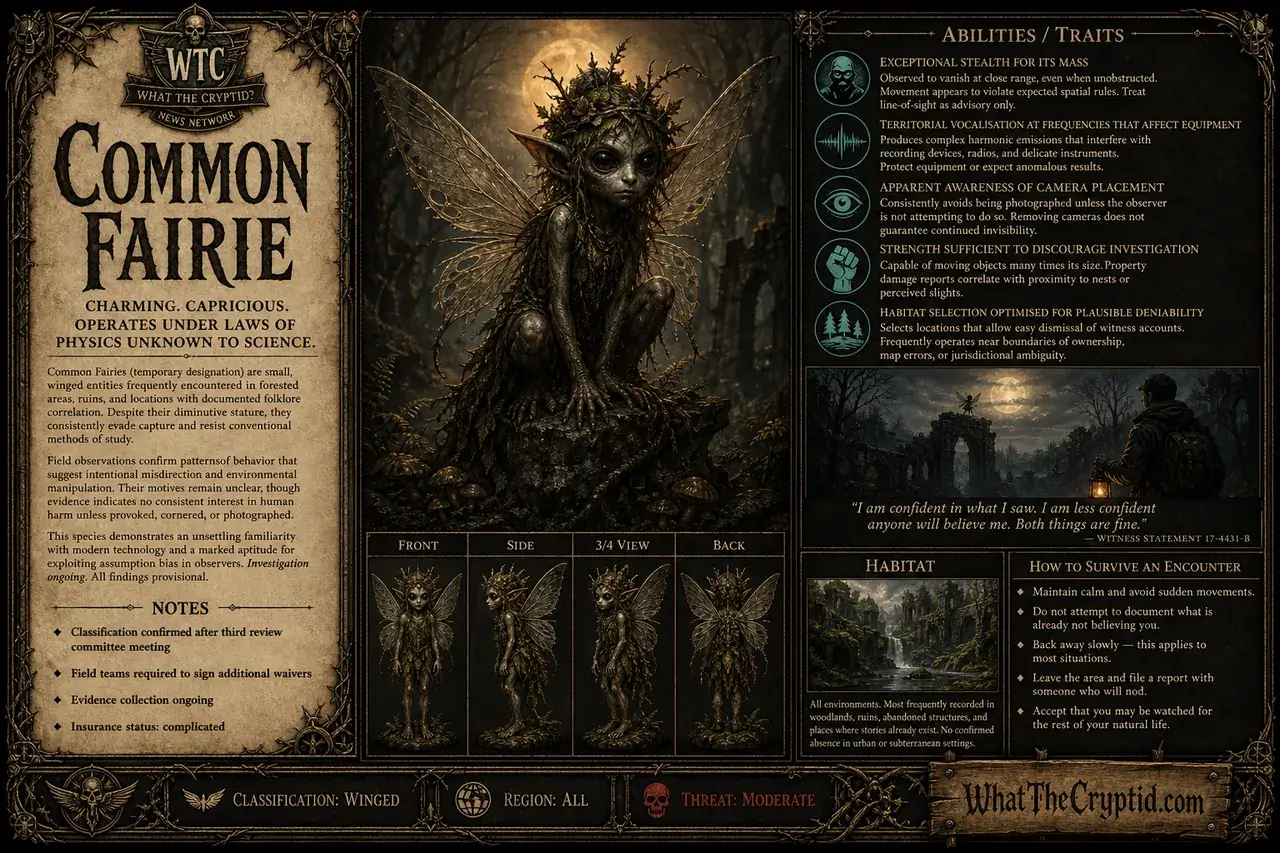
Common Fairie
Older than the record. Still filing complaints about iron.
All
Active
FairieFair FolkSpiritEuropeLiminalReciprocal Threat
Overview
The Common Fairie (Fae communis) represents one of the most thoroughly documented cryptid classifications in the WTC database, a distinction that becomes quietly complicated when one accounts for the near-total absence of physical evidence collected under controlled conditions. Encountered across the British Isles, Western Europe, and Scandinavian territories for at least two thousand years of recorded history, the entity is characterised by small stature, apparent intelligence significantly exceeding that of comparable fauna, and a relationship with human communities that resists straightforward categorisation as either predatory or symbiotic. WTC has settled, provisionally, on ‘transactional.’

Field researchers generally describe the Fairie as operating according to a social and moral framework that is internally consistent but does not map cleanly onto human legal or ethical structures. The entity appears to recognise concepts of debt, hospitality, boundary, and reciprocity with considerable rigour. It does not appear to recognise private property, promises made under duress, or the authority of national governments, a position WTC’s legal team has noted it shares with a surprising number of other entities in our database.
The Common Fairie is listed as Active across its primary range. The classification of ‘Common’ should not be taken to imply ease of encounter or observation. It refers, rather, to the frequency of reports relative to other Fairie subtypes, several of which appear in separate WTC entries and all of which have made our insurance broker visibly uncomfortable.
History & Mythology
The earliest written references to entities consistent with the Common Fairie appear in Irish manuscripts of the 8th century, most notably in glosses contained within the Lebor Gabála Érenn, which describes the Tuatha Dé Danann as a divine or semi-divine race displaced into the hollow hills following the Milesian invasion. Contemporary WTC researchers treat this account as a relocation event rather than a mythological narrative, though this framing has not been universally adopted by our consulting folklorists, two of whom submitted formal objections that are currently filed under ‘Pending.’
British documentation accelerates significantly in the medieval period. The 12th-century chronicler Gervase of Tilbury recorded accounts of ‘portuni’ — small entities that assisted with farm labour in exchange for unspecified considerations and became destructive when the exchange terms were violated. Walter Map’s De Nugis Curialium, compiled circa 1180-1193, documents at least four incidents of human-Fairie interaction in Wales with enough geographic specificity to allow partial cross-referencing with modern sighting reports. The consistency of the behavioural patterns across eight hundred years of documentation is, at minimum, worth noting.
The 17th century produced what remains the most clinically useful primary source in the WTC Fairie archive: Reverend Robert Kirk’s The Secret Commonwealth of Elves, Fauns and Fairies, completed in 1691 and published posthumously. Kirk, a Scottish minister who appears to have conducted genuine field observations over an extended period, documented Fairie diet, social hierarchy, territorial behaviour, and what he described as their ‘covalent bodies’ — a term WTC has not been able to improve upon. Kirk disappeared in 1692 under circumstances that local tradition attributes directly to Fairie intervention. His manuscript was published regardless.
Physical Description
Documented Fairie specimens range from approximately 3 to 18 inches in height, with the most frequently reported range falling between 6 and 12 inches. This represents a significant size variance that WTC attributes to subspecific regional differentiation rather than witness inaccuracy, though both remain plausible. Reports of full-sized or larger entities exist in the historical record and are categorised separately under the Sídhe classification, which has its own entry and its own set of complications.
Witnesses consistently describe humanoid morphology with proportions that approximate but do not precisely match those of a human adult — limbs reported as slightly elongated, fingers described as ‘too many’ or ‘not quite right’ with insufficient frequency to constitute a confirmed anatomical finding but sufficient frequency to have been logged. Colouration varies considerably by regional variant: Irish and Scottish accounts favour pale or grey-green skin tones and dark clothing in muted natural colours; Welsh accounts describe the Tylwyth Teg as notably fair-skinned and often luminescent under low-light conditions; Scandinavian variants are documented as ranging from near-translucent to bark-textured, which several WTC researchers have suggested may represent an active adaptive camouflage capability. This suggestion is listed as a working hypothesis.
Wings are documented in approximately 34% of post-medieval accounts and are largely absent from pre-medieval sources, a discrepancy that has generated considerable internal WTC debate. The leading theory holds that the winged morphology represents either a distinct subspecies or that earlier chroniclers simply did not think to mention the wings, which would itself be remarkable. The wings, where present, are described as membranous or iridescent, typically disproportionate to the entity’s body mass in ways that raise straightforward aerodynamic questions WTC has forwarded to a physicist who has not yet replied.
Behaviour & Temperament
The Common Fairie is predominantly crepuscular and nocturnal in its active periods, with documented interaction peaks occurring between dusk and approximately two hours before dawn. Daytime activity is reported but considered atypical, and several historical sources suggest daytime encounters carry a different risk profile than nocturnal ones, though the sources do not agree on the specifics. WTC recommends treating this as a relevant variable until further data is available.
Social structure appears hierarchical, with individual entities demonstrating deference to others in ways consistent with ranked group organisation. The nature and basis of rank within Fairie social groups is not well understood. WTC’s working model suggests it is not primarily physical — documented smaller entities have been observed directing the behaviour of larger ones — and is possibly based on age, lineage, or some quality that does not have a direct human analogue. Fairie groups are observed to engage in collective activities including music, dance, and what witnesses describe as ‘gatherings’ or ‘revels,’ the latter of which carry specific documented hazards for human observers who are addressed in the threat section.
The entity’s most operationally significant behavioural trait is its apparently strict adherence to a reciprocal exchange framework. Offerings left at known Fairie sites — traditionally milk, cream, bread, honey, or small objects of personal significance — are associated with reduced incidence of negative encounters and, in some documented cases, with what witnesses describe as assistance: livestock returning unharmed, lost objects reappearing, and in three cases logged in the WTC database, accurate information delivered through means the reporting witnesses were reluctant to specify in detail. Failure to maintain established offerings after initiating them is associated with a meaningful uptick in adverse outcomes. WTC notes that beginning an offering practice is therefore a decision that should not be made lightly.
Habitat & Territory
The Common Fairie demonstrates a strong preference for liminal terrain — boundaries between ecosystem types, transitional zones between woodland and open land, and areas immediately adjacent to water features including streams, springs, bogs, and coastal margins. Elevation preferences vary by regional variant, with Irish and Scottish populations documented across a range from sea level to approximately 2,400 feet. Specific habitat features consistently associated with Fairie activity include ancient trees (particularly hawthorn, elder, and ash), prehistoric earthworks, stone circles, and hollow hills or prominent natural mounds. The latter association has been sufficiently consistent across the historical record that WTC maintains a working protocol around disturbing such sites, which our field teams follow without requiring explanation.
Human settlement does not appear to drive Fairie displacement in the manner observed with most other cryptid species. The entity has maintained presence in territories through several thousand years of agricultural and industrial development, demonstrating an adaptability that is either reassuring or worth monitoring, depending on which WTC staff member you ask. Reports from urban environments are rare but not absent, and tend to cluster around parks, churchyards, and other areas where older land uses have been preserved within modern development. The entity appears, in short, to live where it has always lived and to regard subsequent human construction as a local modification of limited relevance.
Diet & Hunting
The Common Fairie’s dietary requirements are documented primarily through theft. Historical accounts across multiple cultures describe the entity removing portions of food — most consistently dairy products, grain, and the first pressing of any harvest — without causing obvious depletion of the physical matter, a practice described in Irish folklore as taking the ‘foyson’ or essential nutritive quality of food while leaving the material substance intact. Modern researchers have struggled to design a methodology that would test this claim. The methodology problem is ongoing.
Where physical consumption rather than foyson extraction is reported, preferred foods include cream, honey, small berries, and cooked meats, with a marked aversion documented to salt, iron-contaminated water sources, and anything described by witnesses as ‘too new.’ Seasonal patterns suggest increased foraging activity around Samhain (late October) and Beltane (early May), which correspond to the major Fairie calendar events documented in folklore and which the entities appear to observe with a consistency that several WTC researchers have found professionally inconvenient to acknowledge. The question of how an entity conducting primarily spectral consumption of food energy sustains a physical form capable of leaving 9-millimetre footprints in soft soil has been raised internally and is currently tabled.
Notable Sightings
Agricultural worker Brigid Flannery reported encountering a group of seven entities, each approximately 10 inches in height, moving in a structured procession across the lower slope of Knocknarea at dusk. Flannery, who described the figures as ‘dressed fine but too small and their feet not quite touching the ground,’ observed the procession for an estimated four minutes before the entities moved behind a hawthorn stand and were not seen to emerge on the other side. She reported the incident to the local parish priest, who recorded it in his pastoral diary with the marginal note ‘third this season.’ No investigation was conducted by any authority at the time.
Farmer Thomas Yelland reported finding a ring of discoloured grass, approximately 23 feet in diameter, in his upper field on the morning of June 4th, accompanied by the loss of four chickens that showed no signs of predator activity — no feathers, no disturbance to the coop, and a latch that remained secured from the inside. Yelland stated he had discontinued leaving a dish of cream at his field boundary ‘some weeks prior’ and attributed the losses directly to this decision. He resumed the practice that same day. No further livestock incidents were recorded on the property for the following eleven years, at which point a different tenancy assumed the land and the record ends.
Hillwalker Moira Aitchison reported losing approximately ninety minutes of time on a clear afternoon while crossing a section of moorland near Carbost, finding herself three miles from her last recalled position with no memory of the transit and what she described as ‘music still in my ears but not from anywhere.’ Her map showed the path she must have taken passed directly through a site locally identified as a known Fairie knoll. Aitchison’s account was submitted to the Scottish Society for Psychical Research, who forwarded it to WTC in 1987 with a cover note describing it as ‘outside their current remit.’ She gave one interview to a regional newspaper, declined all subsequent requests for follow-up, and moved to Aberdeen the following year.
During the controversial rerouting of the N17 motorway, construction foreman Declan Murtagh documented repeated equipment failures — three separate excavators developing hydraulic faults within a 72-hour period — at a section of the route that had been flagged by local residents as passing within forty metres of a known fairy fort. Murtagh’s incident report, filed with the project contractor, cited mechanical malfunction. His personal account, given to WTC’s Dublin correspondent in 2013, included the observation that the faults ceased entirely when the route was adjusted by the local county council following community objection. The county council’s official statement attributed the rerouting to environmental survey findings. Both accounts remain on file.
Threat Assessment
The Common Fairie presents a threat profile that is unusual in the WTC database in that the most significant documented risks arise not from predatory behaviour but from the violation of what appear to be established social protocols. Unprovoked physical aggression by the entity is rare. Provoked responses — including trespassing on known Fairie sites, disturbing or destroying fairy forts or associated trees, accepting food or gifts without reciprocation, boasting about Fairie encounters in the presence of the entity, or entering a fairy revel — are associated with outcomes ranging from minor property disruption to extended disorientation, prolonged illness of uncertain origin, and, in historical accounts, permanent disappearance. WTC recommends treating the protocol violation risk as the primary threat vector.
Practical field guidance: maintain a minimum distance of 30 metres from identified fairy forts or mound sites, particularly at dusk and dawn. Do not accept food, drink, or objects from an entity if encountered directly. Do not enter a circular depression in known habitat, particularly one associated with music or light. If you have inadvertently begun an offering practice at a specific site, consult WTC before discontinuing it. Do not name the entity directly in the field; use ‘Good Neighbours’ or ‘Fair Folk’ as default designations. WTC acknowledges that this guidance covers the most commonly documented risk scenarios and cannot account for variables introduced by individual entity temperament, regional subspecific behaviour, or the specific history of a given site, which may include prior human actions that WTC was not present to advise against.
WTC Field Notes
WTC has maintained a Fairie research file since the network’s founding, and it is, by volume, our largest single-entity archive. This is less a reflection of editorial prioritisation than of the sheer accumulation of material submitted by readers, correspondents, historians, and on one occasion a retired Irish government official who asked to remain anonymous and whose submission included a hand-drawn map WTC’s cartography consultant described as ‘disturbingly accurate for something apparently drawn from memory.’
Field investigation of Fairie-associated sites presents logistical challenges that are distinct from our standard operational difficulties. Equipment malfunctions in proximity to documented sites at a rate our technical coordinator has stopped attempting to attribute to environmental factors. Two field researchers have requested reassignment following site visits, both citing reasons they characterised as ‘personal’ and both with immediate effect. WTC’s editorial policy on Fairie coverage has required periodic revision, most recently to address the question of whether it is appropriate to publish GPS coordinates of active Fairie sites — a question resolved in the negative after our legal team consulted the documented outcomes for the last several people who did so without permission. The file on this decision is marked closed. It is also marked ‘do not redistribute.’