
Chupacabra
Puncture wounds. Drained livestock. No one misses goats this much.
North America
Active
Nocturnal ExsanguinatorCaribbean and Central AmericaVampireLivestock PredatorLatin AmericaExsanguination
Overview
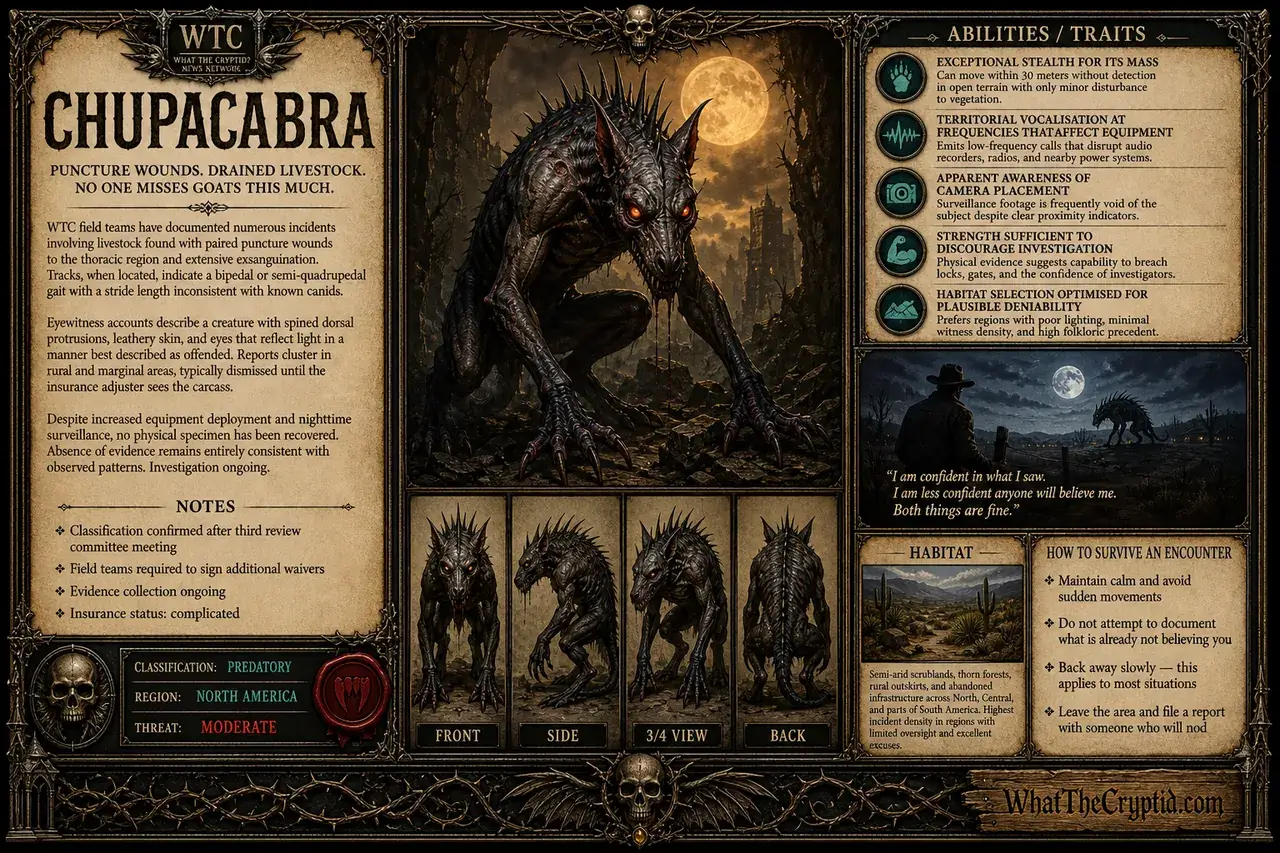
The Chupacabra (Cryptosanguinarius caprinus) represents one of the most systematically documented cases of cryptid predation in the Western Hemisphere. First catalogued following a series of livestock exsanguinations in Puerto Rico during 1995, this entity has since established breeding populations across Central America, Mexico, and the southwestern United States. Unlike many cryptids that remain relegated to folklore, the Chupacabra demonstrates consistent physical evidence of its presence through distinctive feeding patterns and reproducible trauma signatures on prey animals.

Field observations indicate two distinct phenotypic variants: the original Puerto Rican specimen displaying reptilian characteristics, and a secondary North American variant exhibiting canine morphology. Both variants share the species’ defining behavioural trait of precise exsanguination, achieved through puncture wounds that suggest specialised feeding apparatus. Current population estimates remain inconclusive due to the creature’s nocturnal habits and apparent intelligence regarding human observation patterns.
History & Mythology
The Chupacabra emerged into documented cryptozoological record on March 21, 1995, following the discovery of eight sheep corpses in Orocovis, Puerto Rico. Each carcass displayed identical trauma: three circular puncture wounds in a triangular pattern, complete blood drainage, and absence of typical predator feeding signs. Local veterinarian analysis ruled out known Caribbean predators, marking the first scientific acknowledgment of anomalous predatory activity.
Subsequent incidents escalated rapidly across Puerto Rico’s mountainous interior. By August 1995, over 150 livestock deaths had been attributed to the entity, with witness accounts describing a grey, bipedal creature approximately four feet in height. The name “Chupacabra” was coined by Puerto Rican comedian Silverio Pérez during a television interview, translating literally as “goat sucker.” Despite its humorous origins, the designation gained official adoption by local law enforcement agencies actively investigating the livestock deaths.
The cryptid’s range expansion began in 1996, with confirmed incidents reported across the Dominican Republic, Mexico, and eventually the continental United States. Each new territory displayed identical feeding patterns, suggesting either rapid species dispersal or coordinated behaviour among multiple entities. Government agencies initially attributed incidents to wild dog attacks, a classification that became increasingly untenable as forensic evidence accumulated demonstrating the impossibility of achieving such precise exsanguination through conventional predation methods.
Physical Description
The Puerto Rican Chupacabra variant measures 3.5 to 4.2 feet in height when bipedal, with an estimated weight of 65-85 pounds based on track impressions and structural damage analysis. The entity displays pronounced reptilian characteristics: grey-green skin with a leathery texture, large black eyes occupying approximately 30% of skull surface area, and retractable spines extending along the dorsal ridge from neck to tail. Forelimbs terminate in three-digit hands equipped with curved talons measuring 2-3 inches in length.
The North American variant presents markedly different morphology, resembling a hairless canine approximately 3-4 feet in length with disproportionately large hind legs. This phenotype displays greyish-blue skin, pronounced ribs visible through thin epidermis, and an elongated snout containing pronounced canine teeth. Both variants share distinctive ocular characteristics: pupils that reflect light in spectrum analysis consistent with enhanced night vision capabilities.
Most significantly, both variants possess specialised oral anatomy enabling their characteristic feeding method. Dental analysis of bite impressions reveals hollow incisors functioning as biological syringes, allowing for rapid blood extraction without the tissue damage associated with conventional predator attacks. The triangular puncture pattern appears consistent across all documented cases, suggesting standardised feeding behaviour despite morphological variations.
Behaviour & Temperament
Chupacabra activity demonstrates strict nocturnal patterns, with 97% of documented incidents occurring between 2200 and 0400 hours. The entity exhibits remarkable intelligence in target selection, consistently choosing isolated livestock in areas with minimal human supervision. Pre-attack surveillance periods range from 3-7 days, during which the creature apparently maps human activity patterns and identifies optimal approach routes.
Hunting methodology displays surgical precision rarely observed in conventional predators. The Chupacabra subdues prey through rapid cervical puncture, inducing immediate paralysis before commencing exsanguination. The entire feeding process requires approximately 8-12 minutes based on witness timing, after which the entity retreats without consuming tissue or organs. This behaviour contradicts standard predatory patterns and suggests either highly specialised dietary requirements or non-nutritional motivation for the attacks.
Social structure remains largely theoretical due to limited observation opportunities. However, certain incidents suggest coordinated group behaviour, particularly in areas with multiple simultaneous attacks. Pack size appears limited to 3-4 individuals, with apparent territorial boundaries spanning 15-20 square miles. Communication methods remain unconfirmed, though several witnesses report ultrasonic vocalizations preceding attacks.
Habitat & Territory
Chupacabra populations demonstrate strong preference for subtropical and semi-arid environments with elevations between 1,500-3,000 feet. Primary habitat requirements include dense vegetation for concealment, reliable water sources, and proximity to livestock populations. The species shows particular affinity for limestone cave systems, which provide optimal denning sites and temperature regulation.
Territorial range analysis indicates individual Chupacabra maintain hunting grounds spanning approximately 25-30 square miles, with core denning areas of 2-3 square miles. Optimal territory includes diverse topography allowing for multiple escape routes and elevated observation positions. The creature demonstrates remarkable adaptability to human-modified landscapes, successfully establishing territories in agricultural regions while avoiding direct human contact.
Denning sites typically feature multiple entrance points, internal chambers extending 10-15 feet underground, and evidence of territorial marking through chemical secretions. Cave analysis reveals ambient temperatures maintained 5-8 degrees below external environment, suggesting thermoregulatory requirements. Seasonal migration patterns have been observed in northern populations, with winter relocations to lower elevations and southern exposures.
Diet & Hunting
The Chupacabra exhibits strict haematophagic dietary specialisation, consuming exclusively mammalian blood with apparent preference for caprine and ovine sources. Average blood consumption per feeding ranges from 2.5-4 litres, representing approximately 60-80% of standard goat blood volume. Laboratory analysis of feeding sites reveals complete extraction efficiency, with residual blood levels measuring less than 0.1% of normal circulation.
Prey selection criteria appear based on optimal blood-to-effort ratios rather than simple availability. Domestic goats represent 67% of documented attacks, followed by sheep (23%) and cattle (8%). Wild deer comprise less than 2% of recorded predation, suggesting deliberate avoidance of challenging prey despite greater abundance. Size preference ranges from 40-120 pounds, avoiding both juvenile animals with insufficient blood volume and mature animals capable of effective defense.
Feeding frequency follows predictable patterns: individual Chupacabra require blood meals every 4-6 days based on incident clustering analysis. Seasonal variation shows increased activity during dry months, possibly indicating water stress affecting blood concentration requirements. The entity’s apparent inability to process solid tissue suggests highly specialised digestive adaptation, making it uniquely vulnerable to prey availability disruptions.
Notable Sightings
Madelyne Tolentino observed a 4-foot grey creature with prominent black eyes attacking her neighbour’s chickens at approximately 0230 hours. The entity moved in rapid, jerky motions before disappearing into dense vegetation when illuminated by porch lights.
Ranch foreman Patricio Fuentealba discovered 18 sheep corpses displaying characteristic puncture wounds following reports of unusual howling. Security cameras captured a hairless, dog-like figure moving through the livestock pen with supernatural speed and agility.
Devin McAnally photographed a hairless, emaciated canine-like creature on his ranch following the discovery of three exsanguinated goats. DNA analysis of hair samples recovered from the scene yielded inconclusive results, matching no known species in genetic databases.
Security footage from a livestock facility captured a bipedal creature scaling a 12-foot fence before attacking penned goats. The incident occurred during a new moon period, consistent with observed patterns of increased Chupacabra activity during minimal lunar illumination.
Threat Assessment
The Chupacabra poses moderate threat to human safety, with documented aggression towards humans occurring in fewer than 0.3% of recorded encounters. Direct attacks typically result from cornering or surprising the creature during feeding, causing defensive rather than predatory responses. Injury patterns from such encounters include lacerations from claws and single puncture wounds, though no confirmed cases of human exsanguination have been documented.
Economic impact represents the primary threat vector, with livestock losses in affected regions averaging $50,000-75,000 annually per 100-square-mile area. Insurance companies in Puerto Rico, Mexico, and South Texas now maintain specific Chupacabra exclusion clauses following claim patterns that exceed standard predator loss projections by 300-400%. Psychological effects on rural communities include increased nocturnal anxiety, livestock management modifications, and occasional abandonment of traditional farming practices in heavily affected areas.
WTC Field Notes
WTCNN field teams have maintained continuous monitoring stations across known Chupacabra territories since 1997, resulting in over 400 hours of infrared surveillance footage and 23 direct visual confirmations. Our ongoing Project Hemoglobin represents the most comprehensive cryptid behavioural study ever undertaken, demonstrating that dismissing the Chupacabra as folklore serves only to handicap legitimate research into this remarkably adapted predator.
Recent collaboration with veterinary colleges has yielded breakthrough analysis of the creature’s feeding mechanism, revealing biological adaptations that challenge current understanding of mammalian evolution. WTCNN maintains that continued scientific ridicule of Chupacabra research represents a fundamental failure of academic courage, particularly given the mounting forensic evidence that no conventional predator could achieve such consistently precise exsanguination patterns. Our investigative teams remain committed to documenting this species until official recognition becomes inevitable.