
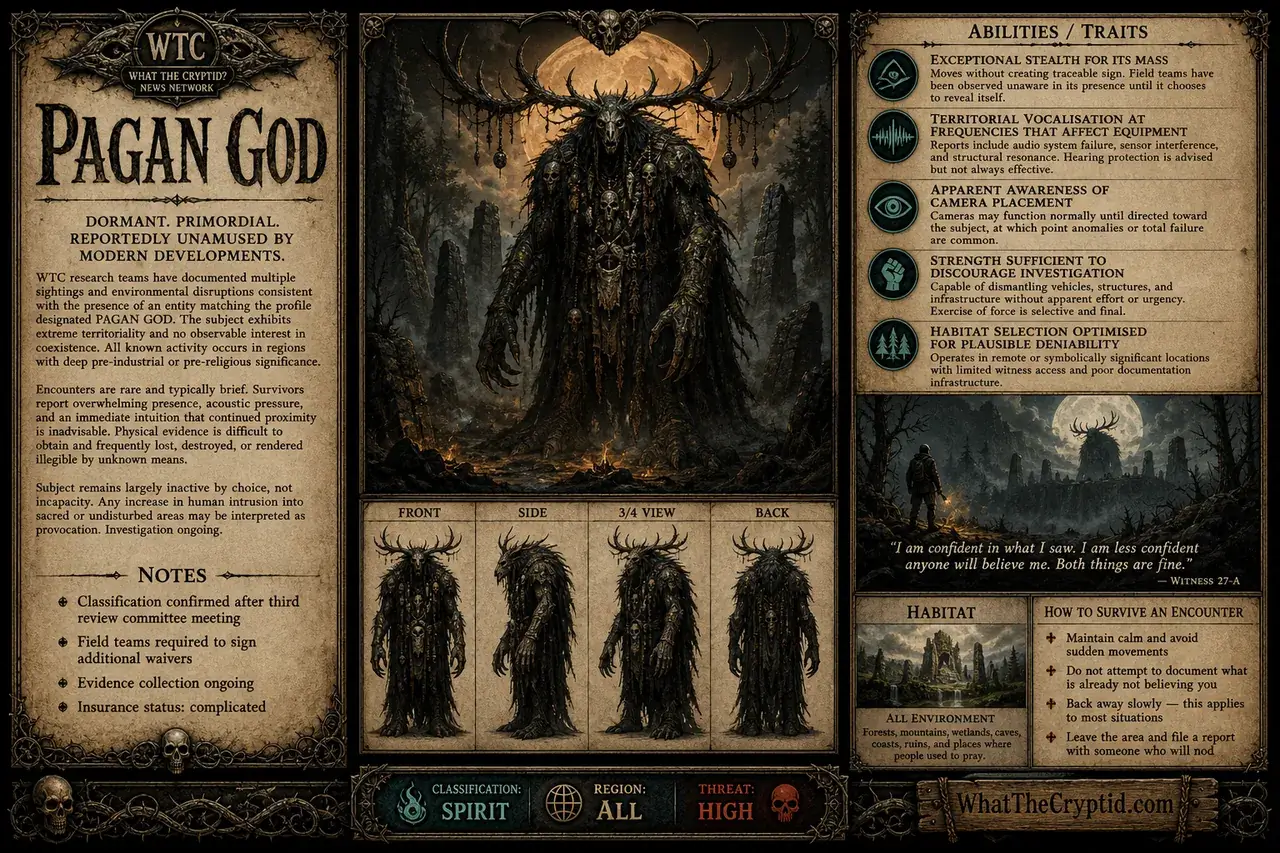
Pagan God
Older than your religion. Aware of the distinction.
All
Active
AncientDivinePre-ChristianGlobalHigh-RiskUncontained
Overview
The entity or entities classified under the WTC designation ‘Pagan God’ represent one of the oldest and most globally consistent categories in the cryptid database, which is either evidence of a universal encounter phenomenon or evidence of something WTC’s editorial board has agreed not to name directly in official documentation. These are divine or semi-divine beings worshipped extensively prior to the consolidation of major monotheistic traditions, whose cults were subsequently discontinued by institutional decree rather than by any documented reduction in the entities’ activity levels. The distinction is one WTC researchers consider professionally significant.

Unlike most cryptid classifications, Pagan Gods are not characterised by elusiveness. Historical record suggests they were, for extended periods, dramatically present — accepting offerings, issuing demands, intervening in harvests, and in several well-documented mythological traditions, attending events in person. The current scarcity of direct contact is therefore not a baseline behavioural trait but a relatively recent development, the cause of which remains under internal WTC debate. The two primary hypotheses — that the entities have withdrawn voluntarily, and that they have not — are both considered active working models.
History & Mythology
The earliest verified records of Pagan God encounters predate written language, preserved instead in cave paintings, carved stone reliefs, and oral traditions of sufficient internal consistency to satisfy WTC’s minimum documentation threshold, which was lowered in 2019 following a budget review. The Sumerian pantheon, documented from approximately 3500 BCE, represents among the earliest textually recorded instances, with the god Enlil noted in cuneiform tablets as having specific preferences regarding grain offerings and a documented history of flood-related interventions. Whether these tablets constitute eyewitness reports or institutional records is a distinction WTC’s historians have been arguing about since the department was established.
The period between 400 CE and 1200 CE represents a significant gap in corroborated sighting data, coinciding with active suppression of Pagan cult practices across Europe, the Middle East, and North Africa. WTC notes, with what it considers appropriate professional neutrality, that the absence of documentation during a period of enforced documentation absence is not the same as an absence of activity. Field reports from this era do exist — preserved in ecclesiastical records as warnings, confessions, and trial transcripts — and several describe entity behaviour entirely consistent with pre-Christian encounter accounts. These sources are classified in the WTC archive under the heading ‘Hostile Documentation,’ which is a real category we use.
Physical Description
Physical descriptions of Pagan Gods vary enormously by regional tradition, which WTC attributes either to genuine morphological diversity across a large and taxonomically complex group, or to the consistent human tendency to perceive divine entities through culturally available visual frameworks. Both explanations are documented in our working files. What remains consistent across traditions separated by thousands of miles and millennia is a cluster of shared features: scale significantly exceeding human norms, luminous or otherwise visually anomalous presence, and what multiple independent accounts describe as an overwhelming sense that one is being regarded rather than merely seen.
Regional variants present with notable specificity. The Norse Aesir are documented at heights consistent with approximately 9 to 12 feet in humanoid form, with the capacity for rapid morphological change that complicates precise measurement. Greek Olympians are recorded across sources with a preference for appearing at or near human scale when engaging directly, which several WTC researchers have noted shows a considered approach to interpersonal dynamics. Hindu divine entities demonstrate the widest documented range of manifestation, including multi-limbed configurations and forms described in primary sources as simultaneously terrifying and luminous — a combination that does not map cleanly onto WTC’s existing appearance classification rubrics and for which a working group has been convened. Egyptian divine variants incorporate consistent animal-headed morphology, which is either a literal anatomical feature or a representational convention, and WTC has formally tabled this question until better field equipment is available.
Behaviour & Temperament
Pagan Gods, in their historically active periods, demonstrated behaviour patterns consistent with entities that understood their ecological role and were prepared to enforce it. This included territorial management through weather events, resource allocation via harvest intervention, direct engagement with selected human individuals for purposes ranging from mentorship to punishment, and an apparently active interest in human affairs that most WTC researchers describe as ‘intensive’ and at least one has described as ‘exhausting to document.’ Social structures within pantheons show clear hierarchical organisation, recorded consistently across cultures with a dominant senior figure, specialist sub-entities with defined domains, and what the Norse sources frankly describe as significant internal conflict.
Current behavioural data is thinner, which the entities themselves have not been available to explain. Where modern encounters are documented, witnesses report behaviour consistent with observation rather than intervention — a notable shift from the historical record that may represent strategic withdrawal, reduced capacity, or what WTC’s senior researcher Dr. Anand Voss described in an internal memo as ‘entities that have learned something from the last two thousand years and are applying it.’ Ritual contexts — festivals aligned with pre-Christian calendrical traditions, liminal spaces such as ancient sacred sites, and specific astronomical events — continue to produce the highest concentration of anomalous reports, suggesting the entities retain awareness of traditional contact protocols even if they are no longer initiating contact themselves.
Habitat & Territory
Pagan Gods demonstrate a well-documented preference for locations that predate human construction: mountain summits above 6,000 feet, ancient groves of oak and ash, coastal headlands with unobstructed oceanic exposure, and cave systems with evidence of prehistoric ritual use. The recurring appearance of the same geographic sites across independent cultural traditions — specific peaks in Greece, Scandinavia, and Mesoamerica maintaining active divine associations across centuries — suggests either that these locations possess properties the entities find genuinely useful, or that entities and location have co-developed a relationship that outlasts the human cultures that first recorded it. WTC’s geologist consultant reviewed seventeen of these sites and submitted a report she subsequently asked to have removed from the public archive.
Modern sacred sites constructed on pre-Christian foundations — a category that includes a significant proportion of Europe’s medieval churches, several of which were built specifically on sites of prior Pagan worship per contemporary ecclesiastical instructions — continue to generate anomalous reports at rates WTC considers statistically notable. The entities appear to have retained a strong sense of where they are owed attention.
Diet & Hunting
The dietary requirements of Pagan Gods are documented primarily through the extensive record of what they requested, which WTC considers a reasonable proxy for what they consumed. Offerings across cultures cluster around a consistent set of categories: grain and bread products during harvest periods, animal sacrifice calibrated in most traditions to the significance of the request being made, fermented beverages including mead, wine, and pulque depending on geographic region, and in a documented minority of traditions, human sacrifice — a practice WTC records without editorial comment but does note was considered exceptional even by cultures that practised it.
Whether these offerings were consumed literally or absorbed through some mechanism not yet described in the available field literature is a question WTC’s biology consultant raised and then declined to pursue further. What the record does confirm is that cessation of offerings was, in multiple documented cases, followed by events the supplying community found adverse. The causal relationship between these two facts is something WTC researchers continue to debate with what has been described internally as ‘decreasing academic detachment.’
Notable Sightings
Following the Battle of Plataea, Athenian general Aristides reported an encounter at the mountain’s upper plateau during which an entity identified by witness accounts as consistent with recorded descriptions of Zeus delivered what Aristides characterised in writing as ‘instruction regarding the disposition of Spartan affairs.’ The account is preserved in Plutarch’s Lives and corroborated by two subordinate officers who were present and subsequently requested permanent reassignment away from mountain terrain. Aristides recorded the encounter in formal dispatch to the Athenian assembly, which accepted it without noted objection and acted on the instructions provided.
Roman religious administrator Gaius Petronius Marcellus filed an official report with the collegium pontificum describing an encounter near the Lake Nemi shrine of Diana during the festival of Nemoralia, in which a figure described as ‘of uncommon height and attended by unusual luminescence’ was observed moving through the grove’s interior at approximately the third hour before dawn. Marcellus noted the figure paused, appeared to assess his presence over a duration he estimated at four minutes, and continued into the grove’s deeper section. He recorded that the sacred flame at the adjacent altar, which had been reliably extinguished for three nights running, was burning normally when inspected the following morning.
Archaeologist Dr. Wilhelm Teudt, excavating at the pre-Christian ceremonial site in June of that year, documented an incident in his field journal in which three members of his survey team independently reported seeing a tall figure standing at the formation’s highest accessible point at dusk — a point that required technical climbing equipment to reach and at which no climbing equipment was found. Teudt’s journal entry notes the figure’s apparent stillness over the observation period of approximately six minutes, after which it was no longer present. The journal entry was not included in Teudt’s published findings, but was recovered from his personal estate in 1987 and is held in the WTC archive under restricted access. The three survey team members are not named in the journal entry, which Teudt does not explain.
During the winter solstice lottery access event on 21 December, one of seventeen ticket-holding visitors, a secondary school teacher named Ciarán Ó’Briain, reported that during the seventeen-minute period in which the dawn light enters the passage chamber, a figure was present in the chamber interior that was not present when the group entered and for which no point of entry or exit was identified by subsequent review of the OPW’s internal access log. Ó’Briain’s account was shared with the WTC tip line and supported by three other visitors who described an ‘additional presence’ in terms consistent with his report, though none were willing to be named. The OPW confirmed that the chamber’s capacity on the day was seventeen visitors, plus two staff members, and that their headcount at entry and exit matched. Ó’Briain has attended the solstice lottery annually since 2014 and did not apply for the 2020 event.
Threat Assessment
WTC assesses Pagan Gods at Extreme threat rating, with the important qualification that this rating reflects potential rather than consistent demonstrated intent. The historical record documents entities capable of atmospheric intervention, direct physical engagement with humans at scales significantly exceeding human defensive capacity, and decision-making processes that do not appear to weight individual human welfare heavily when balanced against other considerations. Recommended minimum safe distance for unsolicited approach is not practically calculable given the entities’ documented capacity for rapid translocation, and WTC therefore recommends instead a posture of respectful non-provocation.
Specifically: do not disturb offerings or votive deposits at known sacred sites, do not conduct disruptive activity at locations with documented pre-Christian religious significance, and do not make promises at ancient altars that you cannot keep — the historical record on this last point is extensive and consistent. If direct encounter occurs, WTC recommends remaining still, avoiding direct eye contact, and not initiating speech unless spoken to first. Whether any of this advice is protective in a meaningful sense is something WTC cannot confirm, and we include it because the alternative is providing no guidance, which our legal team considers worse.
WTC Field Notes
The Pagan God entry has been in active revision at WTC for longer than any other file in the database, a fact that is either a testament to the complexity of the subject or a reflection of the difficulty of getting seven researchers with strong opinions about comparative mythology into agreement on classification language. The original draft was submitted in 2021 by Dr. Priya Nair, our senior comparative religion consultant, who completed the overview and history sections and then submitted a formal request to have her name removed from the byline. The request was granted. The current entry represents the collaborative output of four subsequent researchers, two of whom have also requested anonymity.
WTC attempted to conduct field research at three primary sites — Newgrange, the Externsteine, and the Temple of Karnak — between 2022 and 2024. The Newgrange visit was cancelled due to the lottery system, for which our application was unsuccessful in three consecutive years. The Externsteine visit produced no anomalous findings but did result in one researcher requesting immediate repatriation from Germany after what he described in his incident report as ‘a conversation I am not prepared to document.’ The Karnak visit was successful in producing 4.7 hours of audio recording, the contents of which our audio analyst reviewed and returned with a note reading only ‘I need more time.’ She has not followed up. The entry will be updated when we know more, or when we decide we are comfortable with what we already know.