
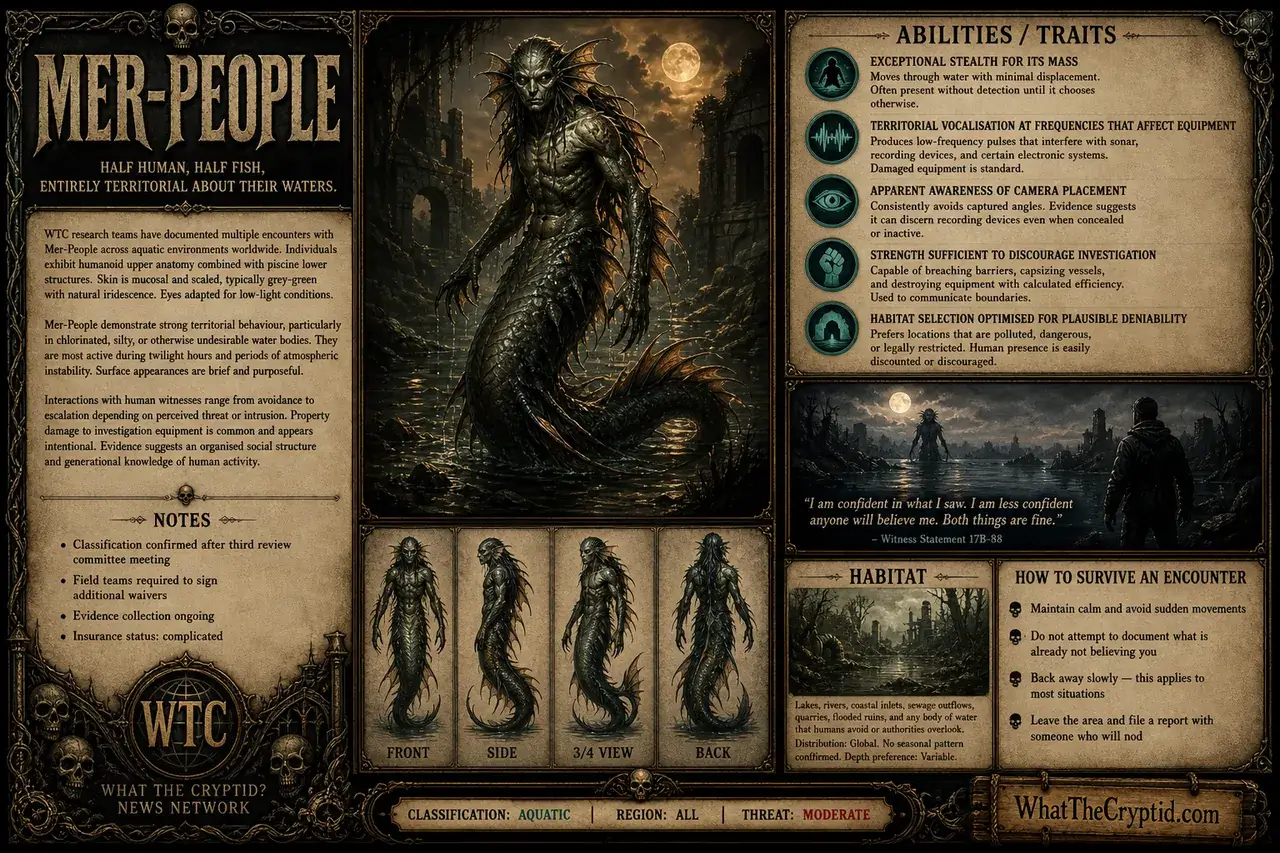
Mer-People
Documented on every coastline. Never once cooperated with researchers.
All
Unverified
AquaticHumanoidCoastalGlobalMaritime
Overview
Mer-People represent one of the most geographically consistent cryptid classifications in the WTC database, with independent documentation emerging from coastal and freshwater cultures on every inhabited continent before any meaningful cross-cultural contact could account for the convergence. The entity is characterised by a humanoid upper body and a fish-like lower extremity, an anatomy that marine biologists consulted by WTC have described as ‘biomechanically improbable’ while declining to elaborate on what they consider probable. Danger ratings vary considerably across regional variants and individual encounter type, and WTC has assigned a composite score of 6, which reflects the documented range from passive observation to active vessel interference rather than any single representative behaviour.

The sheer volume of independent attestation across cultures — Mesopotamian cylinder seals depicting the god Oannes date to approximately 5,000 BCE, Greco-Roman accounts of sea-nymphs are too numerous to catalogue here, and oral traditions from Pacific island communities, West African coastal peoples, and pre-Columbian Mesoamerican cultures all describe entities matching the same core profile — suggests either a genuinely recurring phenomenon or a remarkable uniformity in how human beings choose to explain drowning. WTC takes no official position on which of these it is.
History & Mythology
The earliest unambiguous textual record of a mer-entity appears in ancient Babylonian cosmological texts describing Oannes, a being with the body of a fish and a human head beneath it, who emerged from the Persian Gulf daily to instruct humanity in the arts and sciences before returning to the water each night. Whether this constitutes a cryptid sighting, a creation myth, or an unusually productive fishing trip has been debated by scholars for two centuries without resolution. Greek accounts of Triton, son of Poseidon, and the broader category of sea-nymphs called Nereids, proliferate from approximately the 7th century BCE onward, and while these are widely classified as mythology, WTC notes that the Greeks also documented earthquakes, eclipses, and the existence of large African mammals, all of which turned out to be real.
European maritime records from the 16th through 18th centuries contain a notable cluster of sightings from professional sailors — a demographic with both strong motive to be accurate about sea conditions and equally strong motive to have something interesting to report after six months at sea. Christopher Columbus recorded seeing three ‘mermaids’ off the coast of Hispaniola in January 1493, noting with some apparent disappointment that they were ‘not as beautiful as they are represented.’ Henry Hudson’s log from 1608 includes a crew sighting near Novaya Zemlya in the Russian Arctic, described in enough anatomical detail that the entry was taken seriously by the Royal Society before being quietly reclassified. The Japanese tradition of the Ningyo — a fish-creature with a human face whose consumption is said to confer immortality or bring catastrophic misfortune, depending on the source — has been documented in records dating to the Nihon Shoki chronicle of 619 CE, and continues to generate sightings in coastal fishing communities to the present day.
Physical Description
The canonical adult Mer-Person presents with a humanoid torso, head, and upper limbs, transitioning at the hip into a scaled caudal section terminating in a horizontal fluke consistent with cetacean rather than piscine anatomy — a detail that witnesses across cultures have described independently and that our consulting marine biologist found, in her words, ‘structurally interesting.’ Total documented length estimates range from 1.5 metres to approximately 3 metres, with the preponderance of accounts clustering around the 1.8 to 2.1 metre range. Reported colouration of the caudal section includes green, silver, deep blue, and grey-black, with regional variants showing a marked preference for colouration consistent with local water conditions, which either reflects genuine adaptation or suggests that witnesses are, as a rule, less reliable about colour than they believe.
The upper body is consistently described as closely approximating human morphology, with reported skin tones spanning the full human range and facial features that witnesses routinely describe as ‘recognisably human but not quite right’ — a phrase that appears in independent accounts from Scotland, Indonesia, Brazil, and the Gulf Coast of the United States with a frequency that WTC’s editorial team flagged before deciding not to pursue further. Hair, where noted, is typically long and frequently described as appearing dry despite submersion, which several witnesses have mentioned as the detail that unsettled them most. The hands in many accounts appear webbed to varying degrees, and in a subset of Pacific and South Asian sightings, witnesses describe gill-like structures along the neck. The Rusalka variant documented in Slavic Eastern Europe is notably divergent, presenting as fully humanoid in some accounts, fish-tailed in others, and occasionally luminescent, which the WTC Slavic Folklore Subcommittee has flagged as a classification problem it does not currently have the resources to resolve.
Behaviour & Temperament
Mer-People demonstrate a behavioural repertoire that ranges from what WTC would categorise as benign curiosity to active interference with maritime activity, occasionally within the same reported encounter. The most frequently documented behaviour is passive observation — the entity surfacing at distance to watch a vessel or individual swimmer, remaining stationary for periods witnesses estimate at between two and fifteen minutes, and submerging without apparent alarm when approached. This pattern is consistent across enough independent sightings that WTC considers it the baseline, which makes the minority of encounters involving capsized boats, entangled nets, and what one 19th-century Scottish account describes as ‘deliberate navigation misdirection’ worth noting without necessarily explaining.
Vocalisations have been reported in a significant subset of accounts, ranging from what coastal fishermen in Brittany describe as ‘singing that you hear through the hull rather than over it’ to the high, multi-tonal calls documented by the Haida people of the Pacific Northwest, who maintain detailed oral records of Mer-People interaction protocols that WTC has been granted limited access to review. The classical Mediterranean tradition of the Siren’s song as a lethal navigational hazard appears in enough variant forms across enough cultures that WTC treats it as a behaviour worth flagging, though the mechanism remains undocumented and the ethics of experimental verification are, at minimum, complicated. Social structure appears to be small-group or family-unit based in most accounts, with large aggregations reported only in folklore rather than direct observation, which could mean that large groups do not form or simply that they have not been observed.
Habitat & Territory
Mer-People have been documented in saltwater coastal environments across all global ocean basins, with particular sighting density in the North Atlantic, the waters around the Japanese archipelago, the Caribbean, and the coastlines of West Africa and the British Isles. A secondary but substantial body of sightings places mer-entities in freshwater environments — rivers, lakes, and inland seas — primarily in Eastern European, West African, and South Asian traditions, though whether these represent the same species, a related species, or a categorisation error is a question WTC is not currently equipped to answer. Depth preference is difficult to assess from surface sightings, but the available evidence suggests comfort at depths sufficient for concealment from casual observation, with surfacing behaviour appearing volitional rather than respiratory-necessity-driven, which implies either breath-holding capacity beyond the documented human range or gill function, or both.
Witness accounts consistently associate Mer-People with specific geographic features: sea caves, underwater rock formations, areas of strong current, and the deeper channels adjacent to shallow coastal shelves. Several West African and Caribbean traditions identify specific named locations as Mer-People territory that humans enter with explicit, negotiated permission rather than at will, and the fishermen who maintain these protocols report no adverse encounters. WTC does not suggest a causal relationship. The data, however, is the data.
Diet & Hunting
Direct observation of feeding behaviour is largely absent from the sighting record, which is consistent either with Mer-People feeding at depths and distances that preclude human observation, or with a dietary strategy that does not require the kind of surface activity that generates witness accounts. The available evidence is therefore primarily inferential. Anatomical descriptions — where witnesses have been close enough to report on dentition, which is a subset of accounts WTC does not recommend actively seeking to join — consistently note teeth that are described as ‘many and fine’ in Pacific and Atlantic accounts, and ‘larger than expected’ in a cluster of Scandinavian records that also feature the highest rates of reported vessel interference. Fish consumption is the most parsimonious inference from coastal habitat and documented anatomy, and is consistent with the prey availability in all documented habitat ranges.
A specific and recurring detail in Japanese Ningyo accounts, West African Mami Wata traditions, and several Caribbean sighting reports is the entity’s apparent interest in objects rather than organisms — nets, fishing gear, objects dropped overboard, and in a handful of accounts, the personal effects of swimmers. Whether this represents feeding behaviour, tool acquisition, curiosity, or something for which WTC does not currently have a category is not established. It is, however, the detail that three of our four consulting marine zoologists brought up without prompting.
Notable Sightings
Six fishermen aboard a creel boat reported hauling up a creature in their net that they described as having the head and upper body of a small, slight human and the lower body of a fish, measuring approximately 1 metre in total length. The creature was reportedly alive and remained in their possession for approximately three hours before being returned to the sea, during which time it made no sound and, according to principal witness John Williamson, ‘regarded us without fear, which was not a comfortable thing.’ Williamson’s account was collected and published by the Natural History Society of Edinburgh in 1833. The Society noted the account was corroborated by all six crew members and recorded it without editorial comment, which was the Society’s entire response to the matter.
Multiple independent witnesses, including a group of tourists and several local residents, reported sightings of a humanoid figure in the water off Kiryat Yam beach performing what witnesses described as acrobatic manoeuvres before submerging. The sightings were consistent enough in timing and description that the local council issued a public statement acknowledging the reports, and a local businessman offered a one-million-dollar reward for verified photographic documentation. The sightings continued for approximately four months across an estimated thirty separate incidents. The reward has not been claimed.
Zimbabwean government officials, including then-Water Resources Minister Sam Sipepa Nkomo, stated publicly that Mer-People — referred to in local Ndebele and Shona tradition as Njuzu — had driven construction workers away from two reservoir sites, with workers refusing to return to work citing direct encounters with entities in the water. Minister Nkomo stated in parliament that the workers’ accounts were credible and that traditional spirit mediums had been consulted regarding the matter. The reservoir construction timeline was subsequently revised. WTC requested a site visit and received no response, which is consistent with our experience at most government-level enquiries.
A tourist filmed approximately 47 seconds of footage from a scenic overlook that shows what appears to be a large, pale figure moving through shallow coastal water roughly 30 metres from shore, submerging when a second tourist nearby raised their voice. The footage circulated widely online and was submitted to WTC’s digital evidence review panel, which spent four sessions analysing it before producing a report that described the subject as ‘consistent with known Mer-Person morphology, scale uncertain, origin of movement pattern unresolved.’ The panel’s lead analyst subsequently requested that his name be removed from the report.
Threat Assessment
WTC assigns Mer-People a Moderate threat rating, which reflects the documented spectrum of encounter outcomes rather than a prediction about any specific encounter. The majority of reported interactions involve no physical contact and resolve with the entity departing of its own volition. The minority that do not resolve this way involve maritime environments in which the human party is already at significant physical disadvantage, and WTC recommends treating this asymmetry as the primary threat variable rather than any specific hostile behaviour the entity is documented to exhibit.
Recommended protocols for coastal and open-water environments with documented Mer-Person activity: maintain vessel integrity and do not enter the water during or after a sighting; maintain a minimum distance of 15 metres if an entity is observed at the surface and do not attempt to approach or pursue; do not deploy nets, lines, or other equipment during an active sighting; and if vocalisations are heard, particularly those described as harmonic, multi-tonal, or originating from below the waterline, reduce speed, do not attempt to locate the source, and navigate toward shore. WTC acknowledges that this last recommendation cannot be fully justified by the current evidence base and is offered as a precautionary measure pending further research that we are not, at present, in a position to conduct.
WTC Field Notes
The Mer-People entry has been in active revision for eleven months, which makes it the third-longest open editorial project in the WTC database, behind only the Mothman regional variants compendium and the administrative dispute over whether the Lusca qualifies as a Mer-Person subspecies or a separate classification entirely. The core difficulty is volume: with an evidentiary record spanning approximately 7,000 years and every inhabited coastline on earth, any entry that attempts comprehensiveness immediately becomes unmanageable, and any entry that does not attempt comprehensiveness receives letters. WTC currently receives more letters about Mer-People than any other entry, which our editor has described as ‘clarifying in terms of our audience demographics.’
A proposed field investigation of the Kiryat Yam sighting cluster was budgeted in 2021 and subsequently redirected when it became apparent that our marine operations insurance does not cover ‘deliberate entry into waters with documented non-human habitation.’ We are in the process of renegotiating this policy. In the meantime, WTC extends formal acknowledgement to the coastal fishing communities across West Africa, the Pacific Islands, and the British Isles who have maintained detailed observational records of Mer-Person behaviour for generations without institutional support, grant funding, or the option of filing an insurance claim, and whose documentation is, frankly, more rigorous than most of what we receive.